SaaS Compliance in 2026: A Checklist for Control Ownership and Clear Evidence
Build a SaaS compliance program around the services you deliver and the obligations that apply. Use this practical checklist to clarify cloud responsibilities, assign control owners and verify evidence as your product, infrastructure and data flows change.
SaaS compliance is easier to manage when every requirement is tied to a defined service, a control owner, evidence of operation and a clear response when something fails. A policy or dashboard can show intent, but experienced buyers and assessors need to know what systems and people were covered, what happened during the relevant period, and how the team handled exceptions.
That is the difference between a checklist that records activity and one that helps run a program. Use the steps below to decide what applies, test whether controls work across the right population, and keep evidence that supports both operational decisions and independent assurance.
What SaaS compliance covers
SaaS compliance is the work of meeting the legal, contractual and assurance requirements that apply to a cloud-delivered service. Depending on the product and customers, those requirements may concern security, privacy, resilience, payment account data or a requested independent assessment.
Security controls are part of the work, but the control’s existence is not proof of effectiveness. If multifactor authentication is enabled, identify which identity providers, accounts and production systems are in scope. If a vulnerability scanner is running, establish which assets it covers, how findings are prioritized, who owns remediation and whether fixes are retested. If a backup job succeeds, test whether the service can be restored within the agreed recovery objective.
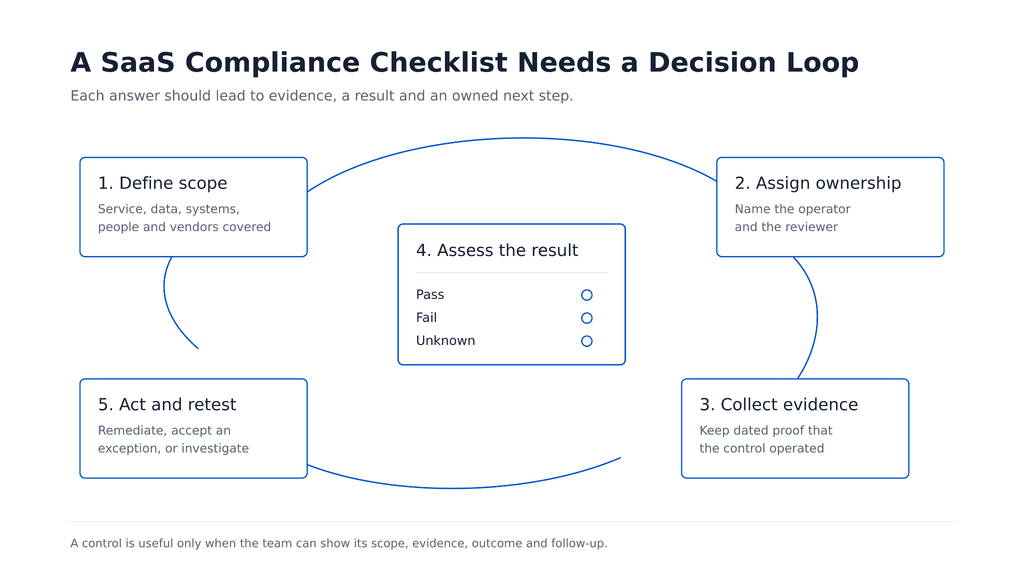
A useful control record answers five questions: what population is covered, who operates and reviews the control, what evidence shows it ran, what result did it produce, and what happens when the result is failed or unknown? Use that test throughout the program.
Which SaaS compliance frameworks matter in 2026?
Start with the product, data, jurisdictions, customer commitments and contracts. A customer request can influence the assurance work you choose to pursue, but it does not by itself make every framework a legal requirement. Conversely, a binding obligation does not wait for an audit project to begin.
Framework or requirement
When to assess it
Scope questions to resolve
SOC 2
A customer requests independent assurance about a service
Which system and Trust Services Criteria are in scope? Is a Type 1 or Type 2 report requested, and for what period?
ISO/IEC 27001
Customers or the organization need a certified information security management system
What services and locations are in the ISMS scope? How are risks, controls, internal audit and management review handled?
GDPR and other privacy laws
The company processes personal data or otherwise falls within a law’s territorial and material scope
What are the company’s role, data flows, processing purposes, contracts, rights processes and incident duties?
HIPAA
The service handles protected health information in circumstances covered by HIPAA
Is the organization a covered entity or business associate? What safeguards and agreements apply to the service?
PCI DSS
The environment stores, processes or transmits payment account data, or is otherwise in assessment scope
What is the cardholder data environment, what systems can affect it, and which validation route applies?
ISO/IEC 42001
A formal AI management system is useful for the organization or requested by a customer
Which AI systems and lifecycle activities are in scope, and what governance and risk processes are needed?
SOC 2 is an attestation report, not a certification. ISO/IEC 27001 is a certifiable standard for an information security management system. Some control evidence can support both, but their scopes, criteria and assessment outcomes are different. If pursuing [ISO 27001 certification](https://spog.ai/blog/iso-27001-certification-guide/), define the ISMS boundary and plan for the audit and ongoing management requirements.
As of October 2026, the published ISO/IEC 27001 requirements are the 2022 edition with Amendment 1:2024; do not assume an “ISO 27001:2026” edition exists. PCI SSC’s document library lists PCI DSS v4.0.1. Check the relevant official publication and your assessor’s guidance before making a customer commitment. A version statement should be reviewed again before publication because standards can change.
Do not turn the table into a shopping list. A SaaS provider selling to a bank may receive contractual requirements shaped by the bank’s regulatory duties; that does not automatically make the provider a regulated bank. Record the actual service, jurisdiction, data and contract that drive each obligation.
Where does the cloud provider’s responsibility end?
Cloud provider reports cover specified services and responsibilities. They do not establish that your application is configured correctly or that your people follow the required process. Your team still needs to understand its role in identity, application security, data handling, logging, change management, incident response, backup configuration and third-party integrations.
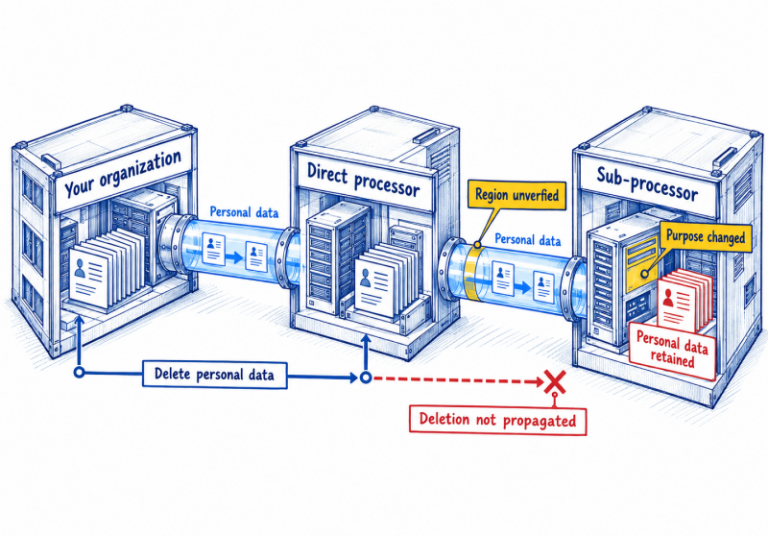
Write the shared-responsibility boundary down for each critical service. For managed backups, document who configures retention, monitors failures and tests recovery. For encryption, identify who controls the keys and the application permissions around them. For an integration, identify what customer data leaves your environment, what the provider can access and how the arrangement is reviewed.
A provider report is evidence about the provider’s stated scope. It is not a substitute for testing your own controls or documenting how you rely on the provider.
How to build a SaaS compliance program
1. Set the boundary
Name the product and services in scope, the data they handle, the people and identities with access, the infrastructure they depend on and the third parties involved. Map data from collection through use, storage, sharing, retention and deletion. Legal, security, engineering and product teams should be able to work from the same boundary.
Separate binding legal and contractual requirements from assurance frameworks selected to meet customer expectations. If you do not yet have a requested report or certification, describe the current position accurately and give customers a realistic plan.
2. Find gaps that affect the service
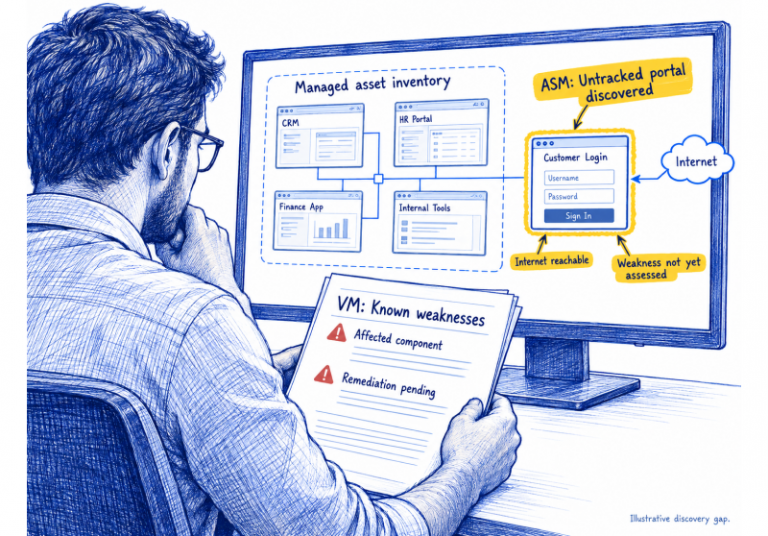
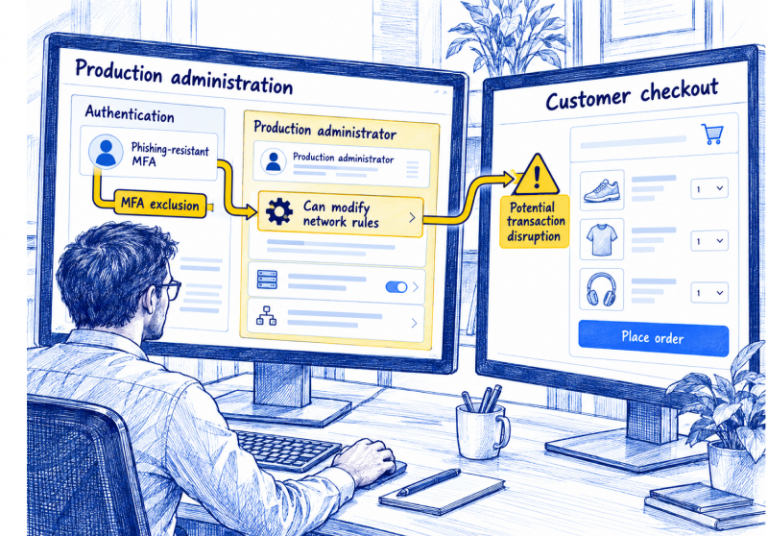
Compare current operations with the requirements in scope. Look for missing controls and controls whose coverage cannot be shown. Examples include production administrator accounts outside MFA, newly deployed assets missing from logging, overdue access reviews, a vendor with no current review, or backups with no recent restore result.
Prioritize gaps using service criticality, data sensitivity, plausible impact and deadlines. Assign one accountable owner and a target date. Do not let an unresolved “unknown” silently become a pass.
3. Define controls and evidence together
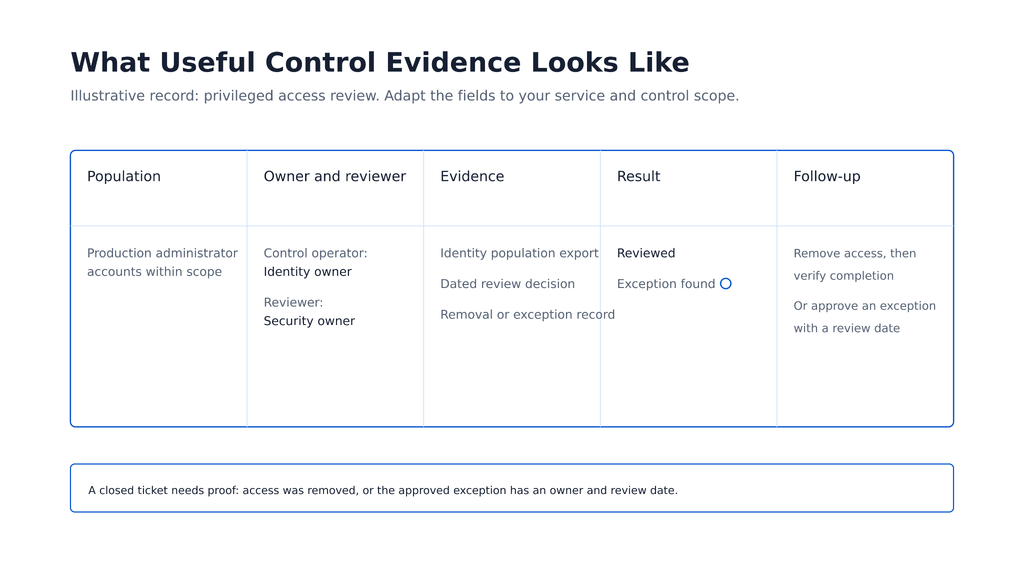
For each important control, document its purpose, population, owner, reviewer, operating frequency, evidence source and failure path. An access review may need the identity population, reviewer decision, removals and evidence that removals completed. A backup control may need the protected-service list, job results, failure handling and a restore test against the recovery objective.
Reuse evidence across frameworks when the same operation genuinely supports more than one requirement. Keep the separate criteria and scopes visible. A single access review may help support both SOC 2 and ISO/IEC 27001, but it does not prove every obligation under either framework. SPOG.AI’s [control monitoring and GRC capabilities](https://spog.ai/governance-risk-management-compliance.html) can help teams bring operational evidence into a shared context; source coverage and freshness depend on the connected systems and configuration.
4. Operate the controls and follow exceptions
Set the routine: who reviews alerts, who approves an exception, who can accept residual risk and who confirms a fix. When a test identifies an unmanaged account, retain the affected system, owner, decision, remediation record and retest result. Closing the ticket without retesting may show activity, but it does not show that the control now works.
Set review intervals based on risk, system change and the requirement. A frequently changing production environment may need more frequent checks than a static archive. Describe evidence freshness accurately; do not call a daily feed real time or imply automatic coverage when a step is manual.
5. Prepare for assurance and keep improving
Collect evidence as the work happens, with dates and context, rather than rebuilding the history immediately before an audit. For SOC 2, agree with the independent auditor on the system boundary, criteria and examination period. For ISO/IEC 27001, maintain the ISMS, internal audit, management review and corrective action processes within the defined scope.
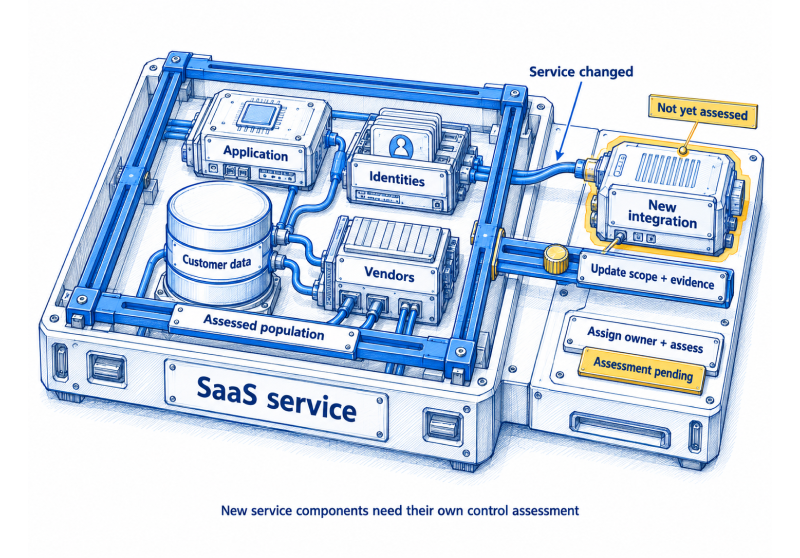
After an assessment, review what changed. A new AI feature, customer region, data processor or production service can alter the scope or risk. Update the boundary, control population and evidence plan when the service changes.
SaaS compliance checklist for operating teams
Use this with security, engineering, privacy, IT and business owners. A “no” or “unknown” should create a decision or action, not a completed checkbox.
Area
Question
Evidence to retain
Scope
Which services, data flows, identities and vendors are in scope?
Service inventory, data map and approved scope decisions
Requirements
Which laws, contracts and assurance criteria apply to each service?
Requirements register and customer commitments
Ownership
Does each material control have an operator and reviewer?
Control inventory, named owners and review assignments
Identity
Are access approvals, protections and removals complete for the relevant population?
Identity settings, review decisions and removal records
Change
Are production changes reviewed and security impact checked?
Change records, approvals and validation results
Exposure
Are assets covered by scanning, findings prioritized and fixes verified?
Asset coverage, findings, remediation and retest results
Data
Are retention, deletion and privacy requests handled as promised?
Data handling procedures and request records
Recovery
Can critical services be restored within agreed targets?
Backup coverage, job results, restore tests and follow-up
Vendors
Do reviews cover the services and data each provider actually receives?
Contracts, review decisions and monitoring records
Incidents
Can the team detect, investigate and respond to relevant events?
Runbooks, alert records, exercises and incident records
Assurance
Does evidence show controls operated across the defined period?
Dated evidence, exceptions and remediation history
Adjust the checklist to the service boundary. A product that handles regulated health information needs a different privacy and contractual review from one that never receives it.
What changes SaaS compliance in 2026?
The service boundary can move faster than the compliance record. Teams add integrations, cloud resources and AI features; records become stale when new assets or data paths are outside the control population. The practical response is to review material changes and reconcile current systems against the scope, not simply to repeat last year’s checklist.
For AI-enabled products, identify where prompts, uploaded files and outputs may contain customer information. Review provider terms, retention, access settings, subprocessors and the claims made to customers. Whether a specific law or management standard applies depends on the product, role and jurisdiction. An AI feature does not create identical duties for every SaaS company.
Continuous compliance monitoring is a way to check control coverage and respond to drift between formal assessments. Track the current populations of assets, identities and vendors. Connect each control to the systems it should cover. Investigate when a source stops reporting or a new asset appears, and document the decision. A move from periodic snapshots toward [continuous assurance](https://spog.ai/blog/what-is-continuous-assurance-in-cybersecurity/) helps teams see changes sooner, provided the evidence source is appropriate and current.
How SPOG.AI can support the work
SPOG.AI describes bringing evidence from security, cloud, identity, IT and governance systems into a shared context for control assessment, compliance visibility and remediation. For a SaaS provider, that can support questions such as whether the relevant privileged accounts are protected, whether a critical backup has a restore result or whether new cloud assets are represented in monitoring.
Treat the platform as an aid to the people who own the controls. It does not decide legal applicability, make a company compliant, replace an independent assessor or guarantee that every system is covered. Confirm source integrations, refresh intervals, scope and workflow behavior for your environment. The value is a clearer view of control state and follow-up, with evidence that the accountable teams can review.
Frequently asked questions about SaaS compliance
Start with applicable laws and contracts, then identify the assurance customers actually request. The best first framework depends on the service, jurisdictions, data, buyers and existing control maturity.
No. SOC 2 results in an independent attestation report for a defined system and criteria. ISO/IEC 27001 certification concerns an information security management system within a defined scope. Some operational evidence can support both, but neither outcome substitutes for the other.
No. The provider’s report applies to its named services and responsibilities. Your company remains responsible for controls in its own application, configuration, identities, data handling, vendor use and processes.
Keep records showing the control population, expected operation, date or period, result, exceptions and follow-up. A dated review with removal evidence is more useful than a policy that only says access reviews occur.
Start with the product and services, customer data, locations, identities, infrastructure, processes and third parties that support delivery. Document exclusions and why they are outside the boundary, then revisit scope when the service changes.
Use the applicable requirement and the risk and change rate of the system to set a review schedule. High-change or high-impact controls may need more frequent monitoring than stable, low-impact processes. Document the rationale and investigate missed reviews.
It can be continuous for signals that are available and refreshed frequently, but not every control is continuously observable. State which controls are automated, which rely on periodic review, and how stale or missing data is handled.
Evidence should show which services are protected, whether jobs completed, how failures were handled and whether a restore test met the recovery objective. A successful backup job alone does not prove that data can be restored as needed.
No. It is an AI management system standard that an organization may adopt when useful or requested. Applicability depends on the company’s objectives, AI systems, customers and obligations; adding an AI feature does not automatically require certification.
Keep the original finding, affected scope, accountable owner, remediation action and a retest or other verification that demonstrates the control now works. Record any residual risk or accepted exception with an approver and review date.
Technology writer and content strategist with 5+ years of experience, including work for a US-based B2B SaaS client and a cybersecurity solution. I create cybersecurity and GRC content, product documentation, and user guides that help technical teams and business leaders understand security capabilities and workflows. Currently working on Confluence documentations on vulnerability management, ITSM, incident management, and continuous control monitoring, alongside SEO and AEO content, and technology partner database development.