Operationalize CTEM
Across the Enterprise







Connected Stages.
Disconnected Context.
One Context Across
Every CTEM Stage
Scope What Matters
Define scope around critical services, business priorities, attack surfaces, and risk appetite.
Discover the Environment:
Reconcile assets, identities, controls, findings, and dependencies through integrations and Knowledge Graph.
Prioritize Exposure
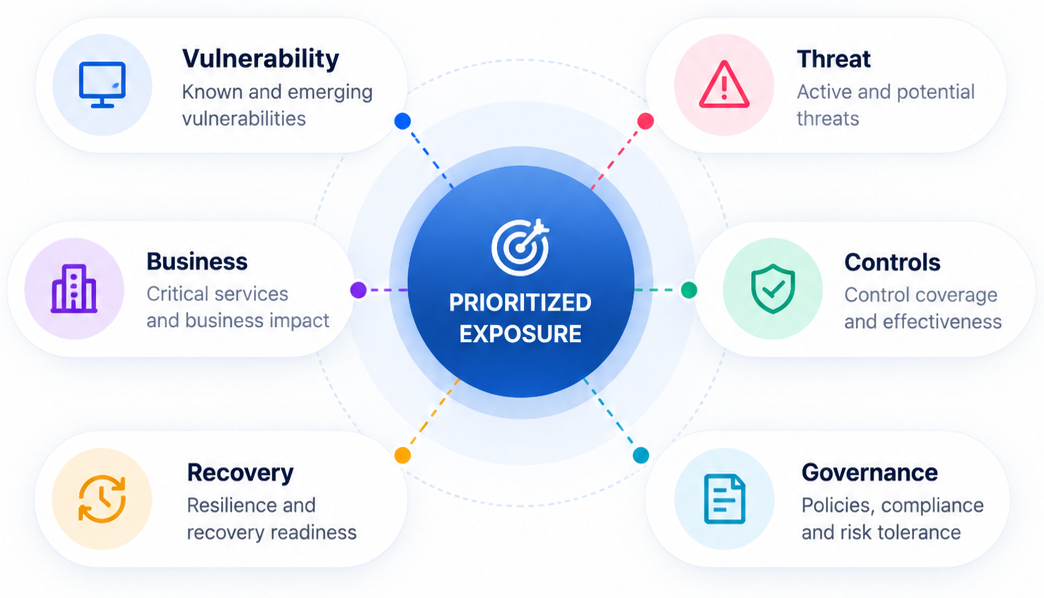
Combine vulnerability, threat, business, control, recovery, & governance evidence to identify what needs attention now.
Validate Readiness
Use testing, configuration checks, recovery exercises, and operational evidence to reveal protection gaps.
Mobilize Action
Resolve ownership, launch playbooks, govern SLAs, and track remediation through completion.
Make CTEM Measurable
and Accountable



Connect the Systems
Behind CTEM.









































































into governed remediation across the enterprise.
Frequently
Asked Questions
What is CTEM?
Continuous Threat Exposure Management is an ongoing program for identifying, prioritizing, validating, and mobilizing action against exposures most likely to affect the business. It keeps decisions aligned as the environment and threat landscape change.
How is CTEM different from vulnerability management?
Vulnerability management focuses primarily on finding and remediating software weaknesses. CTEM considers a broader set of exposures and connects technical findings with asset, threat, business, control, recovery, and governance context.
What are the five stages of CTEM?
The five stages of Continuous Threat Exposure Management are Scoping, Discovery, Prioritization, Validation, and Mobilization. Together, they create a continuous cycle for identifying meaningful exposure and moving priority issues into remediation.
Is CTEM a linear five-step process?
No. The five stages form a continuous cycle. New assets, threats, configuration changes, control evidence, and remediation results can cause the program to rescope and reassess exposure.
How does SPOG help organizations implement CTEM?
SPOG connects assets, threats, controls, business services, ownership, and workflows across the CTEM lifecycle. This preserves context between stages and helps teams move from exposure discovery to governed remediation.
How does CTEM prioritize cyber exposures?
CTEM prioritizes exposures using more than technical severity. SPOG combines vulnerability, threat, business, control, recovery, and governance evidence to determine which exposures are most likely to create unacceptable business outcomes.
How does AreWeExposed™ fit into CTEM?
AreWeExposed™ is the SPOG framework that supports prioritization and validation in CTEM. It combines current exposure, readiness, and governance signals to determine what requires action now.
How often should a CTEM program reassess exposure?
CTEM is a continuous program rather than a fixed assessment cycle. New assets, threats, configuration changes, control failures, and remediation results can trigger rescoping, reprioritization, or renewed validation.
How can organizations measure CTEM effectiveness?
Organizations can measure CTEM through remediation speed, SLA performance, ownership, preparedness, validated outcomes, and remaining exposure. SPOG connects these measures to provide accountable oversight across the CTEM lifecycle.
Does SPOG replace scanners, CMDBs, ITSM, or security controls?
No. SPOG connects evidence from existing enterprise systems, relates it through a shared knowledge layer, and carries the resulting context into exposure decisions and operational workflows.