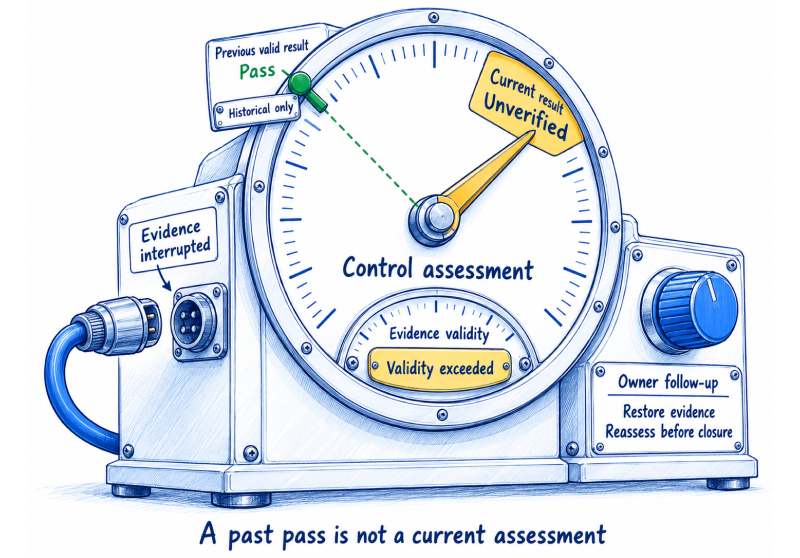
A passing result is only useful when its coverage, evidence and test remain valid. Learn how to distinguish control failures from missing evidence, report assessment gaps and verify corrective action before closing findings.
Compliance monitoring should show which defined requirements are being met, which conditions have failed and where the organization lacks enough evidence to reach a conclusion.
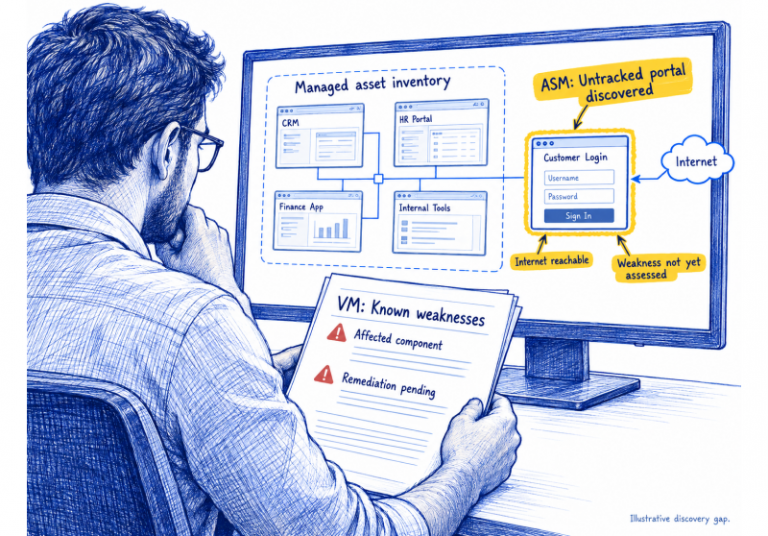
Those answers can diverge. A dashboard may report a high pass rate while newly deployed assets remain outside its assessment population. A previously passing result may become unverified when its evidence exceeds the approved freshness limit.
The practical challenge is maintaining a valid result as populations, evidence and test conditions change. This article explains how to define those boundaries, distinguish failure from uncertainty and verify corrective action before closing a finding.
What Is Compliance Monitoring
Compliance monitoring is the recurring assessment of whether applicable requirements and the controls supporting them are being met within a defined scope.
Requirements may come from laws, contracts, security standards or internal policies. Monitoring connects those requirements to observable conditions, evidence, responsible owners and follow-up decisions.
For technical controls, those conditions may concern access, logging, endpoint protection or configuration. Other controls require document review, interviews, exercises or professional judgment.
An automated check establishes the condition it was designed to test. Its passing result should not be presented as proof that an entire framework, service or legal obligation is satisfied.
What Does Continuous Compliance Monitoring Mean
Continuous compliance monitoring means maintaining an ongoing assessment process at a frequency appropriate to the requirement, risk and rate of change.
Some checks can run when a relevant event occurs. Others depend on scheduled collection. Management reviews, recovery exercises and certain approval decisions still require people.
Define three intervals separately:
Collection interval: How often the source supplies evidence.
Assessment interval: How often the evidence is evaluated.
Response target: How quickly an owner must investigate or act.
Frequent testing cannot compensate for stale source data. Likewise, rapid collection adds little value if material failures wait indefinitely for review.
Independent assessments retain their own scope, criteria and evidence requirements. Monitoring should support them while also helping teams act between audits. Within a SaaS compliance program, apply the monitoring process to the defined product boundary and applicable requirements.
Six Practices for Maintaining Valid Compliance Monitoring Results
1 Define the Requirement and Expected Population
Begin with a control objective that can be tested.
For privileged access, identify the systems, account types and authentication conditions in scope. Include local administrators, emergency accounts and other access paths where applicable. Machine identities may require different safeguards from human accounts.
Build the expected population from appropriate records, such as identity directories, cloud inventories and service ownership data. Compare it with the population visible to the control tool.
Resolve missing records, duplicates and inconsistent identifiers. Record exclusions and their rationale.
A tool’s inventory describes what that tool knows about. It does not independently establish everything the control should cover.
2 Specify the Test Before Collecting Evidence
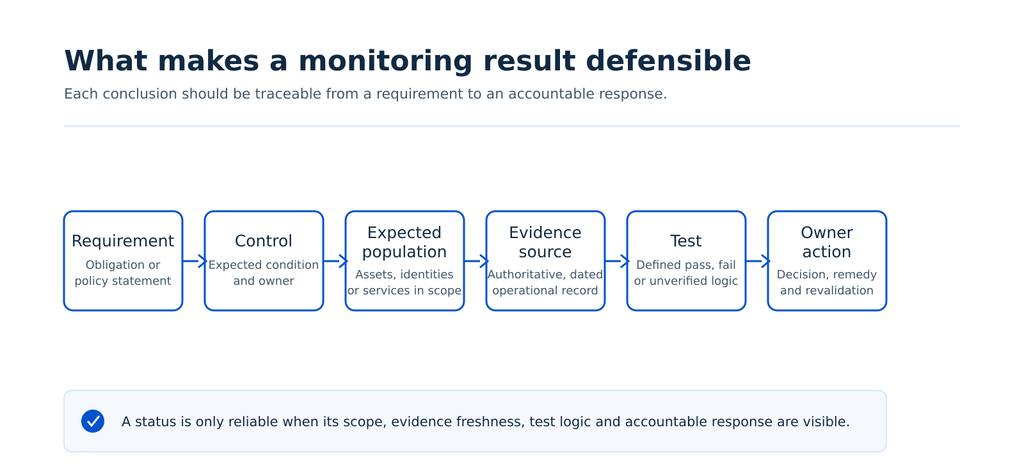
Record the expected condition, evidence source, assessment method, owner, frequency and response rule.
Separate tests that answer different questions. An endpoint agent being installed does not establish that it is reporting, configured correctly or enforcing the required protection. A completed backup does not establish that a service can be restored.
For automated checks, retain the test logic and its version. When the rule changes, preserve the historical result and explain the change.
Use human assessment where the conclusion depends on context, such as whether a safeguard adequately addresses an exception.
3 Make Evidence Validity Part of the Result
Evidence needs identifiable scope, timestamps, provenance and sufficient completeness.
Set an acceptable age according to the control’s operating frequency and the period being claimed. A completed annual review and a production configuration check have different validity expectations.
If collection fails, retain the last successful result as history. Continue treating it as current only while it remains within the approved validity rule. Once that rule is exceeded, mark the current assessment unverified and investigate.
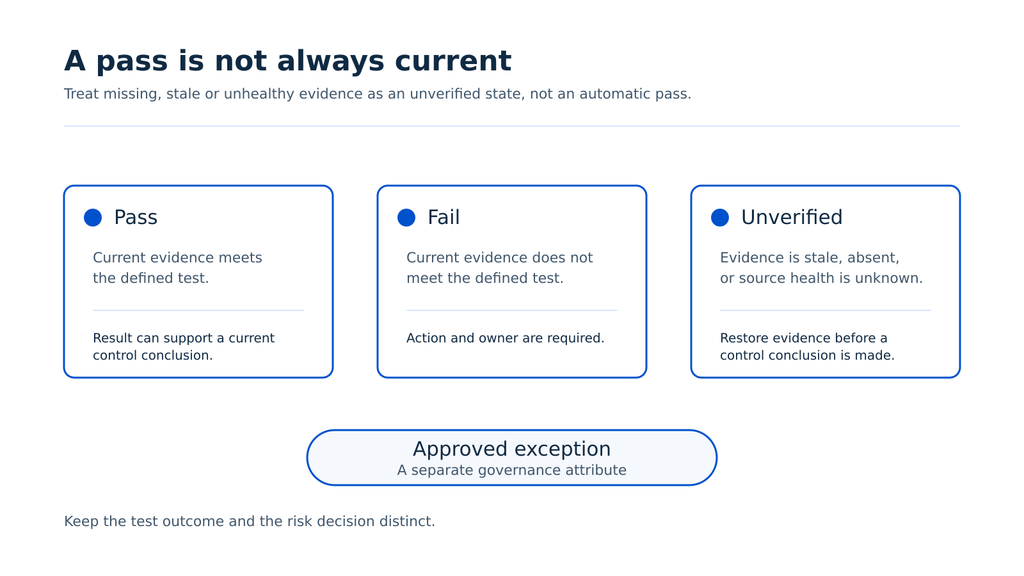
Distinguish three conditions:
Assessment state
Meaning
Required response
Pass
Valid evidence supports the defined test condition.
Continue monitoring within the agreed scope.
Fail
Valid evidence shows the condition is unmet.
Investigate and route treatment to an owner.
Unknown or unverified
Evidence is missing, stale or insufficient.
Restore visibility or obtain an appropriate assessment.
A separate ‘not assessed’ label may help distinguish work never performed from an assessment that lost validity.
Keep approved exceptions as an additional attribute. Approval does not change an observed failure into a pass.
4 Route Failed and Unverified Results Separately
A confirmed failure and an evidence gap require different investigations.
For a failed result, identify the affected population, unmet condition, responsible control owner and response deadline. For an unverified result, identify what evidence is missing, which conclusions it prevents and who must restore visibility or perform an alternative assessment.
Prioritize both using service criticality, exposure and the significance of the requirement. Missing evidence for a critical control may require urgent attention even when no failure has been confirmed.
Retain approved exceptions alongside the observed result, including their scope, approver and review triggers. Approval does not turn a failed condition into a pass. Escalate risk acceptance and questions about binding obligations through the organization’s established governance process.
5 Verify Restoration Before Closing Findings
A completed remediation task needs a verification result.
If logging is restored, confirm that the required events reach the intended destination. If an account is removed, verify the relevant access paths. If endpoint protection is repaired, reassess the affected devices against the defined condition.
Retain the evidence of the change and the subsequent test. If the test remains unverified, preserve that uncertainty in the finding.
Monitor recurrence too. Repeated failures after deployments may indicate a weakness in configuration management, onboarding or control design.
The closure rule should state what evidence establishes restoration and who can approve closure.
For recovery controls, define whether the finding concerns backup execution, recovery coverage or restoration. Verify the specific condition that failed before closing it.
6 Review the Monitoring Program Itself
Monitoring can drift as environments and assessment logic change.
Review whether new services enter scope, integrations retain the required permissions and failed collection reaches an owner. Test whether an unexpected asset, stale source or invalid record produces the intended response.
Where appropriate, use a controlled test environment to introduce a known failure and verify detection, routing and reporting.
Revisit the program after material architecture changes, incidents, acquisitions or changes in obligations.
Compliance readiness depends on the accuracy of that operating process as well as the records it produces. These checks contribute to continuous assurance, whose broader purpose includes assessing control effectiveness and security outcomes.
Which Compliance Monitoring Metrics Should Leaders See
Start with measures that expose uncertainty and support decisions.
Measure
Definition
Interpretation
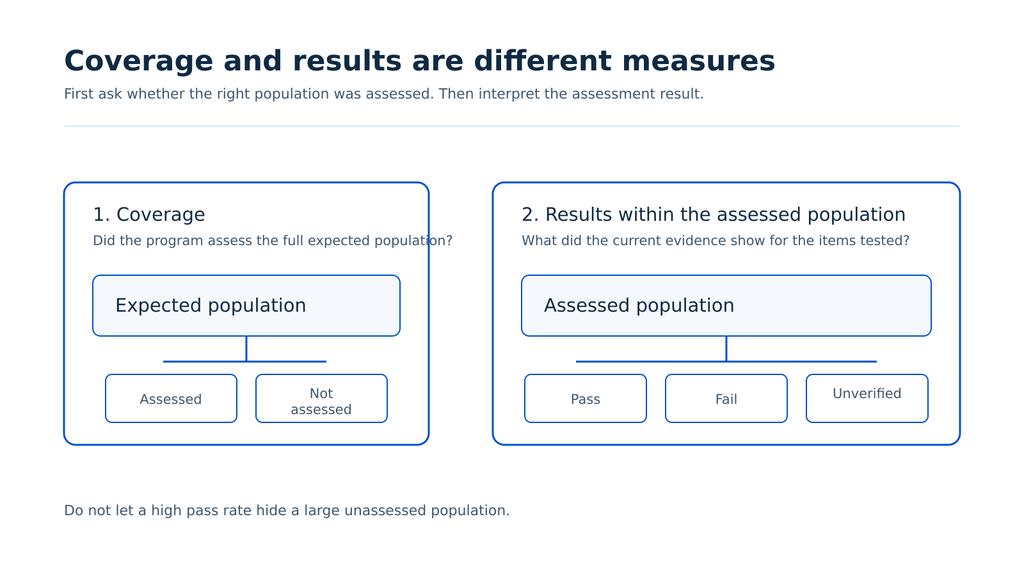
Assessment coverage
In-scope items with valid results divided by the expected population
Shows how much of the population was assessed
Observed pass rate
Assessed items meeting the condition divided by assessed items
Describes results within the assessed population
Unverified population
In-scope items without a valid current result
Shows where conclusions are unsupported
Material exceptions
Significant deviations, with scope and review dates
Keeps accepted exposure visible
Verified remediation
Findings supported by successful restoration checks
Shows whether corrective work achieved its objective
Report the relevant service, observation period and evidence limitations beside each measure.
A high pass rate can coexist with incomplete coverage. If the expected population is unreliable, qualify the coverage measure rather than presenting it as complete.
For leaders, surface decisions that require approval. For control owners, expose the affected items and next actions.
Use these measures to explain each monitoring result, with the population, calculation, observation period and important exceptions visible.
Worked Example of Missing Assessments
An illustrative monitoring check covers 100 in-scope endpoints. Current, valid evidence is available for 90. Of those, 84 meet the defined condition and six fail. Ten endpoints remain unverified.
Measure
Result
Assessment coverage
90%
Observed pass rate among assessed endpoints
93.3%
Failed endpoints
6
Unverified endpoints
10
Reporting only the 93.3% pass rate hides the ten endpoints without valid assessments. Report coverage, failures and unverified items together, then assign separate actions to correct failed conditions and resolve missing evidence.
These figures describe one defined test. They do not establish that the organization is 93.3% compliant.
Can the Tool Preserve Result Validity When Conditions Change
Use a representative control to evaluate the full workflow.
Demonstration
What it should establish
Add an in-scope item to the test environment
Population changes become visible.
Introduce a known control deviation
The correct test detects the deviation.
Stop or delay an evidence feed
Freshness rules affect the current result.
Record an approved exception
The gap remains visible with its decision history.
Complete a fix that does not restore the condition
Task completion does not produce unsupported closure.
Export the assessment history
Records retain scope, timestamps, test version and decisions.
Confirm the specific integration permissions, supported fields, collection limits and manual steps. A connector’s existence does not establish that it supplies everything a proposed test needs.
Assess security around the monitoring platform itself: evidence access, administrative privileges, retention, auditability and integration credential handling.
Evaluate how findings move between security tools, GRC and ITSM. The handoff should preserve the control question and verification requirement.
If the tool uses AI to summarize findings or explain results, check that reviewers can inspect the underlying evidence and assessment method. Generated explanations should not create a passing result or conceal missing evidence. Confirm data handling and approval requirements for the intended use.
How SPOG.AI Supports Compliance Monitoring
SPOG.AI’s continuous control monitoring approach connects defined controls with operational evidence, coverage assessment, ownership and revalidation. Its governance, risk and compliance approach connects requirements with control and risk context.
Evaluate that approach against a specific control and your actual evidence sources. Confirm the supported scope, test behavior, collection frequency and remediation workflow.
Book a demo to explore how your control requirements and evidence sources can be connected.
Start With One Monitoring Result
Choose an important control and document its expected population, evidence validity rule, test condition and response owner.
Then test three situations: a confirmed failure, an item missing from the assessment population and evidence that exceeds its freshness limit. Check whether each produces the correct result, reaches the responsible owner and remains visible until resolved.
Compliance monitoring becomes useful when every reported result explains what was assessed, what remains uncertain and what evidence supports closure.
Frequently Asked Questions
It helps an organization assess defined requirements, identify gaps, assign decisions and verify corrective action within an agreed scope.
Monitoring operates as a recurring management process. An audit or independent examination follows its own scope, criteria and assessment method.
No. Frequency depends on risk, obligations, available evidence and change. Some checks are event-driven, others scheduled or performed by people.
Preserve the historical result, apply the agreed validity rule and mark the current result unverified when that rule is exceeded.
It means the conclusion lacks adequate support. Investigate the uncertainty separately from a confirmed control failure.
Compare valid assessment results with a reconciled expected population. Report pass rates separately and qualify unreliable population data.
Approval records a decision about the deviation. It does not change the observed condition. Keep scope, safeguards and review dates visible.
Evidence that the affected scope now meets the defined condition, supported by a successful verification check and authorized closure.
Applicability decisions, risk acceptance, ambiguous evidence and judgments about safeguard adequacy often require qualified review.
Demonstrate a representative control through population changes, failure, stale evidence, exceptions, remediation and evidence export.
Technology writer and content strategist with 5+ years of experience, including work for a US-based B2B SaaS client and a cybersecurity solution. I create cybersecurity and GRC content, product documentation, and user guides that help technical teams and business leaders understand security capabilities and workflows. Currently working on Confluence documentations on vulnerability management, ITSM, incident management, and continuous control monitoring, alongside SEO and AEO content, and technology partner database development.