ISO Security Standards in 2026: Which Ones Matter for Your Organization?
Choose ISO security standards based on your business needs, responsibilities and the assurance stakeholders expect. Compare security, privacy, cloud, continuity and AI standards, and understand where certification, guidance and shared evidence fit.
A customer asks for ISO 27001 certification. Another asks how you protect personal information in the cloud. Your board wants assurance about service continuity, and your product team is introducing AI.
These requests concern related risks, but they do not ask for the same assurance. Adding more standard names to a compliance roadmap will not resolve the difference.
The practical approach is to choose standards against the services you operate, the obligations you face and the assurance your stakeholders need. Build shared governance and evidence where it makes sense, while keeping each standard’s scope and requirements explicit.
Start with the assurance question
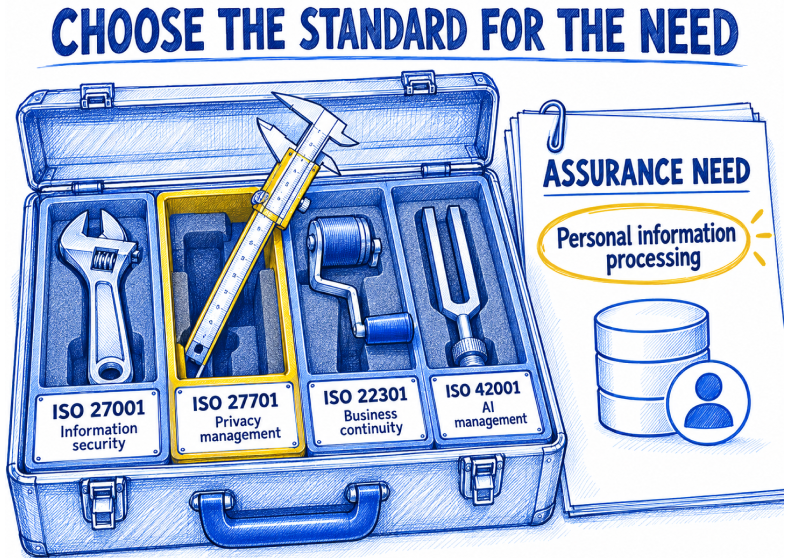
Before selecting an ISO security standard, establish what the requester needs to know. Is the concern information security governance, privacy management, cloud responsibilities, continuity or AI governance? Does the requester need an independently certified management system, or evidence that particular controls operate?
For a procurement request, confirm the exact standard, edition, certificate scope and accepted assessment scheme. A certificate covering one business unit or service may not cover the service being purchased.
Distinguish two kinds of standards:
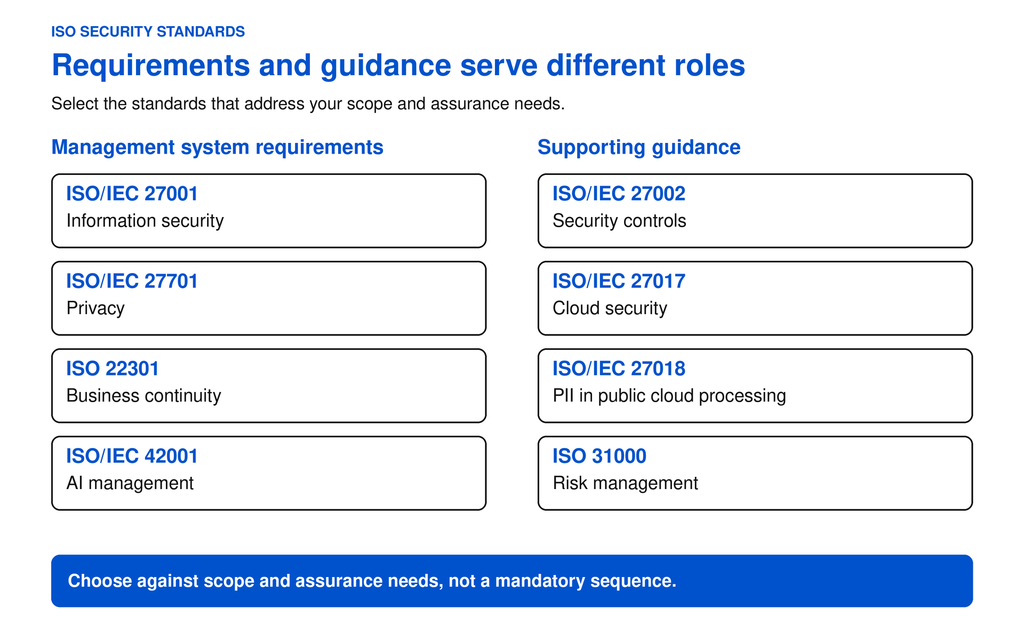
Management system requirements: ISO/IEC 27001, ISO/IEC 27701, ISO 22301 and ISO/IEC 42001 define requirements against which their respective management systems can be certified.
Guidance: ISO/IEC 27002, ISO/IEC 27017, ISO/IEC 27018 and ISO 31000 help organizations design controls or manage risk. They serve a different purpose from standalone management system requirements.
ISO develops standards; independent certification bodies perform certification. When a supplier presents a cloud control certificate or attestation, check its assessment basis and scheme rather than inferring assurance from the standard number alone.
ISO itself does not certify organizations or issue certificates.
If a customer asks for “ISO compliance,” clarify which standard, edition, scope and form of assurance it expects.
If a customer asks for “ISO compliance,” clarify which standard, edition, scope and form of assurance it expects.
ISO standards also do not automatically satisfy a law or sector regulation. They can support a structured programme and provide reusable evidence, while specific legal and contractual duties must still be assessed separately.
Which ISO standards matter most for security in 2026?
The table below compares the editions and purposes of the standards relevant to this selection decision.
Standard and current edition
Type
Main decision it supports
ISO/IEC 27001:2022, with Amendment 1:2024
ISMS requirements
How will we govern information security risk within a defined scope?
ISO/IEC 27002:2022
Control guidance
How should we design and implement information security controls?
ISO/IEC 27701:2025
PIMS requirements
How will we govern the processing of personal information?
ISO/IEC 27017:2026
Cloud security guidance
Which cloud controls and responsibilities belong to the provider and customer?
ISO/IEC 27018:2025
Public cloud privacy guidance
How should a public cloud provider protect PII when acting as a processor?
ISO 22301:2019, with Amendment 1:2024
BCMS requirements
How will we maintain and recover prioritized activities during disruption?
ISO 31000:2018
Risk management guidance
How will we make consistent risk decisions across the organization?
ISO/IEC 42001:2023
AIMS requirements
How will we govern AI systems within a defined scope?
ISMS means information security management system; PIMS, privacy information management system; BCMS, business continuity management system; and AIMS, artificial intelligence management system. PII means personally identifiable information.
Choose ISO 27001 for ISMS requirements and ISO 27002 for control guidance
ISO 27701:2025 defines requirements for a PIMS. The 2025 edition is a standalone management system standard, rather than the earlier extension to ISO 27001 and ISO 27002. It can still be integrated with an ISMS.
The practical question is whether your governance adequately addresses personal information processing in your role as a controller, processor or both.
An access control may protect a personal information database, but it does not establish that every processing activity is appropriate. Privacy management also needs decisions about the processing itself, its purposes, responsibilities and applicable obligations.
Before adding a privacy certification objective, map the relevant processing activities and accountable roles. Agree the proposed PIMS scope with your privacy and legal teams. ISO 27701 certification does not automatically establish compliance with every privacy law.
Treat cloud standards as responsibility guidance
ISO 27017:2026 provides cloud security control guidance for cloud service providers and customers. The current edition was published in July 2026. It builds on ISO 27002:2022 and adds cloud-specific guidance and controls.
Use it to make responsibilities concrete. Who configures identity permissions? Who retains logs? Who manages encryption keys? Who investigates an incident that crosses the provider and customer boundary?
A provider’s assurance report may describe its controls while leaving customer configuration outside the assessment. Record the controls your team must operate and the evidence it will retain.
ISO 27018:2025 addresses PII protection by public cloud providers acting as processors. It is more specific than general cloud security guidance. Its relevance depends on the service and processing role, not simply whether an organization uses cloud infrastructure.
If you buy a cloud service, review the provider’s assurance alongside your contracts and own responsibilities. If you provide one, establish which processing activities and services the claimed assurance actually covers.
Separate security recovery from business continuity
ISO 22301 defines requirements for a BCMS. Its scope extends beyond restoring IT systems to maintaining and recovering prioritized business activities during disruption.
A successful backup job answers one question. A recovery exercise that demonstrates a critical customer service can resume, with the necessary people, suppliers and communications, answers a broader one.
Security and continuity teams should agree which disruption scenarios they will assess together and which need separate treatment. Use service dependencies and business impact to guide exercises. Do not treat a technical restore result as proof that the whole business activity can continue.
ISO 31000 provides broader risk management guidance and is not intended for organizational certification. It can help align security, privacy, continuity and enterprise risk decisions around agreed criteria and escalation practices. It does not replace the requirements of the management systems you adopt.
Add AI governance when AI changes your responsibilities
ISO 42001 defines requirements for an AIMS for organizations providing or using AI systems. It addresses a governance need that an ISMS alone may not fully cover.
First establish the AI systems in scope, their intended uses, accountable owners and effects on stakeholders. The governance work should follow the organization’s actual role and exposure.
For example, securing an AI application’s infrastructure is one responsibility. Deciding whether a change in its intended use needs further evaluation is another. These decisions may share technical evidence but require different owners and assessment criteria.
Adopt ISO 42001 because the AI management objective is relevant to your organization or assurance commitments. An AI feature in a product does not, by itself, make certification mandatory.
Reuse evidence without overstating what it proves
Integrated management systems can reduce duplicated administration when evidence is reused with clear mappings and separate conclusions.
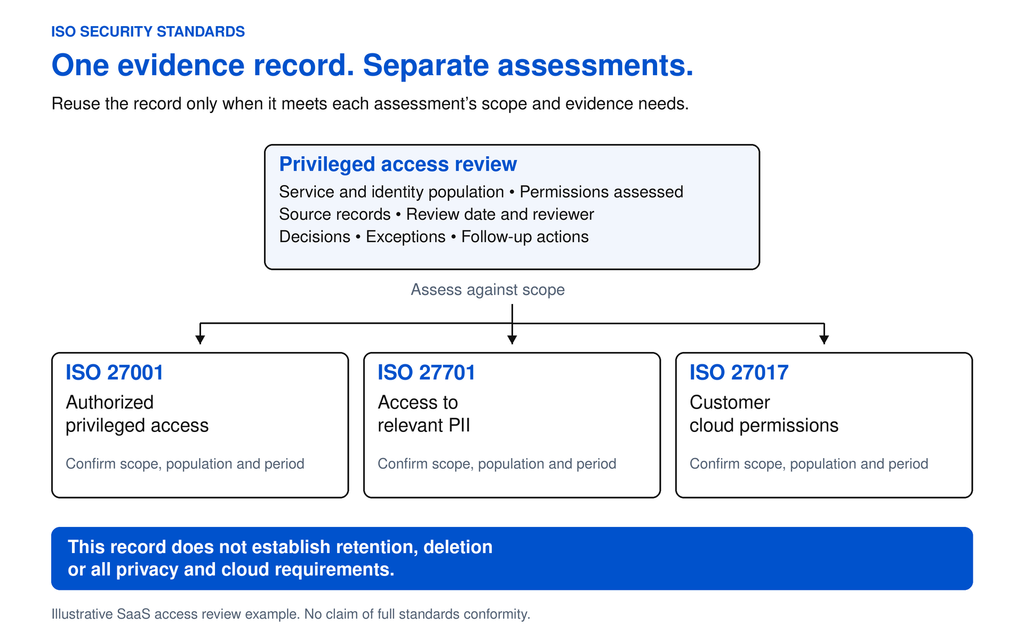
A completed access review may inform information security, privacy and cloud assessments. For each use, identify the requirement being assessed, whether the record covers the relevant scope and period, and the conclusion it supports.
The same record does not establish every privacy obligation, cloud responsibility or information security requirement. Retain a separate interpretation and assessment result for each use. Where evidence is incomplete, make the limitation visible. Reusing the record does not make the assessment conclusions interchangeable.
Make the roadmap a sequence of decisions
A useful standards roadmap names the outcome, owner and evidence needed at each step.
Identify the assurance needed. Capture the business, customer or contractual question driving the work.
Establish the role and boundaries. Identify the service, organizational responsibilities and scope involved.
Separate requirements from guidance. Decide which management system requirements and supporting guidance address the need.
Compare with existing governance. Assess which relevant responsibilities and assurance commitments are already covered.
Identify the additional work. Determine the governance, evidence and management system responsibilities each candidate standard would add.
Prioritize the commitment. Choose the implementation or certification objective that resolves the next important assurance question. Revisit the choice when needs change.
Where SPOG.AI can support the work
SPOG.AI’s continuous control monitoring and governance, risk and compliance capabilities connect operational evidence with controls, ownership and follow-up. Where evidence is reused, preserve the relevant requirement mapping and a separate assessment conclusion for each standard.
Confirm available framework mappings, connector coverage, assessed populations, evidence freshness and manual review needs before configuring assessments. Support for one framework does not establish coverage of every standard discussed here.
The organization remains responsible for management system scope and risk decisions. Legal interpretation should involve appropriate advisers, while certification decisions remain with the certification body.
Choose the standard that resolves the next important question
A strong ISO program can explain why each adopted standard is relevant, what falls within its scope and what evidence supports its conclusions.
Begin with the service or obligation that matters most. Choose the management system requirements and guidance that address it, assign ownership and establish evidence you can defend. Expand the program when a distinct need justifies the additional work.
Frequently asked questions
e regulatory compliance?
structure controls and evidence, but the organization must assess its applicable legal and sector-specific requirements separately.
ISO/IEC 27001 is a common foundation because it defines ISMS requirements and risk treatment. The best starting point still depends on the organization’s objectives, contracts and existing controls.
ISO 27001 defines ISMS requirements and supports management system certification. ISO 27002 provides guidance for information security controls. Using ISO 27002 helps with control design, but it does not establish conformity with all ISO 27001 requirements.
Relevant current editions include ISO/IEC 27001:2022 with Amendment 1:2024, 27002:2022, 27701:2025, 27017:2026, 27018:2025 and 42001:2023. ISO 22301:2019 with Amendment 1:2024 and ISO 31000:2018 also remain relevant. Check editions again when planning a new assessment.
Yes. ISO 27701:2025 defines a standalone privacy information management system. It can be implemented independently or integrated with an ISMS. Certification arrangements, scope and any transition from the earlier edition should be confirmed with the certification body.
The current cloud security guidance edition was published in July 2026. It uses ISO 27002:2022 as its reference and provides cloud-specific implementation guidance and additional controls for providers and customers. Teams should review existing cloud responsibility and control mappings against the new edition.
ISO 27017 provides cloud security guidance for providers and customers. ISO 27018 focuses on PII protection by public cloud providers acting as processors. Their relevance depends on the cloud service, processing role and responsibilities being assessed.
No. ISO 27001, ISO 27701, ISO 22301 and ISO 42001 define management system requirements. ISO 27002, ISO 27017, ISO 27018 and ISO 31000 provide guidance. For cloud-related certificates or attestations, check the scheme and assessment basis rather than assuming standalone management system certification.
Yes, when its scope, population, period and content meet the relevant assessment needs. A privileged access review may support security, privacy and cloud assessments. It does not prove every requirement of those standards. Retain separate mappings and conclusions for each assessed requirement.
No. Certification assesses conformity with a defined standard and scope. Organizations must separately identify and address applicable legal, regulatory and contractual obligations. A certificate should not be presented as blanket proof of privacy, cybersecurity or AI legal compliance.
Start with the assurance your customers, regulators and other stakeholders need. Identify the relevant services and your organization’s role, then assess what existing governance already covers. Prioritize the standard that addresses the most important unmet need, considering the additional responsibilities, evidence and implementation effort it introduces.
With 8.5+ years in B2B SaaS, I’ve led demand generation and GTM initiatives across global markets (US, UK, Europe, Africa), helping companies move from fragmented marketing efforts to structured, revenue-focused growth engines.