Your access policy says former employees lose production access promptly. The tickets are closed. But an account review finds an active contractor identity nobody has checked in months. Which record should the team trust?
This is why compliance monitoring matters. A written policy and a completed workflow describe the intended process. Monitoring tests whether the control covers the people, systems and data it should cover today. When it finds a gap, the team needs to know who owns it and whether the fix worked.
In 2026, cloud services, identities and integrations change too quickly for an annual evidence chase. Here is how continuous compliance monitoring works and how to choose supporting tools.
What is compliance monitoring?
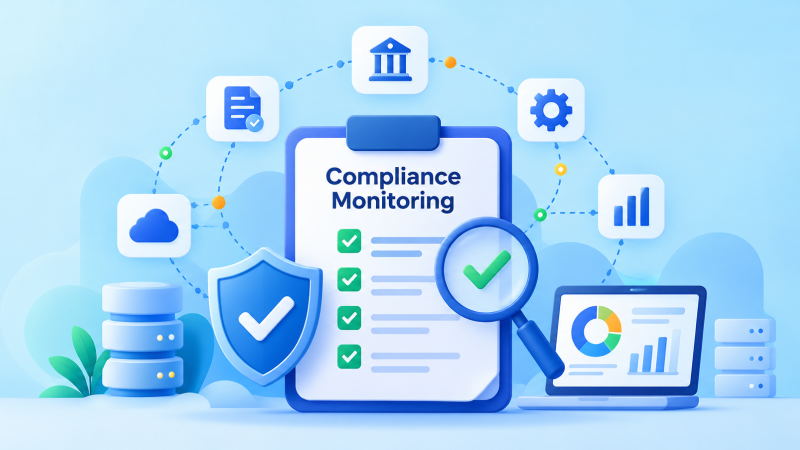
Compliance monitoring is the recurring check that an organization is meeting defined requirements and that the related controls operate as intended. A requirement may come from a regulation, contract, security standard or internal policy. Each check needs a scope, evidence source, expected result, owner and response when the result is wrong or missing.
“MFA is enabled” is hard to test. Ask whether every in-scope privileged account on production systems has the approved authentication method. Record the account population, protected accounts, exceptions, gaps and data collection time.
Monitoring helps the organization address gaps during operations. A compliance audit examines control design and evidence for a defined scope and period. A SOC 2 Type 2 examination considers how controls operated over an examination period. Monitoring supports that evidence but does not replace independent assessment.
What should a compliance monitoring program contain?
Control mapping across frameworks
Begin with a list of controls the organization actually operates. For each one, state the objective, systems and people in scope, control owner, applicable requirement and evidence source. Map the same operation to more than one framework when it truly supports each one, while preserving the differences in scope and criteria.
An access review might support both ISO 27001 and SOC 2 without proving every requirement in either. Mapping controls across frameworks reduces duplicate work where evidence genuinely overlaps.
Automated control testing with human review
Some checks can be automated from identity, cloud or security systems. Others need a person to assess a decision, interview an owner or inspect a sample. Use automation for repeatable facts such as whether required logging is enabled on all in-scope resources. Use human review when the question is whether an exception is justified or an incident response decision was appropriate.
Set a pass condition before collecting data. For a backup control, “job completed” and “service can be restored within its recovery target” are different tests. For a vulnerability control, the scan status, asset coverage and overdue critical findings are separate signals. Keep those differences visible in the monitoring design.
Evidence collection with time and scope
Evidence should explain what was checked, when, for which assets or people, against which expected result, and what the outcome was. A screenshot without a date or system boundary may be difficult to use. A raw log without an explanation may leave a reviewer to reconstruct the conclusion.
Keep the link between a control result and its original source. If the source stops sending data, the monitoring result should become “unknown” or an investigation item rather than silently remaining green. Define how long evidence must be retained according to the applicable obligation and the period you need to demonstrate.
Alerts, ownership and remediation
A failed check should reach someone who can investigate and act. The record should show the affected asset, severity, owner, due date, decision, fix and recheck. An approved exception may be appropriate, but it needs a reason, an expiry or review point, and visibility into the remaining risk.
Closing a ticket is not the same as confirming a control recovered. After the change, run the relevant test again and record the result. This matters when several teams share responsibility across IT, security, engineering and GRC.
Reporting that supports decisions
Leaders need to know where important controls are incomplete and whether the team is reducing the gap. Useful reporting shows the in-scope population, coverage, failed tests, approved exceptions, aging remediation and trends. A simple count of completed checks can hide a critical service that was never included.
Make reports fit the audience. A control owner needs affected assets and next steps. GRC needs requirement mapping and evidence history. Leadership needs material risks and decisions. An assessor needs traceable records for the agreed scope and period.
Six compliance monitoring best practices for 2026
1. Start with a reliable scope
A control cannot be monitored meaningfully if no one knows which systems or accounts it should cover. Use a current asset or identity inventory, identify critical services and document exclusions. Reconcile monitoring sources with that inventory so newly created cloud resources do not disappear from the denominator.
For a privileged access check, coverage means protected privileged accounts divided by all in-scope privileged accounts. If the inventory misses service accounts, a high percentage can be misleading. Record both the percentage and the uncovered population.
2. Assign owners before adding alerts
Name the person or team that operates each control and the one that reviews its results. Agree on who accepts exceptions and who verifies remediation. The GRC team can coordinate the program, but it cannot fix every cloud setting, revoke every account or retest every recovery process itself.
If ownership spans teams, document the handoff. A cloud engineer may correct a setting, while security validates the result and a risk owner decides whether a temporary exception is acceptable.
3. Set monitoring frequency by risk and evidence freshness
There is no universal rule that every control must be checked daily or every vendor quarterly. Choose a cadence based on how fast the underlying state can change, the impact of failure, the available data and any specific requirement that applies.
Privilege or critical cloud configuration changes may justify frequent checks. A management review may run less often because the decision itself occurs on a schedule. Record the cadence, the age of the latest result and what happens when a check does not run. A tool that refreshes weekly should not be presented as a live view of today’s state.
4. Connect changes to the controls they affect
A new application, region, identity provider or vendor can change the monitoring scope. Include control coverage in onboarding and change reviews. After a material production change, recheck the controls most likely to be affected rather than assuming the original approval proves their current state.
For instance, a new cloud account may need to be added to logging, backup and access checks. ISO 27001 change management is one way to make the review and the resulting verification explicit.
5. Treat missing evidence as a signal
The absence of a failure alert does not prove a control passed. A connector may stop reporting, a scheduled test may be skipped, or the inventory may no longer match reality. Monitor the health of evidence sources and distinguish “passed,” “failed,” “not tested” and “not in scope.”
When a source fails, identify the period affected and decide whether an alternative check is needed. Preserve the gap and the response in the record. A credible monitoring history includes what the team could not verify.
6. Recheck after remediation
Make closure depend on a new result for the affected population. If MFA was missing on four privileged accounts, verify those four and look for the same cause elsewhere. If backup coverage missed a database, confirm the job now runs and test recovery where appropriate.
This is the difference between collecting exceptions and building continuous assurance. The team learns whether the control was restored and whether the risk actually changed.
Which compliance monitoring tools do you need?
Different tools answer different parts of the question. Choose them around the controls and decisions your program needs, not the size of a feature list.
| Tool category | What it can contribute | What you still need to check |
|---|---|---|
| Identity, endpoint and cloud systems | Current settings, account populations, asset state and technical events | Whether every in-scope environment is connected and the data is fresh |
| Security posture and detection tools | Misconfigurations, exposures and operational alerts | Whether findings map to control objectives, owners and evidence periods |
| ITSM and workflow tools | Assigned fixes, approvals, exceptions and closure history | Whether closing work includes a control recheck |
| GRC and control monitoring tools | Requirement mapping, evidence, testing results and reporting | Whether connections, scopes, tests and exception decisions match your program |
| Document and collaboration tools | Policies, review minutes and human decisions | Whether records are versioned, dated and linked to operational results |
Ask a vendor to demonstrate one real control: asset population, source freshness, failure, owner, exception, retest and report. A tool that only shows a policy exists cannot show whether it covers the right assets.
Check access to evidence as well. The platform may connect to sensitive security systems, so permissions, retention and audit trails matter. Understand which integrations are supported for your environment and what must remain a manual review. No product can infer every regulatory obligation or approve every risk decision for your organization.
How should teams use AI in monitoring?
AI can help group similar findings, summarize evidence and identify patterns that deserve investigation. It may help a team spot a rising trend in privileged exceptions or recurring failures after deployments. These uses still depend on accurate source data and a human who can test the conclusion.
Avoid treating generated explanations as evidence that a control passed. Record the underlying source, calculation and reviewer decision. If customer or employee information is sent to an AI service, assess its data handling, access, retention and contractual terms before connecting it to the workflow.
How SPOG.AI fits into the program
SPOG.AI brings security and IT signals into governance context so teams can relate assets, controls, risks, exceptions and remediation. A control view can show the intended population, observed coverage and gaps that need an owner. The operational systems remain the sources of the evidence and the teams remain responsible for interpreting and acting on it.
For example, a company may know it deployed endpoint protection to most laptops. Monitoring becomes useful when it shows the complete laptop population, unprotected devices, any approved exceptions and whether remediation returned those devices to the expected state. That is a more actionable answer than “the endpoint tool is installed.”
The same pattern applies across identity, vulnerability management, logging and backup. Build the checks around the controls that matter, connect them to reliable evidence, and give every unresolved result an owner. In 2026, that is what turns compliance monitoring into a routine the business can use between audits.