ISO 27001 Certification in 2026: Readiness, Audit Evidence and What Happens Next
Prepare for ISO 27001 certification with a clear scope, traceable evidence and accountable control owners. Understand the audit stages, timeline and cost factors, and what it takes to maintain your ISMS after certification.
ISO 27001 certification readiness means being able to explain the information security management system (ISMS) you have established, demonstrate that it operates within the proposed scope, and show how you evaluate and improve it.
Before booking the external audit, identify which required records and operating results are available, which gaps remain and who owns the follow-up. Prepare a traceable set of records that supports both the certification assessment and the management system you will continue to operate afterward.
What ISO 27001 certification covers
ISO 27001 certification provides independent assessment of an organization’s ISMS against the standard’s requirements. The certificate applies to its stated scope, which may cover particular services, entities and locations.
It does not establish that every asset was tested, guarantee that incidents cannot occur, or automatically demonstrate compliance with every law or customer contract.
ISO publishes the standard. A certification body audits the ISMS and makes the certification decision. For accredited certification, verify the body’s accreditation for ISO/IEC 27001 and its relevant accreditation scope. Confirm that customers will accept the proposed certification and scope before commissioning the audit.
Which edition applies in 2026?
In 2026, prepare for certification against ISO/IEC 27001:2022, including Amendment 1:2024.
Define the scope you intend to certify
Define the services and information the certificate needs to cover, then identify the people, locations, technologies and external dependencies that support them.
For a SaaS product, the scope discussion should consider development, production operations, customer data and the shared services on which they depend. A central identity platform or outsourced support function may sit outside the organizational boundary while still affecting security within it.
A focused scope is legitimate. The interfaces and dependencies still need to be understood and managed. Avoid language that makes a certificate for one product sound like certification of every group company or service.
Leadership should agree to the scope, appoint an accountable ISMS lead, establish responsibilities and fund the work. Give process owners responsibility for operating controls and retaining evidence. Treat certification as work across the business rather than an evidence-collection task assigned solely to GRC.
Prepare the ISMS records and operating evidence for certification
The management system requirements in clauses 4 to 10 cover context, leadership, planning, support, operation, performance evaluation and improvement. Annex A provides a reference set of 93 controls. It is not a requirement to implement all 93 identically in every organization.
Determine necessary controls through risk treatment, then compare them with Annex A to avoid omissions. Necessary controls can also come from other sources. Obtain risk owners’ approval of the treatment plan and acceptance of residual information security risks.
The Statement of Applicability (SoA) should record necessary controls, the reasons for inclusion, whether they are implemented, and justification for excluded Annex A controls. Supporting records should explain the actual implementation.
Use the following preparation checklist. It summarizes the work; it is not an exhaustive list of mandatory documents or a substitute for the standard.
Area
Records to prepare
What to establish
Context and scope
Scope, relevant issues, interested-party requirements and dependencies
The ISMS represents the service and its obligations
Leadership and support
Policy, objectives, responsibilities, competence and awareness records
People understand the work and have resources to perform it
Risk assessment and treatment
Method, assessment results, treatment plan, approvals and SoA
Control choices follow the assessed risks
Operation
Procedures and records from applicable access, change, supplier, incident and other processes
The selected controls operate within their intended scope
Performance evaluation
Monitoring results, internal audit programme and reports, management review results
The organization evaluates conformity and effectiveness
Improvement
Nonconformities, correction, cause analysis, corrective action and effectiveness reviews
Problems receive action that addresses recurrence
For each priority control, identify its intended population, objective, owner, evidence source and assessment method. A policy and an installation screenshot will not answer the same questions as a completed access review or a recovery test.
The ISO 27001 certification process
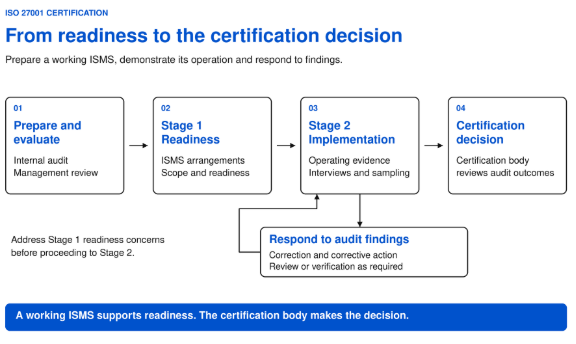
Start with a gap assessment against the standard and your intended scope. Prioritize missing practices and material weaknesses, operate the ISMS, and evaluate its performance before seeking the certification decision. An optional consultant-led readiness review does not replace your internal audit or the external certification audit.
Internal audit and management review
Internal audit evaluates whether the ISMS meets applicable requirements and is effectively implemented and maintained. Plan the programme around process importance and previous audit results, and select auditors so that the work is objective and impartial.
Management review should demonstrate decisions based on ISMS performance, including actions on recurring weaknesses, resource needs and opportunities for improvement. Retain the decisions, assigned owners and follow-up.
Stage 1 and Stage 2 external audits
Audit stage
Main purpose
How to prepare
Stage 1
Assess documented arrangements, scope and readiness for Stage 2
Explain the ISMS design and relevant operating context; make required records available; address readiness concerns
Stage 2
Evaluate implementation and effectiveness through sampled records, interviews and other audit activity
Let owners demonstrate real processes and trace examples from control decisions through results and follow-up
Stage 1 is more than submitting policies. It informs the next audit’s planning and whether the organization is ready to proceed. Stage 2 tests how the ISMS works in practice. Neither should be treated as an exercise in selecting attractive screenshots.
Agree audit arrangements with the certification body, including sites, remote or on-site activity, availability of owners and secure access to evidence. Its audit team samples evidence; a certificate does not mean every account or transaction was examined individually.
Prepare evidence that auditors can trace
Prepare records that support a specific assertion about an ISMS requirement or selected control. Make the relevant service, population or sample, period, activity, result and follow-up identifiable.
Check that owners can retrieve the records and explain what they establish. A current screenshot may show today’s configuration without demonstrating that a recurring activity operated during the period under review.
Protect the records appropriately and align retention with applicable requirements, organizational needs and the audit programs. Audit sampling and requested evidence remain matters for the certification body.
Example: tracing a control before the audit
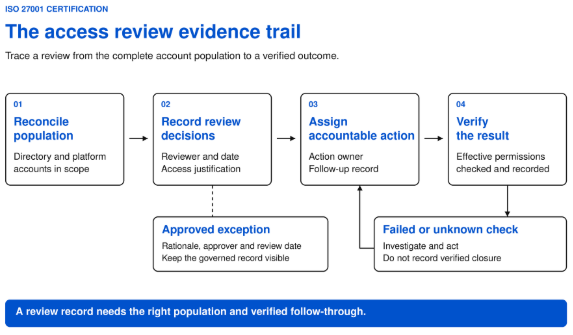
For an illustrative access-review control, assemble a traceable set of records: the risk treatment decision, relevant SoA entry, procedure, completed review, recorded decisions and any corrective-action follow-up.
Confirm that the service scope, review population and record dates are consistent. Ask the owner to explain the review outcome and how unresolved issues were handled.
Auditors determine their own sampling. This exercise checks whether the organization can demonstrate its implementation; it does not guarantee audit acceptance.
Handle audit findings through to an effective corrective action
A nonconformity means a requirement has not been fulfilled. Its classification and effect on certification follow the certification body’s process.
For a major nonconformity, the body must review, accept and verify the correction and corrective actions before granting certification. For a minor nonconformity, it must review and accept the plan for correction and corrective action before that decision. Confirm deadlines and follow-up arrangements with the body; do not assume a universal closure window.
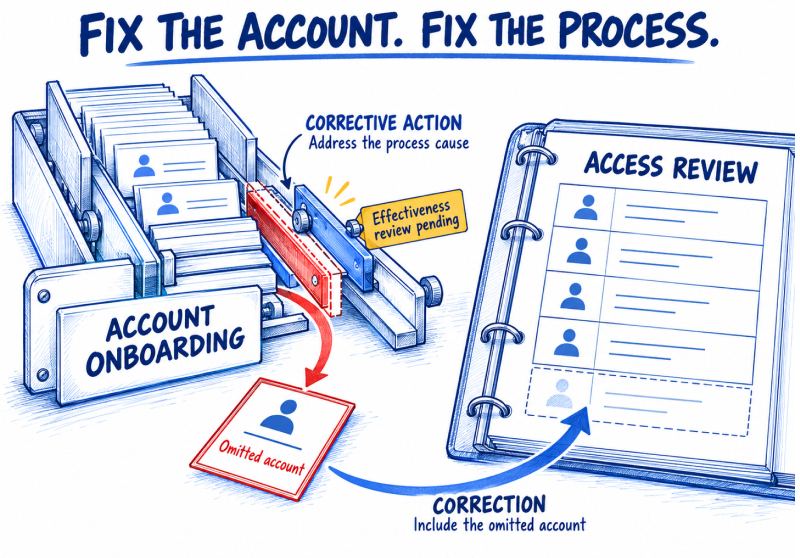
Correction fixes the immediate problem. Corrective action addresses its cause to prevent recurrence. Removing one inappropriate account corrects that instance; repairing the process that omitted accounts addresses the wider failure.
Record the requirement and evidence behind the finding, assess its extent and consequences, investigate the cause, implement the necessary action and review its effectiveness. Keep operational risk approval distinct from conformity: approving an exception does not by itself resolve a nonconformity.
How long does ISO 27001 certification take?
Build the schedule after defining scope and assessing gaps. Include control implementation, meaningful operating evidence, internal audit, management review, findings and certification-body availability.
There is no universal certification timeline or single evidence-history period for every control. A recurring review needs records that demonstrate its operation; a recovery control needs an appropriate test and follow-up. Agree readiness expectations with the certification body instead of applying one calendar estimate to every organization.
Before booking Stage 2, ask owners to trace a real example from scope and control selection to operating evidence and an action taken when the result was unsatisfactory. This practical check can expose weaknesses that a document-completion dashboard misses.
How much does ISO 27001 certification cost?
Budget for establishing and maintaining the ISMS across the certification cycle.
Internal effort: process owners, GRC, security, IT, management and internal audit.
Implementation: control gaps, training, technical changes and evidence handling.
Optional support: advisory services and software appropriate to the work.
Certification: Stage 1, Stage 2, follow-up where needed, surveillance and recertification.
Request quotes against the same scope and assumptions. Compare included sites, audit duration, travel, follow-up charges and ongoing fees. A cheaper initial audit does not necessarily mean a lower total programme cost. Avoid generic price ranges that conceal these differences.
Plan surveillance, recertification and significant-change notifications
Certification commonly follows a three-year cycle, with surveillance during the cycle and recertification before expiry. Confirm the programme and deadlines with the certification body.
Continue operating and improving the ISMS between external audits, including internal audit and management review. Notify the certification body of significant changes in line with its requirements, particularly where changes affect the certified organization or scope.
A new service or location may have implications for certification coverage that differ from adding an account within an existing service. Resolve uncertainty with the body rather than waiting for the next surveillance audit.
ISO 27001 certification versus SOC 2
ISO 27001 certification assesses an ISMS against the standard within its certified scope. SOC 2 is an examination and reporting engagement performed by CPAs using applicable Trust Services Criteria for a service organization’s system.
Choose based on the assurance your customers need and the services they use. Shared evidence can support both programmes, but control mappings do not establish equivalence. Check scope, criteria and reporting requirements separately.
How SPOG.AI supports the work
SPOG.AI’s governance, risk and compliance capabilities connect requirements and controls with ownership and remediation. Its continuous control monitoring capabilities connect selected controls with operational evidence. For certification preparation, this helps teams organize supporting records, identify unresolved readiness gaps and track accountable follow-up.
Available coverage depends on connected systems, evidence quality and configured assessments. Platform evidence should support documentary review, professional judgment and internal audit. The organization remains responsible for its ISMS; the certification body remains responsible for the certification decision.
Start with one in-scope service and trace a material control through its evidence and follow-up. A certification programme is easier to sustain when those records support daily security decisions as well as the next audit.
See how SPOG.AI connects ISO 27001 controls, evidence and accountable action.
Frequently asked questions
It is an independent certification of an organization’s information security management system against ISO/IEC 27001 within a stated scope. It assesses the management system rather than guaranteeing that every asset is secure or every incident is prevented.
For accredited certification, verify that the body holds accreditation for ISO/IEC 27001 and that its scope covers the certification service you need. Confirm customer acceptance of the proposed certificate, assess relevant audit experience, and compare quotes covering initial audits, surveillance, recertification and additional charges.
A certification body makes the certification decision and issues the certificate. ISO publishes the standard but does not certify organizations. For accredited certification, verify the body’s ISO/IEC 27001 accreditation and relevant scope.
Complete internal audit and management review as part of certification readiness, with records of results, decisions and follow-up available for assessment. Confirm the certification body’s expectations before Stage 1 and ensure these activities have been completed before Stage 2.
Stage 1 assesses the ISMS’s documented arrangements, scope and readiness for Stage 2. Stage 2 evaluates implementation and effectiveness through sampled evidence, interviews and other audit activity. Stage 1 does not award certification.
Prepare required ISMS records and relevant operating evidence, including scope, risk assessment and treatment, the SoA, internal audit and management review results. Control records should identify the population or sample, activity, time, result and follow-up. Specific samples depend on the audit plan.
There is no universal timeline. Scope, existing practices, remediation, operating evidence and certification-body availability influence the schedule. Include internal audit, management review and action on findings when planning the two external audit stages.
Costs include internal effort, implementation, training, optional support, initial audits, surveillance and recertification. Compare quotes against the same scope, sites and assumptions. An initial audit fee alone does not represent the full programme cost.
Follow the certification body’s response process. Major nonconformities require review, acceptance and verification of correction and corrective actions before certification is granted. Minor nonconformities require acceptance of the correction and corrective-action plan. Confirm deadlines and subsequent verification with the body.
Continue operating and improving the ISMS, conduct internal audits and management reviews, and complete the certification body’s surveillance and recertification programme. Reassess relevant changes, keep control evidence current and notify the body of significant changes according to its requirements.
With 8.5+ years in B2B SaaS, I’ve led demand generation and GTM initiatives across global markets (US, UK, Europe, Africa), helping companies move from fragmented marketing efforts to structured, revenue-focused growth engines.