Cybersecurity control impact analysis traces a failed or weakened control through the systems, identities and business operations it affects. It helps security and GRC teams decide how urgently to act and what to test before closing the finding. An MFA exception illustrates the problem. One excluded administrator may look insignificant in a coverage report. If that identity can change production infrastructure, the consequence depends on its permissions and the safeguards around them. Counting exceptions alone misses that distinction.
Here, control impact analysis means a practical review approach, not a prescribed standard or a dedicated scoring model. Its central question is specific: what could this control gap allow in this environment?
Start with a testable control failure
Define the intended protection and the condition that violates it. “Privileged access is secure” is too broad. “Human administrators must use phishing-resistant multifactor authentication when accessing production cloud administration” gives reviewers something to test.
Record the systems and identities in scope, including alternative access routes. Console access, command-line access and existing sessions may follow different enforcement paths. Test the routes covered by the control rather than assuming a successful console check establishes coverage everywhere.
Keep human and workload identities separate. A managed identity can support authentication by an application or workload; it is not a replacement for a person’s administrator account. Human privileged access needs appropriate authentication, authorization and oversight. Approved exceptions also need analysis. Approval records a decision about a deviation. Whether the required protection is present remains a separate technical question.
Build the impact path from verified relationships
Begin with the affected identity or asset. Follow its effective permissions to reachable resources, then identify the operations those resources support. Include inherited privileges and shared infrastructure where they change the consequence.
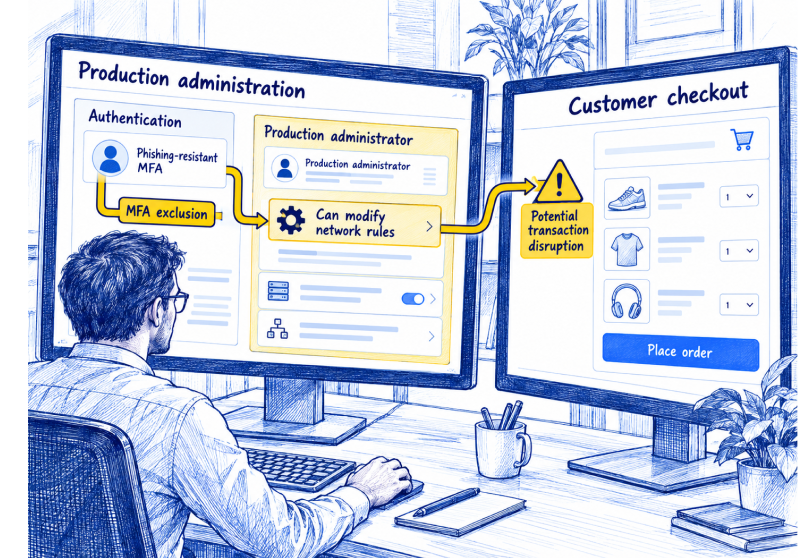
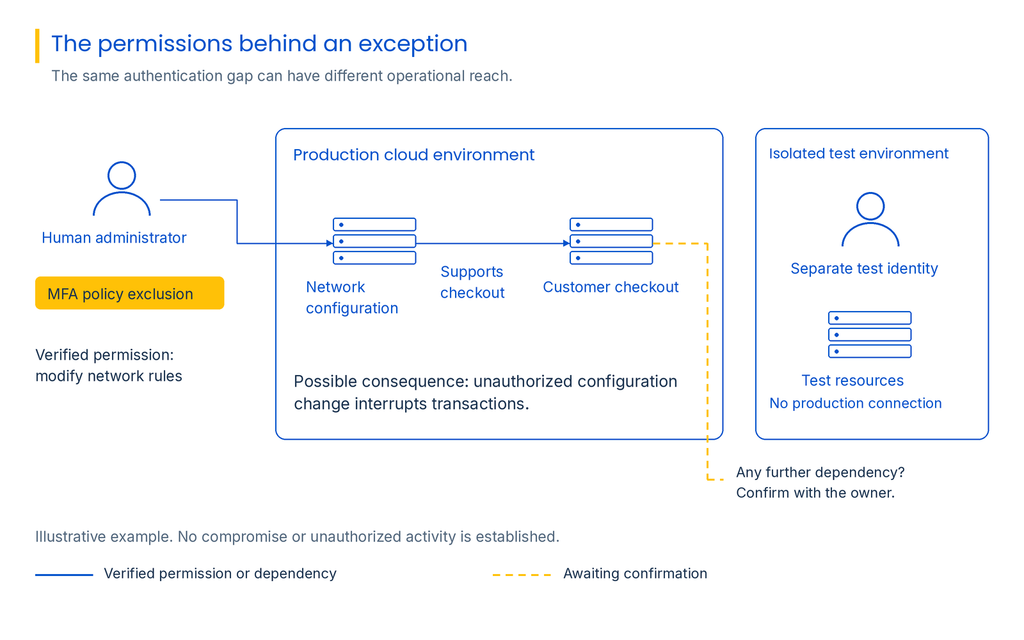
A useful path might connect an MFA exclusion to a production administrator role, then to permission to modify network rules supporting customer transactions. The possible consequence is unauthorized configuration change and interruption. Customer-data theft needs a separate, supported access path; do not infer it from an administrator label alone.
Mark what is observed, inferred or unknown. Role assignments may establish permission, while a business dependency still needs confirmation from an application owner. A missing dependency map should become a question to resolve, not an invented connection. Record evidence dates. Combining yesterday’s identity export with last quarter’s infrastructure inventory can produce a relationship that no longer exists. Where sources disagree, reconcile the identifiers and effective state before deciding the scope.
Check which safeguards interrupt the path
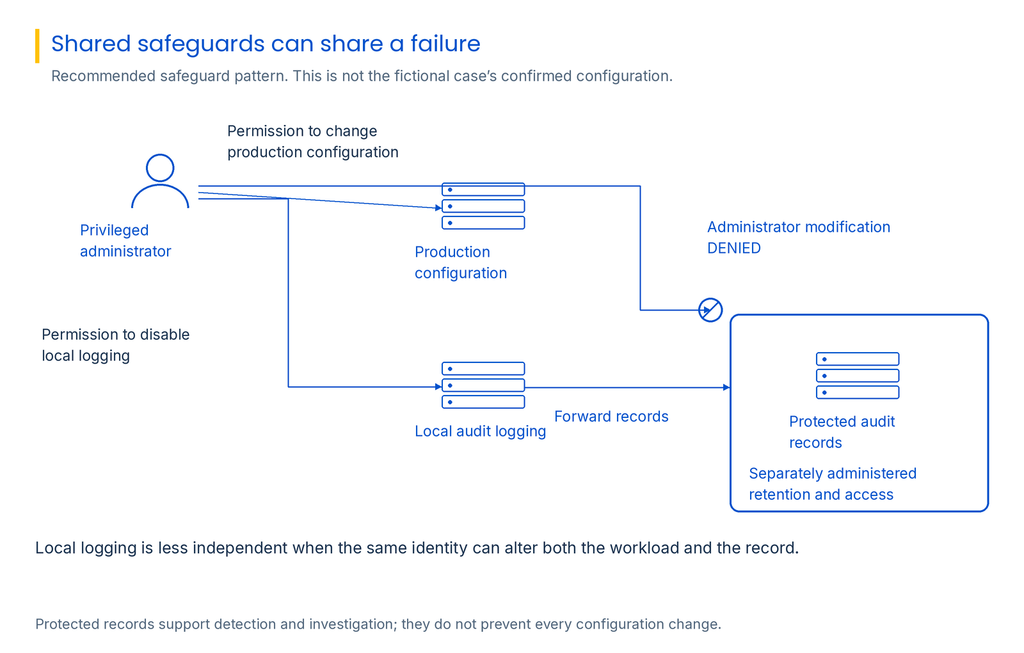
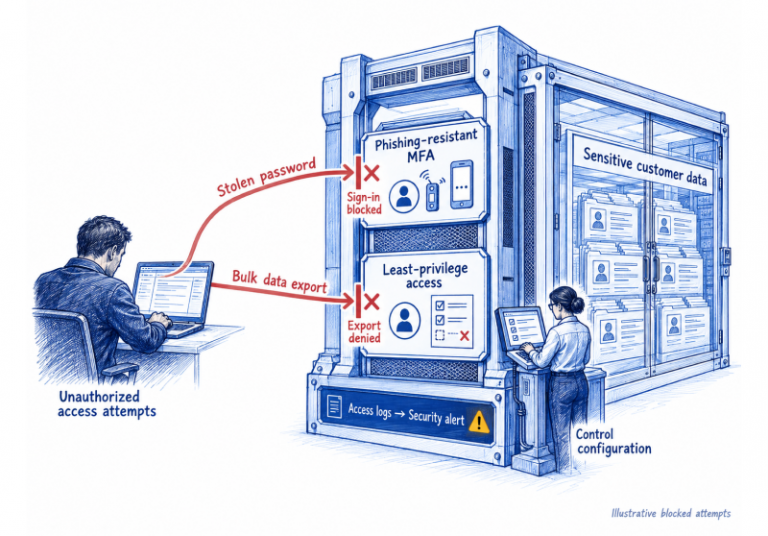
Assess prevention, detection and recovery against the specific consequence. A second approval requirement may constrain configuration changes. Activity logging may reveal misuse. A tested configuration rollback may shorten disruption. Each has a different purpose. Check independence as well. If the same administrator can alter production resources and disable the relevant audit logs, those logs provide weaker assurance than an independently protected record. Shared dependencies can cause several safeguards to fail together.
Implementation details matter during containment. Microsoft’s access-revocation guidance explains that application sessions can persist independently of identity-provider sessions. Blocking new sign-ins does not automatically establish that every existing application session has ended. Test the relevant application behavior and document any remaining access window.
NIST SP 800-61 Rev. 3, published in April 2025, integrates incident response recommendations throughout cybersecurity risk management. That supports considering detection, response and recovery alongside prevention; it does not prescribe the method described here.
Worked example of an MFA exception
The following fictional example demonstrates the method.
A cloud team finds a named human administrator excluded from its phishing-resistant MFA policy. Effective permissions allow the account to modify network rules in a production environment supporting customer checkout. The documented control covers human administrative access through the cloud console.
The review confirms the exclusion and role assignment from current configuration records. Application owners confirm the checkout dependency. The team identifies a plausible disruption scenario: misuse of the account could change network rules and interrupt transactions. Available evidence does not establish credential theft or unauthorized activity.
The team checks surrounding safeguards. Administrative changes are logged, but no approval step prevents this account from changing network rules. Recovery depends on restoring an approved configuration. The gap therefore receives priority over an otherwise similar exception on an isolated test environment.
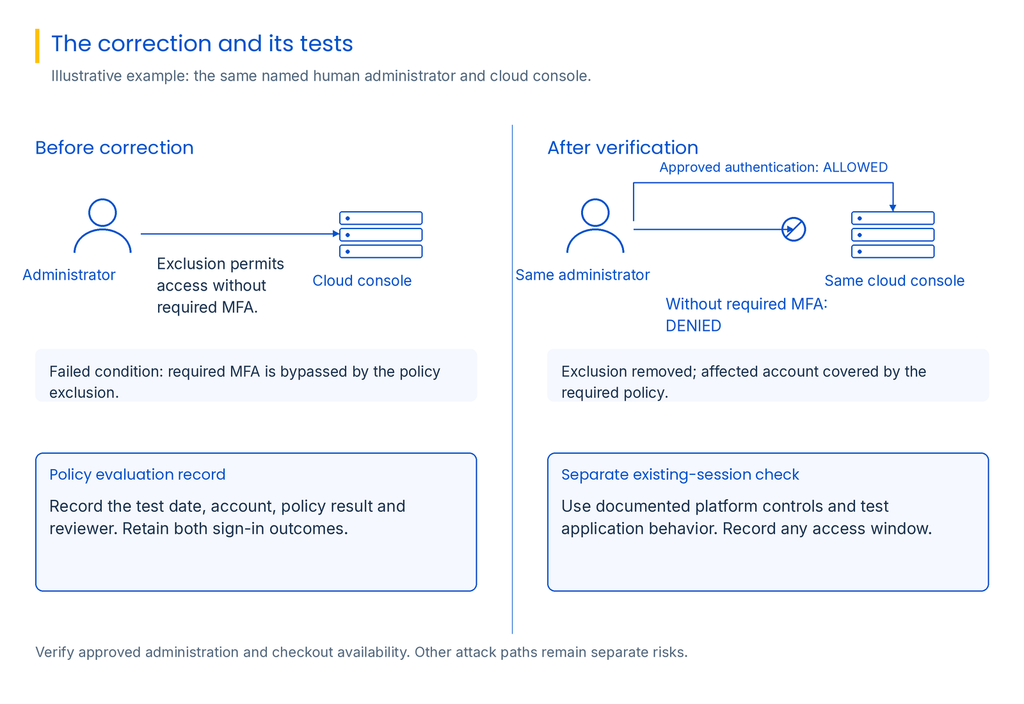
The cloud administrator removes the exclusion through an approved change. The user retains a named human account and completes the required authentication enrollment. Before changing access, the team confirms that a separately governed emergency access route remains usable.
Verification includes a controlled sign-in attempt without the required authentication, which is denied, followed by an authorized sign-in using the approved method. The reviewer checks policy evaluation records and confirms that the correction covers the affected account. Existing sessions are addressed using the platform’s documented controls and tested behavior.
The review also checks other human administrators subject to the same policy for equivalent exclusions. An independently monitored alert is tested for future policy changes. The finding closes with the failed condition corrected and the tested scope recorded. The application owner confirms that checkout remains available after the access change.
This operational check matters because correcting an authentication policy can inadvertently block legitimate administration during an outage. Credential theft and other attack paths remain separate risks; the MFA correction does not eliminate them.
Decide urgency without inventing precision
Compare findings using the consequence they enable, the access conditions required, affected business criticality and verified safeguards. Explain why one deserves attention first. A privileged production path may warrant immediate restriction while a limited test-system gap follows normal change scheduling.
Where dependencies are unknown, take a bounded protective action and investigate. Avoid assigning a precise loss estimate or probability solely from a control failure. Those outputs require a defined scenario and additional analysis.
A temporary compensating measure should interrupt the same path. Restricting the affected role may reduce exposure while authentication is corrected. An unrelated awareness campaign would not establish equivalent protection.
Use the result in GRC and compliance reviews
Connect the finding to the applicable requirement and control objective. Show the affected population, test procedure, result and corrective action. A sample failure should prompt a reasoned assessment of whether the problem extends beyond that sample.
The analysis can support an audit finding or risk decision, but it does not establish compliance with an entire framework. Assessors still consider the relevant criteria, scope and evidence period. An approved exception cannot waive a binding obligation.
Failure Mode and Effects Analysis, or FMEA, systematically examines possible failure modes and their effects. This article focuses on tracing a specific control condition through current enterprise relationships. Business impact analysis instead examines operational consequences over time and recovery needs. Keeping those purposes clear prevents duplicate assessments.
How SPOG supports control impact analysis
SPOG’s Continuous Control Monitoring connects defined controls with operational evidence to assess coverage and effectiveness and support remediation and revalidation. This helps teams examine a finding in its technical and business context.
Its Exposure Management solution connects evidence and workflows for prioritizing exposure. Governance, Risk and Compliance links requirements, controls and operational evidence for oversight. Coverage depends on connected systems and available information; reviewers must validate missing relationships and interpret consequences.
Close the path you actually tested
A useful conclusion names the failed protection, affected operation and corrective action, then states what verification demonstrated. Start with one consequential gap and trace it far enough to justify a decision. Close the finding when the original failure condition has been retested across the relevant scope, with remaining limitations recorded.
Frequently asked questions
A practical review of how a weakened control affects systems and operations, including the safeguards and corrective actions that limit its consequences.
A test checks a defined condition. Impact analysis follows the consequences of that result through permissions, dependencies and business operations.
No. A formal FMEA requires its own defined method. This approach does not prescribe a Risk Priority Number or severity calculation.
Use current configurations, effective permissions, operational logs and confirmed dependency records. Record scope, observation dates and unresolved inconsistencies.
State the uncertainty, seek confirmation from technical and business owners, and consider temporary restrictions where the possible consequence warrants action.
They may support an authorized decision if they address the same exposure and are tested. Applicable obligations still need to be met.
Trace each material dependency and identify shared safeguards. Do not assume that separate applications have independent protection or recovery arrangements.
After relevant permission, configuration or dependency changes, new failures or incidents. Set routine review intervals according to the control and exposure.
No. Verification establishes the tested protection within its scope. Other failure modes, attack routes and unknown dependencies can remain.
The original failure condition, affected scope, action taken, dated retest results and remaining limitations, with responsibility for follow-up where needed.
With 8.5+ years in B2B SaaS, I’ve led demand generation and GTM initiatives across global markets (US, UK, Europe, Africa), helping companies move from fragmented marketing efforts to structured, revenue-focused growth engines.