Sub-Processor Risk Management: Keep Privacy Controls Across Data Chains
A direct vendor is only the first link in a personal-data chain. Build a program that keeps purpose, location, authorization, safeguards, and evidence connected as downstream processors change.
Sub-processor risk management is the work of understanding and governing every downstream organization that processes personal data for a vendor acting on your behalf. It matters because a contract, privacy assessment, or vendor list can be accurate on signing day and incomplete after a product adds an analytics platform, a model provider, a hosting region, or a support tool. The practical question is not simply “Which vendors do we use?” It is “Which parties touch this data, for what purpose, under whose authority, and what changes when the chain moves?”
For privacy and GRC leaders, that answer has to hold across jurisdictions and operational systems. SPOG supports frameworks including the General Data Protection Regulation (GDPR), India’s Digital Personal Data Protection Act (DPDP), and Saudi Arabia’s Personal Data Protection Law (PDPL). Framework alignment can organize requirements and control evidence; it does not replace jurisdiction-specific legal interpretation, contractual review, or a decision about whether a particular processing arrangement is permitted.
Why the direct-vendor list is not enough
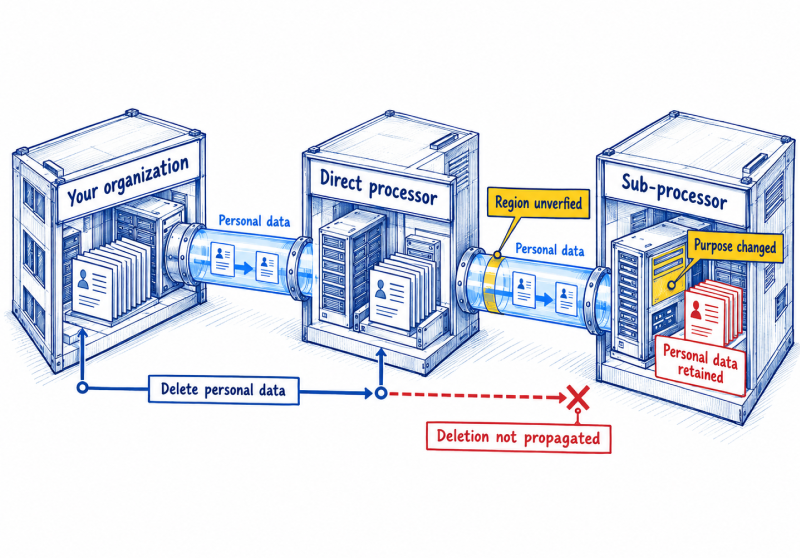
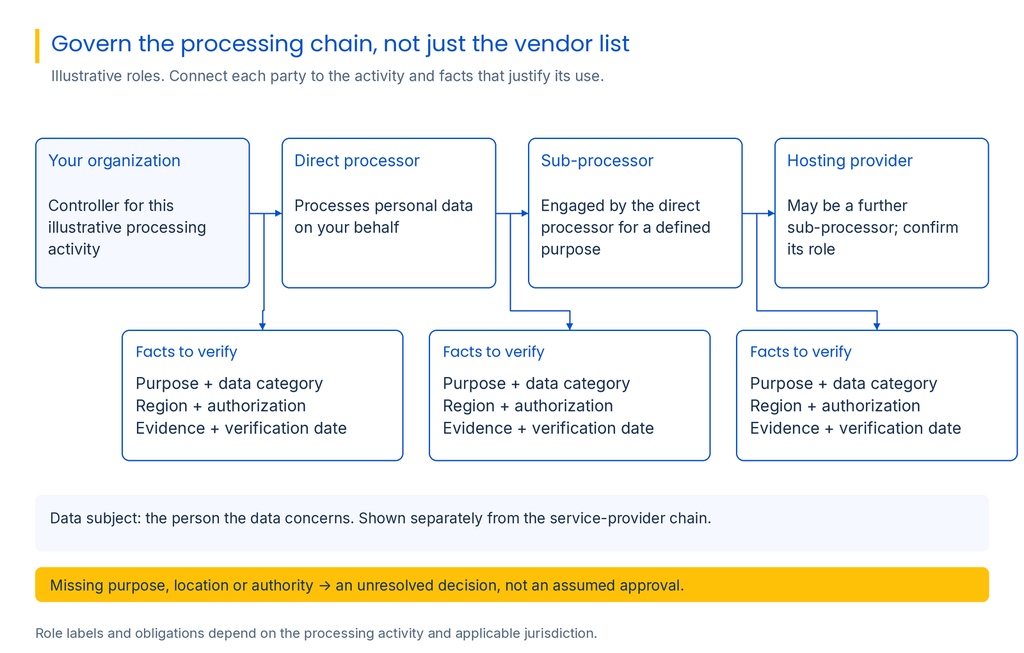
A supplier register answers a procurement question; a sub-processor record must answer a data question. One cloud vendor may host data, another party may handle support, and a fourth may provide telemetry. They can touch different data, in different regions, under different retention rules—and may not appear in your purchasing system because your supplier selected them.
This gap matters when a customer asks who handles its data, a person requests access or deletion, or an incident needs scoping. A name-only list cannot explain the party’s role, data categories, purpose, location, or contract status.
Track current requirements by effective date
The regulatory context is shifting. India’s DPDP Act commencement notice schedules core provisions for 18 months after publication, in May 2027. Track requirements by effective date, not just framework name.
Build a processing-chain record, not another vendor spreadsheet
Begin with processing activities and the systems handling personal data. Record each activity’s purpose, data categories, data subjects, system, retention expectations, and storage or access regions. Attach the direct processor and known downstream parties to that activity so their roles stay connected to real use.
Capture only details the team can maintain: legal entity and contact; role and purpose; data categories; location and transfer route; contract and authorization status; relied-upon safeguards; change-notice route; evidence owner; verification date; and review trigger. Record unknowns explicitly. An unverified location is a decision item, not a blank cell.
Gather facts from the teams closest to the flow. Privacy and legal interpret purpose and authority; engineering identifies data paths and regions; procurement locates contracts and notices; security reviews safeguards. Assign an owner to resolve conflicts. Combining inconsistent records in a dashboard will not reconcile them.
Prioritize by processing consequence
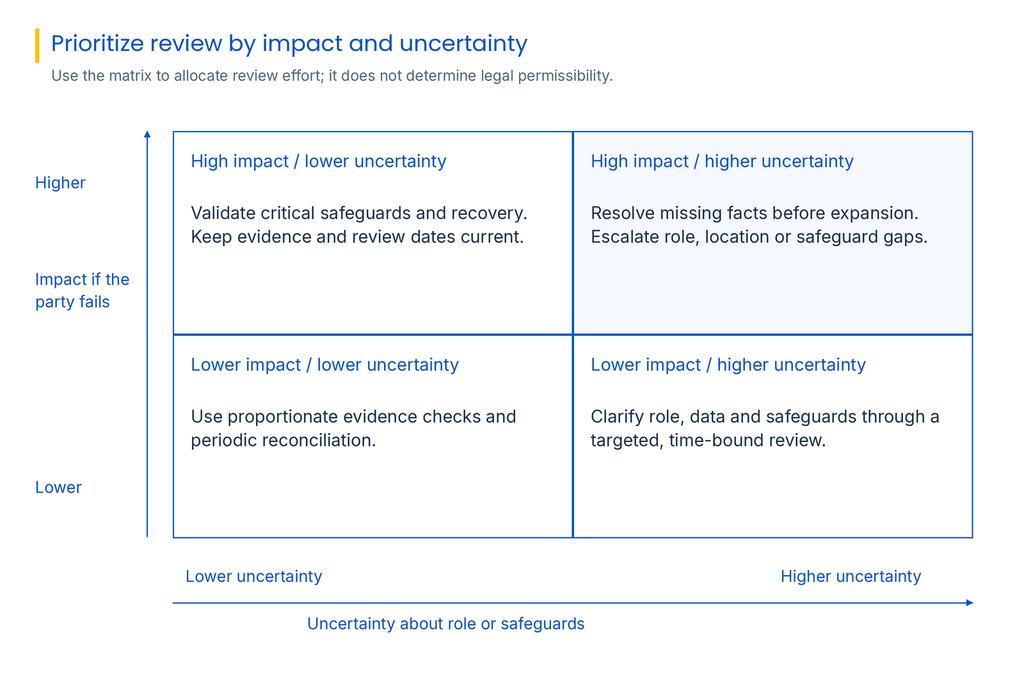
Prioritize by the consequence of misuse, exposure, loss, or inability to return data. Consider sensitivity, identifiability, volume, privilege, business criticality, cross-border handling, and replaceability. A low-volume processor with production credentials may matter more than a large party receiving de-identified metrics.
This guides review effort; it is not a legal exemption. Lower tiers may need less evidence or a different cadence, but statutory and contract duties still apply. Raise a tier when data sensitivity, purpose, privilege, location, incident status, or control evidence changes.
Turn authorization and contracts into a change process
A data processing agreement works as a control only when its terms match the actual chain. Check whether downstream use is authorized, how planned changes are communicated, whether there is an opportunity to object, and which privacy and security duties flow down. Confirm that the terms cover the processing activity, not just a generic promise to follow applicable law.
Make the change path usable. A new party, purpose, data category, or region should trigger review before production when advance notice or authorization is required. Give reviewers the affected activity, rationale, data, location, safeguards, contract terms, customer commitments, and deadline. Record the approval, objection, mitigation, or alternative with an owner.
The level of review can vary. A low-impact telemetry change may need a targeted check; a new party accessing identifiable health or employee data may need legal, privacy, security, and customer review. Record why the selected scrutiny fits the change.
Verify the safeguards that matter to the data flow
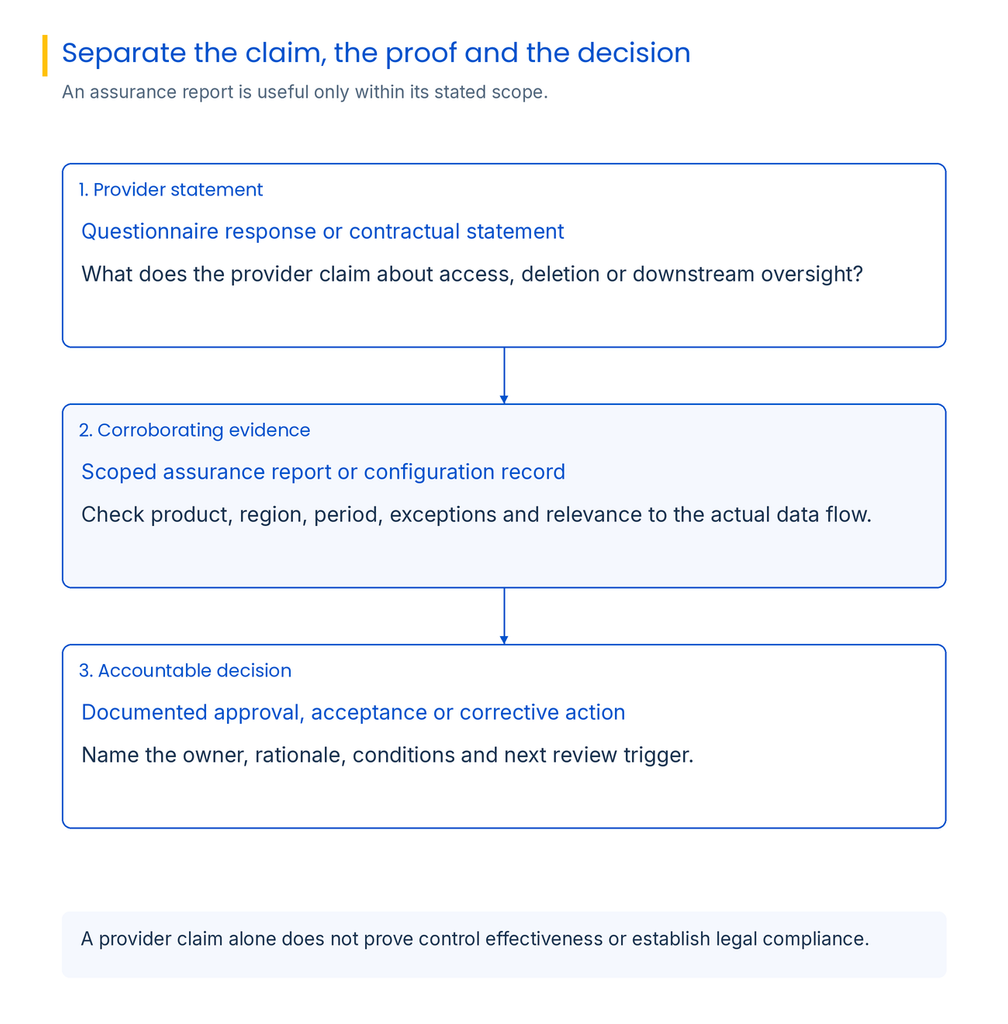
Collect evidence for the actual exposure. A broad assurance report may not cover the product, region, or period you rely on. Check whether controls address access, encryption, tenant separation, incident escalation, deletion, downstream oversight, and relevant transfer conditions. Link each artifact to a requirement and note scope limits, exceptions, and dates.
Separate what the provider claims, what evidence supports it, and what your organization accepts. A report may exclude systems in the chain; an automated status check may not prove that a control works for the specific data flow. Use technical evidence where available, contract evidence for obligations, and accountable review for judgment.
SPOG’s GRC solution can help teams map framework requirements to controls, ownership, operational evidence, and remediation. Its Continuous Control Monitoring solution connects defined controls with current evidence from connected systems to assess coverage and effectiveness. For sub-processor oversight, those capabilities are most useful when the organization has mapped the relevant parties and data flows, and when connected evidence actually represents the controls being relied on.
Keep the record alive as systems and rules change
Set review triggers around real change: a new downstream notice or feature, incident, transfer route, retention practice, acquisition, expired report, or customer requirement. Periodic review still catches silent drift and confirms high-impact relationships.
For India, distinguish preparation from provisions not yet commenced. In California, check which amended requirements apply and their dates. For GDPR and Saudi Arabia’s PDPL, assess the activity against current jurisdiction-specific requirements. One global addendum may not address different transfer, notice, and retention rules.
Reconcile the chain at onboarding, before material changes, after incidents, and on a risk-based schedule. Track verified high-impact chains, overdue decisions, unresolved location or authorization gaps, expired evidence, and time to identify affected data. These are decision signals, not compliance scores.
A short scenario: a new analytics path
Illustrative scenario: a product team adds behavioral analytics. The provider names a new downstream processor in another region. Its general assurance report is current, but the review still needs to ask whether the feature collects identifiers, whether the party is covered by authorization and contract, whether the location fits the transfer plan, and whether deletion requests can reach the new path.
The team could approve with a documented basis, limit the data, add terms, delay launch, or choose another design. Decide before data flows and retain the reason.
Govern the chain you actually use
Effective sub-processor risk management keeps each processing activity connected to its parties, purpose, data, region, authority, safeguards, and evidence. Review material changes, distinguish legal duties from internal prioritization, and route open gaps to decision-makers.
SPOG supports DPDP, GDPR, and PDPL frameworks. Its GRC solution and Continuous Control Monitoring solution can support requirement mapping, evidence context, control assessment, and remediation. Results depend on accurate processing maps, configured integrations, and human review of legal and business decisions.
Frequently asked questions
A sub-processor is an organization engaged by a processor to handle personal data on behalf of a controller as part of the processor’s work. Legal definitions and role labels vary by framework.
Third-party risk covers a wider set of supplier exposures. Sub-processor risk focuses on the downstream parties that process personal data, the purposes and locations involved, and the privacy obligations that must follow the data.
No. Scale evidence depth to data sensitivity, access, impact, uncertainty, and applicable requirements. A risk tier can guide review effort, but it cannot waive a legal or contract requirement.
Update it when a relevant change occurs and reconcile it periodically. High-impact processing usually warrants more frequent checks than low-impact processing, based on contract terms and risk.
At minimum, link each party to the processing purpose, data categories, location, role, contract and authorization status, relevant safeguards, evidence owner, and last verification date.
Only to the extent the report’s scope says so. Check which entities, products, systems, locations, and periods are covered, and record any reliance gaps.
Route the notice to the owner for that processing activity, check required authorization and objection windows, assess data and location impacts, and document the decision before the change takes effect where required.
Not all provisions began at once. India’s November 2025 commencement notification sets staged dates; the core provisions listed for 18 months after publication are scheduled for May 2027. Confirm the date and provision relevant to your processing.
No. Framework support can help organize requirements, controls, evidence, ownership, and remediation. Legal applicability, processing decisions, and sufficiency of evidence remain organization-specific.
Choose one high-impact processing activity, trace its data path end to end, identify missing facts, and assign an owner to close the gaps. Use that pilot to define fields and triggers before expanding the inventory.
Technology writer and content strategist with 5+ years of experience, including work for a US-based B2B SaaS client and a cybersecurity solution. I create cybersecurity and GRC content, product documentation, and user guides that help technical teams and business leaders understand security capabilities and workflows. Currently working on Confluence documentations on vulnerability management, ITSM, incident management, and continuous control monitoring, alongside SEO and AEO content, and technology partner database development.