ISO 27001 Change Management: From Approval to Verified Outcome
An approved change can still leave a security control in the wrong state. Connect ISO 27001 change management with post-change validation to verify control outcomes, resolve gaps and retain evidence for closure decisions.
Consider a cloud network rule approved to support a new service. The deployment pipeline reports success, and the change ticket is closed. A later exposure check finds that the rule also made an administrative endpoint reachable from the internet.
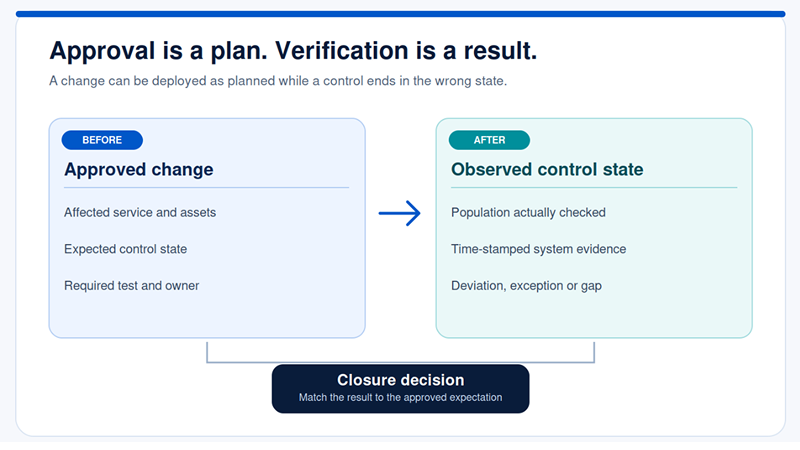
The approval record explains why the work was authorized. The deployment log confirms that it ran. Neither establishes that the resulting exposure was acceptable.
Effective ISO 27001 change management connects three things: the intended change, the expected control state, and evidence of the actual outcome. That connection helps security and GRC teams decide whether to close the change, correct a failure, or seek authorized acceptance of the remaining risk.
What ISO 27001 requires, and where the scopes differ
ISO/IEC 27001:2022 is the current edition, with its 2024 amendment. There is no separate ISO/IEC 27001:2026 edition.
Two parts of the standard matter here:
Annex A control 8.32, Change management: Addresses changes to information processing facilities and information systems. The applicability of reference control 8.32 is considered through risk treatment and recorded in the Statement of Applicability (SoA).
Clause 6.3, Planning of changes: Requires changes to the information security management system (ISMS) itself to be carried out in a planned manner.
A production identity-platform migration and a change to ISMS scope may need related planning, but they have different purposes and approval responsibilities.
ISO 27001 does not prescribe a particular ticketing tool or change advisory board. The process should reflect the organization’s risks, applicable requirements, and selected controls. The approach below is a practical method for strengthening assurance, rather than a universal ISO checklist.
Define the expected outcome before approval
For each material change, define the security conditions that must hold after implementation and the evidence that will demonstrate them. Record the following:
Scope: Affected services, assets, accounts, data flows, and dependencies.
Expected state: The access, configuration, logging, availability, or recovery conditions the change must preserve or establish.
Baseline: Record the relevant control state before implementation, including known weaknesses. Compare it with the resulting state to determine whether the change introduced, worsened, or revealed a security issue.
Validation method: Checks that demonstrate the expected state, including negative tests where relevant. For an access change, test whether an unauthorized route is blocked as well as whether the approved route works.
Evidence and timing: The technical sources, population to be checked, and validation windows.
Responsibilities and authority: Who implements, who validates, and who can accept residual risk. Higher-risk changes may warrant independent review.
Failure response: Conditions that require remediation, containment, rollback, or escalation, with a feasible fallback or contingency plan.
Keep the effort proportionate. A preapproved routine change can use standardized tests and automated records. An internet-facing rule, privileged access migration, or critical recovery change warrants closer scrutiny.
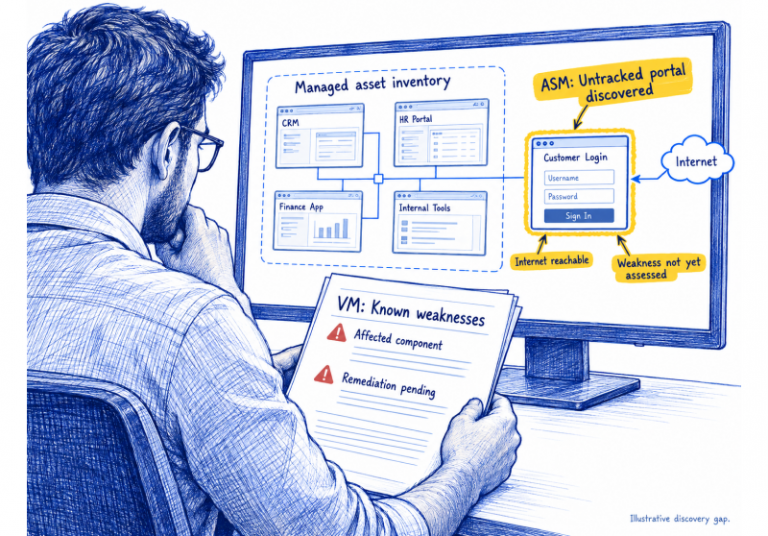
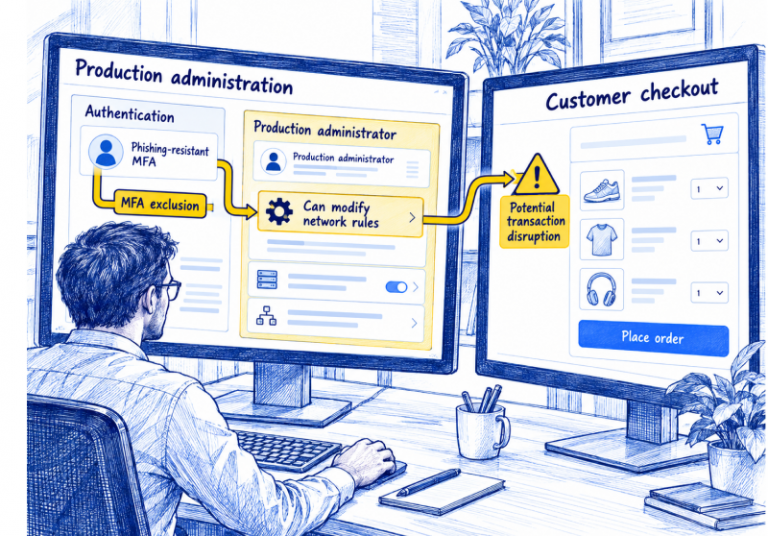
Look beyond the component named in the ticket. A role change can alter inherited permissions. A deployment can disrupt log collection. A backup configuration update can succeed while recovery remains untested.
Connect the approval to the observed result
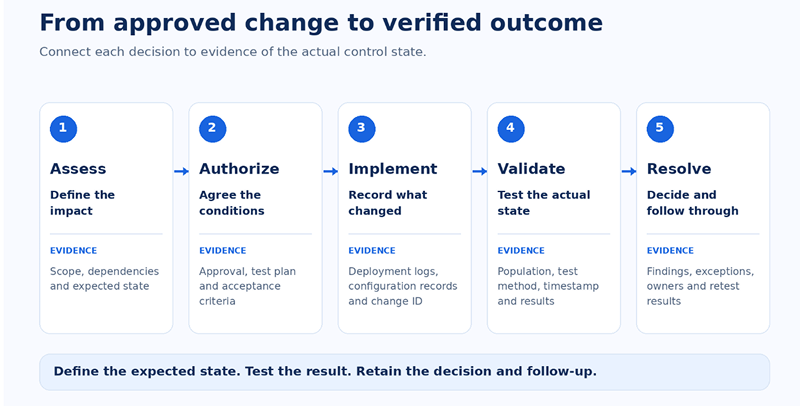
A defensible record allows a reviewer to follow the change through five stages: assessment, authorization, implementation, validation, and resolution. Each stage should link the decision to its supporting evidence.
Use the change identifier to connect the approved request, implementation record, validation results and any deferred checks or follow-up findings.
Establish the full affected population before choosing the validation method. Use automated population checks where feasible. Where deeper testing uses sampling, document its rationale, exclusions, limitations, and treatment of critical assets. A passing sample should not be presented as proof that every asset passed.
Timing matters too. Immediate testing can confirm that a configuration took effect. A later check may be needed after policy propagation, synchronization, scheduled jobs, or asset creation. Assign that check to an owner and due date, and record any conditional acceptance before final validation.
Example: validating a privileged access change
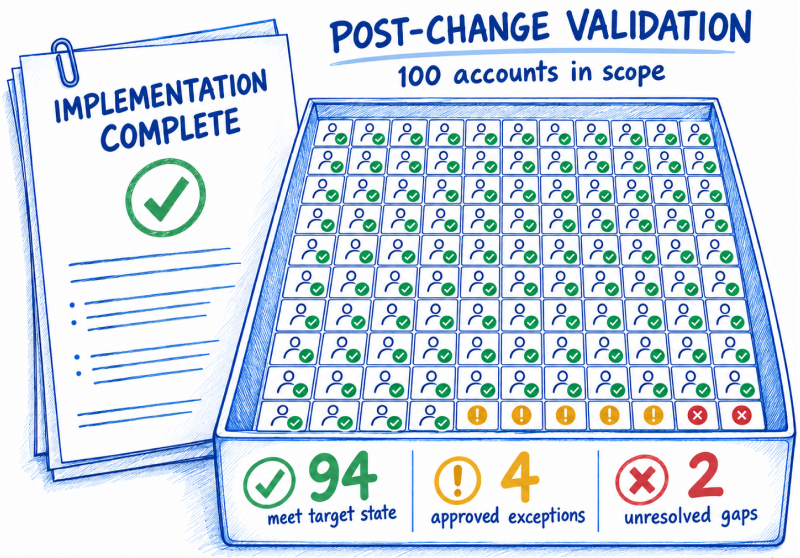
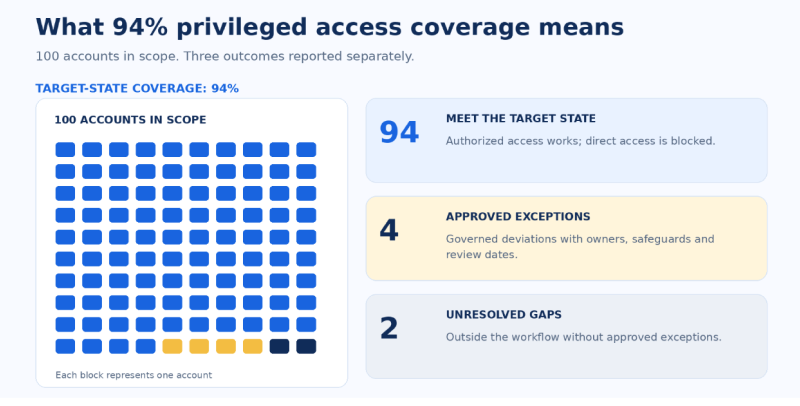
An operations team plans to move administrator accounts for a critical application into a managed privileged access workflow. It establishes 100 accounts in scope and defines two conditions: authorized access must work through the approved route, and direct access outside that route must be blocked unless explicitly accepted.
After deployment, validation finds:
94 accounts meet the defined access conditions.
Four service accounts have approved exceptions, named owners, compensating measures, and review dates.
Two user accounts remain outside the workflow without approved exceptions.
Target-state coverage is 94% across the 100-account population, with four approved exceptions and two unresolved gaps. Counting the exceptions as passing would obscure the technical state.
Coverage, exception governance, and conformity are separate assessments. An approved deviation does not automatically establish an ISO 27001 nonconformity, but approval alone does not prove that applicable requirements are met. Assess the residual risk, compensating controls, applicable obligations, and authority behind the acceptance decision.
The two unresolved accounts require investigation. Identify their privileges, exposure, and business dependencies, then determine whether to restrict access immediately or remediate within an authorized timeframe. Retest after correction and retain the result.
The four exceptions also remain visible. Review them when they expire, when their conditions change, or when the assumptions supporting risk acceptance no longer hold.
All figures are illustrative. The useful pattern is the same: population, expected state, observed state, deviations, risk decision, ownership, and revalidation.
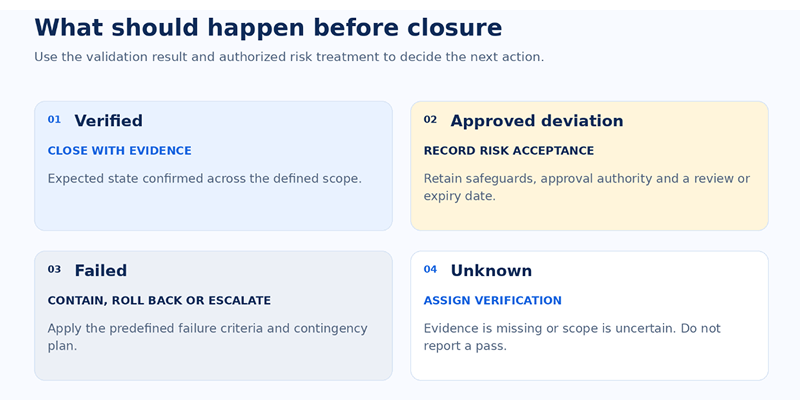
Decide what should block closure
Define failure triggers and closure conditions before implementation. An unauthorized privileged access path to a critical system should block a verified closure outcome until it is corrected and retested. A deviation may permit qualified closure only when applicable requirements allow it and an authorized decision records the residual risk, compensating measures, owner, and review date.
Missing, stale, or incomplete evidence should produce an unknown or inconclusive result. Assign an owner and a deadline to obtain reliable evidence. Until then, do not report the affected control as verified.
Unexpected internet exposure, an unauthorized privileged access path, or loss of critical logging may require containment before routine remediation. Rollback should be considered alongside service impact and the risk of the fallback state.
Separate three decisions: implementation is complete, validation has passed, and remaining risk has been accepted. The person who deployed the change should not automatically be assumed to hold all three authorities.
If the procedure allows the change ticket to close with a linked finding still open, preserve the qualified outcome, owner, due date, and retest requirement. Ticket closure must not make an unresolved control failure disappear from reporting.
For emergency changes, use the defined emergency authorization route. Retain the implementation record, validate the outcome, and complete retrospective review within the organization’s required timeframe. Urgency changes the sequence of work; it does not establish that the resulting state is acceptable.
What to retain in a post-change validation record
Retain a record that links the change, its baseline and acceptance criteria to the observed result. These fields can sit in the ITSM record or a linked assurance record.
Field
What to record
Change reference
Identifier linked to implementation and evidence records
Scope and population
Affected services, assets or accounts, population source, and exclusions
Expected state
Relevant pre-change baseline and explicit acceptance criteria
Test and timing
Method, evidence source, timestamp, and any deferred checks
Observed result
Passed, failed, excepted, and unknown results reported separately
Risk decision
Impact, compensating measures, authorized acceptance or escalation
Accountability
Implementer, validator, remediation owner, and risk acceptance authority
Follow-up
Due dates, exception expiry, retest result, and final disposition
Preserve the evidence behind the decision, including relevant query scope or test configuration. Shared change, account, or asset identifiers make records easier to reconcile across ITSM, deployment, cloud, identity, and security systems.
A current screenshot may show today’s state. It may not establish what was tested at closure, which population was included, or what happened afterward.
Measure whether the process detects security failures
Measure whether changes that require security validation receive it, whether failures are detected and whether restoration is verified. State the relevant change population and measurement window alongside each rate. Track the following measures:
Unrecorded changes: Material changes observed without a matching authorized record.
Validation coverage: Changes requiring checks that received them within the defined window, with exclusions and deferred checks visible.
Post-change failures: Failed access, exposure, configuration, logging, or recovery checks linked to changes.
Overdue exceptions: Deviations past their review or expiry date without renewed authorization.
Time to verified restoration: Elapsed time from a failed check to a passing retest, segmented by criticality.
Review the underlying cases alongside the percentages. A 98% validation rate is weak assurance if the remaining 2% includes the most sensitive systems. Repeated failures should prompt review of the change method, test design, and approval criteria.
How SPOG.AI supports change assurance
SPOG.AI’s continuous control monitoring capabilities connect control evidence with affected assets, risk context, ownership, exceptions and remediation. For change assurance, this supports assessment of the resulting control state and visibility into whether remediation restored it.
Its governance, risk and compliance capabilities connect requirements, controls, evidence and accountability. Available assessment coverage depends on connected systems, evidence sources and configured checks. Results can be linked to change records where supported by the available integrations and workflows.
Approval, closure authority and residual-risk acceptance remain governed decisions within the organization’s process.
Explore continuous control monitoring with SPOG.AI.
Close on a defensible decision
A closed change should leave a clear answer: what changed, whether the expected control state was achieved, and who owns any remaining risk.
Set acceptance criteria before implementation, validate the resulting state, and retain the evidence behind the closure decision. Any remaining deviation or uncertainty should have an explicit treatment decision and accountable owner.
Frequently asked questions
It addresses changes that could affect information security, including systems, configurations, access, and supporting facilities. The process should reflect risk, applicable requirements, and selected controls.
Control 8.32 concerns changes to information processing facilities and systems. Clause 6.3 concerns planned changes to the ISMS itself. A project can affect both scopes.
Retain the affected population, acceptance criteria, test method, evidence source, timestamp, results, and decisions on deviations. Link them to the change and any follow-up records.
Report deviations separately from assets or accounts that meet the target state. Assess their acceptability against applicable requirements, residual risk, compensating measures, and authorized approval.
Apply the predefined failure criteria. Depending on impact, contain, roll back, escalate, or assign remediation. Record the decision and retest before reporting the control as restored.
Use the emergency authorization procedure, retain implementation evidence, validate affected controls, and complete retrospective review and follow-up within the required timeframe.
Assign validation to someone with the competence and authority to assess the expected security outcome. For higher-risk changes, consider a reviewer independent of implementation. Define who performs the checks, reviews the evidence and accepts any remaining risk.
Repeat validation when the initial checks cannot establish the final state, such as after policy propagation, synchronization or scheduled jobs. Assign deferred checks to an owner and deadline. Reassesses when later changes invalidate the assumptions behind the original result.
Consider rollback when predefined failure triggers are met and the fallback state offers an acceptable security and operational outcome. Assess service impact and whether rollback would restore the required protection. Where rollback is unsuitable, record the containment or remediation decision and validate its outcome.
If the organization’s procedure permits it, a ticket may close with a qualified outcome and a linked finding. Keep the unresolved issue, accountable owner, due date, risk decision and retest requirement visible. Ticket closure should not make a failed or unknown control result appear verified.
With 8.5+ years in B2B SaaS, I’ve led demand generation and GTM initiatives across global markets (US, UK, Europe, Africa), helping companies move from fragmented marketing efforts to structured, revenue-focused growth engines.