#compliance
Compliance Monitoring in 2026: Know What Is Working
Your access policy says former employees lose production access promptly. The tickets are closed. But an account review...
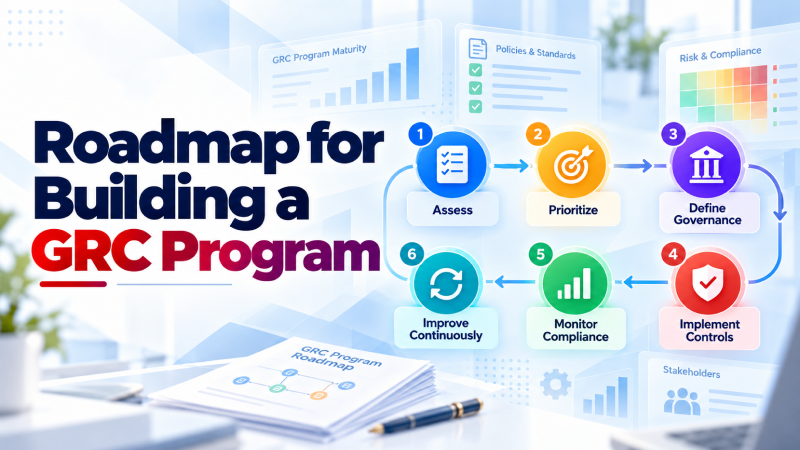
A governance, risk, and compliance (GRC) program becomes useful when requirements lead to controls, controls have owners, and the organization can show how those controls operated. Many teams have policies and a list of obligations but cannot readily connect them to the systems, evidence, and decisions needed to manage risk.
This 90-day GRC implementation roadmap gives security and compliance leaders a manageable starting sequence. It aims to establish an operating routine over one quarter, not to promise certification or complete every control in 90 days. The scope, review frequency, and evidence needed will depend on the business, its obligations, and the maturity of its existing processes.
Start with a specific reason for building the program. It may be a regulatory requirement, a customer assurance request, a board concern, or a gap exposed by an incident. Record the decision the program needs to support and the date by which it must be supported.
Next, define the boundary. Which business services, legal entities, applications, data, suppliers, and infrastructure are in scope? Who can approve an exception? Which requirements apply? If an audit or certification is involved, confirm its actual scope and evidence period with the appropriate adviser or assessor before setting a timetable.
Choose a primary set of requirements for the first implementation cycle, then identify controls that can support related obligations as well. You do not need to pretend other obligations disappear while you focus on the work. The point is to give the team a clear first deliverable and avoid mapping every requirement before any control is tested.
A successful first quarter should leave you with five tangible outputs: a documented scope, a control and owner register, identified evidence sources, a process for handling gaps and exceptions, and a review of whether the priority controls actually operated.
Weeks 1 and 2: Map the environment. List the important services in scope and the systems, identities, vendors, and teams on which they depend. Bring together existing policies, control descriptions, risk records, audit findings, and relevant tickets. Note what is known, what needs confirmation, and where different systems disagree about ownership or scope.
Select a small number of priority control areas for the first cycle. Identity and access, change management, logging, and recovery are often useful places to investigate, but the selection should follow the actual requirements and risks of your organization. For each area, define the expected behavior in language the operating team can test.
Weeks 3 and 4: Assign decisions and evidence. Name the person responsible for operating each priority control, the source of evidence, the reviewer, and the person authorized to decide what happens when the control falls short. Those roles can sit in different teams. The GRC lead coordinates the program but should not become the default owner of every operational control.
Create a control record with the requirement it supports, scope, owner, expected result, evidence source, review method, and current status. Test this record on a few controls. If the team cannot identify an owner or find credible evidence, flag the gap now. Do not mark a control effective because a policy describes it.
End-of-month check: The team should be able to trace at least its highest-priority requirements to named controls and owners. It should also have a list of unresolved scope and evidence questions, with someone assigned to answer each one.
Weeks 5 and 6: Verify what runs. Ask control owners to demonstrate a recent instance of each priority control. For example, a change-management control might require a sample of production changes showing the approval, implementation record, and any exception. Compare the evidence with the expected behavior and the defined scope. Record whether the control operated, where it did not, and whether the available evidence is sufficient to reach a conclusion.
Define an evidence standard before automating collection. Document the source, period covered, time collected, relevant system, reviewer, and any limitation. If one control supports multiple requirements, retain a clear mapping so the same verified record can be reused appropriately without losing its context.
Weeks 7 and 8: Build the response loop. Set a routine for reviewing failed checks, missing evidence, and exceptions. An issue record should identify the affected control and service, a named owner, the decision required, an agreed date, and the evidence needed to confirm the outcome. Leadership should approve risk acceptance where its authority is required; a technical task being closed should not silently stand in for that decision.
Connect a small number of high-value systems where this reduces repeated manual collection. Identity, cloud, security, and IT workflows can provide current operational evidence. Check the accuracy and coverage of each connection before relying on it for reporting. If a source omits a subsidiary or application, a polished dashboard can still give an incomplete answer.
End-of-month check: The priority controls have a repeatable review method, and material findings have an owner and a recorded next decision. The team knows which evidence is current, which is missing, and which requires human review.
Weeks 9 and 10: Challenge the results. Select samples across the in-scope services and test the entire path from requirement to decision. Include recently changed systems and controls with earlier gaps. Ask whether the control covered the intended assets, whether the evidence proves its operation for the relevant period, and whether exceptions were approved and revisited.
Bring in someone independent of the control’s day-to-day operation to review the sample where possible. The exercise may reveal an incomplete asset list, evidence that covers only part of the period, or a finding that was closed without checking the result. Record these as distinct issues so the right team can address each cause.
Weeks 11 to 13: Set the ongoing cadence. Review open gaps and exceptions with owners and decision makers. Publish a concise view of control coverage, evidence status, significant risks, and overdue actions. Agree on how the program will respond when a new service, supplier, or regulation changes its scope. Document what must be reviewed monthly, quarterly, or at another interval appropriate to the control and obligation.
If an external assessment is planned, organize the evidence and confirm the assessor’s requests and period of review. A 90-day implementation can establish credible control operations and identify missing work, but it cannot create a historical evidence record that did not exist.
End-of-quarter check: Leadership can see where controls are working, where assurance is incomplete, who owns the decisions, and what the next cycle will improve.
There is no universal list of ten controls that makes every organization audit ready. Select the first set using three questions: Does the requirement apply? What could happen if the control fails? Can the organization currently observe whether it works?
Access management, privileged access, change approval, logging, vulnerability management, backup and recovery, incident response, and supplier oversight are common candidates. Their exact design, frequency, evidence, and deadlines must come from the applicable framework, contracts, risk assessment, and system environment. For example, the right log retention period is a scoped requirement and decision, not a single figure that applies to every GRC program.
Automation is most useful once a control’s scope, evidence standard, and owner are clear. It can collect relevant records, identify changes, show missing evidence, and route findings. It should also show where a connection has stopped supplying data or does not cover part of the environment.
The judgment remains with people. A failed check may affect a test system or a critical service. A risk owner may accept a time-limited exception, while an operating team works on a fix. The program needs both the system signal and the business decision, connected by a traceable record.
SPOG.AI’s continuous compliance approach connects requirements, controls, evidence, ownership, and exceptions across existing systems. Its continuous control monitoring capabilities help teams assess the state of controls as operational evidence changes. This can support the later phases of a GRC implementation by making gaps and accountable follow-up visible beyond an audit cycle.
Treat the quarter as the first operating cycle. Extend coverage to other services and requirements using what the team learned from actual control evidence. Review material changes, revisit accepted risks, and check that completed actions improved the control. A GRC program is established when this work has owners and a reliable rhythm, rather than depending on a one-time project team.
Your access policy says former employees lose production access promptly. The tickets are closed. But an account review...
A SaaS company can have strong security practices and still struggle to answer a customer’s questionnaire. The team...

The backup dashboard is green. A customer asks how quickly a critical service can be restored after an...