GRC
Sub-Processor Risk Management: Keep Privacy Controls Across Data Chains
A direct vendor is only the first link in a personal-data chain. Build a program that keeps purpose,...
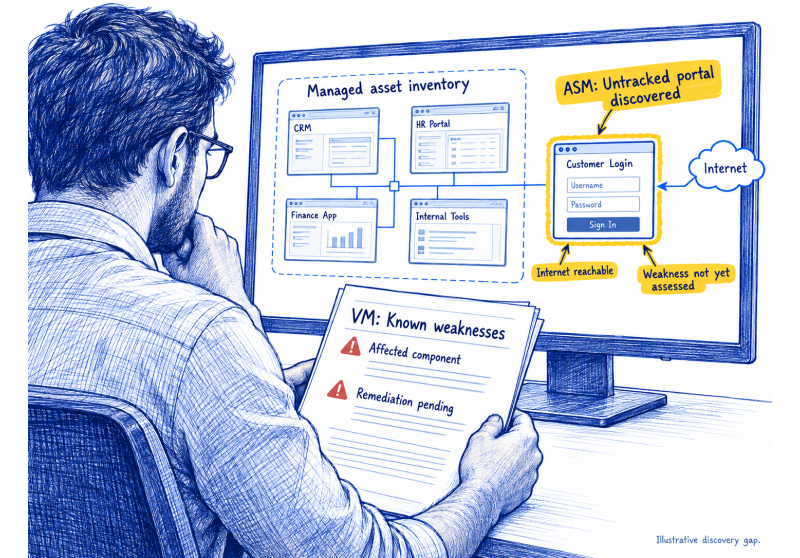
The comparison, vulnerability management vs attack surface management, starts with two different questions. The first asks which known weaknesses affect technology and how to treat them. The second asks what assets and paths an attacker could reach, including those missing from managed inventories.
The challenge is the handoff. A scanner may identify a vulnerable component without reliable reachability or ownership. External discovery may find an exposed asset but cannot confirm a specific weakness. Kept in separate queues, these findings leave teams unsure what to fix first.
Vulnerability management identifies, validates, prioritizes, and treats weaknesses in systems, software, and cloud configurations using scans, inventories, advisories, and tests.
Its core unit is a finding tied to an affected asset or component. The output should establish whether the asset is affected, whether the vulnerable feature is present, what treatment is possible, who can perform it, and how the outcome will be checked.
CVSS describes technical severity under defined assumptions. It is useful evidence, but it is not a complete enterprise priority. A high-severity weakness on an unreachable, isolated test system may require a different response from a remotely exploitable weakness on a public-facing production component. Exploitation evidence, exposure, asset importance, available safeguards, and change risk all influence the decision.
Vulnerability management owns the technical depth: confirming the weakness, selecting treatment, planning the change, and checking whether the condition was removed or mitigated. Scanner coverage and asset records limit what it can see.
Attack surface management (ASM) focuses on assets, interfaces, identities, and paths that could provide access. External ASM examines visible domains, applications, APIs, cloud endpoints, and remote access gateways; internal views examine routes that could enable misuse or lateral movement.
ASM can find an overlooked asset or public endpoint before a specific weakness is known. It can connect exposure to an application, identity, owner, or control. That context does not prove a vulnerability exists or that a safeguard works.
Current guidance supports this outside-in view. CISA’s June 2025 Internet Exposure Reduction Guidance recommends tools that identify publicly exposed systems and improve visibility into an organization’s online footprint. An external observation still does not prove a vulnerability.
Cyber Asset Attack Surface Management (CAASM) reconciles asset and security information across connected systems. It can expose disagreements between cloud, endpoint, identity, vulnerability, and IT records. CAASM and external discovery complement one another: connected records cannot reveal assets absent from sources, while outside-in discovery may lack ownership or business context.
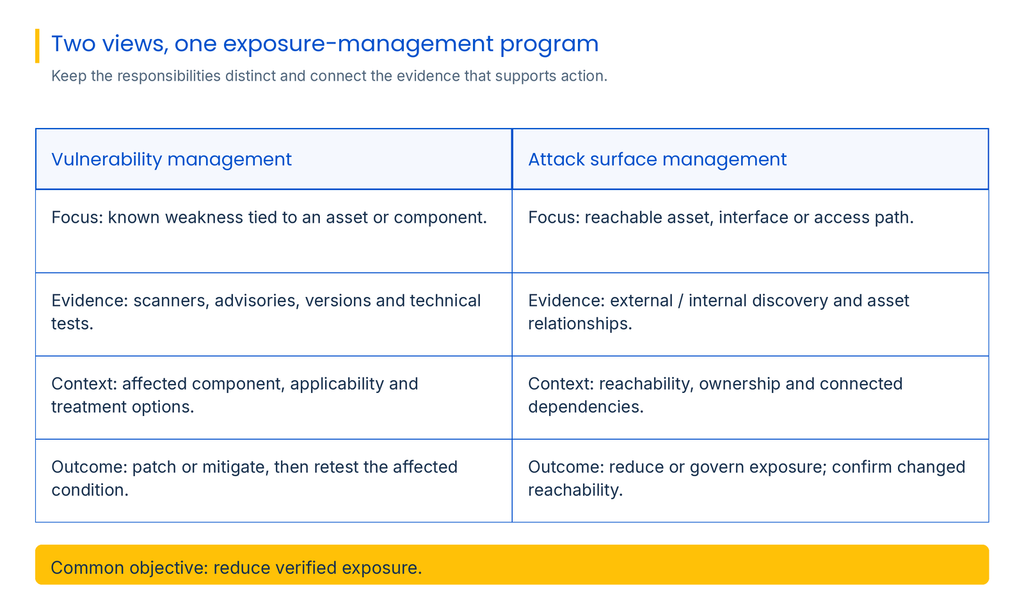
The distinction is operational. ASM owns breadth and relationships; vulnerability management owns verification and treatment of known weaknesses. A finding should move between them when context changes, not merely when a ticket is opened.
| Dimension | Vulnerability management | Attack surface management | Shared handoff |
|---|---|---|---|
| Primary question | Which known weaknesses affect us? | What assets and routes are reachable? | Which exposure merits action now? |
| Typical evidence | Scanner results, versions, advisories, tests | External observations, asset links, reachability | Matched asset, owner, freshness, controls, decision |
| Main output | Validated finding and treatment | Exposure picture and asset relationships | Assigned work and evidence of changed state |
| Blind spot | Unknown or unscanned assets | Unconfirmed weakness and patch status | Missing or conflicting source data |
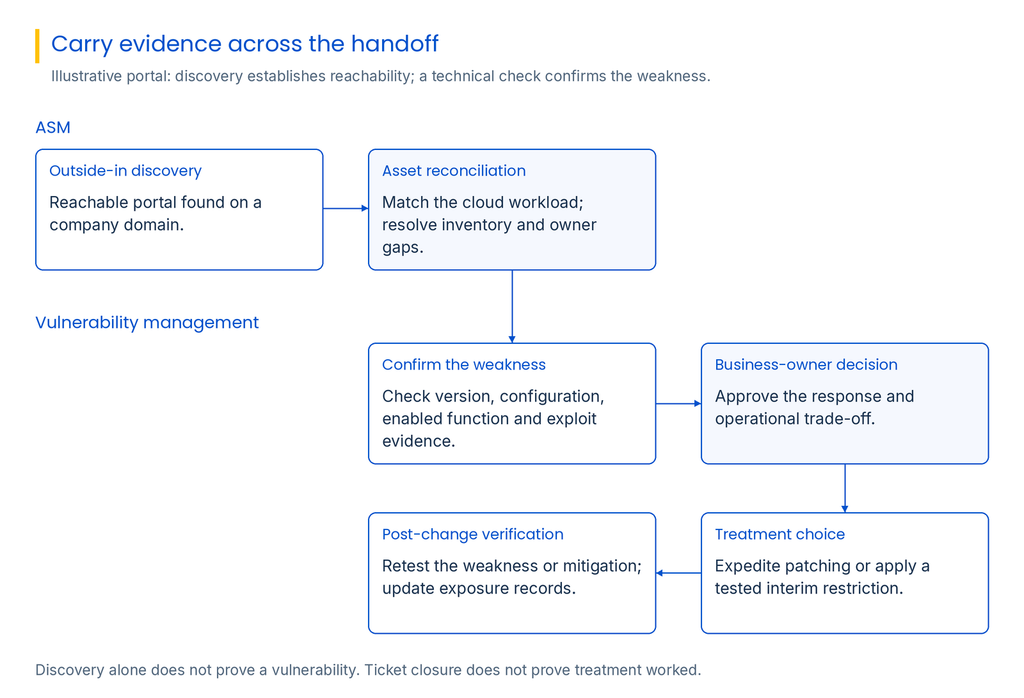
Illustrative scenario: outside-in discovery finds a login portal on a company domain, but its production cloud workload is missing from the asset inventory. ASM has surfaced a reachable, untracked entry point, not proven a vulnerability.
Vulnerability management checks the version and configuration, confirms a known weakness applies, and verifies the vulnerable function is enabled. Exploitation is reported in the wild; the owner says the portal supports customer transactions and the next release window is five days away.
The response must protect a reachable transaction path, not simply rank a score. The team can assess an expedited patch; if that is unsafe, it may restrict access or disable the affected function temporarily, then patch and verify the result. The right treatment depends on the technology and must be tested in that environment.
Patch decisions also involve operational trade-offs. NIST’s August 2025 update to SP 800-53 discusses balancing rapid deployment against testing to reduce disruption, and monitoring the updated component in relation to the larger system.
The scenario is illustrative, not a universal response rule: ASM surfaced reachability; vulnerability management confirmed the weakness; the owner chose treatment; and a technical recheck tested the result.
A workable program shares a minimum set of evidence between attack surface management and vulnerability management. Each record needs a stable asset identifier, source and observation time, environment, owner or ownership confidence, exposure state, affected component, finding reference, relevant control coverage, business function, decision, and verification result. Not every tool will supply every field; missing or stale values should remain visible.
Use a short sequence to keep the handoff disciplined:
1. Reconcile the asset. Match the finding to a current asset record using durable identifiers where possible. Flag ambiguous matches rather than silently merging them.
2. Confirm the condition. Validate the affected version, configuration, exposure path, and exploit evidence. Separate confirmed findings from candidates that need investigation.
3. Decide the treatment. Choose a patch, upgrade, configuration change, access restriction, isolation, compensating safeguard, or time-bound exception. Record why the chosen action fits the operational risk.
4. Assign the work. Route it to an accountable technical owner with a due date that reflects exposure and consequence. Escalate blocked remediation with the evidence and decision needed.
5. Recheck the result. Confirm the component is no longer affected or that the interim safeguard is operating as intended. Update the asset and finding records; do not equate ticket completion with risk reduction.
When records conflict, preserve the source and observation time for each fact. An external observation may be recent while a scan is old, or a finding may refer to a rebuilt asset. Keep uncertainty visible and define what verification will resolve it.
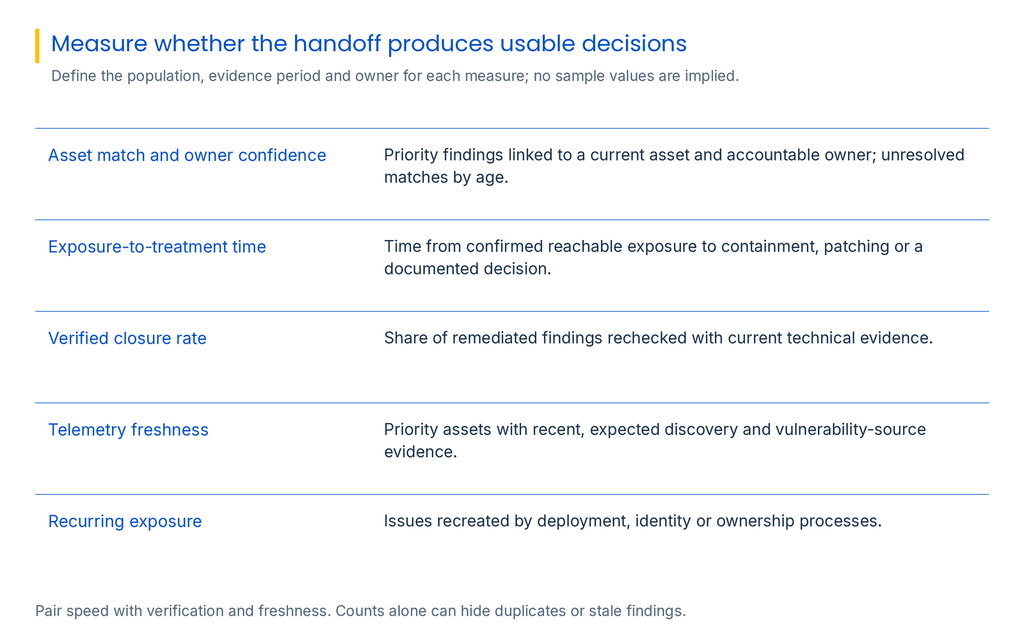
Counting findings closed or assets discovered is not enough. A better scorecard tests whether the two disciplines produce usable decisions. Consider tracking:
• Asset reconciliation: share of priority findings matched to a current asset and accountable owner; unresolved matches by age.
• Exposure-to-treatment time: elapsed time from confirmed reachable exposure to containment, patch, or documented decision.
• Verification rate: share of remediated findings rechecked with current evidence, rather than closed solely from workflow status.
• Coverage confidence: priority assets with recent, expected telemetry from the required discovery and vulnerability sources.
• Repeat exposure: issues that recur because deployment, identity, or ownership processes recreated the same condition.
Define each measure carefully. Closure speed without proof rewards ticket updates; discovery counts can include duplicates. Pair speed with validation and data freshness.
SPOG.AI’s Exposure Management solution describes connecting vulnerability scanners, asset records, threat intelligence, security controls, recovery systems, and ITSM workflows. Its role is to help carry context and ownership through prioritization and remediation; discovery and technical validation still depend on the connected sources and relevant security tools. See the Exposure Management solution.
For teams that need to relate exposure to control status, SPOG.AI’s Continuous Control Monitoring solution describes connecting operational evidence to control coverage and effectiveness, and revalidating after remediation. This can support assurance about whether an expected safeguard is present across the relevant assets. It does not replace a scanner, penetration test, or authorized external discovery.
Evaluate whether evidence source, freshness, asset identity, owner, and verification outcome survive the handoff. A consolidated view is useful only if it preserves a reliable decision record.
Keep the responsibilities distinct but connect their evidence. ASM exposes reachable assets and relationships; vulnerability management confirms weaknesses and treatment. The shared output is an owner, a decision, and verified change.
Start with one critical application. Compare its inventory with authorized external observations, resolve mismatches, confirm priority weaknesses, and follow one treatment through a technical recheck. Then fix the process that allowed the gap. Leadership should see what was exposed, what changed, and what evidence shows exposure fell. For an overview of how SPOG.AI connects this work, review the Exposure Management solution.

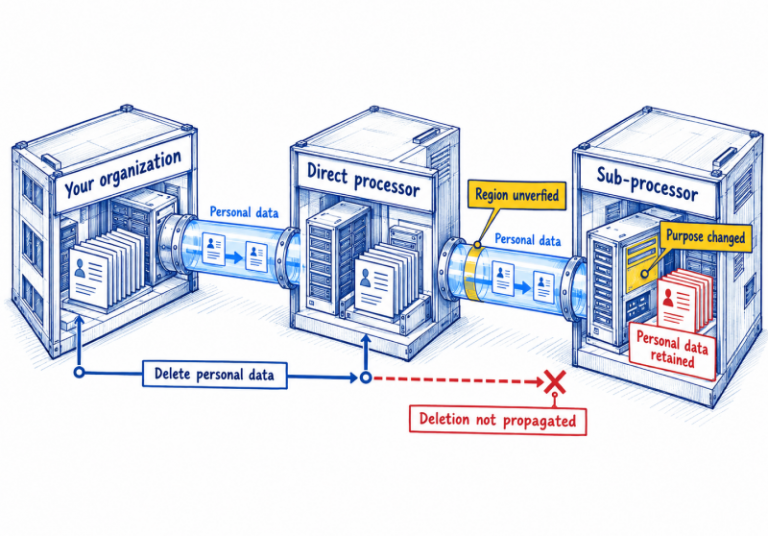
A direct vendor is only the first link in a personal-data chain. Build a program that keeps purpose,...
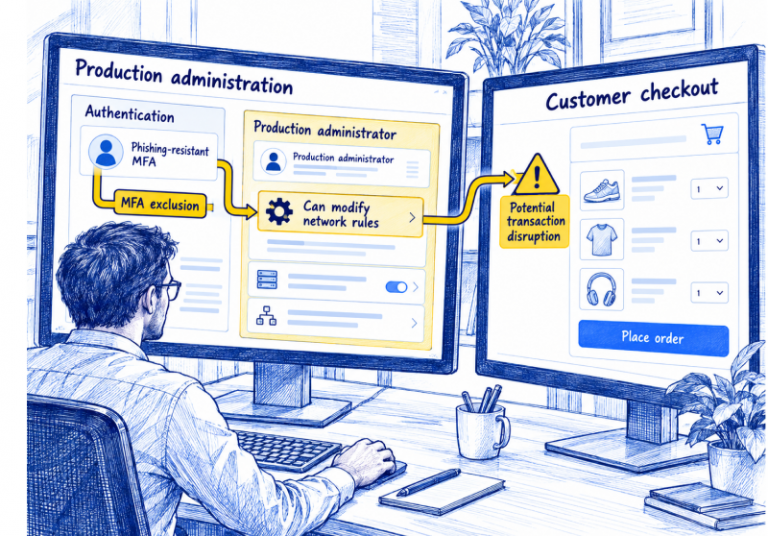
Understand what a weakened control exposes, which operations depend on it and how to verify that corrective action...
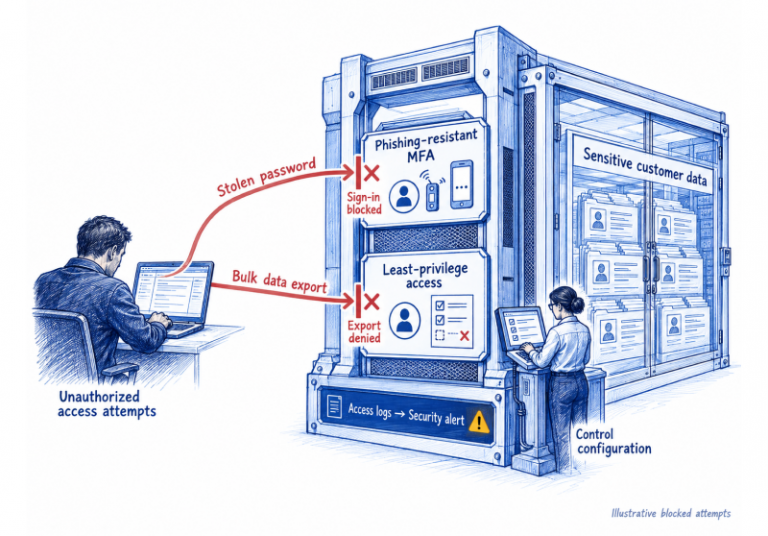
A practical guide to reducing the paths attackers can use to reach sensitive information.Build prevention around data, identity,...