Inherent Risk vs Residual Risk: Use Control Evidence to Defend the Risk You Accept
Inherent risk vs residual risk is a comparison between exposure without specified risk responses and exposure after those responses. The distinction helps leaders decide what protection is necessary, what risk remains today and whether further treatment is justified.
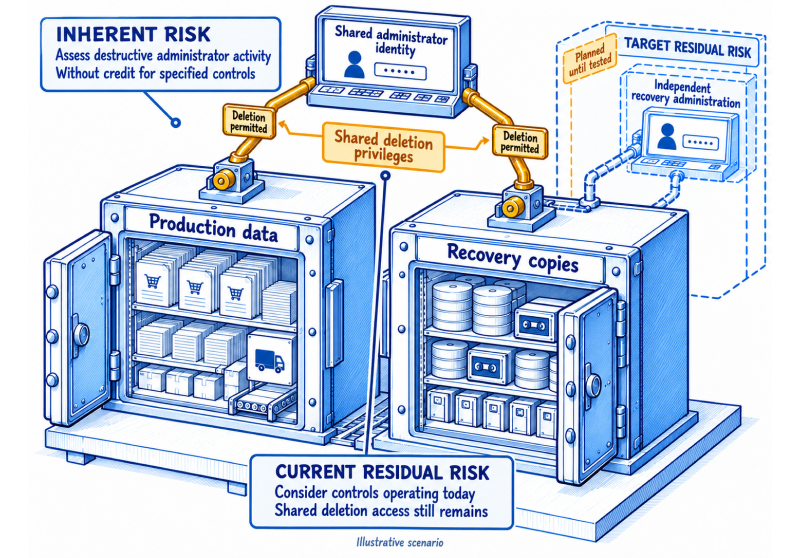
An order-fulfilment platform has privileged-access controls and backups. Its risk register records High inherent risk and Medium residual risk for destructive administrator activity. Then a review finds that the same administrative identity can delete both production records and recovery copies.
The controls exist. Their combined protection is weaker than the assessment assumed. In this illustrative scenario, management needs to revisit the residual estimate and its operating decision. Adding another control to the register will not resolve the problem unless its contribution is understood and tested.
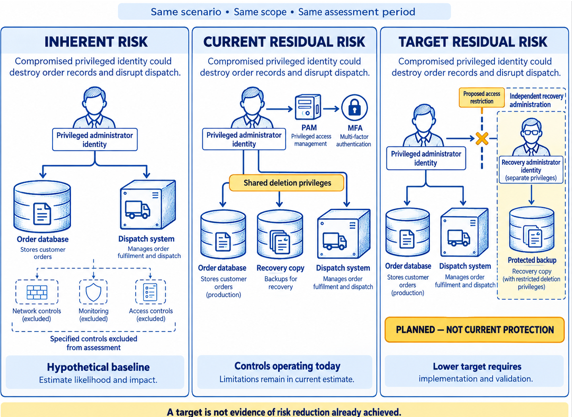
Inherent risk vs residual risk starts with the same scenario
Inherent risk describes exposure before credit is given for the risk responses excluded by the assessment method. Residual risk describes what remains after implemented responses are considered. It may still exceed the organization’s tolerance.
NIST IR 8286 Revision 1, published in December 2025, distinguishes inherent risk, actual residual risk and target residual risk. Keeping all three visible prevents a planned improvement from appearing as protection already achieved.
Define the inherent risk baseline
An inherent risk assessment is usually a hypothetical assessment, not a measurement taken before the organization installed security. State which safeguards are excluded, which operating conditions remain and why. Otherwise, two teams can produce incomparable ratings while using the same terminology.
For the fulfilment platform, define the event: a compromised privileged identity destroys order records, interrupting dispatch and requiring reconstruction. Specify the affected environment, business consequences and assessment period. Estimate inherent likelihood and impact without credit for the access and recovery controls being evaluated.
The baseline is not automatically permanent. A major change in transaction volume, data sensitivity or operating dependencies may change the underlying scenario. Record that change separately from deterioration in controls.
Separate current residual risk from the target
Current residual risk considers safeguards operating today, including their limitations. Target residual risk describes the position management seeks through its chosen response. A forecast after planned treatment should remain distinguishable from the current estimate.
For the platform, independent recovery administration may support a lower future estimate. Until it is implemented and tested, the current assessment must retain the shared-identity weakness. All risk labels in this example are illustrative.
The comparison is useful only when its columns describe the same event, scope and period. A lower target does not demonstrate current risk reduction.
Give each control a specific role in reducing risk
Controls may affect different parts of the scenario. Privileged access management (PAM) and multi-factor authentication (MFA) can restrict opportunities for account misuse. Backup protection and tested restoration can limit consequences after destructive activity. Their contribution depends on implementation and the relevant attack path.
Ask what each control changes: access to a privileged action, the chance of detecting misuse, the time to contain it or the extent of recoverable loss. Then identify evidence capable of supporting that claim.
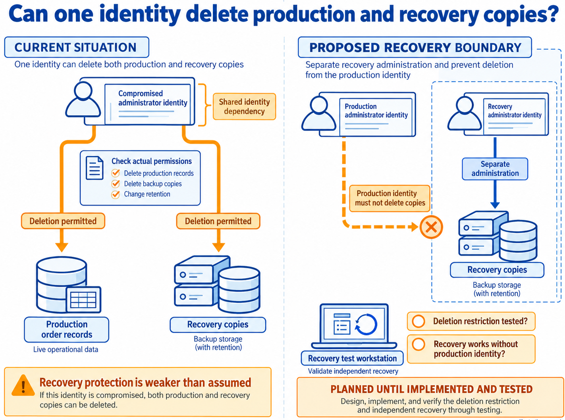
For this platform, reconcile identities able to delete production data with those able to delete backups. Test recovery using a path that does not depend on the compromised administrative identity. A successful restore during routine operations does not answer whether recovery remains possible after that identity is abused.
SPOG.AI’s treatment of control coverage and operational health shows why coverage, configuration and continued operation require separate attention. An approved exception explains a deviation; it does not make the affected population technically protected.
Examine shared dependencies before crediting layered protection
Two controls can fail together if they depend on the same identity, management plane or evidence source. Their existence does not establish independent protection.
For the illustrative platform, backup isolation is the decisive issue. Confirm who can alter retention, delete copies or change recovery permissions. If the production administrator can perform those actions, the residual assessment should explain how that affects the expected duration and cost of disruption.
This exposes a dependency hidden by a list of individually reasonable controls. The next action is a focused access and recovery test.
Assess residual risk without manufacturing precision
NIST IR 8286A Revision 1, published in December 2025, supports scenario-based likelihood and impact analysis, including uncertainty. Choose a qualitative or quantitative method suited to the decision and available evidence.
With qualitative risk assessment, define what High, Medium and Low mean. Explain why observed controls change likelihood or impact under those criteria. A numerical label attached to a category does not turn it into a measured quantity.
Avoid subtracting a control-health percentage from an inherent risk score. An illustrative coverage result of 95% does not establish a 95% reduction in loss. The uncovered population may contain the most consequential identities, and different tests may address overlapping protections.
With quantitative risk assessment, estimate event frequency and loss magnitude under explicit assumptions, using ranges where appropriate. Reassess how safeguards affect those inputs. Preserve dependencies and uncertainty rather than compressing them into an unexplained effectiveness multiplier. Neither method makes the residual estimate a prediction of what will happen.
Keep evidence confidence separate from risk magnitude
Missing evidence increases uncertainty; it does not prove that protection failed. Record the limitation, investigate it and determine whether interim restrictions are warranted. Do not carry forward a favourable rating solely because a connector stopped reporting before the scheduled review.
The opposite mistake is declaring every unverified control failed. For the platform, an unavailable access export calls for evidence recovery or an alternative test. A demonstrated ability to delete both data and backups calls for treatment of a confirmed weakness.
Use residual risk to decide treatment and acceptance
Risk appetite establishes the broad exposure an organization is willing to pursue; risk tolerance makes limits usable in specific decisions. Compare current residual risk with the applicable criteria, including uncertainty and mandatory obligations.
Management can avoid the activity, reduce exposure, transfer specified financial consequences or accept remaining risk within delegated authority. Insurance may address covered losses without restoring dispatch capability. Acceptance does not remove the weakness or waive an applicable legal duty.
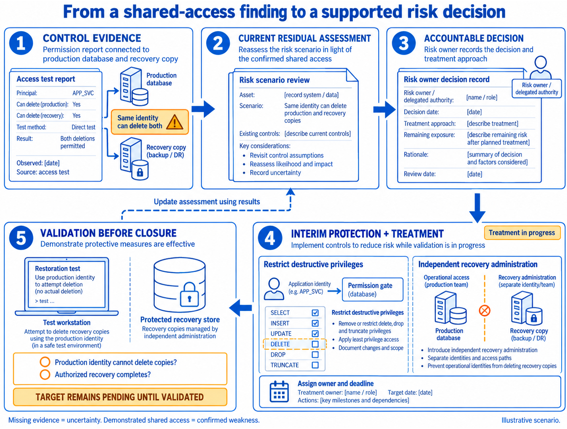
Record the accountable owner, decision rationale, remaining exposure, treatment deadline and review triggers. For the platform, this could mean restricting destructive privileges while independent recovery administration is introduced. Approval should identify what remains uncertain and who must verify the intended outcome. This risk mitigation plan needs a closure test: demonstrate that the production identity cannot delete protected copies and that authorized recovery can complete under the agreed disruption conditions.
The issue is observable in practice. The Australian National Audit Office’s May 2026 Census cybersecurity audit identified shortcomings in risk updates, ownership and control-effectiveness information. Its findings illustrate why recorded ratings need current supporting evidence; they are a dated audit assessment, not a statement about the organization’s position today.
Reassess when the basis of the comparison changes
Material changes can affect inherent exposure, control performance or both. More critical operations may depend on the platform; new administrative access may bypass restrictions; a recovery test may expose a previously unknown limitation.
The need to revisit risk assumptions as conditions change also applies to accepted residual risk. Keep the assessment connected to the changed condition and route the decision to the appropriate owner.
Inherent risk excludes specified responses. Residual risk considers implemented responses and the exposure remaining.
No. It must be compared with the organization’s acceptance criteria and applicable obligations.
No. The inherent assessment excludes their risk-reducing contribution under the chosen baseline.
No. A target is a desired position. Current risk requires evidence about protections operating today.
Reassess the same scenario’s likelihood and impact considering implemented safeguards, dependencies and uncertainty.
Only use arithmetic justified by the model’s quantities and assumptions. Control coverage is not a loss-reduction percentage.
Yes. Changes in activities, information, threats or dependencies can alter the underlying exposure.
No. It limits confidence and requires investigation, with proportionate interim protection where warranted.
The designated risk owner or approving authority, within delegated limits and applicable obligations.
At scheduled intervals and when material changes challenge the assumptions supporting acceptance.
Before You Accept the Remaining Risk
Choose one material risk marked below its inherent rating. Ask which controls justify that difference, what current evidence supports them and whether any shared dependency undermines their contribution. Keep planned improvements separate. The review should end with a supported acceptance decision or a specific action, owner and verification condition.
With 8.5+ years in B2B SaaS, I’ve led demand generation and GTM initiatives across global markets (US, UK, Europe, Africa), helping companies move from fragmented marketing efforts to structured, revenue-focused growth engines.