Risk Management Framework in Practice From System Scope to Decisions You Can Defend
A risk management framework connects system scope, control evidence and accountable decisions. Applying NIST RMF means establishing why a system can operate, what exposure remains and which changes require that decision to be reviewed.
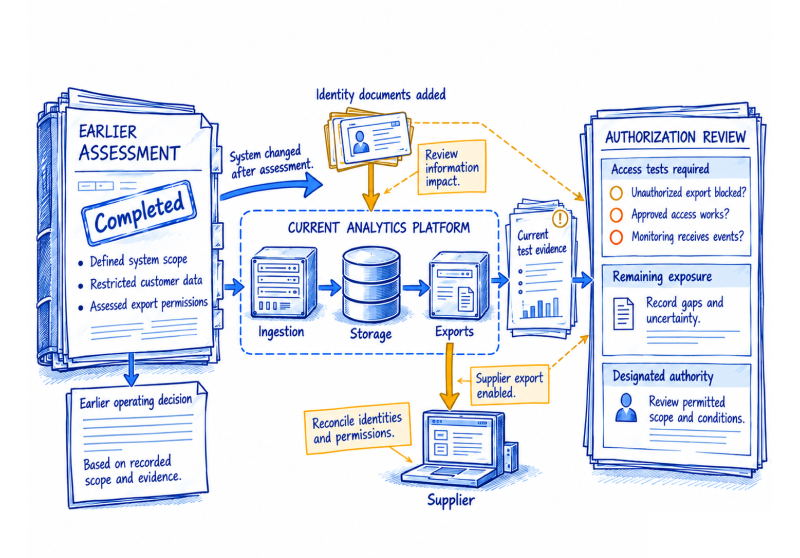
An analytics platform receives approval to operate with restricted customer data. Months later, engineers add identity documents and enable a support provider’s export access. Its assessment remains complete, but the system now handles different information through a different access path.
This illustrative scenario exposes an implementation problem: completing a framework does not keep its conclusions current. The risk management framework must connect changes to the decisions they affect.
What is a risk management framework
A risk management framework establishes a repeatable approach to identifying, assessing, responding to and monitoring risk, with defined responsibilities. In cybersecurity, NIST RMF specifically integrates security and privacy risk management throughout a system’s life cycle, including supply chain considerations.
NIST SP 800-37 Revision 2 remains the RMF reference identified in NIST’s June 2026 system-planning guidance, SP 800-18 Revision 2. That newer publication supports implementation; it does not introduce a new RMF edition. It connects system security, privacy and cybersecurity supply chain risk management plans with RMF activities.
For commercial adoption, establish applicable obligations separately. Using NIST RMF does not itself establish regulatory compliance or confer certification. Formal authorization requirements depend on the organization’s governing context.
How to apply the seven NIST RMF steps
The seven RMF steps are Prepare, Categorize, Select, Implement, Assess, Authorize and Monitor. Use the following questions to translate them into work for the analytics platform. The questions are implementation recommendations, not additional NIST requirements.
Prepare and Categorize establish what the decision covers
Prepare establishes context and responsibilities. Identify the service owner, system owner, privacy lead, suppliers and decision authority. Agree who can accept residual risk and who must escalate it. Define risk tolerance before teams negotiate exceptions.
Categorize considers the consequences of losing confidentiality, integrity or availability. Examine the information processed, stored and transmitted, and involve business owners in evaluating impact. Federal security categorization uses FIPS 199 impact levels of Low, Moderate and High; a commercial team should document its chosen method.
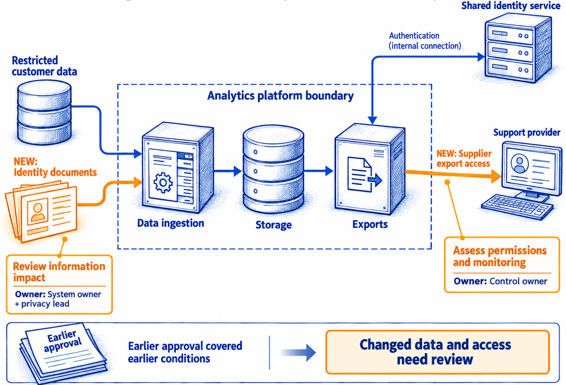
For the platform, map data ingestion, storage, exports and support access. Record shared identity services and supplier dependencies. When identity documents enter the platform, revisit information handling and potential harm to individuals, even if no technical vulnerability has changed.
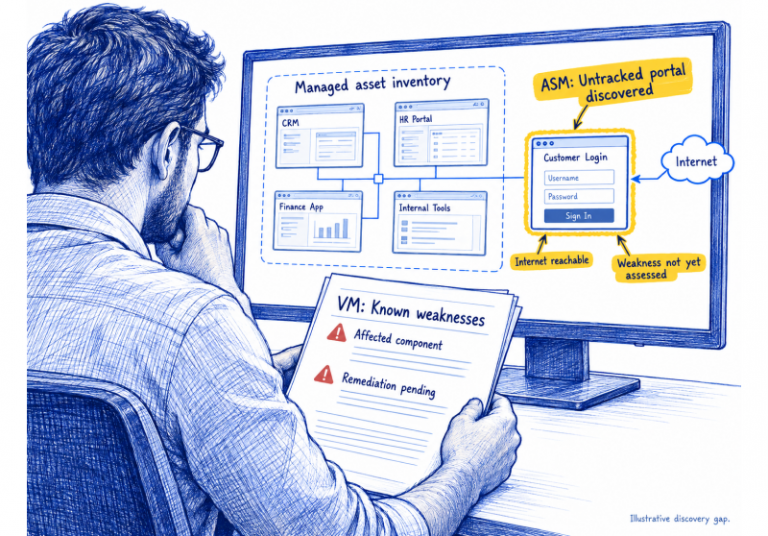
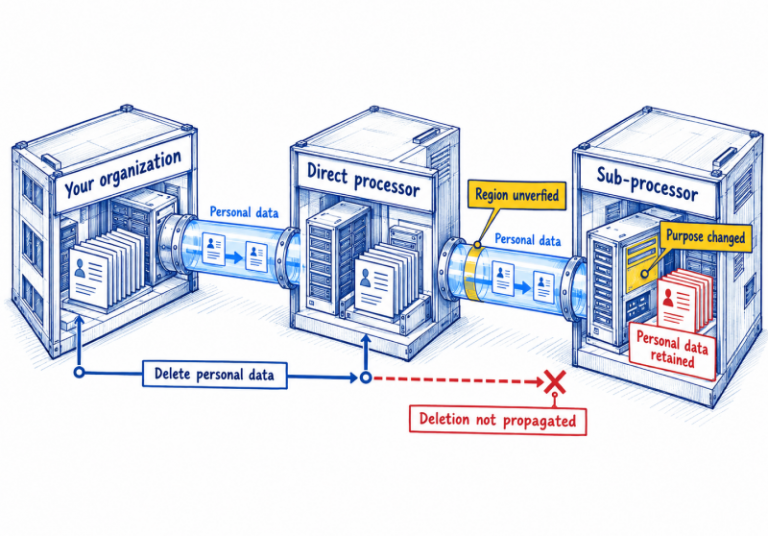
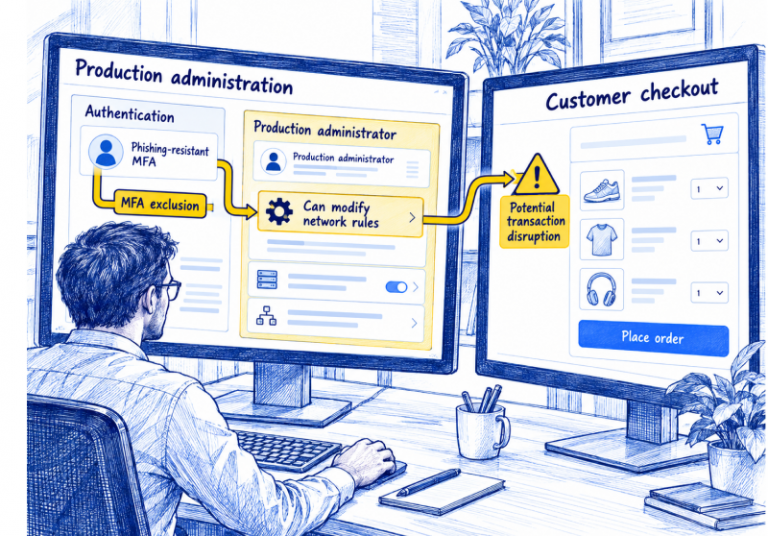
An explicit boundary prevents the application team from assuming that another team has assessed an export service. Connections outside the boundary still need risk consideration.
The boundary is a statement about responsibility. Every highlighted connection needs an owner and evidence appropriate to the risk it introduces.
Select and Implement turn requirements into operating safeguards
Select determines the controls needed for the assessed risks and obligations. NIST SP 800-53 provides the control catalog; SP 800-53B provides baselines. Document tailoring decisions and distinguish system-specific controls from inherited common controls and hybrid controls with shared responsibilities.
For the platform, consider whether export restrictions, privileged-access safeguards, retention limits and monitoring address the defined scenarios. Specify which provider protections apply and which customer configurations remain your responsibility. A provider assurance report cannot establish that your tenant’s export permissions are appropriate.
Implement puts selected controls into operation and records what was actually deployed. Write implementation details that an assessor can test: affected population, enforcement point, responsible team and evidence location. Describe partial coverage honestly.
Version the control references. NIST’s August 2025 Release 5.2.0 updated SP 800-53 and corresponding assessment procedures in SP 800-53A; the announcement reported no baseline changes to SP 800-53B. A catalog update is a reason to examine applicability, not assume every system needs identical changes.
Assess and Authorize connect evidence to permission to operate
Assess evaluates whether implemented controls achieve their intended results. Define an assessment plan, suitable methods and the required assessor independence. Test real operating conditions rather than relying entirely on configuration screenshots.
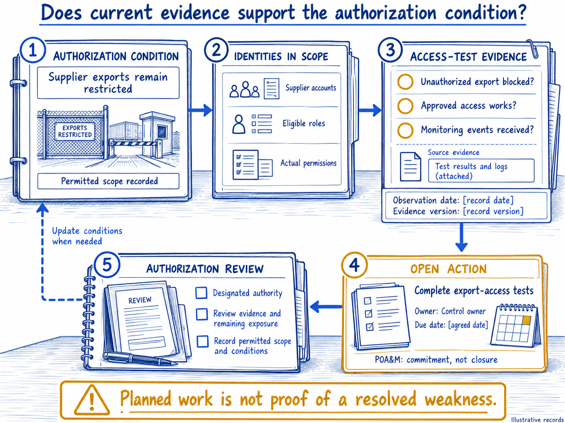
For export access, reconcile eligible identities with actual permissions. Attempt an unauthorized export through an approved test, inspect approval records and confirm that monitoring receives the relevant events. Separate a demonstrated failure from insufficient evidence. Both need attention, but their corrective actions differ.
Authorize places the operating-risk decision with the designated authority. Assemble the relevant System Security Plan (SSP), privacy plan, Security Assessment Report (SAR), unresolved deficiencies and planned corrective actions. A Plan of Action and Milestones (POA&M) records remediation commitments; it does not demonstrate that weaknesses are resolved.
For the illustrative platform, propose restricting supplier exports until access tests support wider use. Record the decision, permitted scope, outstanding work and review conditions. If the proposed exposure exceeds delegated authority, escalate it. Assessment completion alone should not grant permission to operate.
Monitor tests whether the operating decision still holds
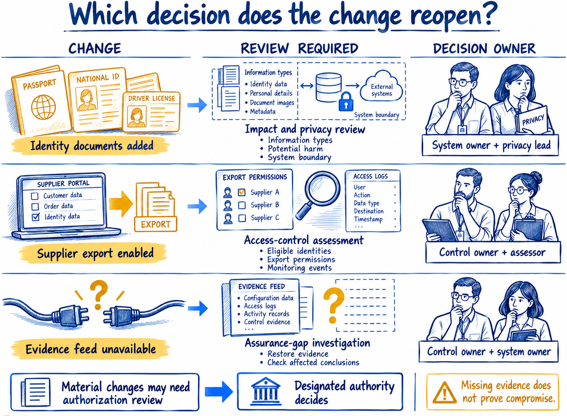
Monitor maintains visibility into relevant changes and control performance. Define scheduled checks alongside triggers such as new information types, changed supplier access or weakened safeguards. Decide which findings require investigation, reassessment or referral to the authorizing authority.
This is consistent with the broader need to revisit risk assumptions when business conditions change. Monitoring frequency should follow the consequence and speed of change, rather than an arbitrary promise of real-time coverage.
An unavailable feed does not establish compromise. It limits what management can conclude until reliable evidence returns.
Keep risk estimates connected to the operating decision
NIST IR 8286A Revision 1, published in December 2025, supports documenting scenarios, likelihood and impact in cybersecurity risk registers. Its companion IR 8286 Revision 1 connects those records to enterprise risk management and business objectives.
For this platform, use a specific scenario: a compromised supplier identity exports customer documents, creating disclosure and service-response costs. Estimate likelihood and impact with stated assumptions and uncertainty. Distinguish inherent risk from residual risk after controls, explaining which observed safeguards support the latter.
A rating without that explanation makes review difficult. If export restrictions fail, the owner needs to know which assumption changed and whether the accepted residual risk remains tolerable.
For a pilot, measure the time between identifying a material change and reaching the responsible decision-maker. Separately measure how long corrective work takes to produce a verified result. Fast routing cannot compensate for weak assessment, and rapid ticket closure cannot establish restored protection.
Review unresolved decisions by affected service and consequence. Count evidence gaps separately from confirmed control failures. Check whether temporary restrictions have an owner and whether their review conditions remain satisfied. These are proposed operating measures, not NIST-prescribed metrics.
The analytics platform provides a useful test: can a reviewer identify which supplier identities gained export access, which assessment covers them and who authorized the remaining exposure? If those answers require a new investigation every time, improve the links between records before increasing the reporting frequency.
Make evidence traceable without duplicating every document
Maintain linked records for the system boundary, control implementation, assessment, risk decision and outstanding actions. Preserve versions so reviewers can reconstruct what was known when approval was given.
This trace makes a narrow question answerable: does today’s evidence still support the condition under which access was approved?
Test the framework against one recent change
Choose a system change from the last month. Trace it through scope, impact, control selection, implementation, assessment, authorization and monitoring. Identify the first unsupported assumption and assign the missing review. Expanding a risk management framework is easier when one complete decision can already withstand scrutiny.
Frequently asked questions
RMF means Risk Management Framework. Here it refers to NIST’s information-system risk management process.
Prepare, Categorize, Select, Implement, Assess, Authorize and Monitor. Their outputs support subsequent activities and ongoing review.
A risk assessment analyzes exposure. RMF also organizes control implementation, assessment, authorization and continuing monitoring.
No. CSF organizes cybersecurity outcomes; RMF structures system risk decisions. An organization can use them together.
Yes. Define its application and applicable obligations without assuming that federal authorization procedures automatically apply.
An ATO records an authorized official’s permission for operation based on an operating-risk decision. It is not certification.
The designated authority accepts it within delegated limits. A control operator should not assume that authority.
No. Establish what the provider covers, what remains system-specific and whether the inherited protection applies.
No. Evaluate significance against defined criteria and refer material changes through the applicable authorization process.
Automation can gather evidence and route reviews. The designated authority remains accountable for the authorization decision.
Technology writer and content strategist with 5+ years of experience, including work for a US-based B2B SaaS client and a cybersecurity solution. I create cybersecurity and GRC content, product documentation, and user guides that help technical teams and business leaders understand security capabilities and workflows. Currently working on Confluence documentations on vulnerability management, ITSM, incident management, and continuous control monitoring, alongside SEO and AEO content, and technology partner database development.