Vendor Risk Management Best Practices for Business Impact, Access and Resilience
A vendor review should tell decision-makers what access and dependency they are accepting, what conditions must hold, and what would trigger a change in that decision. This guide turns vendor criticality into a practical operating model for security, procurement, legal, and business owners.
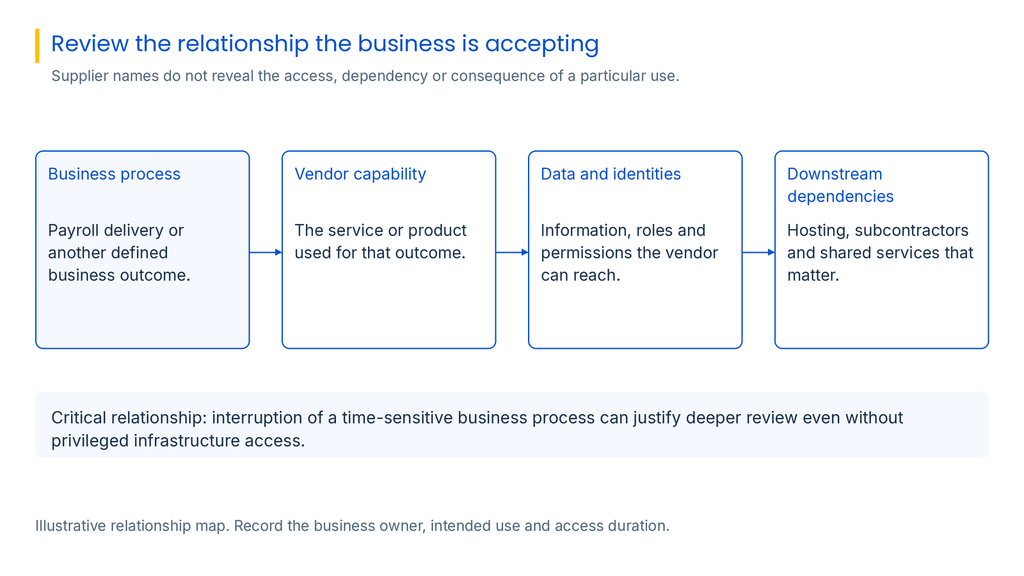
“Vendor” is a procurement category, not a risk rating. A cloud platform holding customer records, a consultant with temporary production access, and a stationery supplier may all be vendors, but their failure paths are different. A useful intake captures the service or product being supplied, the business owner, systems or data involved, access type, locations, critical dependencies, and the planned duration of the relationship.
Assess the specific relationship, not the supplier name alone. One supplier may support use cases with different data, permissions, and consequences. Map material subcontractors or software components when they affect the dependency; a long supplier list is not visibility.
Current NIST Cybersecurity Supply Chain Risk Management guidance integrates supply-chain risk into enterprise risk decisions. Practically, capture what the relationship enables before asking whether a control is present.
Use criticality to set the review, not just the score
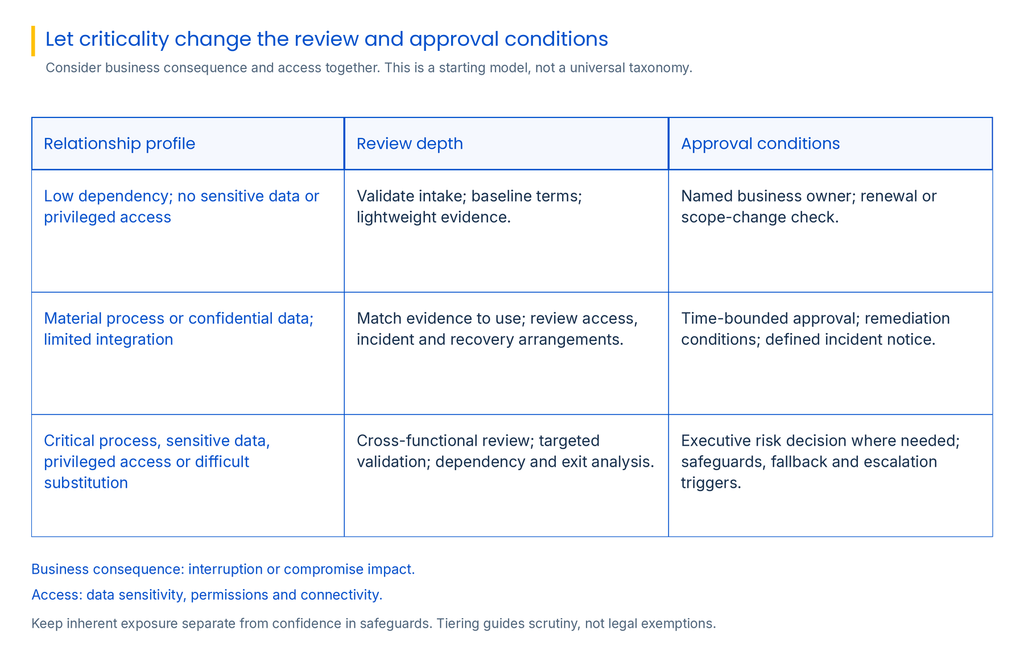
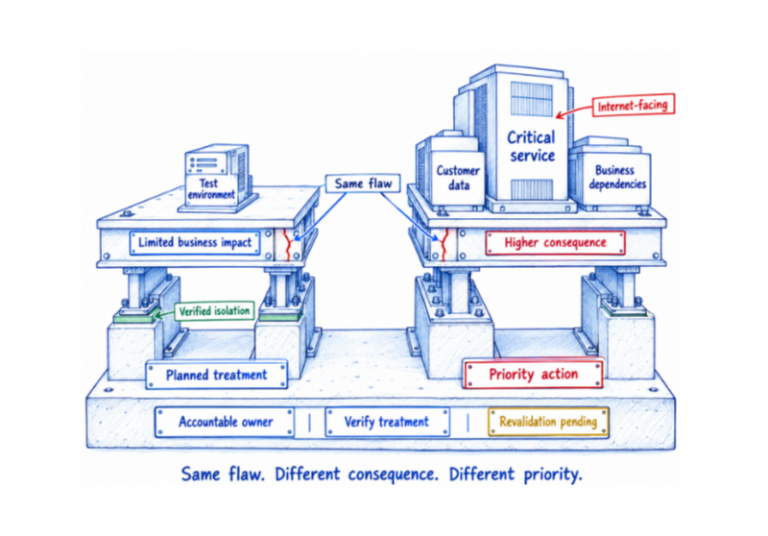
A tier is useful only if it changes what the organization does. Define a small number of tiers with observable criteria. Consider two dimensions together: consequence if the vendor is unavailable or compromised, and the depth of access it receives. Data sensitivity, privileged connectivity, concentration, recovery options, and substitutability can refine the decision.
Relationship profile
Typical review depth
Decision conditions
Low dependency, no sensitive data or privileged access
Named business owner; renewal or scope-change check
Material process or confidential data; limited integration
Control evidence matched to use; review of incident, recovery, and access arrangements
Time-bounded approval; remediation conditions; defined incident notice
Critical process, sensitive data, privileged access, or difficult substitution
Cross-functional review; targeted evidence validation; dependency and exit analysis
Executive risk decision where needed; explicit safeguards, fallback, and escalation triggers
Use this as a starting model, not a universal taxonomy. Certifications do not make a high-dependency vendor inconsequential; a smaller supplier may need deeper scrutiny if it has privileged access or is difficult to replace. Low-impact purchases should not inherit enterprise-grade reviews by default.
Keep inherent risk separate from control confidence. The first describes exposure before safeguards; the second describes whether relevant safeguards are designed and operating. A single score can hide a critical dependency behind strong controls.
Ask for evidence that answers the use case
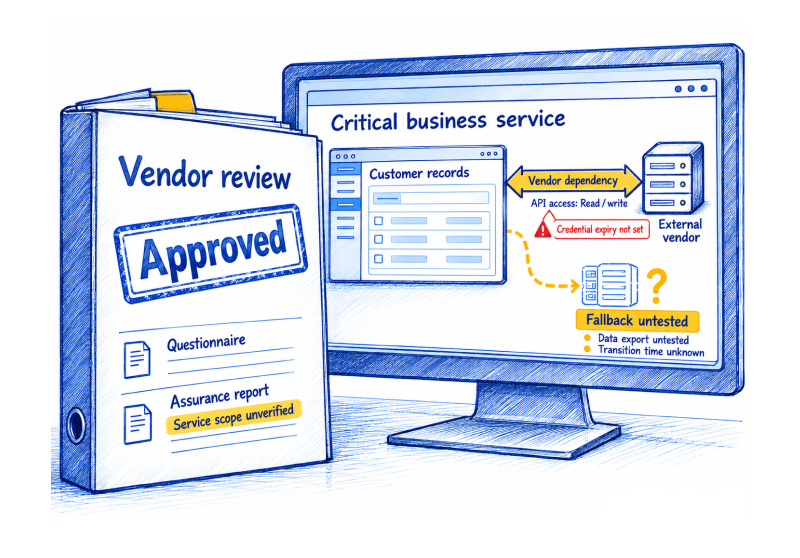
A questionnaire gathers claims; it is not proof. Ask what decision each item informs. For sensitive data, examine handling, identity, encryption, incident response, recovery, and relevant subcontractors. For privileged access, focus on approval, authentication, session control, logging, and revocation. A certificate can establish scope and intent, but does not prove that your specific system is covered or that a safeguard works.
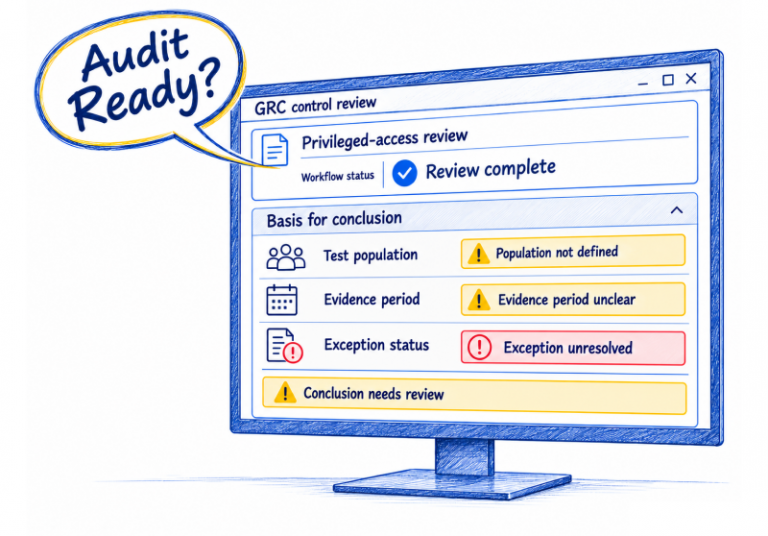
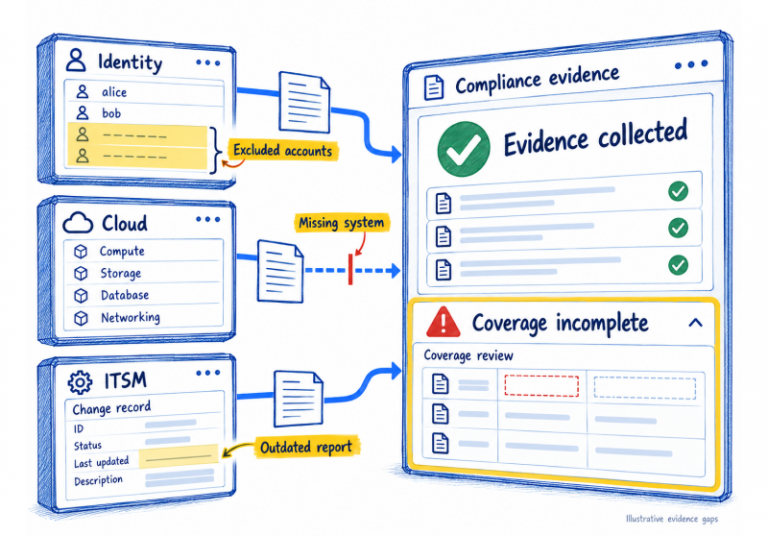
Validate evidence against the service you will use. Check scope, dates, exceptions, test coverage, and whether findings relate to the environment, product, or controls in question. Where evidence is incomplete, ask a narrower follow-up question or test a specific claim. Avoid requesting broad documents that no reviewer has time to interpret.
A CISA and NIST resource released in 2026 recommends that software customers and vendors identify, assess, and mitigate supply-chain risk. That does not call for source-code audits on every purchase; tailor assurance questions to how a product is developed, delivered, updated, and used.
Put decision conditions into the relationship
Security review is most useful before the vendor receives production access or data. Procurement, legal, security, privacy, and the business owner should agree on the conditions that make the relationship acceptable. Contract language should match the actual risk: permitted use and data handling, security responsibilities, incident notification and cooperation, subcontractor transparency where relevant, evidence rights, continuity expectations, data return or deletion, and access termination.
Contract clauses do not operate themselves. Translate them into owners and actions: name an intake path for incident notices and an offboarding step to confirm deletion. For temporary gaps, record scope, rationale, safeguards, approver, and expiry.
Reopen the decision when the relationship changes
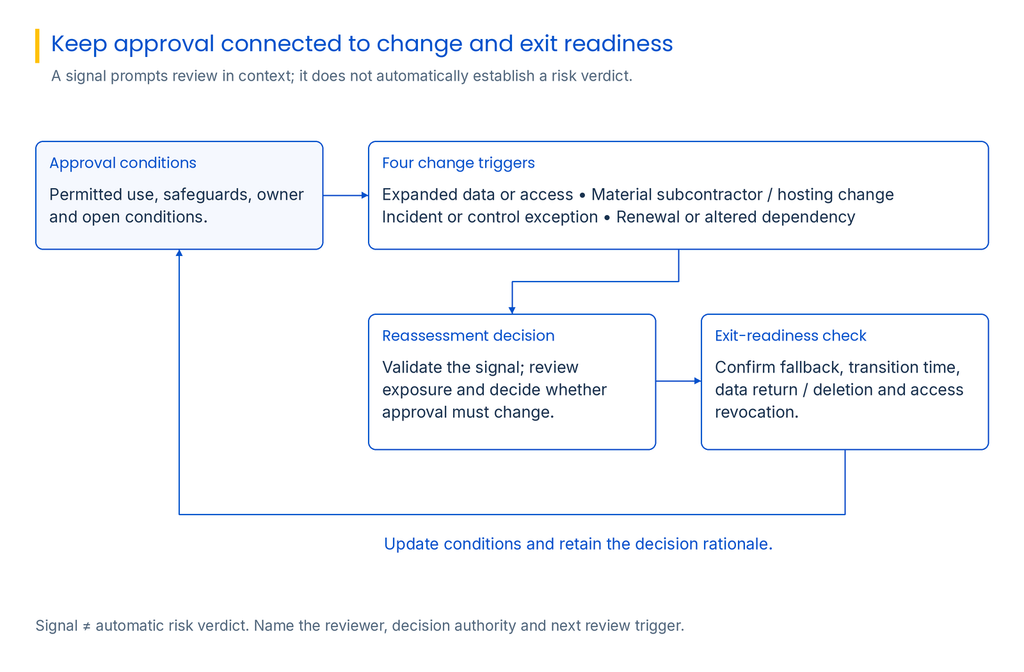
An annual review can miss material changes. Set tier-based triggers: new data use, expanded access, a significant subcontractor or hosting change, an incident, control exception, altered dependency, or renewal. Define which signals require a decision and who owns follow-up.
External ratings and alerts can prompt investigation, but they cannot replace context or evidence validation. Ask whether exposure changed, whether safeguards still apply, and whether approval or contingency plans should change.
Make exit readiness part of approval
A vendor may meet security requirements and still create continuity risk. Ask how the business would continue during an outage or exit. Identify export formats, transition time, replacement options, technical dependencies, and credential-revocation steps. An exit clause is not a recovery plan until the business can use it.
Illustrative scenario: a payroll platform has no privileged access to production infrastructure, but it processes employee data and supports a time-critical monthly operation. Its review should be stronger than a basic software subscription, yet different from that of a cloud administrator. The business owner should confirm a workable payroll fallback; security and privacy should verify access and data safeguards; procurement and legal should confirm transition and deletion terms. The scenario is illustrative, not a claim about a specific organization.
Connect risk decisions to operational evidence
The program’s record should let a reviewer trace the relationship from business owner and tier to evidence, open conditions, approval, and subsequent change. This is where a GRC solution can support a consistent view of requirements, control evidence, accountable owners, and exceptions. SPOG.AI describes its GRC solution in these terms. Its Continuous Control Monitoring solution connects defined controls with operational evidence to assess coverage and effectiveness. These pages describe governance and control capabilities; this article does not claim a dedicated vendor-risk module.
For an experienced team, the test is not whether the file is complete. It is whether the record supports a decision: which access may be granted, which condition remains open, who accepted it, what would trigger reassessment, and how the organization would operate if the relationship failed.
Conclusion: scale scrutiny with dependency
Strong vendor risk management best practices align scrutiny with the dependency an organization accepts. Start by mapping the specific use, data, access, and business consequence. Use that context to set the evidence request and approval conditions. Reopen the decision when the relationship changes, and make exit readiness credible before it is needed.
A sound program can explain why a relationship receives deeper review and what the organization will do with the findings. That is more useful than questionnaire volume or a tidy score.
Frequently asked questions
It is the process of identifying and governing risks created by an organization’s dependence on outside suppliers, products, and providers, from intake through exit.
The scope should follow the relationship: business impact, data, access, integration, subcontractors, relevant safeguards, incident arrangements, continuity, and exit conditions.
Set review intervals by tier, then define event triggers such as expanded access, changed data use, an incident, a material subcontractor change, or renewal.
Vendor risk commonly describes suppliers providing goods or technology. Third-party risk is broader and may include partners, contractors, processors, and other external relationships.
No. They gather claims. Validate material answers against scoped evidence, contract terms, or targeted testing that relates to the planned use.
A relationship is critical when compromise or loss could materially affect a business process, sensitive data, privileged access, or a dependency that is difficult to replace.
No. A proportionate program uses the relationship’s access and consequences to determine review depth, evidence, approval authority, and reassessment triggers.
Relevant topics include security responsibilities, data handling, incident cooperation, subcontracting, assurance rights, continuity, data return or deletion, and termination of access.
Record the exposure, business rationale, compensating measures, accountable approver, scope, and review or expiry date. Escalate according to the organization’s risk authority.
Monitoring can surface a change that merits review. Teams still need to interpret the signal in context, validate impact, and decide whether controls or approval conditions should change.
Technology writer and content strategist with 5+ years of experience, including work for a US-based B2B SaaS client and a cybersecurity solution. I create cybersecurity and GRC content, product documentation, and user guides that help technical teams and business leaders understand security capabilities and workflows. Currently working on Confluence documentations on vulnerability management, ITSM, incident management, and continuous control monitoring, alongside SEO and AEO content, and technology partner database development.