Continuous Control Monitoring
Why Passing an Audit Does Not Prove Ongoing Compliance
An audit can confirm that security controls met assessed requirements during a defined period. But system changes can...


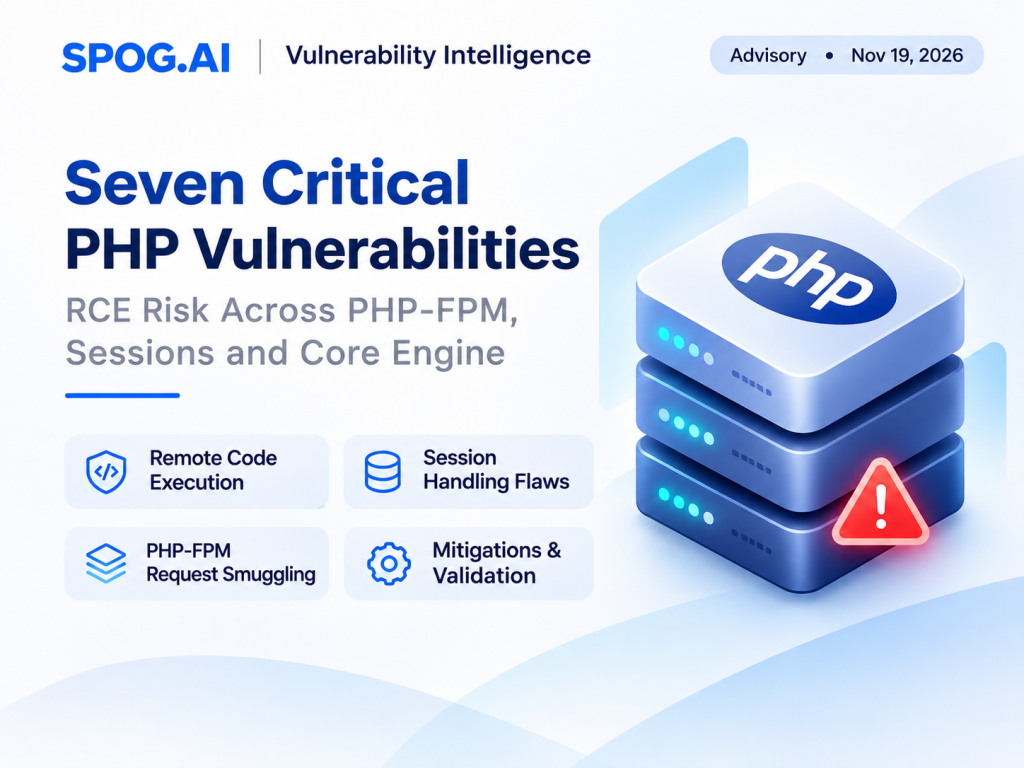
Seven critical PHP vulnerabilities disclosed on November 19, 2026, affect request processing, session handling and memory management, with several potentially allowing remote code execution (RCE). Five have reported configuration-based mitigations, while two require patching as the primary action. WAF rules may provide additional protection against specific exploitation techniques.
| Attribute | Details |
|---|---|
| Product | PHP 8.2, 8.3, 8.4 and 8.5 |
| Vendor | PHP Development Team |
| Asset Classes | Servers, virtual machines, containers, application servers and appliances with embedded PHP |
| Impact | Remote code execution, memory corruption and service disruption |
| Exploitation Prerequisites | Specific FastCGI, session-handling or PHP runtime conditions |
| Patch Available | Yes |
| Compensating Controls | PHP configuration changes, WAF virtual patching and runtime hardening |
| Published | November 19, 2026 |
| Last Reviewed | November 20, 2026 |
The seven vulnerabilities affect PHP request processing, session management and memory handling. Their exploitability depends on the application and runtime configuration; systems running the same vulnerable version may have different exposure.
| CVE | Vulnerability | PHP Branches | Potential Impact |
|---|---|---|---|
| CVE-2026-129289 | PHP-FPM request smuggling | 8.2–8.5 | Remote code execution |
| CVE-2026-115560 | Session serializer mismatch | 8.2–8.5 | Object injection / potential RCE |
| CVE-2026-126714 | Session file corruption | 8.2–8.5 | Object injection / potential RCE |
| CVE-2026-129481 | Session use-after-free | 8.3–8.5 | Memory corruption |
| CVE-2026-129496 | Date-extension use-after-free | 8.2–8.5 | Memory corruption / potential RCE |
| CVE-2026-129182 | PHP engine use-after-free | 8.5 | Memory corruption |
| CVE-2026-129474 | PHP engine use-after-free | 8.5 | Potential code execution |
Five vulnerabilities have reported configuration-based mitigations for specific attack conditions. These measures reduce exposure but do not fix the underlying defects.
| CVE | Configuration Change | Purpose |
|---|---|---|
| CVE-2026-129289 | NGINX: fastcgi_keep_conn off; Apache: disable FastCGI connection reuse. | Addresses documented request-smuggling path. |
| CVE-2026-115560 | session.upload_progress.enabled=0; use compatible session serializers across applications sharing storage. | Addresses reported session attack conditions. |
| CVE-2026-129496 | Resolve PHP startup warnings, including invalid date-extension settings. | Removes a reported trigger. |
| CVE-2026-129182 | PHP 8.5: fatal_error_backtraces=0 | Addresses reported backtrace condition. |
| CVE-2026-129474 | PHP 8.5: fatal_error_backtraces=0 and zend.exception_ignore_args=On | Addresses reported backtrace conditions. |
| CVE | Action |
|---|---|
| CVE-2026-126714 | Patch PHP. Disabling session upload progress may reduce exposure but does not eliminate the vulnerability. |
| CVE-2026-129481 | Patch PHP. No reliable configuration-only mitigation has been established. |
If you use a WAF, enable vendor-provided virtual patching rules for the affected CVEs and verify they are in blocking mode. Coverage is limited to the exploitation techniques addressed by those rules; do not assume protection against all seven vulnerabilities.
All seven vulnerabilities should be addressed through the applicable PHP security updates. Where immediate patching is not possible, apply the relevant settings above and available WAF protections.
| PHP Branch | Reported Fixed Release |
|---|---|
| PHP 8.2 | 8.2.36 |
| PHP 8.3 | 8.3.37 |
| PHP 8.4 | 8.4.28 |
| PHP 8.5 | 8.5.13 |
For distribution-packaged PHP, verify vendor backports. Prioritize the two CVEs without reliable configuration-only mitigations, while updating all affected installations.
| Check | Expected Evidence |
|---|---|
| PHP Inventory | Versions and application-to-runtime mapping |
| FastCGI | Effective NGINX / Apache reuse configuration |
| Session Settings | Upload progress disabled and compatible serializers |
| PHP 8.5 Settings | Backtrace and exception settings active |
| Startup Warnings | Relevant warnings resolved |
| WAF | Applicable rules enabled in blocking mode; blocks verified |
| Patches | Fixed release or verified vendor security backport |
Command-line checks:
php -v
php --ini
Verify PHP-FPM, containers and application runtimes separately: their effective settings may differ from command-line PHP.
The goal is to identify which exploitation paths are blocked, which remain exposed and whether patching is complete.
SPOG.AI connects vulnerability intelligence with asset context, security configurations, control validation and remediation, helping teams assess existing protection and verify outcomes.
Know the vulnerability. Understand the protection. Validate the outcome.
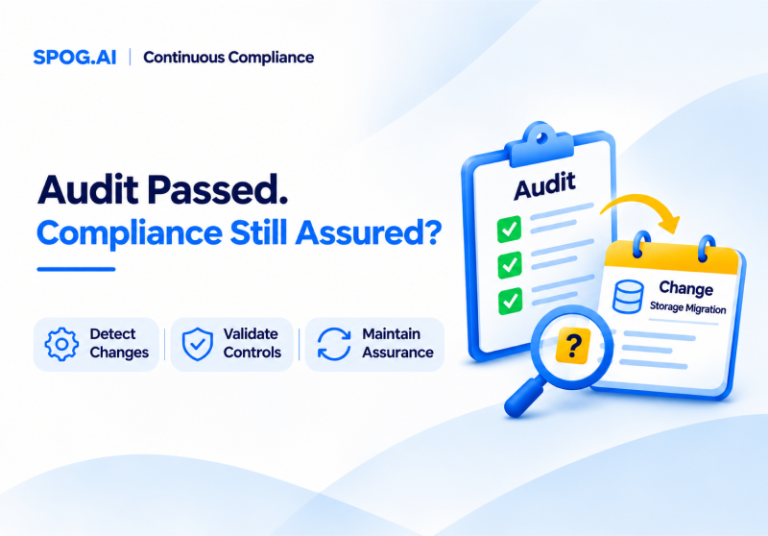
An audit can confirm that security controls met assessed requirements during a defined period. But system changes can...
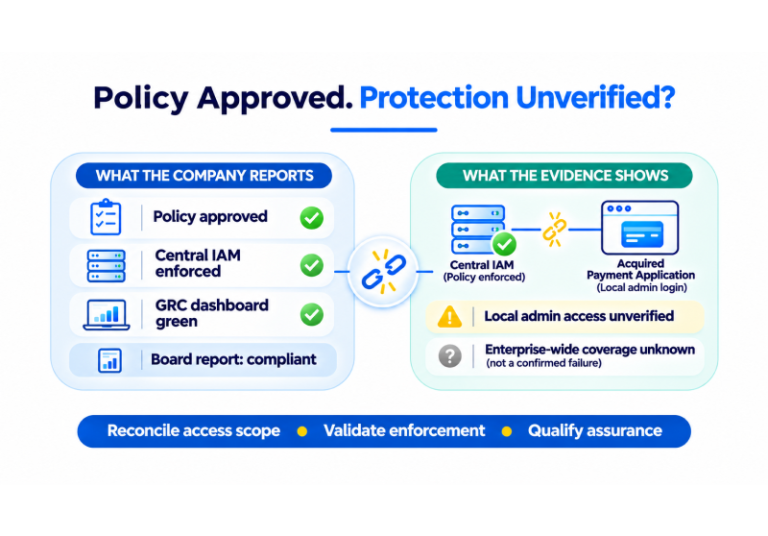
An approved policy can coexist with an unprotected business-critical system. The governance failure begins when leadership treats approval,...
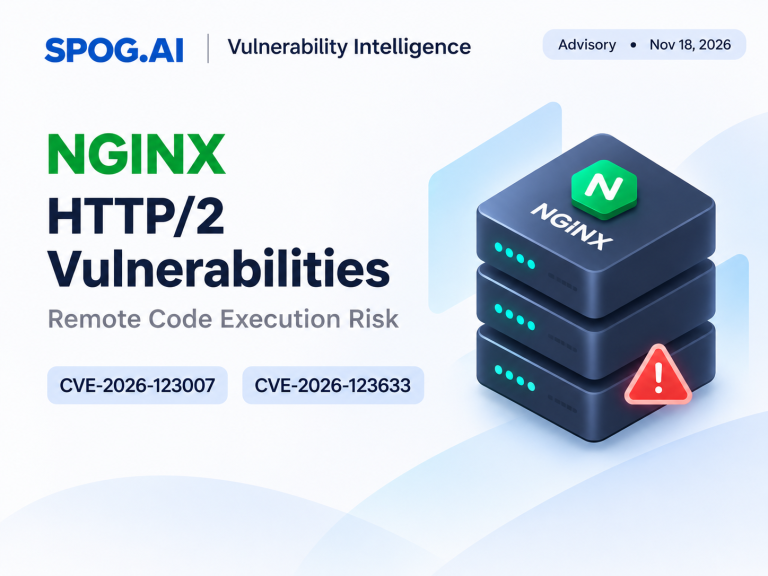
Two critical NGINX HTTP/2 vulnerabilities pose remote code execution risks. Understand which systems are affected, how existing security...