Continuous Control Monitoring
Why Passing an Audit Does Not Prove Ongoing Compliance
An audit can confirm that security controls met assessed requirements during a defined period. But system changes can...


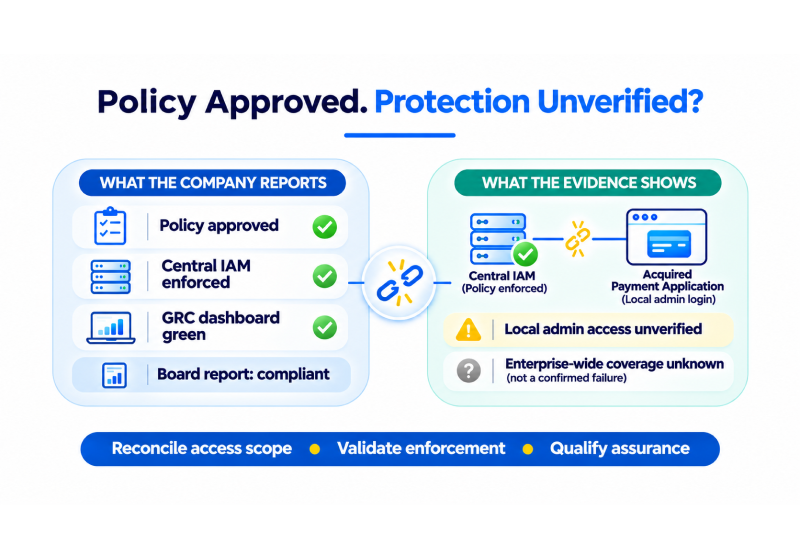
A newly acquired payment application is brought into an enterprise. The security policy requires phishing-resistant authentication for administrators. IAM reports the central policy as enforced, the annual policy review is signed, and the governance dashboard remains green. Yet the acquired application retains local administrator logins outside central authentication. The board receives a reassuring compliance summary without that limitation.
No compromise has been established. The problem is more fundamental: the enterprise cannot substantiate its assertion that privileged access to the payment service meets the approved requirement. A policy approval records management intent; it does not prove that every relevant enforcement point implements that intent.
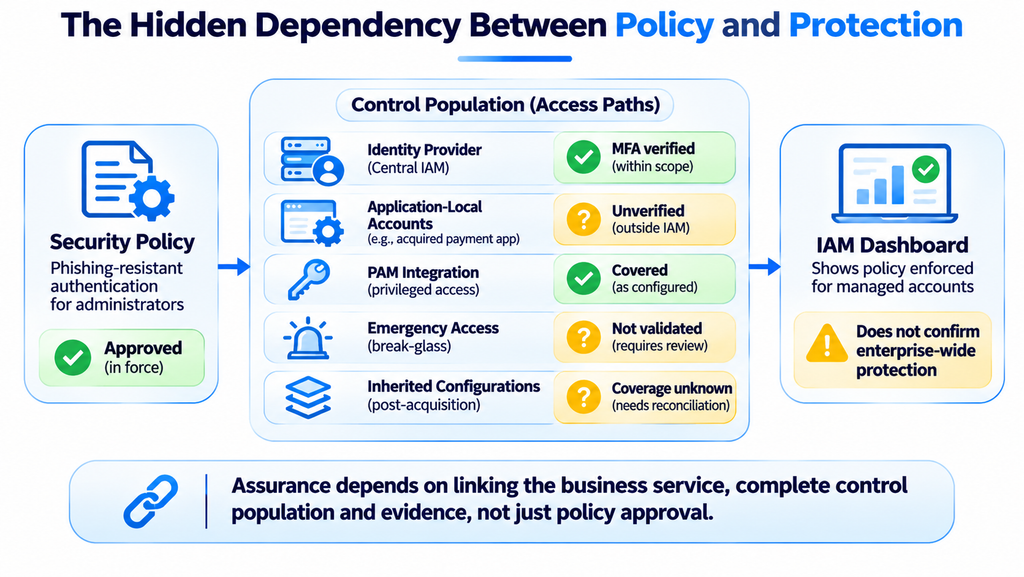
Policies define required outcomes, but protection depends on changing technical populations: identity providers, application-local accounts, PAM integrations, emergency access paths and inherited configurations. An acquisition can add new administrative routes without changing the policy version or the health of existing controls.
A central IAM query may accurately show that all accounts it manages have the required factor. That result says nothing about local accounts the identity source cannot see. Before reporting enterprise coverage, the control owner needs an authoritative inventory of systems and access paths, reconciliation of unmatched records, and evidence collected for a stated period.
An accurate IAM dashboard can still support an inaccurate enterprise-wide assurance claim.
The overlooked dependency is not another approval step. It is the link between a business service, its complete control population and the evidence that supports the claimed protection.
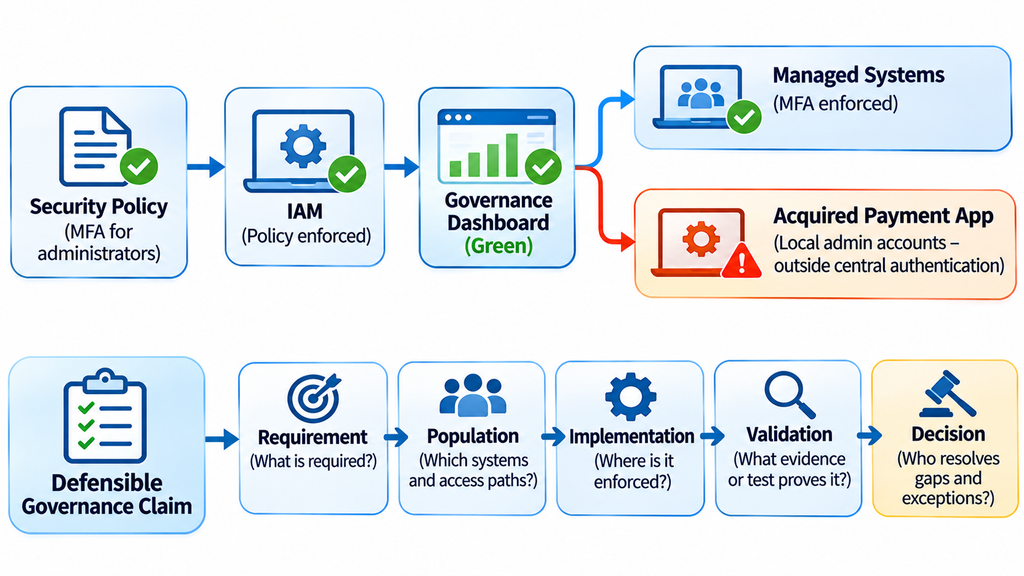
“The privileged-access policy is compliant” is too broad to test. A defensible statement identifies the requirement, affected population, enforcement points, observation period, validation method and unresolved conditions. These links answer different questions and cannot be substituted for one another.
| Governance link | Evidence question |
| Requirement | What protective outcome is required, and for whom? |
| Population | Which systems, identities and access paths are included? |
| Implementation | Where is the requirement actually enforced? |
| Validation | What observed state or controlled test supports the result? |
| Decision | Who resolves failures, accepts exceptions and qualifies unknowns? |
A mapping row that associates “privileged access” with “MFA enabled” may establish design traceability, but it does not demonstrate coverage or effectiveness across separate login paths. A policy-to-control map is therefore the starting point for assurance, not its conclusion.
Consider an illustrative review of 200 privileged access paths associated with the payment service. Identity and application records show 184 paths with the required authentication configured, eight approved time-bound exceptions, five observed paths missing the required factor and three unmatched records. The groups are mutually exclusive and total 200.
| Observed state | Paths | Management treatment |
| Required factor configured | 184 | Coverage observed; effectiveness requires appropriate testing |
| Approved exceptions | 8 | Record risk authority, safeguards and expiry |
| Required factor absent | 5 | Investigate and remediate confirmed gaps |
| Unmatched records | 3 | Keep unknown until sources are reconciled |
The 184 configured paths cannot automatically be described as 184 successfully protected paths. Configuration evidence establishes an observed setting; a representative, safe authentication test may be needed to support an enforcement-effectiveness claim. Equally, the three unmatched paths are unknown, not confirmed failures.
Configuration coverage describes what is assigned. Tested effectiveness describes what actually holds.
The governance decision now changes. Leadership cannot approve “all privileged access protected.” It can approve a qualified statement, direct investigation of the five observed gaps, require reconciliation of the three unknowns and ensure that exceptions have authorized owners and review dates. A broader assurance conclusion must wait for evidence that supports it.
The consequences are not limited to a compliance report. First, an application-local administrator may bypass centrally managed authentication or deprovisioning, depending on the application configuration and available safeguards. That creates a plausible exposure path, not proof of exploitation.
Second, disconnected control evidence can distort governance metrics. A dashboard may report high compliance because it measures only integrated systems, while an acquired business service remains outside the denominator. Management can then prioritize the wrong remediation work or accept residual risk without seeing the missing population.
Third, disconnected controls can delay incident response. If suspicious activity is detected on a local administrator account in the acquired payment application, the security team may not know who manages that account, whether central IAM or PAM controls apply, or who can authorize its immediate suspension. While teams establish ownership and coordinate action, the suspicious access may remain available. The same gap that produces incomplete assurance during routine reviews can delay containment during a security incident.
The NIST Cybersecurity Framework 2.0 Govern function connects policy, roles and oversight to cybersecurity risk decisions; it does not verify enforcement on a particular application. ENISA’s June 2025 technical implementation guidance offers contextual guidance on assessment methods and evaluation responsibilities for relevant NIS2 requirements, not a universal mandate for all enterprises.
The policy owner maintains the requirement; the control owner establishes its intended scope and evidence criteria. Technical operators discover enforcement points, investigate mismatches and implement corrections. The authorized business risk owner decides whether residual exposure can be accepted. Independent assurance challenges the evidence and the breadth of the claim.
For the payment application, a control owner should request the application account export, identity reconciliation, effective authentication configuration and test results. Missing feeds and stale records remain visible limitations. A corrected configuration needs fresh observation or a scoped retest before its assurance status changes.
Ownership is especially important after acquisitions, migrations, emergency changes and new exceptions. These events should trigger review of the mapping between requirements, business services, control populations and evidence rather than waiting for the next annual policy sign-off.
The challenge is not simply managing security policies. It is establishing whether those policies are implemented across the intended systems, identifying where evidence is missing, and ensuring that unresolved risks reach the right decision-makers.
SPOG.AI’s Governance, Risk & Compliance solution connects policy requirements with controls, supporting evidence, ownership and exceptions. Its Continuous Control Monitoring solution provides visibility into control conditions across connected systems, while Remediation workflows help assign findings, coordinate corrective action and track validation before closure.
In the acquired payment-application scenario, this connected approach helps the organization examine whether the approved authentication requirement is reflected in available IAM, PAM and application evidence. Missing account records or inconsistent enforcement can be identified as gaps requiring investigation rather than treated as proof of compliance. Control owners can assess the affected scope, technical teams can address confirmed issues, and authorized risk owners can decide on documented exceptions.
This gives leadership a clearer distinction between what the policy requires, what operational evidence confirms and what remains unresolved. Assurance still depends on connected-source coverage, configured scope and appropriate testing; SPOG.AI does not independently guarantee that every authentication path is protected.
For the related discipline of defining and maintaining policy requirements, see SPOG.AI’s cybersecurity policy management article.
The payment service did not expose a failure of policy drafting. It exposed a gap between management intent and the operational systems on which the assurance statement depended. A defensible decision states which requirement was assessed, which population was covered, what was tested, what remains unknown and who can authorize the next action.
An audit can confirm that security controls met assessed requirements during a defined period. But system changes can...
Seven critical PHP vulnerabilities pose risks of remote code execution and service disruption. While patching is essential, which...
Two critical NGINX HTTP/2 vulnerabilities pose remote code execution risks. Understand which systems are affected, how existing security...