Continuous Control Monitoring
Why Passing an Audit Does Not Prove Ongoing Compliance
An audit can confirm that security controls met assessed requirements during a defined period. But system changes can...


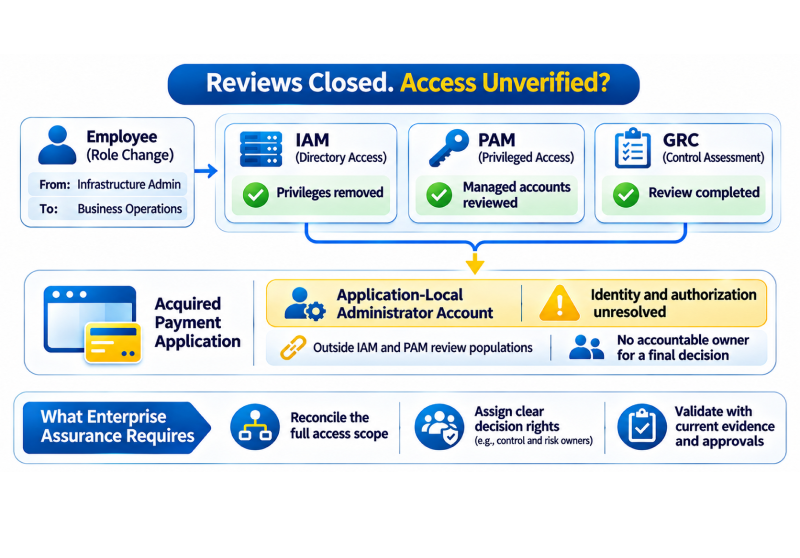
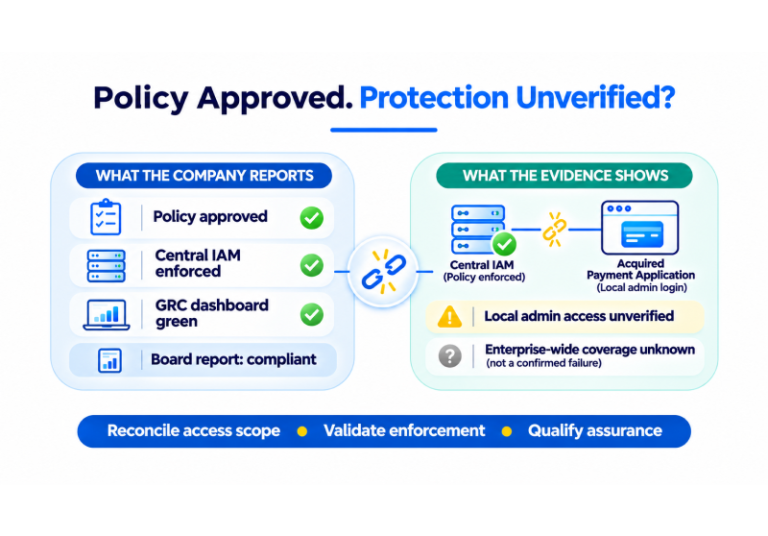
An enterprise completes its quarterly privileged-access review. IAM confirms directory privileges were removed, PAM signs off on managed credentials, and application teams submit their assessments. GRC marks the review complete. Yet an acquired payment application retains a local administrator account associated with an employee who moved out of infrastructure operations.
The directory access was removed, but the application-local account never appeared in IAM or PAM inventories. There is no evidence of misuse. What remains uncertain is whether the account is authorized, whether comparable accounts exist, and who has authority to resolve the discrepancy.
The overlooked account exposes a decision-rights gap: no single owner reconciled the access paths supporting the payment service before GRC approved the result.
A control register may name an owner without defining the outcome that person must defend. IAM can demonstrate directory deprovisioning, while PAM verifies managed credentials. Neither establishes authorization for application-local accounts outside those inventories.
The acquired application has its own identity store. Its administrators may be absent from centralized reviews. Establishing status requires application records, entitlements, last-use information and current approval. The control owner therefore needs a service-level assertion that covers directory, managed and application-local privileges.
Naming a control owner does not guarantee accountability for the control outcome.
Control ownership should follow the security objective and business service, not merely the technology implementing it. Enterprise policy owners establish requirements, while designated control owners determine whether those requirements hold across the intended population.
| Role | Required decision or contribution |
| Control owner | Defines scope, acceptance criteria, evidence requirements and escalation |
| Technical operator | Implements controls, supplies telemetry and corrects defects |
| Business risk owner | Accepts documented residual risk within delegated authority |
| Independent assurance | Challenges whether evidence supports the stated conclusion |
For the payment service, the control owner must ensure that IAM, PAM and application-local identities are reconciled. If teams dispute authorization, the owner assigns investigation and escalation. The authorized risk owner decides whether any remaining exposure can be accepted.
A RACI chart cannot replace final decision authority.
Consider 500 privileged identities supporting a payment service. The quarterly review produces the following illustrative results:
| Review outcome | Identities | Assurance conclusion |
| Authorization verified | 472 | Supported by reviewed evidence |
| Authorization problems | 8 | Confirmed defects requiring remediation |
| Authorization unresolved | 20 | Insufficient evidence to establish status |
| Total | 500 | Full population identified, but not fully assured |
Only 472 identities have verified satisfactory outcomes. Eight require corrective action, while 20 remain unresolved because approval or identity mapping is missing. Unknowns must not be counted as compliant or automatically classified as violations. Management can report 94.4% verified authorization, 1.6% confirmed defects and 4% unresolved, rather than presenting the review as an unqualified pass.
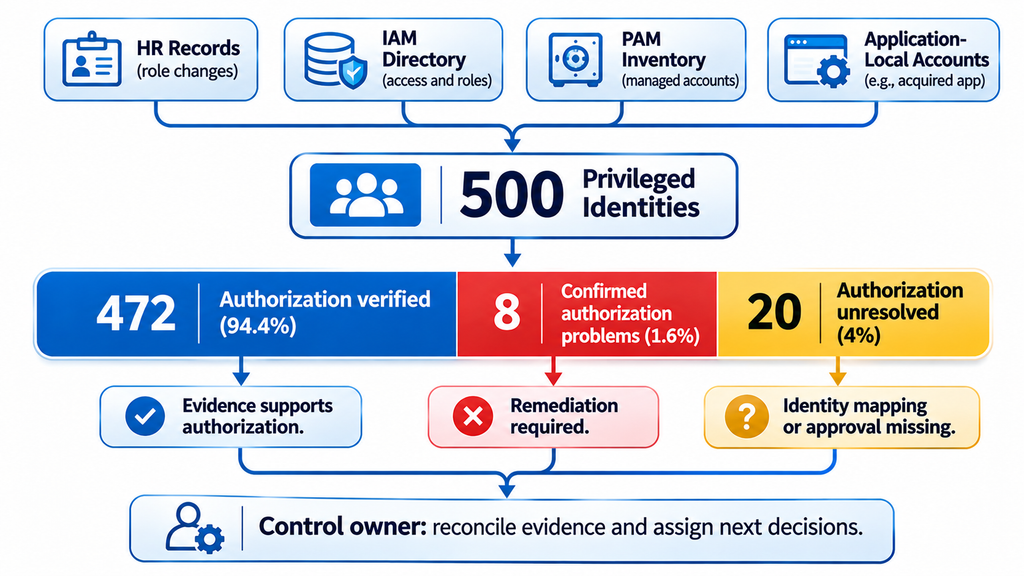
The control owner must reconcile HR, IAM, PAM and application records using stable identifiers, account ownership, entitlements and timestamps. Source provenance, collection dates, exclusions and evidence gaps should remain visible. Exceptions need authorized approval, safeguards and review dates; they do not increase verified coverage.
An unreviewed privileged account does not establish compromise or a regulatory breach. However, it can expose weaknesses extending beyond access administration.
Security exposure: Application-local administrators may retain capabilities outside centralized deprovisioning, privileged-session monitoring or other safeguards. Their actual exposure depends on privileges, reachable attack paths and effective compensating controls.
Governance and compliance: Management may rely on an assurance statement that excludes part of a critical service’s access population. Risk registers, audit findings and remediation reports can consequently present inconsistent conclusions about the same control.
Operational resilience: During a security incident, unclear ownership can delay emergency account suspension, authorization decisions and coordinated containment. Teams may first need to establish which system controls the identity and who can approve intervention.
For a critical payment service, that uncertainty can affect remediation priority, incident containment and the risk statement presented to leadership.
ISO/IEC 27001:2022 and NIST SP 800-53 Rev. 5 provide relevant requirements and controls for access governance, account management and control assessment. Applicable obligations depend on the organization’s control mapping; a signed review alone does not establish complete coverage.
Prioritization should consider service criticality, privilege, attack-path reachability, existing safeguards and the duration of uncertainty.
Acquisitions, employee transfers, cloud migrations and disconnected integrations can change a control’s population without changing its registered owner. The acquisition should trigger a fresh inventory of local administrators, a mapped control owner and a review of evidence-source coverage.
Organizations should use HR changes, asset discovery, application onboarding, migrations and connector failures to trigger ownership reassessment. Each material change needs a named decision-maker, investigation deadline and documented disposition. An earlier assurance statement should be qualified or reassessed when new evidence reveals that its claimed scope was incomplete.
Remediation closure should reflect what current evidence establishes, not simply whether a technical task is complete.
| Observed condition | Defensible closure decision |
| One local administrator disabled; other local accounts unreconciled | Close the specific action, retain the population-level gap |
| Account owner or approval cannot be established | Keep authorization unresolved and escalate |
| Authorization defect corrected and removal independently validated | Eligible for closure within verified scope |
| Authorized exception with safeguards and expiry | Report separately as accepted residual risk |
| Previously verified access reappears or evidence becomes stale | Reassess and reopen the affected assertion |
Closure records should identify the identities tested, the evidence date and any remaining unresolved accounts.
Fixing a defect does not prove assurance across an unverified control population.
In the payment-service scenario, the decision starts with a specific evidence gap: IAM and PAM records do not establish the authorization status of application-local administrators. SPOG.AI connects requirements, controls, evidence, ownership and exceptions with security, IT and business context so that this limitation can be considered alongside the control assertion rather than hidden behind completed review tasks.
SPOG.AI’s Continuous Control Monitoring solution helps teams monitor control conditions across connected systems and identify gaps in available evidence. When application-local accounts fall outside monitored coverage, control owners can document the visibility gap, assign investigations and qualify assurance conclusions. Remediation workflows support corrective actions and evidence-based closure, while Governance, Risk and Compliance connects control ownership, escalation and residual-risk decisions.
SPOG.AI cannot establish authorization from a feed it does not receive. The responsible teams must supply the missing application evidence, validate the outcome and obtain any required risk acceptance before claiming restoration.
Before accepting a control review, CISOs should ask for three things: a reconciled service-level population, evidence that distinguishes verified outcomes from unresolved cases, and one accountable authority for exceptions and closure. For the payment service, approval should remain qualified until the local administrator population is assessed and its outstanding decisions are documented.
An audit can confirm that security controls met assessed requirements during a defined period. But system changes can...
Seven critical PHP vulnerabilities pose risks of remote code execution and service disruption. While patching is essential, which...
An approved policy can coexist with an unprotected business-critical system. The governance failure begins when leadership treats approval,...