Continuous Control Monitoring
Security Questionnaires: Respond with Accurate, Verifiable Answers
Security questionnaires help buyers understand how a supplier protects the data, systems and services involved in a proposed...
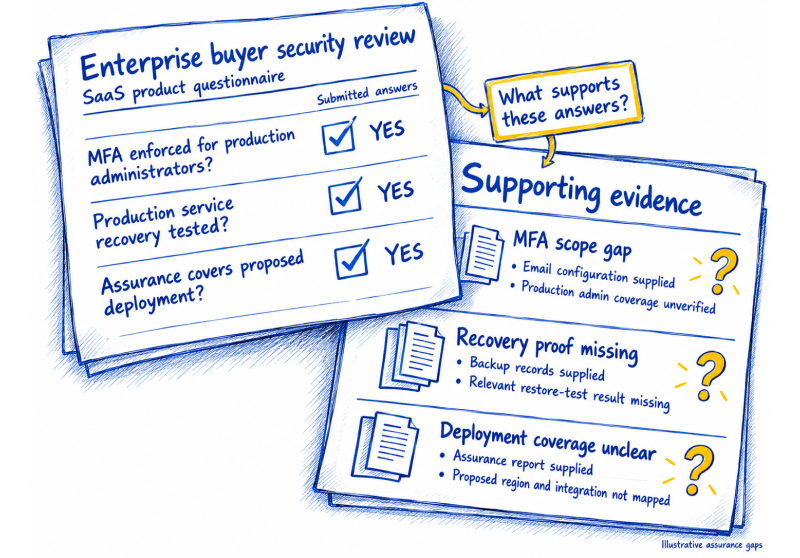
Enterprise reviews become difficult when a startup cannot connect four things: a clearly defined product boundary, risks that matter to that product, controls that address those risks, and current evidence showing that the controls operate as intended. Readiness is the discipline of keeping those connections accurate as the product and business change.
The objective is not to claim that risk has been eliminated. It is to explain what is in scope, how material risks are managed, what has been tested, where limitations remain, and who is accountable for decisions. That is what allows security, engineering, privacy, procurement, legal, and sales teams to give consistent answers without overstating protection.
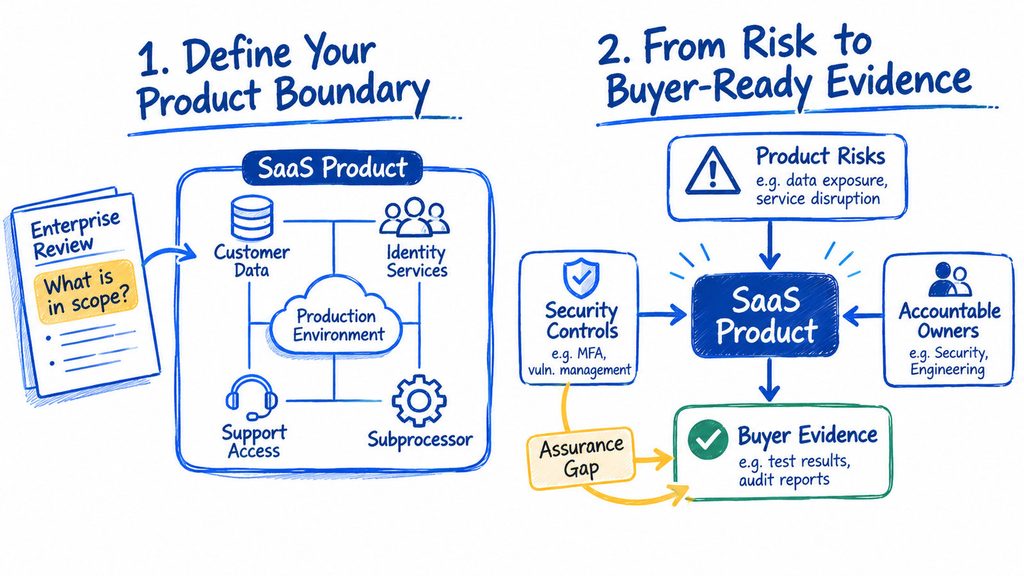
Before selecting controls or collecting evidence, define exactly what is being assessed. Document the production application, cloud or hosting accounts, identity services, data stores, deployment pipelines, administrative interfaces, support processes, backup environments, and subprocessors that store, process, transmit, or can access customer information.
Follow data and operational paths rather than relying on the organisation chart. Record the data types involved, where data is collected and processed, how it moves between services, who can access it, how long it is retained, and how deletion is performed. Include privileged support access, logging and telemetry, analytics integrations, backup copies, and recovery environments where relevant.
Make exclusions explicit. A shared cloud service, a customer-managed deployment, and a dedicated tenant can have different control responsibilities and evidence requirements. State which regions, product editions, environments, features, and services are covered. Explain material exclusions and avoid extending an assurance statement to a deployment or service that has not been assessed.
Map the buyer’s intended use to this boundary. A buyer handling sensitive personal information or relying on the product for a time-critical workflow may introduce requirements that do not apply to every customer. Route new use cases, integrations, or contractual commitments for review when they fall outside the assessed boundary.
Build the control programme around credible failure scenarios, not a generic checklist. Consider unauthorised access to customer data, tenant boundary failure, compromised privileged credentials, malicious or unsafe code changes, exploitation of a vulnerable component, loss of availability, data corruption, supplier compromise, and delayed incident response.
For each scenario, identify the affected assets and data, threat sources, existing safeguards, plausible business consequences, and relevant customer commitments. Assess likelihood and impact using a documented scale. Consider factors such as exposure to the internet, exploitability, known exploitation, asset criticality, data sensitivity, privilege level, compensating controls, and the potential effect on customer operations.
Record inherent risk before safeguards and residual risk after considering control design and operating effectiveness. A vulnerability’s CVSS score can inform technical severity, but it is not a complete business-risk decision. Prioritisation should also consider exploit availability or observed exploitation, exposure, asset importance, reachable attack paths, business service dependency, and the feasibility and urgency of remediation.
Define risk treatment: remediate, mitigate with a documented compensating control, transfer where appropriate, avoid the activity, or formally accept the residual risk. Risk acceptance should identify the authorised risk owner, rationale, affected service and customers, compensating measures, expiry or review date, and conditions that trigger reconsideration. An overdue action should not silently become accepted risk.
This approach helps a startup explain why a control is prioritised and why a temporary exception exists. It also prevents a low-risk checklist score from obscuring a small number of high-impact exposures.
Select controls that address the product’s actual failure paths. Depending on architecture and use, these may include multifactor authentication, least-privilege access, privileged access monitoring, tenant isolation, encryption in transit and at rest, key-management responsibilities, secure software development, dependency management, code review, change approval, vulnerability management, backup protection, recovery testing, security monitoring, and incident escalation.
For vulnerability management, define how assets and components are identified, how findings are validated and prioritised, who owns remediation, and how closure is verified. Set risk-based remediation targets for severity and context rather than treating every vulnerability equally. Document exceptions, compensating controls, patch deferrals, and the evidence required to demonstrate that remediation was effective.
Patch management is more than deploying an update. It includes identifying affected technology, assessing applicability and urgency, acquiring and testing the update, deploying it safely, and verifying installation. Where immediate patching is not possible, document the exposure, temporary mitigation, accountable owner, target date, and reassessment trigger. NIST SP 800-40 Rev. 4 provides guidance on enterprise patch management planning and verification.
Include operational dependencies. Strong cloud configuration does not compensate for unrestricted support access. A documented incident plan does not establish who can declare an incident or approve customer notification. A vendor questionnaire does not show what customer data a subprocessor receives or which controls protect it.
Assign clear responsibilities. Security may define control objectives and monitor risk; engineering may implement and operate technical safeguards; IT may manage workforce identity and endpoints; privacy or legal may interpret data and contractual obligations; product owners may confirm intended behaviour; and business owners may assess service impact. Name an executive or designated risk owner for material residual risks. Control operation, independent review, and risk acceptance should not be treated as interchangeable approvals.
A recognised framework can provide structure and a common language, but it does not replace product-specific risk analysis. NIST Cybersecurity Framework (CSF) 2.0 organises cybersecurity outcomes across six Functions: Govern, Identify, Protect, Detect, Respond, and Recover. Use these Functions to check whether governance, asset and risk understanding, safeguards, monitoring, incident handling, and recovery are all addressed. The Functions should be considered together and adapted to the organisation’s context.
Map selected outcomes to the product boundary, risk scenarios, accountable owners, and evidence. Do not claim that a framework mapping proves implementation or certification. NIST CSF 2.0 is a risk-management framework, not a prescriptive control set or a certification by itself.
Where relevant to buyer expectations, explain how independent assurance such as a SOC 2 report or an ISO/IEC 27001 certification supports the programme. Be precise about the report or certificate type, scope, period or validity, locations, systems, exclusions, and any complementary customer controls. A SOC 2 report is not a blanket certification of every product feature; an ISO/IEC 27001 certificate applies to a defined information security management system scope. Both may need product-specific explanations and supporting evidence.
For suppliers and subprocessors, incorporate cybersecurity supply-chain risk management into vendor selection and ongoing oversight. Assess service criticality, data access, security commitments, incident notification, subcontracting, resilience, and exit or data-return arrangements. Reassess material providers when their service, access, ownership, or risk profile changes.
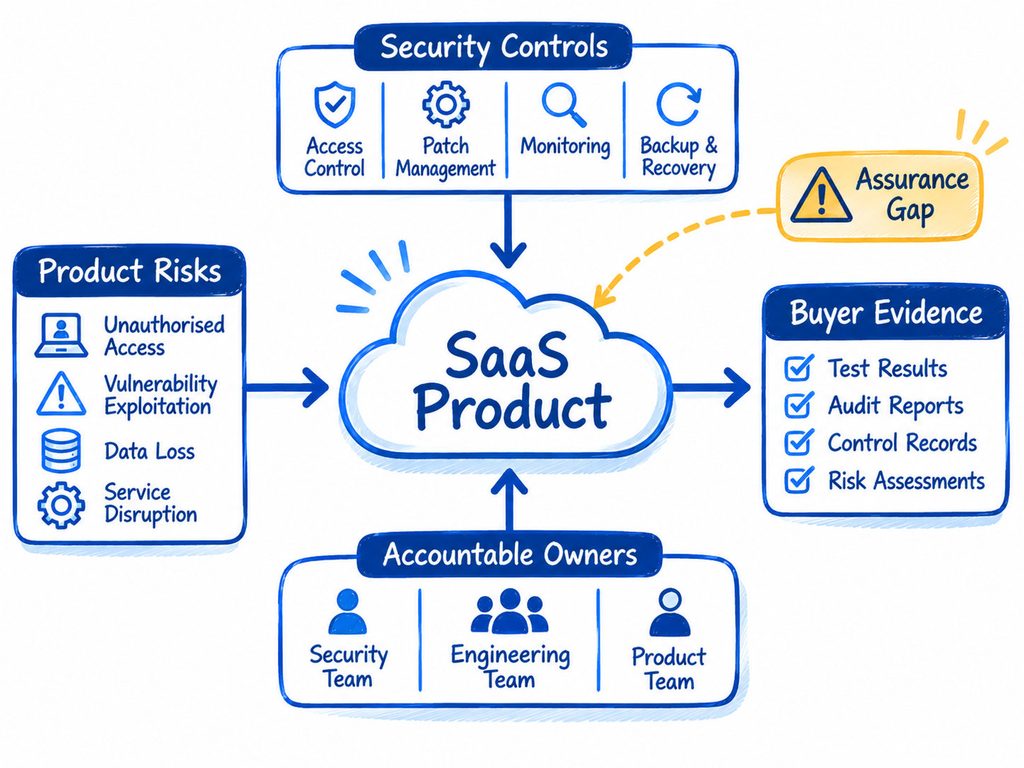
Evidence should match the product, control, population, environment, and period described by the claim. For each material control, record its objective, owner, expected condition, systems and users in scope, evidence source, test method, test date or period, result, exceptions, and follow-up action.
For example, “multifactor authentication is enabled” is incomplete if it applies to workforce email but not production administrators. A defensible statement identifies the relevant identity provider, privileged-user population, production environments, exceptions, and evidence period. Similarly, a recovery claim should state which service and data were included in the test, when it was performed, the result, and any limitations not simply that backups exist.
Distinguish among verified, partially verified, unverified, and not applicable. Missing evidence does not automatically prove a control failed, but it cannot support an unqualified assurance claim. Record the reason, assign an owner, assess the risk, and decide whether more testing or a qualified response is needed.
Use evidence appropriate to the control. Examples include access-review records, configuration exports, change tickets, vulnerability and remediation records, dependency scans, restore-test results, incident exercise outcomes, vendor assessments, and approved policies. Where evidence is sampled, record the sample and selection method. Where a control is automated, retain enough configuration and operating evidence to show that it was active during the period being represented.
Keep a traceable relationship: buyer requirement → product boundary → risk → control → owner → evidence → result → exception or action. This makes evidence easier to refresh and helps reviewers understand not only that a document exists, but what it demonstrates and what it does not.
Prepare a secure, access-controlled package that can be tailored to a buyer’s legitimate use case. It may include a security overview, architecture and data-flow summary, relevant audit reports or certificates, subprocessor list, privacy and retention information, incident contacts, business continuity and recovery summary, vulnerability management approach, and shared-responsibility explanation.
Assign an owner and review date to every artifact. Record its approved version, product and region covered, evidence period, approval date, sensitivity, and next refresh date. Restrict sensitive reports and detailed architecture information to authorised recipients. Replace outdated diagrams and ensure customer-facing excerpts retain the qualifications and scope notes that make them accurate.
Maintain a controlled answer library for recurring questions, but do not automate complex judgement into an unconditional “yes.” Data residency, for example, can depend on primary hosting, backups, support access, telemetry, subprocessors, and contractual commitments not just the cloud provider’s region selection. Route exceptions and novel use cases to the relevant security, privacy, legal, or engineering owner.
A certificate or independent report can support assurance, but check its scope, period, exclusions, and relevance to the product and service under review. Do not imply that a report covers systems or activities outside its stated scope.
Run a realistic review with security, engineering, product, privacy, legal, and account owners. Ask each team to explain the same product boundary, data flows, control responsibilities, known limitations, and customer commitments. Conflicting answers often reveal undocumented assumptions: one person describes the production service, another cites a roadmap feature, and a third repeats an outdated questionnaire response.
Use a scenario grounded in the actual architecture and contract. For example, a customer enables a new identity provider, user data is sent to an analytics subprocessor, and the product supports a time-sensitive workflow. Ask who approves the integration, what data moves, how access is controlled, which supplier obligations apply, how the integration is monitored, and who coordinates communication if the provider is compromised.
Exercise incident decision-making as well as technical response. Confirm who classifies an event, preserves evidence, engages legal and privacy specialists, assesses customer impact, approves external communications, and tracks recovery. Test escalation paths and customer notification commitments against actual contracts and applicable obligations. NIST SP 800-61 Rev. 3 recommends integrating incident response throughout cybersecurity risk management rather than treating it as a standalone activity.
Record each gap with its severity, business and customer impact, owner, due date, treatment decision, and evidence required for closure. If a protection is missing, implement it, introduce a defensible compensating measure, restrict the use case, qualify the answer, or decline the commitment. A sales promise must not become an implicit security control.
Questionnaire completion counts measure workload, not assurance quality. Use measures that show whether important controls and decisions are reliable. Useful indicators include the proportion of material buyer-facing claims supported by current evidence; overdue high-risk vulnerabilities; time to remediate or formally treat material findings; privileged-access reviews completed on schedule; recovery tests meeting defined objectives; critical supplier assessments current; and incidents or exercises with overdue corrective actions.
Define each metric’s numerator, denominator, scope, reporting period, and exclusions. Report exceptions separately. A high pass rate can conceal a weak baseline if out-of-scope systems, missing evidence, or overdue items are excluded without explanation. Pair quantitative measures with management review of significant residual risks and recurring control failures.
Reassess when material changes affect the product boundary or risk: new integrations, AI features, data types, regions, hosting models, customer-managed deployments, privileged support paths, subprocessors, acquisitions, or contractual commitments. Review the relevant risks, controls, owners, evidence, and customer-facing language before the change is represented as covered.
Set a regular review cadence proportionate to risk, and trigger additional reviews after significant incidents, major architecture changes, material supplier changes, or changes in buyer obligations. Readiness is an operating discipline, not a one-time preparation exercise.
SaaS security readiness depends on connecting governance decisions to the operational information that supports them. SPOG.AI’s GRC capabilities can support oversight of requirements, controls, risk ownership and related evidence. Continuous Control Monitoring can support ongoing visibility into control coverage and assessment results. Exposure Management can help teams understand and prioritise technical exposure in business context, while Remediation can support accountable action tracking and validation.
These capabilities are relevant when configured against the organisation’s actual control objectives, evidence sources, asset and service context, and workflows. They do not independently establish compliance, certify a product or guarantee that a buyer’s requirements are met. The startup remains responsible for validating scope, assessing risk, approving evidence and making accurate customer-facing claims.
Enterprise buyers need to understand the product they are buying, the data and services in scope, the safeguards that protect them, the supporting evidence and the responsibilities shared between provider and customer.
A SaaS startup earns confidence when it connects a clearly defined product boundary to risk-led controls, accountable owners, current evidence and accurate commitments. SPOG.AI’s GRC capabilities can support that connection by bringing requirements, controls and operational evidence into governance oversight. Readiness means explaining what is true, what remains uncertain, what action is underway and who is accountable.


Security questionnaires help buyers understand how a supplier protects the data, systems and services involved in a proposed...

A vendor cybersecurity inquiry should establish what the supplier will do, which data and systems it can access,...

A vendor management policy sets the rules for approving suppliers, accepting exceptions and responding when relationships change. This...