Continuous Control Monitoring
Why Passing an Audit Does Not Prove Ongoing Compliance
An audit can confirm that security controls met assessed requirements during a defined period. But system changes can...


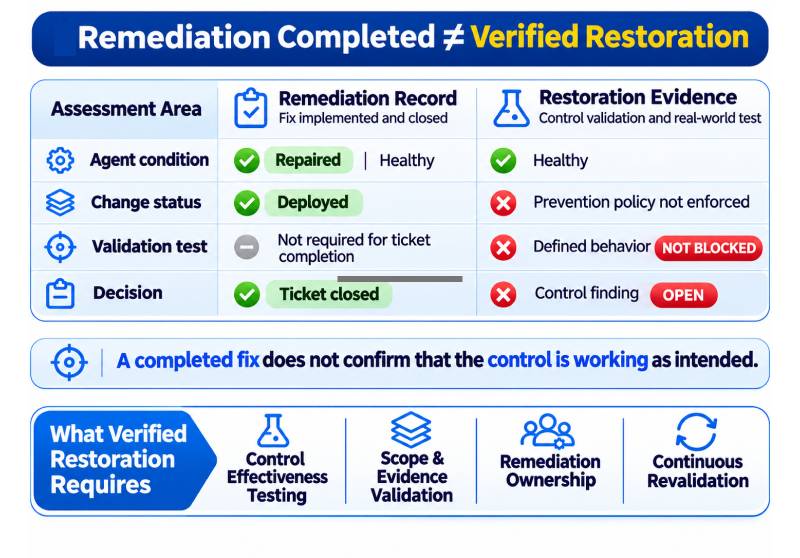
On Friday, a critical application server fails a controlled endpoint detection and response (EDR) prevention test. Engineering repairs its unhealthy agent, restores its connection to the management console, and closes the change request. On Monday, the same safe test generates an alert but the prohibited behavior is not blocked. The agent is healthy; the protection is not.
The distinction travels beyond the server. The completed ticket can disappear from escalation, reduce the count of open control findings and inform a risk report that the exposure has been removed. Yet the original prevention objective remains unmet. The closure record has become more reassuring than the evidence.
For security and GRC leaders, the decision is therefore not whether a component was repaired. It is whether the failed protection now operates as required, on the relevant systems and paths, with uncertainty still visible.
A deployment record establishes that work occurred. An EDR health indicator confirms that an agent is communicating. Neither establishes that a prevention rule is applied in the correct mode or that a defined behavior is blocked. Each claim requires evidence suited to that claim.
In the opening case, the repaired agent sends telemetry to the console, but the prevention policy remains assigned incorrectly. The next controlled exercise produces a detection event without the expected prevention action. The original failed outcome survives the repair.
This is a restoration problem rather than a generic coverage lesson. The finding cannot be closed merely because the suspected component is healthy. The organization must repeat the relevant test, determine why it still fails and establish a passing outcome before changing the assurance status.
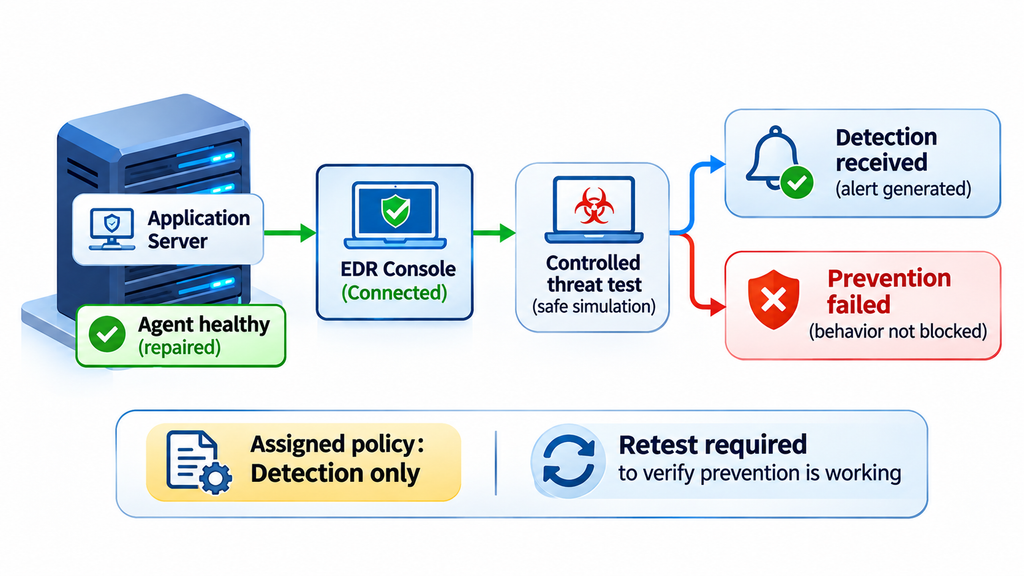
A restoration claim should name the protective outcome, affected systems, test conditions, allowable exclusions and evidence window. In this case: “The EDR prevention policy must block the defined test behavior on the in-scope application server while preserving approved application operations.” A claim this specific can be challenged.
Preserve the original failed test, server identity, agent and policy versions, event timestamps, expected prevention action, business service dependency and accountable owner. The retest must address the same relevant failure condition, with documented changes to the test if the environment has changed.
For a preventive control, a safely executed negative-path test may be necessary. For a detective control, the expected alert must reach the intended response destination. For backup recovery, application and data integrity may matter more than job completion. The evidence must match the outcome being claimed.
A healthy security component is not proof that its intended protection has returned.
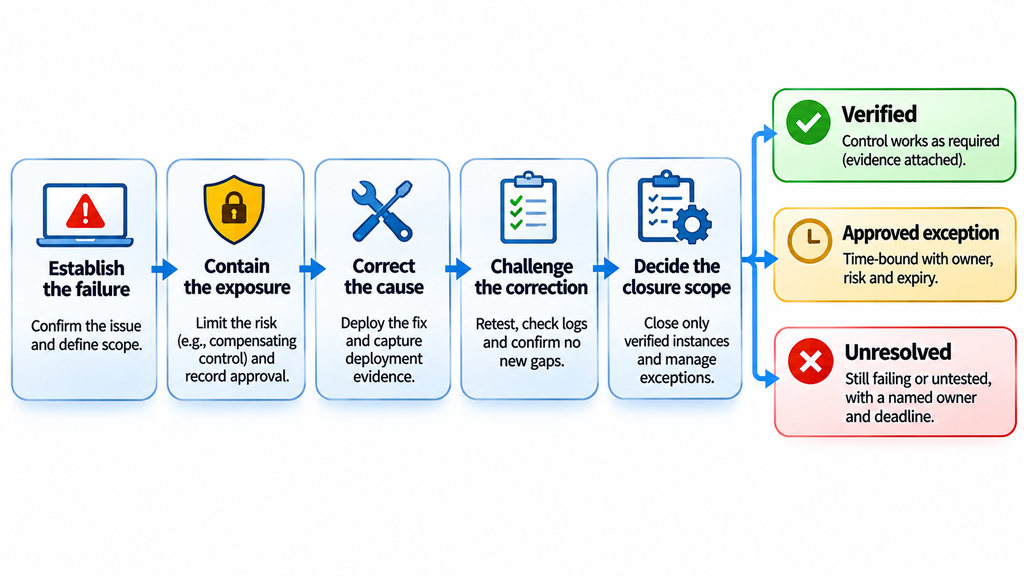
The practical sequence involves five separate decisions. Collapsing them into one “resolved” status makes it difficult for assurance teams to see where the proof ends.
1. Establish the failure. Corroborate or reproduce the observation, identify the affected scope, and distinguish a confirmed failure from missing or stale telemetry.
2. Contain the exposure. Limit the vulnerable path or apply a compensating control while the permanent correction proceeds. Record any temporary risk acceptance with its approver and expiry.
3. Correct the cause. Link the change, version, deployment evidence and dependencies to the finding. This proves what was implemented, not that the protection was restored.
4. Challenge the correction. Repeat the relevant failing test, reconcile the current target population, inspect logs and check that the change has not introduced a new gap in adjacent paths.
5. Decide the closure scope. Close verified instances only. Keep exceptions and unknown outcomes separate, with named owners, deadlines and criteria for reopening.
Consider the critical application server from the opening. Its EDR agent stops enforcing a defined prevention behavior. Engineering repairs the agent and restores telemetry. A change record, successful heartbeat and healthy dashboard establish that the component is operational. None yet proves that the original prohibited behavior will be stopped.
A controlled test uses an approved, non-destructive simulation designed for that specific prevention policy. The console records the event, but the action is not blocked. Investigators find that the server remains assigned to a detection-only policy. This is not an unknown result: the intended preventive outcome has demonstrably failed.
Engineering corrects the policy assignment, verifies that the effective policy reaches the server and repeats the same controlled test. This time the platform blocks the defined behavior and produces the expected event record. The reviewer checks the server identity, policy version, timestamps, test method and result, and confirms that the change did not disrupt the application.
The closure decision is limited to that demonstrated scope and time. If other servers were implicated in the original finding, they require their own evidence or an appropriately justified representative test. An untested server remains unresolved, even when the repaired server passes. This scenario is illustrative, not customer data.
A closure record should let a reviewer reconstruct the claim without interviewing the implementer: control objective; current target population; original failure; change reference; test method and environment; observed results; timestamps and evidence source; exceptions; unresolved instances; and approval authority. Evidence is sufficient only for the claim it actually supports. For broader guidance, the NIST Cybersecurity Framework (CSF) 2.0 emphasizes managing cybersecurity risk through defined outcomes, including response, recovery, and continuous improvement.
The decision to close a control finding must reflect what the available evidence proves, not simply whether corrective action has been completed. The following scenarios illustrate how different validation outcomes affect closure decisions.
| Observed condition | Defensible closure decision |
| Agent repaired; no retest | Restoration unverified |
| Agent healthy; prevention test fails | Control failure remains open |
| Defined prevention test passes with current logs | Eligible for scoped closure |
| Server passes; other affected systems untested | Verified only for tested scope |
| Approved exceptions remain | Report exceptions separately with owners and expiry |
| Previously verified path fails after later change | Investigate and reopen or create a new finding |
Independent validation need not require another department to execute every test. It does require evidence capable of contradicting the implementer’s claim, plus proportionate review. An EDR console heartbeat alone is weaker than a reproducible controlled test supported by current policy state and event logs.
Closure is defensible only for the protection the evidence actually demonstrates.
A passing test is evidence of restoration at a particular time and within a defined scope, not a guarantee of permanent effectiveness. Later policy changes, agent exclusions, application upgrades or telemetry gaps can invalidate the conclusion. The monitoring plan must identify signals that warrant renewed investigation.
Relevant reopening signals include a subsequent failed prevention test, an unexpected policy-mode change, stale endpoint telemetry, a new exception or a material change to the protected service. Track time to verified restoration separately from time to change deployment; do not report an untested condition as a success.
SPOG.AI’s Continuous Control Monitoring solution connects control requirements, operational state and current evidence to support post-remediation assurance. Its Remediation solution links findings, accountable owners, corrective actions and outcome validation, helping teams distinguish completed fixes from verified restoration. The scope of validation depends on connected data sources and configured tests.
Premature closure changes the story leadership receives. A risk register may show reduced exposure and an audit packet may include a completed ticket, even though the original prevention test still fails. The governance problem is not the existence of a dashboard. It is the unsupported conclusion carried into a risk decision.
Engineering should retain implementation evidence. A validator or reviewer should assess the restoration claim. The control owner should confirm the intended scope, while the authorized risk approver handles any residual exposure that cannot yet be resolved. Technical closure and risk acceptance are different decisions. For enterprise risk governance context, see NIST SP 1308 (2026).
The executive question is: “Which protection has been demonstrated, under what test conditions, and what remains unresolved?” A credible answer lets leadership distinguish a repaired component from a restored safeguard.
A repaired component is not a restored security control. The defensible conclusion comes from a clearly defined protective outcome, a test that could disprove it, current evidence that it now holds and an accountable decision about anything left unresolved. Close the finding only as far as the evidence reaches.
An audit can confirm that security controls met assessed requirements during a defined period. But system changes can...
Seven critical PHP vulnerabilities pose risks of remote code execution and service disruption. While patching is essential, which...
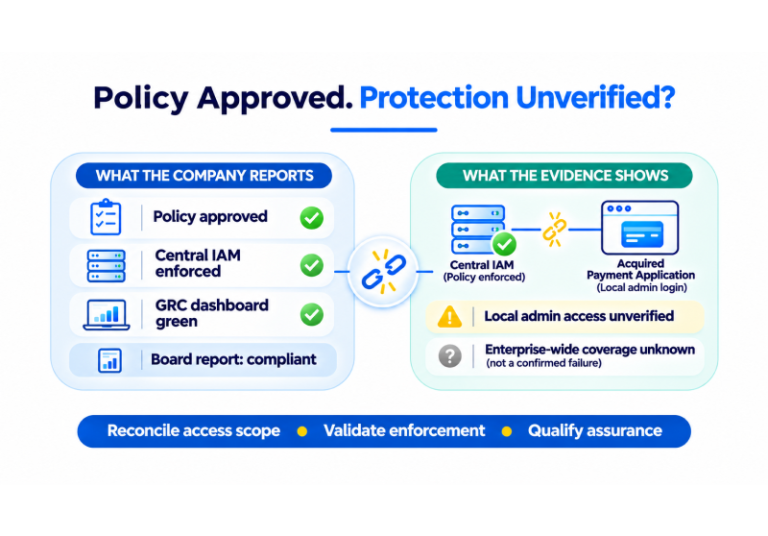
An approved policy can coexist with an unprotected business-critical system. The governance failure begins when leadership treats approval,...