Continuous Control Monitoring
Why Passing an Audit Does Not Prove Ongoing Compliance
An audit can confirm that security controls met assessed requirements during a defined period. But system changes can...


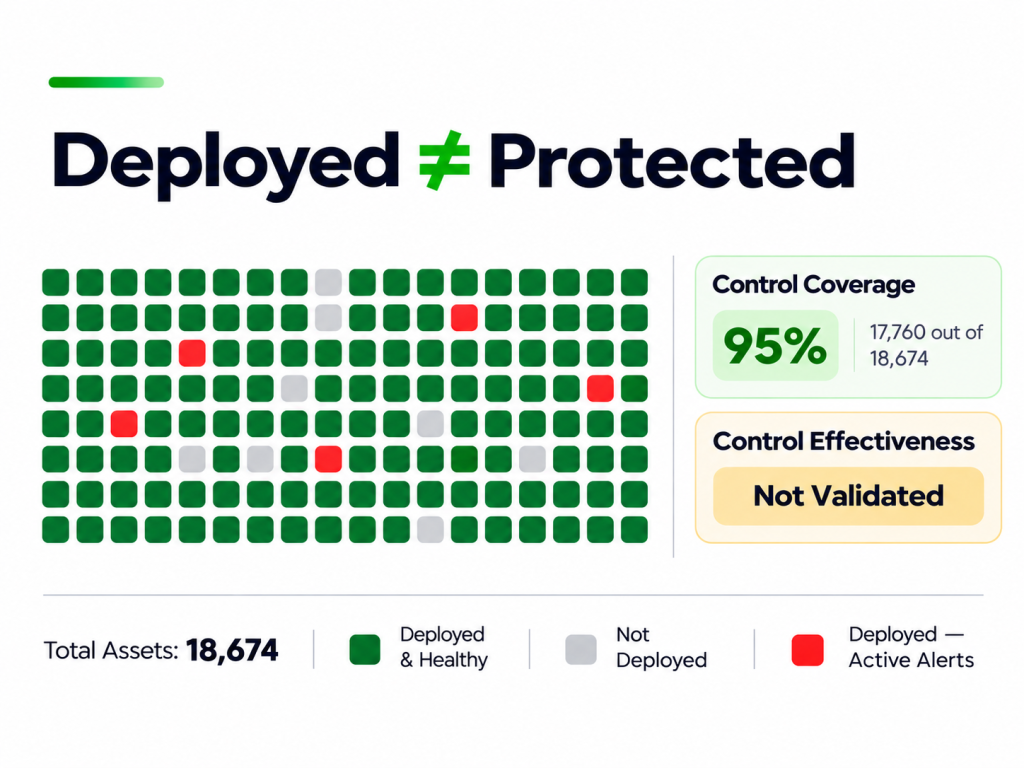
The confusion is understandable. Security technologies are designed to report what they can observe: whether an endpoint security client is installed, a policy is configured or a system is reporting. These measurements are relatively straightforward to automate and present as percentages. Establishing whether a control actually delivers its intended protection requires a different level of evidence.
The challenge becomes more significant across an enterprise, where security requirements span multiple technologies and environments. Measuring coverage requires understanding where controls should be implemented under the organization’s IT security policies, while measuring effectiveness requires validating whether those controls achieve their intended objectives.
Without this distinction, organizations may report strong security control performance while overlooking weaknesses that undermine protection.
Coverage tells you whether a control is where it should be. Effectiveness tells you whether it does what it should do.
Control coverage measures the proportion of applicable assets, systems, identities or processes where a required security control is deployed and observable. It establishes whether the control reaches the environment it is intended to protect.
The starting point is the organization’s IT security policy and associated control standards. These define which controls are mandatory, where they apply and what exceptions are permitted.
For example, an endpoint security policy may require EDR protection across managed endpoints while excluding systems where the EDR client cannot be installed or supported, such as certain VMware infrastructure components, factory-locked devices or systems running custom operating systems. Such exclusions should be explicitly defined, approved and assessed for alternative protection rather than automatically treated as compliant.
Coverage must be evaluated against this defined scope, not simply the systems visible within a particular security tool. An EDR dashboard may report thousands of connected clients, but establishing enterprise-wide coverage requires comparing those records with the complete population of endpoints that should have EDR protection.
Control Coverage (%) = (Covered Applicable Units ÷ Total Applicable Units) × 100
Accurate coverage measurement requires reconciling asset inventories, deployment records and approved exceptions. Newly discovered assets, duplicate records, retired systems and missing telemetry can affect the calculation.
To enforce an effective control coverage monitoring, systems without sufficient evidence should remain visible as unresolved rather than being excluded from the applicable population. Otherwise, reported coverage may improve without any corresponding increase in protection.
Control effectiveness measures whether a security control achieves its intended security objective under defined operating conditions. Unlike coverage, which establishes where a control is deployed, effectiveness evaluates the protection it actually delivers.
The expected outcome depends on the control’s purpose. A preventive control should enforce the required restriction, a detective control should identify relevant activity, and a recovery control should restore systems or services within defined objectives.
A security control can be fully deployed and operationally healthy yet fail to deliver the intended protection. For example, an EDR client may be installed, connected and reporting telemetry but operating in monitoring-only mode rather than prevention mode. If the organization’s security policy requires active threat blocking, this represents a configuration compliance failure against the required preventive baseline.
However, confirming that prevention mode is enabled does not establish that relevant attacks will actually be blocked. That requires additional evidence demonstrating the control’s performance.
Effectiveness assessment therefore requires measurable success criteria and evidence of actual outcomes. This does not always mean attack simulation or penetration testing. Authentication enforcement records, detection outcomes, operational observations, controlled tests and recovery exercises can demonstrate effectiveness when they directly validate the intended control objective.
The conclusions must remain within the scope of the evidence. A successful test demonstrates performance under the conditions evaluated, not proof of effectiveness against every possible threat.
| Dimension | Control Coverage | Control Effectiveness |
|---|---|---|
| Primary question | Where is the control deployed? | Does the control achieve its objective? |
| Measurement focus | Reach across applicable systems | Performance against defined outcomes |
| Assessment basis | Policy-defined scope | Control objectives and success criteria |
| Typical evidence | Asset inventories, deployment and telemetry records | Test results, execution records and observed outcomes |
| Example | Percentage of endpoints with verified EDR client deployment | Whether EDR successfully prevents relevant threats |
| Key limitation | Does not establish performance | Does not establish deployment across the environment |
| Management action | Address deployment and visibility gaps | Improve control design or operation |
These measurements serve different purposes and require different corrective actions. Coverage gaps typically involve missing deployments or visibility, while effectiveness failures may reveal weaknesses in configuration, control design or operational processes.
Consider an organization with 120 endpoints requiring EDR protection under its security policy, after accounting for approved exclusions.
Its EDR platform reports that 114 endpoints are connected, resulting in 95% verified coverage. A configuration assessment finds that only 102 of those endpoints meet the approved security baseline, which requires active prevention mode.
The organization then conducts 10 authorized prevention tests against defined attack scenarios. The EDR control successfully blocks eight scenarios but fails to prevent two.
| Measurement | Result |
|---|---|
| Endpoints requiring EDR | 120 |
| Endpoints with reporting EDR clients | 114 |
| Verified EDR coverage | 95% |
| Endpoints meeting configuration baseline | 102 |
| Configuration compliance across full scope | 85% |
| Prevention test scenarios | 10 |
| Successful prevention tests | 8 of 10 (80%) |
Illustrative assessment results. The prevention test outcomes apply only to the evaluated scenarios and test conditions.
The findings reveal three different conditions.
Coverage: EDR deployment and reporting are verified on 114 endpoints. The remaining six lack confirmed coverage, although this does not necessarily mean the client is absent.
Configuration compliance: Only 102 endpoints meet the approved baseline. The other 12 reporting endpoints have configuration deviations that require investigation or remediation.
Effectiveness: The EDR control successfully prevented eight of the ten tested scenarios. The two failures indicate weaknesses against the evaluated techniques, even though the tested control was deployed and operational.
The 80% test success rate should not be interpreted as an enterprise-wide effectiveness score. It describes performance against the selected scenarios under the conditions tested. The results must also be associated with the specific endpoints, configurations and policies used during validation.
Together, these findings demonstrate why deployment coverage, configuration compliance and effectiveness must be measured separately. Each reveals a different weakness and requires a different corrective action.
Not all control gaps create equal risk. A missing security control on a critical payment system can have far greater consequences than the same gap on an isolated test server. Similarly, an ineffective control protecting an internet-facing application may create more significant exposure than an identical failure in a low-criticality environment.
A 95% verified coverage score indicates that 5% of the applicable environment lacks confirmed protection. It does not reveal whether those systems are internet-facing, contain exploitable vulnerabilities, provide privileged access or support critical business services.
The significance of an effectiveness failure also depends on the threats the control is expected to address and the availability of compensating controls.
Importantly, control effectiveness and risk reduction are related but distinct. Effectiveness establishes whether a control performs its intended function, while risk reduction depends on how relevant that function is to the threats, vulnerabilities and business assets being protected.
A technically effective control may contribute little to reducing a particular risk if it does not address the exposure driving that risk. Conversely, an ineffective control protecting a critical business service against an active threat may create material risk.
Connecting control findings with asset criticality, vulnerabilities, threat intelligence, attack paths and business service dependencies enables organizations to prioritize weaknesses according to their potential consequences rather than treating every deviation equally.
Security environments change continuously as assets are introduced, configurations are modified and controls stop reporting. Periodic assessments provide valuable assurance, but their findings can quickly become outdated.
Continuous Control Monitoring (CCM) addresses this challenge by continuously evaluating control evidence against defined security requirements. It helps organizations identify coverage gaps, configuration deviations and operational weaknesses as conditions change. Where supported by appropriate validation evidence, it can also help assess control effectiveness.
However, identifying a control failure is only part of the challenge. Organizations must also understand which assets and business services are affected and whether the weakness creates material risk.
SPOG.AI connects control evidence across security and IT technologies with assets, vulnerabilities and business services, helping organizations move beyond isolated control scores to understand the potential business impact of control weaknesses and prioritize remediation.
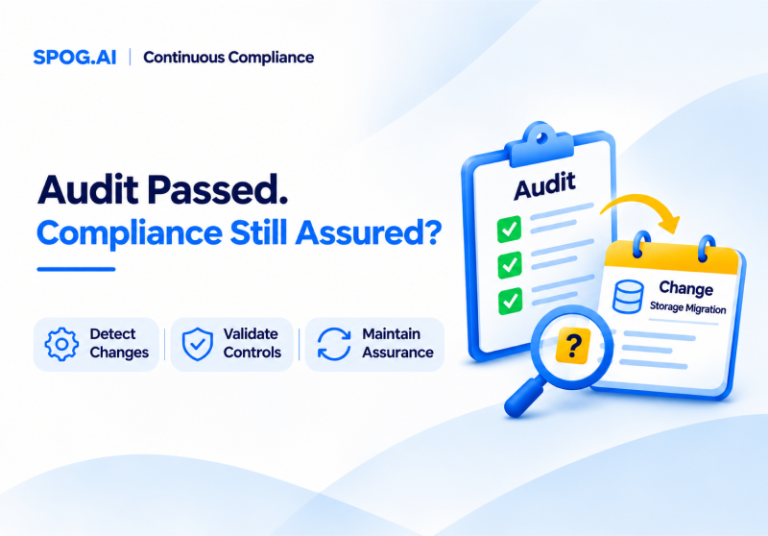
An audit can confirm that security controls met assessed requirements during a defined period. But system changes can...
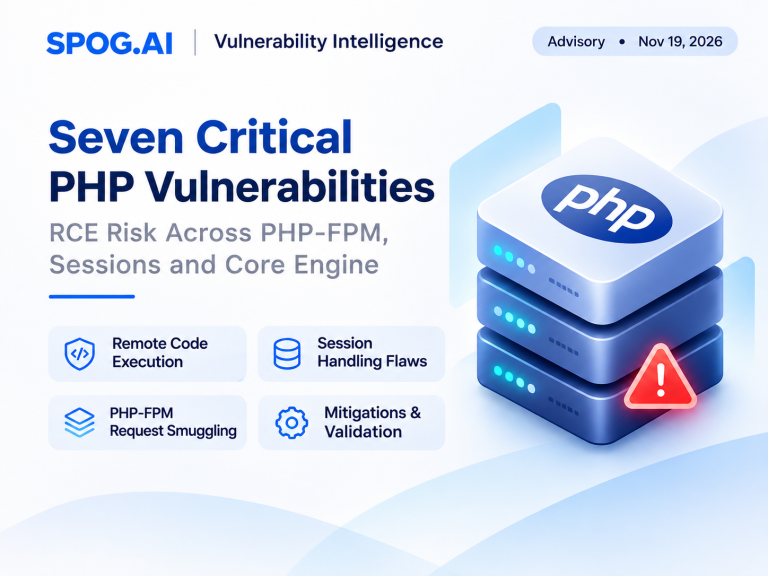
Seven critical PHP vulnerabilities pose risks of remote code execution and service disruption. While patching is essential, which...
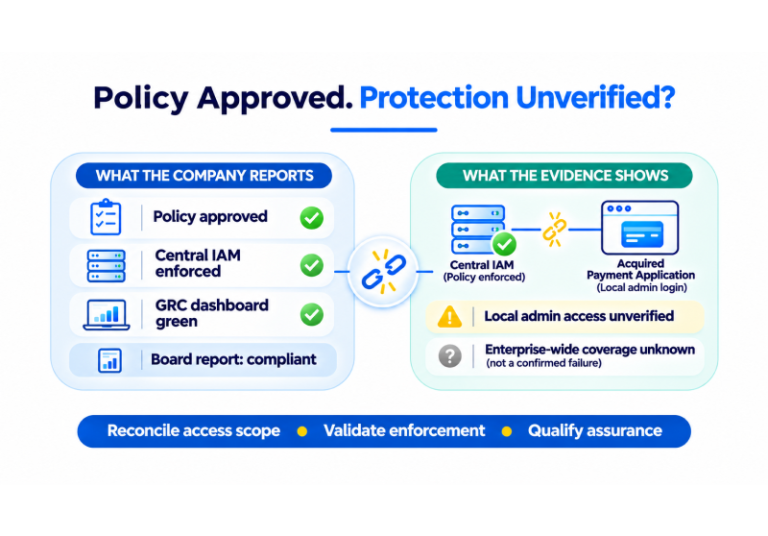
An approved policy can coexist with an unprotected business-critical system. The governance failure begins when leadership treats approval,...