Continuous Control Monitoring
Security Questionnaires: Respond with Accurate, Verifiable Answers
Security questionnaires help buyers understand how a supplier protects the data, systems and services involved in a proposed...
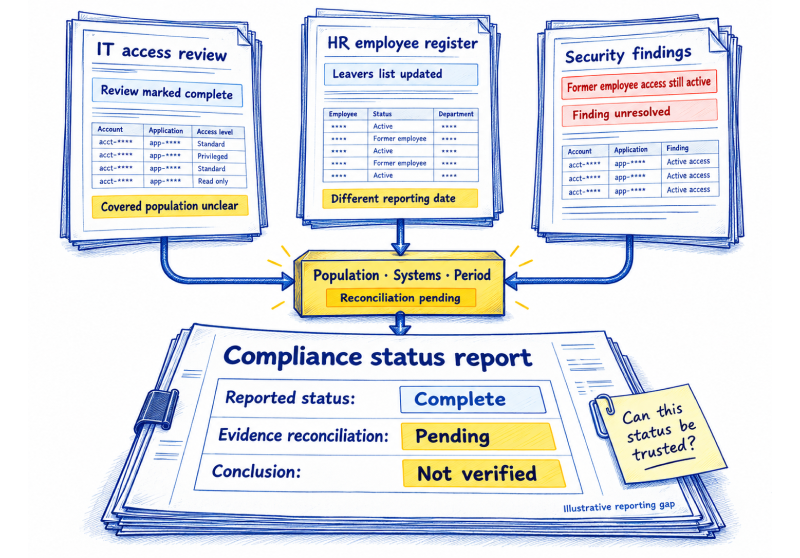
A quarterly dashboard shows 94% of controls as green. Yet a newly launched cloud tenant is missing from the assessment, several results rely on older evidence, and approved exceptions sit inside the passing total. Leaders see progress without knowing which conclusions remain supported.
The reporting task is to make those differences visible before a decision is made. Each material status needs a defined population and period, an evidence basis, and an explanation of unresolved exposure. Readers should be able to identify what changed, who must respond, and what would justify updating the conclusion.
Compliance reporting communicates an organization’s position against applicable obligations, internal requirements or control expectations. Its audience may include executives, control owners, boards, customers, auditors or regulators. Each audience asks different questions, but the underlying facts should remain consistent.
A management status report does not, by itself, establish control effectiveness or constitute an independent audit opinion. Reports can serve as evidence when their source, method and scope support the claim being assessed. Source records support assertions; tests evaluate controls against criteria; management reporting explains results; independent assurance reaches conclusions under its defined engagement.
The focus here is interpreting management status and deciding what follows. Report preparation, document templates and regulatory filing formats need their own procedures. For each significant result, ask whether the stated conclusion follows from the evidence and whether its limitations change the decision.
A headline status needs a boundary. The report should state which entity, systems, teams, locations, controls and time period it covers. If the defined scope excludes a subsidiary, cloud tenant or recently acquired application, show that exclusion rather than allowing a reader to assume it is included.
Keep applicability, test results, evidence sufficiency and exception decisions separate. A control can be applicable, tested as ineffective, supported by current evidence, and subject to an approved temporary exception at the same time. “Not applicable” needs a documented rationale; “not tested” is an assessment limitation. An approved exception does not change either the test result or a mandatory obligation.
For each material result, readers should be able to find the evidence source, date, population covered, accountable owner and any limitation. If a report combines data from several systems, explain the most important gaps in collection or reconciliation. A dashboard that cannot reveal its denominator or evidence date invites confidence beyond what the data warrants.
A compact report can make these distinctions explicit:
Do not hide unresolved evidence behind one percentage. Label untested controls, show partial coverage and identify who must make legal or management judgments.
A point-in-time result shows today’s position; a trend may show improvement, deterioration or a measurement change. Compare trends only when scope and status rules are stable.
If the number of “compliant” controls rises because the team removed out-of-scope controls from the denominator, that is not necessarily an improvement. If a new integration exposes failures that were previously invisible, the reported posture may look worse while oversight has improved. A report should distinguish a real control change from a change in collection, population or scoring method.
Use the trend to frame a specific choice: funding to extend coverage, an owner’s corrective action, or escalation beyond delegated authority. Do not imply that an executive must act on every technical variance. Define materiality so limited review time is directed to changes that affect obligations, critical services or the reliability of the reported conclusion.
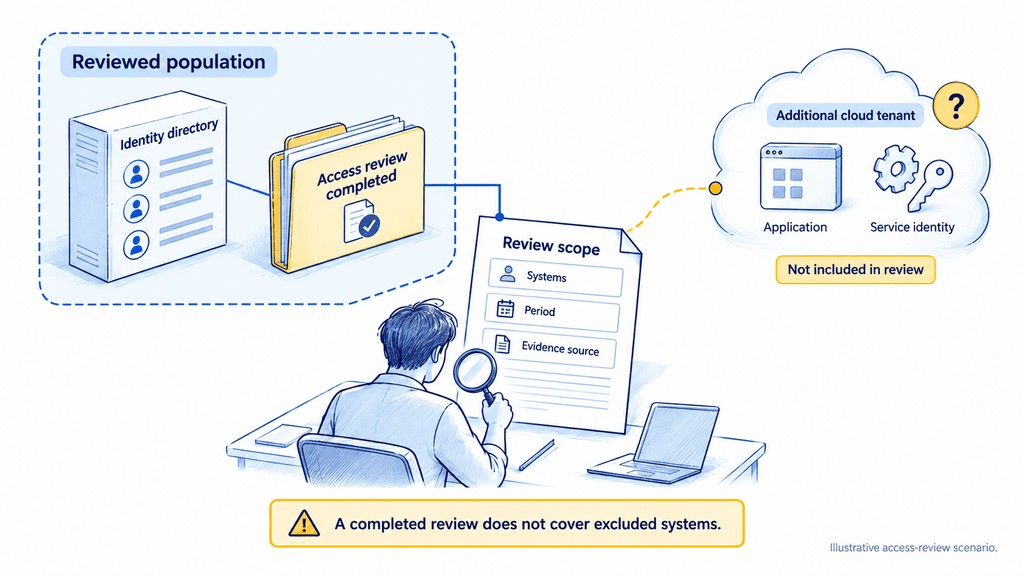
Illustrative scenario: a quarterly report says privileged access reviews are complete. A closer look shows that the review covered the main identity directory but not a separate cloud tenant used by a newly launched product. The completion status may be true for the submitted review, but it does not describe the full access population.
The report should preserve the completed directory review while identifying the cloud tenant as unassessed. Assign the cloud platform owner to reconcile privileged identities and obtain the required review. Any temporary acceptance concerns the remaining exposure; it does not extend the original review’s coverage or waive a binding requirement.
Use a compact reporting entry to make the boundary actionable. The following values and deadlines are illustrative, not a benchmark or regulatory timetable.
| Reporting field | Illustrative access-review entry |
| Scope and period | Quarterly privileged-access review; main directory assessed, new product cloud tenant omitted. |
| Result and confidence | Directory review complete for its recorded population. Cloud-tenant review not tested; overall review coverage incomplete. |
| Business implication | Privileged access supporting the new product has not been assessed under the required review process. |
| Decision and owner | Cloud platform owner to reconcile the tenant inventory and obtain application-owner review within five working days. Escalate an unmet deadline to the designated risk authority. |
| Closure evidence | Reconciled account inventory, reviewer decisions, removal evidence for rejected access and verification of effective permissions. |
| Next report | Keep original omission visible. Change coverage status only after review and validation; report any remaining exceptions separately. |
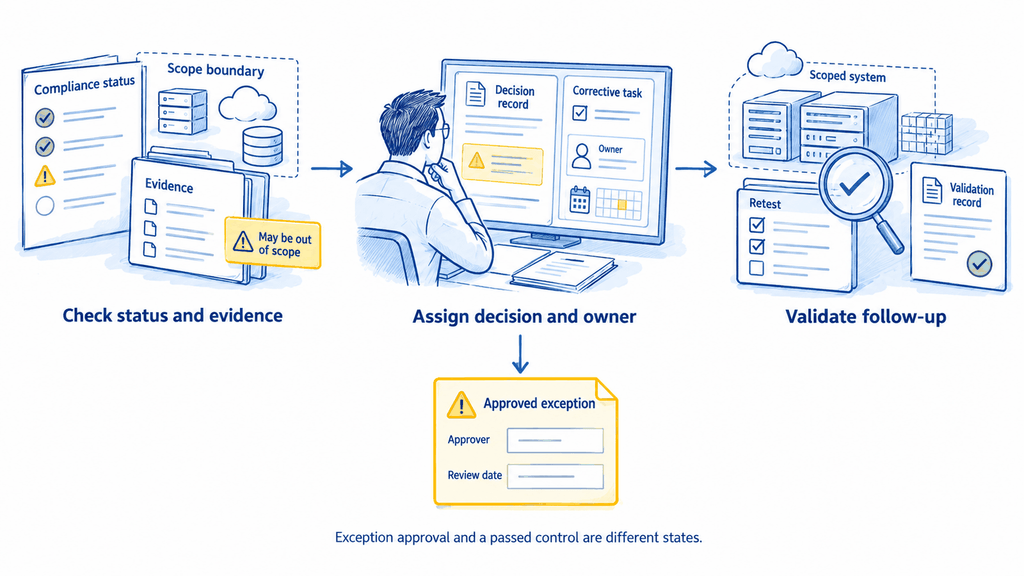
A reporting meeting should not become a live exercise in discovering what the numbers mean. Send the report with clear definitions and the decisions required. Ask control owners to confirm factual scope and evidence, while risk and compliance leaders challenge whether the conclusion follows from the record. Executives should resolve trade-offs that exceed delegated authority.
Record decisions beside the issue: who owns the action, what outcome is expected, when it is due and what will count as closure. Where a condition is temporarily accepted, record the affected scope, approver, rationale and expiry or review trigger. A closed task is not automatically proof that the control state has been restored; the follow-up report should show the validation result.
When publishing an update, retain the previous report, its reporting date and the definitions used. Record corrections and restatements explicitly. If a material gap is discovered after distribution, notify the affected decision-makers rather than waiting for the next scheduled pack. The updated record should identify which earlier conclusion changed and whether a decision needs reconsideration.
SPOG.AI connects requirements, controls, ownership, evidence, exceptions and remediation across operational systems. Its GRC capabilities support the governance record; Continuous Control Monitoring supports assessment of defined controls using connected evidence; Remediation supports assigned corrective work and validation. Reporting should retain the relevant source scope and review decisions so readers can distinguish a completed workflow from a verified control outcome.
Executives need material changes, exposure, decisions and confidence limits. Control owners need populations, evidence and deadlines. External readers need only information authorized for their purpose. Use different views when useful, but keep the underlying scope and meaning consistent. A shared foundation of requirements, controls, evidence and ownership helps keep those views aligned.
Explain technical results in business terms and keep material limitations visible. Share sensitive system detail externally only when authorized; involve legal, privacy or contract owners when needed.
Before publishing, ask four questions: What is in scope? What supports each material status? What remains uncertain or unresolved? Which person or group must decide or act? If the report cannot answer these, a better chart will not fix it.
Compliance reporting earns trust through transparent boundaries, traceable claims and clear follow-through. Connect unresolved findings to accountable remediation and validated outcomes, with named owners, deadlines and evidence of closure. Treat status as a prompt for examination, not a substitute for it. When leaders can see what was checked, what was missed and what choice is theirs, reporting becomes a practical part of governance rather than a periodic presentation exercise.


Security questionnaires help buyers understand how a supplier protects the data, systems and services involved in a proposed...

A vendor cybersecurity inquiry should establish what the supplier will do, which data and systems it can access,...

A vendor management policy sets the rules for approving suppliers, accepting exceptions and responding when relationships change. This...