Continuous Control Monitoring
Why Passing an Audit Does Not Prove Ongoing Compliance
An audit can confirm that security controls met assessed requirements during a defined period. But system changes can...


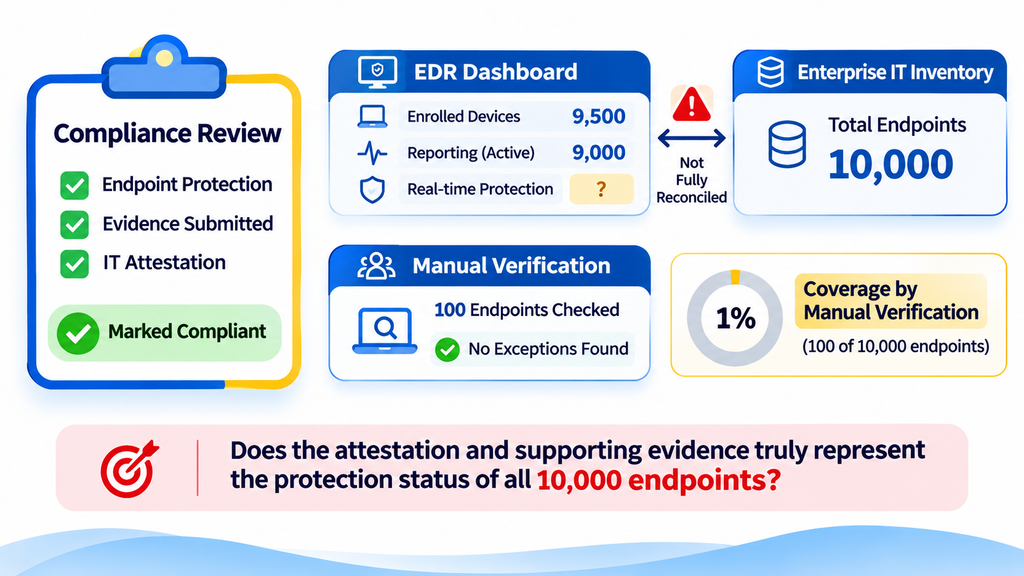
Consider an organization with 10,000 endpoints. Its EDR dashboard shows enrolled devices and their reporting status but may not provide a consolidated view of whether real-time protection is enabled on every endpoint. The IT team manually verifies 100 devices, finds no exceptions, and submits the results as supporting evidence.
There is another gap. The EDR dashboard does not necessarily reconcile its registered devices against the enterprise IT inventory. An endpoint may be missing from EDR altogether or registered under a different hostname, making it difficult to establish whether every applicable device has been assessed.
The attestation may be reasonable within the assessment methodology, but the manual verification directly covers only 1% of the environment for that requirement. Properly designed sampling can provide meaningful assurance, but it does not establish the individual protection status of every endpoint.
The real question is not whether the control owner has attested to compliance, but whether the supporting evidence adequately represents the control being assessed.
Automated evidence collection can address these limitations when security-platform data is reconciled with enterprise IT asset inventories. Instead of relying on the EDR dashboard as the complete population, it starts with the organization’s applicable assets and evaluates their protection status against defined requirements.
In this illustrative environment, automated validation may establish that 9,500 endpoints have the required EDR agent installed, 9,000 are actively reporting, and 8,800 have the necessary protection policies enabled. The remaining 500 endpoints without EDR become visible because the assessment includes assets that are not registered with the security platform.
Asset correlation is an important part of this process. Automated reconciliation can match devices across systems using multiple identifiers, account for differences in hostnames, resolve duplicate records, and identify assets that require further investigation. This helps organizations establish a unified view of control coverage rather than relying on isolated technology dashboards.
With the applicable asset population established, automated checks can repeatedly evaluate three dimensions of control assurance: coverage, whether the required protection is deployed; configuration, whether the relevant settings are enabled; and operational health, whether the protection is functioning and reporting as expected.
The result is a shift from periodic verification of a limited sample to repeatable assessment across the applicable population. Where evidence is unavailable or inconclusive, the assessment should identify that limitation rather than assume the control has passed or failed.
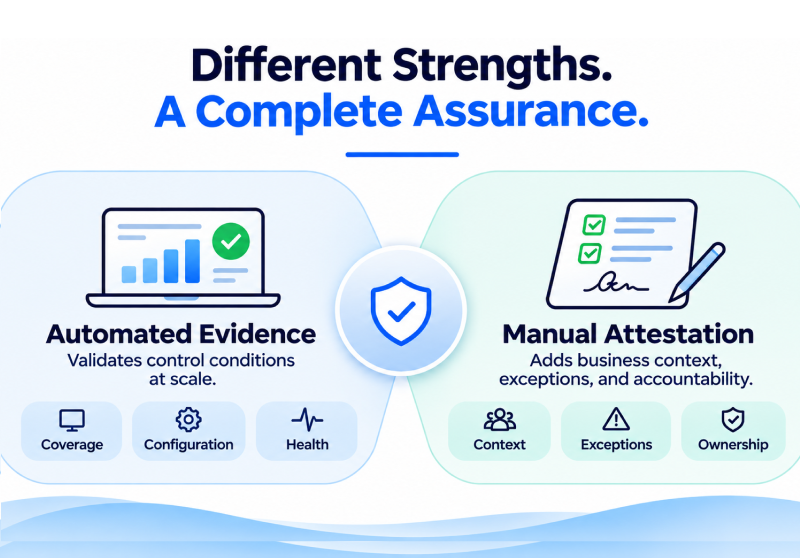
Population-wide automated validation strengthens technical assurance, but it does not eliminate the need for manual attestation. Automation can establish observable control conditions, while responsible individuals must still confirm business context, ownership, and matters requiring judgment.
Returning to the endpoint example, automated validation may identify 1,200 devices that do not fully satisfy the required protection criteria. The control owner can review these findings, confirm which devices support critical business services, verify remediation ownership, and explain whether documented exceptions remain applicable.
This is where attestation adds value. Rather than making a general declaration that endpoint protection is effective, the owner can confirm that the findings have been reviewed, the relevant business context is accurate, and outstanding responsibilities are understood. The attestation does not change a failed technical result into a passing one.
Manual attestation is also necessary for requirements that cannot be established through system data alone. For example, a business owner may need to confirm that a third-party service remains critical or that a documented dependency accurately reflects current operations. These are accountable confirmations that technical integrations cannot always provide.
The distinction is straightforward:
| Dimension | Automated Evidence Collection | Manual Attestation |
| What it establishes | Observable control conditions against defined requirements | Accountable confirmation of findings, context, and responsibilities |
| Primary source | Enterprise systems and operational data | Control owners and supporting information |
| Coverage | Can assess the applicable population where data is available | May rely on sampled or comprehensive evidence and management knowledge |
| Frequency | Frequent, scheduled, or continuous | Periodic or event-driven |
| Primary value | Scale, consistency, and operational visibility | Business judgment, context, and accountability |
| Limitation | Depends on data completeness and validation accuracy | Depends on the evidence reviewed and the accuracy of the declaration |
The objective is therefore not to eliminate attestations, but to make them more meaningful by grounding them in current evidence and focusing human involvement where it contributes to assurance.
Connecting both approaches also makes discrepancies visible. A control owner may attest that endpoint protection is operating effectively, while automated validation identifies devices with disabled protection, inactive agents, or missing coverage.
Such differences should trigger investigation rather than an automatic assumption that either conclusion is correct. The discrepancy may reflect a genuine control failure, incomplete evidence, incorrect validation logic, or an attestation based on information that no longer represents the environment.
Where an approved exception exists, the technical deviation should remain visible alongside its justification, compensating controls, approval status, and remediation expectations. An exception documents how the organization is governing the exposure; it does not automatically establish technical compliance.
This creates a stronger assurance process in which operational evidence challenges unsupported declarations, while accountable review helps identify errors, missing context, and decisions requiring management attention.
In many organizations, security teams generate technical evidence while GRC teams separately collect periodic attestations. This separation can leave governance records disconnected from current operating conditions, particularly when control failures emerge between assessment cycles.
A connected approach changes the sequence. Automated validation establishes the observable control status, identifies deviations, and associates them with the relevant assets and owners. Control owners then review the findings, confirm business context, and acknowledge remediation responsibilities or applicable exceptions.
For example, an endpoint missing EDR protection becomes a visible control finding rather than remaining absent from the security dashboard. The finding can be assigned to the responsible team, tracked through remediation, and reassessed using updated evidence. If an exception is approved, the deviation remains visible with its governance status until it is resolved or otherwise addressed under policy.
SPOG.AI’s Connected Risk Intelligence approach brings these activities together through Continuous Control Monitoring. By connecting enterprise asset inventories, automated control validation, manual attestations, exceptions, and remediation, organizations can move beyond isolated compliance declarations toward a continuously updated view of control assurance.
The goal is not to replace human judgment or automate every declaration. It is to stop asking control owners to repeatedly confirm conditions that enterprise systems can already validate, while ensuring that business context, accountability, and governance decisions remain with the responsible individuals.
Automated evidence establishes what can be measured and verified. Manual attestation confirms what requires human knowledge, judgment, and accountability. Together, they transform periodic compliance reviews into a more continuous, evidence-driven assurance process.
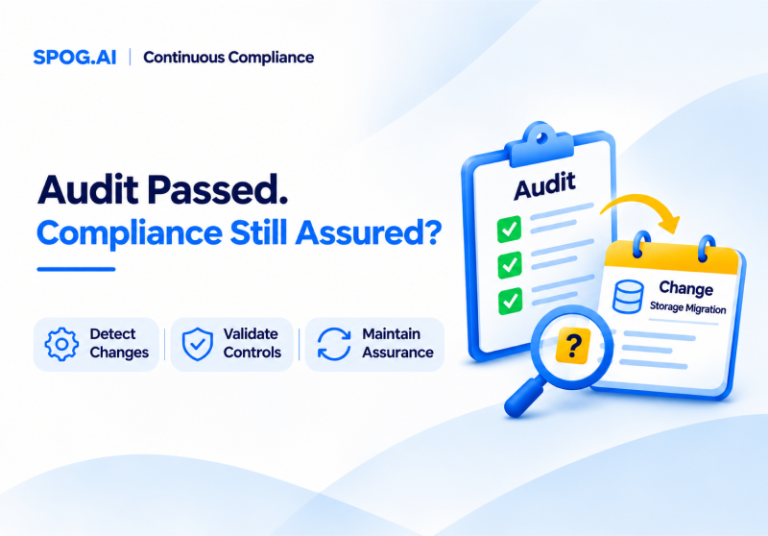
An audit can confirm that security controls met assessed requirements during a defined period. But system changes can...
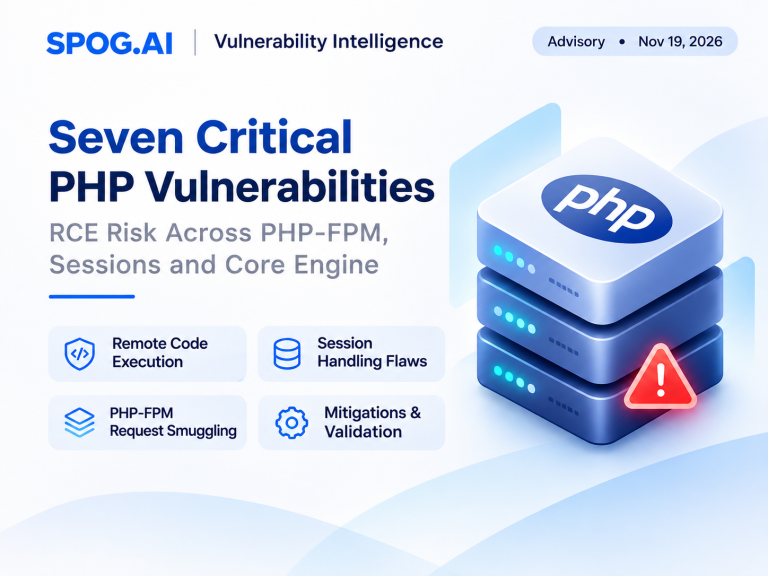
Seven critical PHP vulnerabilities pose risks of remote code execution and service disruption. While patching is essential, which...
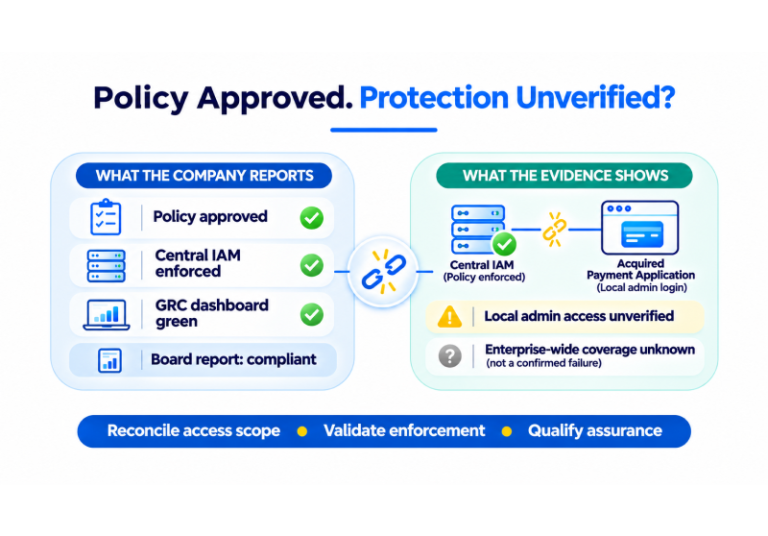
An approved policy can coexist with an unprotected business-critical system. The governance failure begins when leadership treats approval,...