Why CVSS Scores Alone Cannot Set Enterprise Vulnerability Priorities
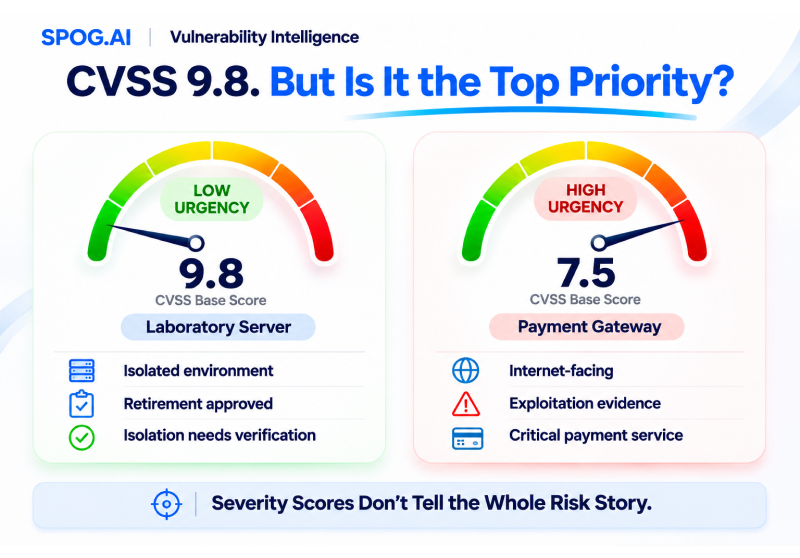
A critical vulnerability on an isolated test server may be less urgent than a lower-scored flaw on an exposed payment gateway. CVSS describes technical severity, but enterprise priority depends on exploitation evidence, actual exposure, business consequences and the controls protecting the affected system.
A security team has one emergency maintenance window. Its CVSS-ranked queue places a 9.8 vulnerability on an isolated laboratory server ahead of a 7.5 vulnerability on an internet-facing payment gateway. The gateway supports live transactions and has credible evidence of exploitation in the wild.
Following the queue without validating exposure could leave the more consequential business risk untreated. If attackers exploit the gateway, payment processing could be disrupted, incident containment could become more complex and customer transactions could be affected. The problem is not that CVSS is inaccurate. It is that a severity score cannot independently establish whether a vulnerable component is present, reachable or critical to the business.
What CVSS Measures and What It Cannot Decide
The Common Vulnerability Scoring System (CVSS) provides a standardized framework for describing vulnerability severity. CVSS 4.0 includes Base, Threat and Environmental metrics. However, organizations frequently rely on published CVSS Base scores without evaluating current exploitation evidence or their own operating environment.
A Base score describes characteristics of the vulnerability under defined assumptions. It does not establish whether a particular enterprise asset is affected or whether its exposure justifies immediate remediation.
Before setting priority, teams must establish:
Applicability: Is the affected software version or configuration actually present?
Exposure: Can an attacker reach the vulnerable component through a relevant attack path?
Threat activity: Is exploitation occurring, anticipated or supported by credible intelligence?
Business consequence: Which services, data or operations could be affected?
Existing safeguards: Are compensating controls present, applicable and functioning?
Scanner findings may be provisional. Vendor advisories, software inventories and authenticated checks help validate applicability. Missing information should trigger investigation rather than automatic deprioritization.
CVSS describes the weakness. Enterprise prioritization determines which exposure requires action first.
How Exploitation Evidence Changes Priorities
Two vulnerabilities with similar severity can require different responses because their exploitation conditions differ. The CISA Known Exploited Vulnerabilities (KEV) catalog identifies vulnerabilities with evidence of exploitation in the wild. The FIRST Exploit Prediction Scoring System (EPSS) estimates the probability that a published vulnerability will be exploited in the next 30 days.
These signals serve different purposes. KEV establishes known exploitation, while EPSS estimates exploitation likelihood. Neither confirms that an organization’s specific systems are affected, reachable or inadequately protected.
An effective vulnerability prioritization decision connects threat intelligence to verified asset context, relevant attack paths, existing safeguards and potential business impact. For example, a firewall rule may reduce exposure to a vulnerable service. But if the service remains reachable through another interface, the assumed protection may not hold. Teams must verify the actual enforcement path before using the safeguard to justify delaying remediation.
Three Vulnerabilities, Three Different Decisions
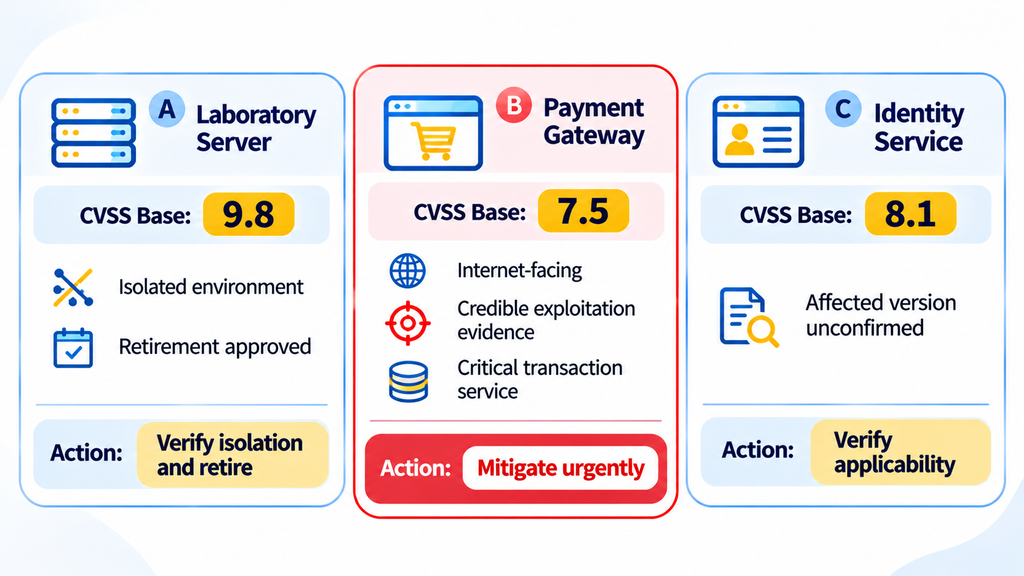
Consider three illustrative findings competing for the same remediation resources.
Finding
CVSS Base
Enterprise context
Appropriate response
A: Laboratory server
9.8
Isolated environment; retirement approved; no critical service dependency
Verify isolation and complete retirement
B: Payment gateway
7.5
Internet-facing; credible exploitation evidence; critical transaction service
Mitigate urgently and validate protection
C: Identity service
8.1
Important authentication dependency; affected version unconfirmed
Verify applicability promptly and restrict exposure if warranted
A severity-only queue places Finding A first. An evidence-led assessment makes Finding B the immediate concern because the gateway is exposed, supports critical transactions and has credible exploitation evidence. Finding C requires a time-bound investigation. Unknown applicability does not establish low risk, particularly when the system supports enterprise authentication.
Finding A still requires action. Its lower operational priority is defensible only if isolation, service dependencies and retirement plans are verified.
The consequence of getting this order wrong is not simply a missed patch deadline. A limited maintenance window may be consumed by a less exposed system while a business-critical transaction path remains vulnerable. The appropriate order must also respect mandatory remediation deadlines and organizational risk policy.
Turn CVSS Findings Into Defensible Decisions
A vulnerability scanner identifies potential weaknesses. It does not independently establish business priority, acceptable risk or successful remediation. Each finding must connect to an identifiable asset, current exposure evidence, an accountable owner and a documented decision.
Decision question
Evidence required
Is the finding applicable?
Asset identifier, software version, detection source and observation timestamp
Is the attack path reachable?
Network exposure, relevant privileges and validated safeguards
What business service is affected?
Service dependency, operational impact and business owner
What action is required?
Mitigation or patch decision, responsible owner and deadline
Who can accept a delay?
Authorized risk owner, rationale, safeguards and review date
What proves risk reduction?
Post-change validation, tested scope and unresolved exposure
Evidence should preserve its source and observation period. A vulnerability detected last week cannot automatically establish the current state of a system that was reconfigured yesterday. Similarly, an asset record without a reliable identifier may not establish which instance needs remediation.
Ownership Must Follow the Decision
Technical teams validate affected versions, exposure and remediation options.
Business service owners establish operational consequences and maintenance constraints.
The authorized vulnerability or risk owner determines prioritization within applicable policy, contractual and regulatory requirements.
Control owners provide evidence that relevant safeguards are configured and operating as required.
Where remediation cannot meet the required deadline, authorized decision-makers must evaluate residual risk and any permitted exception.
Closing a patch ticket is not equivalent to closing the exposure. Verification must establish whether the relevant vulnerability or attack path has been addressed across the stated asset population.
What Leadership Should Verify Before Approving Priorities
A defensible vulnerability queue should answer five questions:
Which exploitable or potentially exploitable findings affect critical business services?
Which priorities are supported by current asset, exposure and threat evidence?
Are safeguards being relied upon to delay remediation actually verified?
Who owns each action, deadline and residual-risk decision?
What evidence will establish that the exposure has been reduced?
Unknown applicability, missing asset records and unverified safeguards should remain visible with assigned investigation deadlines.
A defensible priority is not just a score. It is an accountable decision supported by current evidence.
How SPOG.AI Connects Vulnerability Risk to Action
The challenge is not collecting more vulnerability scores. It is connecting technical findings to the assets, business dependencies, safeguards and decisions that determine enterprise risk. In the payment-gateway example, security leaders need to establish which asset is affected, which transaction service depends on it, whether protective controls cover the relevant attack path and who is responsible for mitigation.
Together, these connected workflows can help teams investigate discrepancies, maintain decision context and track unresolved exposure. SPOG.AI does not independently establish exploitability or guarantee successful remediation. Those conclusions depend on the quality of connected evidence, technical validation and accountable decisions.
The Vulnerability Priority List Leadership Can Defend
CVSS remains an important severity measure, but a published Base score should not become an automatic patch order. Enterprise prioritization requires verified applicability, current exploitation evidence, reachable attack paths, business consequences and accountable remediation decisions.
A defensible priority list makes clear what matters now, why it matters, who must act and what evidence will prove the risk was reduced.
Frequently Asked Questions
No. A lower-scored vulnerability may require faster action when it affects an exposed, business-critical system and credible exploitation evidence supports urgency. Mandatory remediation requirements must still be respected.
No. CVSS describes vulnerability severity, while EPSS estimates exploitation probability over the next 30 days. Both should be evaluated alongside asset exposure, business impact and other threat evidence.
No. KEV is not an exhaustive record of all exploitation activity. Organizations should consider other credible intelligence, vulnerability applicability and their own exposure.
Sometimes, where applicable requirements permit. Teams must verify that the safeguards address the relevant attack path and document residual risk, decision authority and review dates.
The finding should remain unresolved until identifiers, scan timestamps, software records and asset lifecycle information are reconciled. Missing inventory data is not proof that the vulnerability is irrelevant.
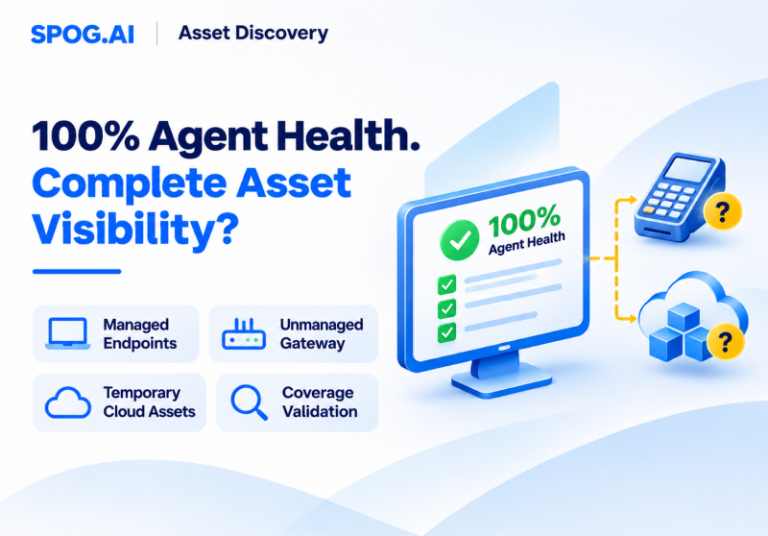
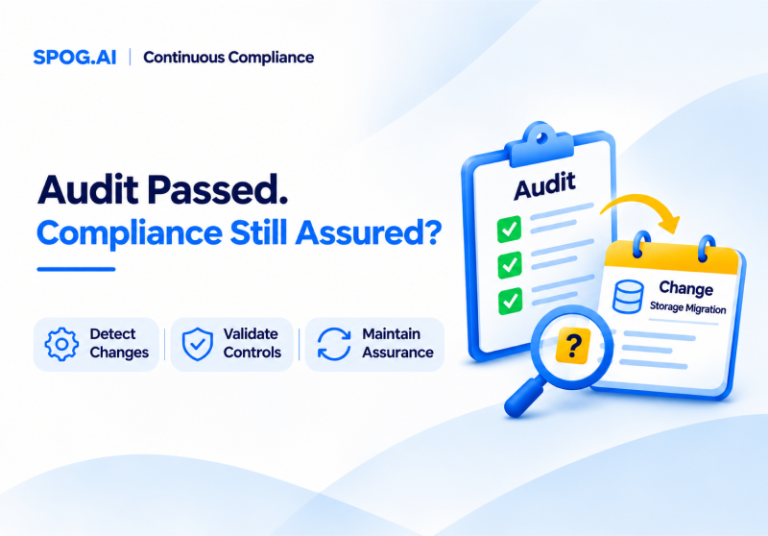
Use deployment images, cloud events and runtime observations to establish whether affected components existed and were exposed during the relevant period. Evaluate the business services and data those workloads supported.
Confirm the patch or mitigation on the affected asset population, validate the relevant exposure or attack path and document any systems that remain vulnerable, excluded or unverified.
Technology writer and content strategist with 5+ years of experience, including work for a US-based B2B SaaS client and a cybersecurity solution. I create cybersecurity and GRC content, product documentation, and user guides that help technical teams and business leaders understand security capabilities and workflows. Currently working on Confluence documentations on vulnerability management, ITSM, incident management, and continuous control monitoring, alongside SEO and AEO content, and technology partner database development.