CAASM: Make Asset Visibility Useful for Security Decisions and Responses
Cyber Asset Attack Surface Management connects fragmented asset records so teams can investigate exposure and security coverage. Its value depends on explainable matching, current evidence and decisions that reach an accountable owner.
CAASM becomes useful when a security leader asks, “Are our important assets actually covered?” An endpoint console can report every enrolled device as healthy while overlooking workloads that never enrolled. A scanner can list findings without knowing which service depends on the affected machine. Combining records helps only if the resulting asset population is credible.
The priority is to make asset data reliable enough for a specific decision. That requires a defined scope, defensible identity resolution, visible evidence limitations and a response that can be verified. A larger inventory by itself cannot establish control effectiveness.
What is CAASM, and what problem does it solve?
Cyber Asset Attack Surface Management (CAASM) aggregates and correlates cyber asset information from existing technology and security sources. It helps teams query the combined data for inventory discrepancies, ownership gaps, exposures and missing security coverage. Implementations vary in asset classes, discovery methods and workflow capabilities.
Cyber assets include devices, workloads, applications, cloud resources and other technology entities relevant to security. Identities, permissions and business relationships provide additional context. The attack surface consists of opportunities for unauthorized access or harmful interaction; it extends beyond internet-facing addresses.
A practical implementation connects sources through application programming interfaces (APIs) or supported integrations, normalizes their fields, reconciles overlapping records and relates findings to assets. It should retain enough provenance to explain where each conclusion came from.
Current exposure-management products increasingly connect these functions. Microsoft’s November 2024 release notes describe external connectors, normalization into an exposure graph and visibility into discovery sources. Subsequent 2025 updates expanded external and cloud-security integration. These are product-specific examples of convergence, not evidence that every CAASM product has equivalent capabilities.
Start with the population behind the percentage
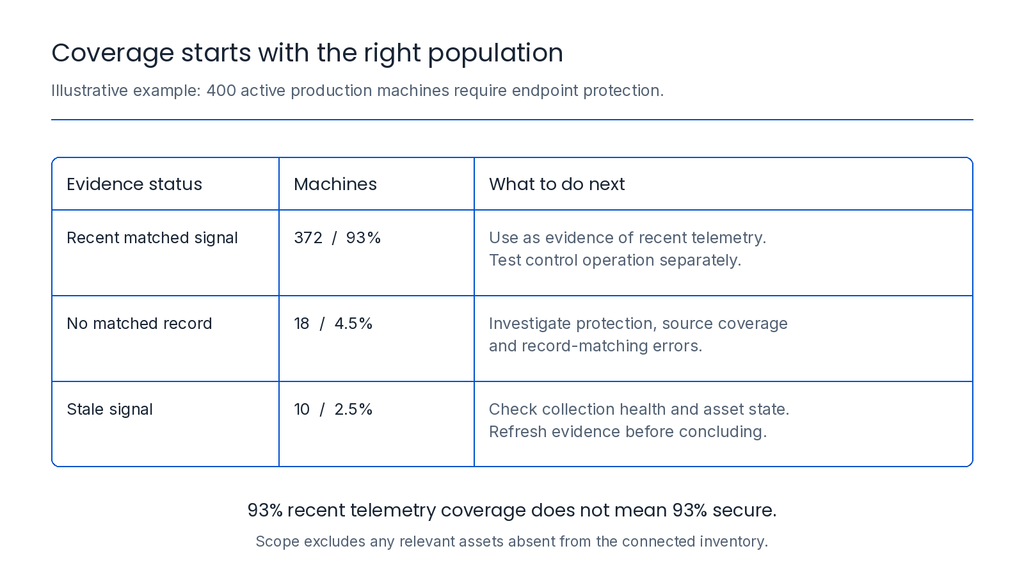
Consider an illustrative platform team with 400 active production virtual machines that require endpoint protection. The cloud inventory identifies that population. Reconciliation finds recent endpoint telemetry for 372 machines, no matched endpoint record for 18, and stale telemetry for 10.
The defensible result is “93% have a recent matched endpoint signal within this defined population.” It is not “93% are secure,” and it does not prove that the remaining 28 machines lack protection. They need investigation. The population itself may also be incomplete if a relevant cloud account was never connected.
The visual makes the denominator explicit. An enrolled-device dashboard answers a narrower question than a test against every machine expected to have the control. CAASM helps reconcile those populations; the control assessment still determines whether protection is functioning as intended.
How CAASM works: preserve identity, time and lineage
Decide which source owns each fact
Use a cloud resource identifier to establish workload identity, an endpoint source for agent observations and a service catalog for ownership. Record the authority selected for each field. “Most recent wins” is insufficient when newer data comes from a less authoritative source.
Document integration permissions, account coverage, collection frequency and failure handling. Successful authentication does not establish that every relevant subscription or asset type was collected. When ingestion fails, distinguish the last observed asset state from the current ability to verify it.
Match records without erasing uncertainty
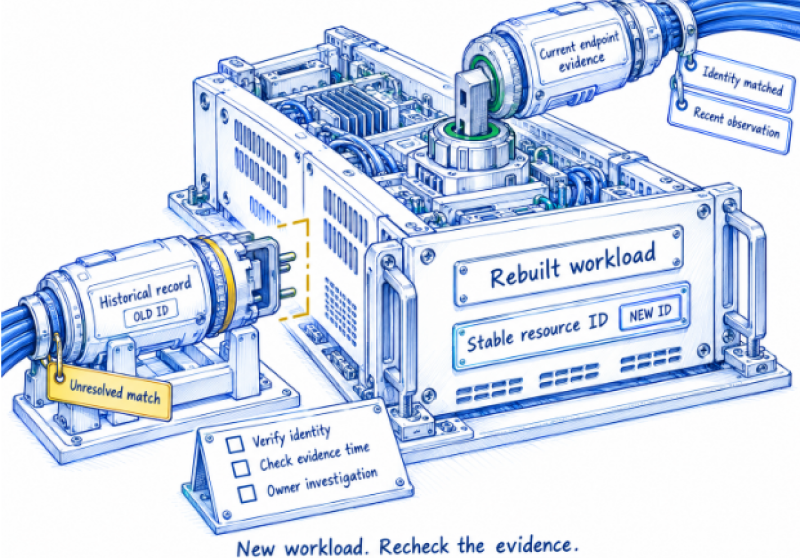
Names and IP addresses can change or be reused. Prefer stable identifiers within their proper account or tenant context, then use corroborating attributes where needed. Preserve unresolved matches for investigation rather than forcing every record into a confident merge.
For a rebuilt machine, test whether the old endpoint record attaches incorrectly to its replacement. A false merge could make a new workload inherit historical coverage; a missed merge could create duplicate findings. Review both error types during the pilot.
Keep lifecycle and evidence time visible
An observation needs a source, observation time and ingestion time. A record received today may describe last week’s state. Define freshness according to the control and asset behavior rather than applying one universal threshold.
Separate active, retired and uncertain assets using evidence from the appropriate source. Preserve historical records for investigations and required retention, while preventing retired assets from inflating today’s coverage denominator. For short-lived workloads, collect evidence at a cadence capable of observing their relevant lifecycle.
Use relationships to improve exposure decisions
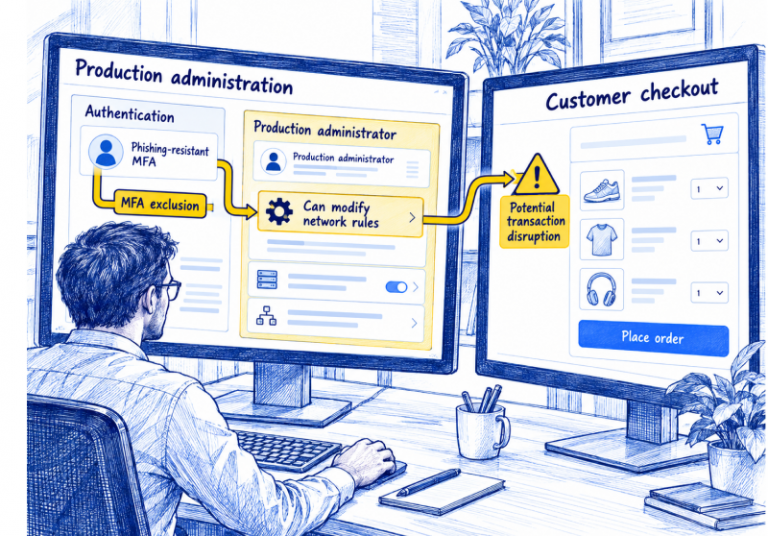
Asset context can change the response to a vulnerability. Join a finding to the actual workload, exposure, service criticality, responsible team and relevant controls. Validate important relationships: an administrative permission is not identical to network reachability, and a modeled path is not proof that an attacker can traverse it.
Include non-human identities (NHIs), such as service accounts and automation credentials, where identity and access management (IAM) sources support them. Knowing that a machine exists says little about which identity can administer it or what dependent service could be affected. Keep observed relationships distinguishable from inferred ones.
This context supports vulnerability prioritization and incident scoping. During an incident, use it to identify systems and owners worth investigating, then confirm the actual affected scope with incident evidence. Inventory relationships cannot establish a precise blast radius on their own.
CAASM, EASM, CMDB and cloud security serve different decisions
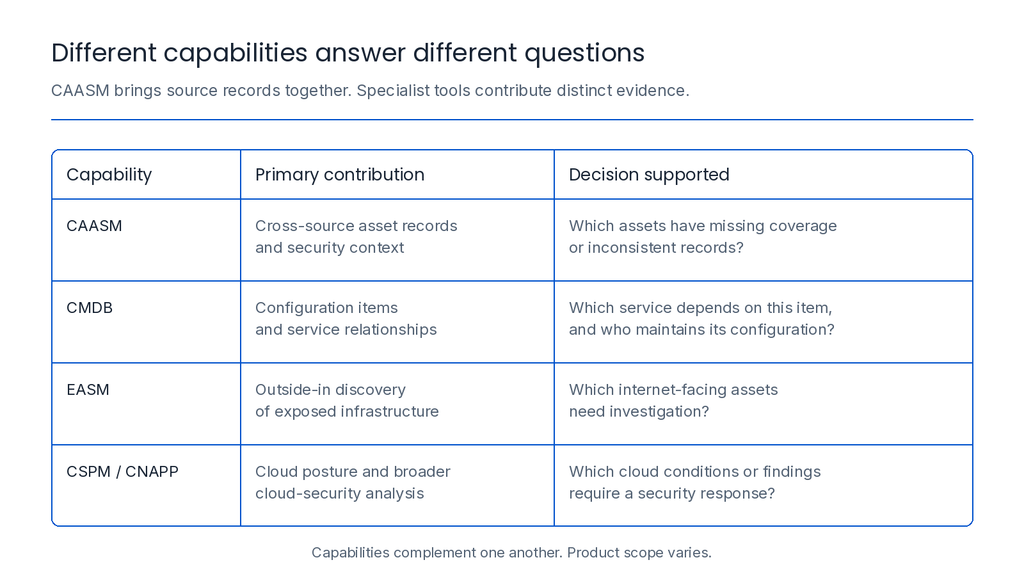
Choose capabilities according to the question being answered. A Configuration Management Database (CMDB) maintains configuration items and service relationships for operational management. CAASM can compare these records with security observations; it does not make the CMDB obsolete.
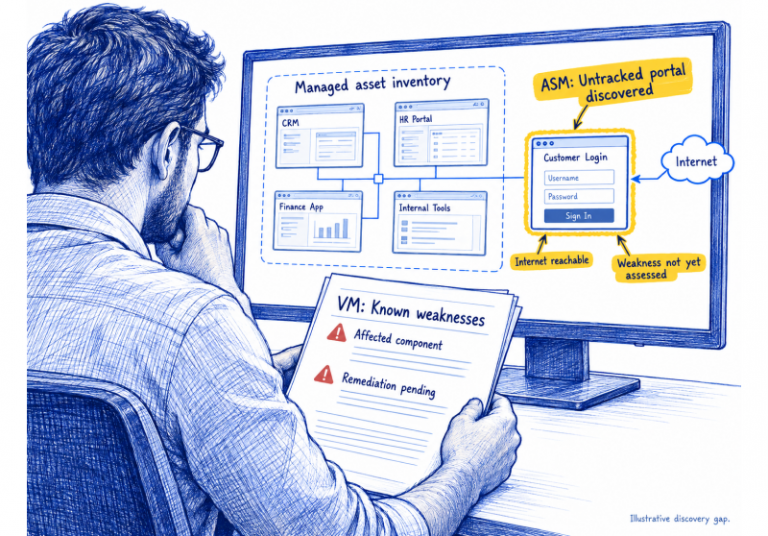
External Attack Surface Management (EASM) supplies an outside-in view of internet-exposed infrastructure. That view can reveal assets missing from internal sources. API aggregation alone cannot guarantee discovery of an asset absent from every connected system.
Cloud Security Posture Management (CSPM) evaluates cloud configuration posture. A Cloud-Native Application Protection Platform (CNAPP) combines cloud-security capabilities whose scope varies by product. CAASM can consume their findings and relate them to other assets, rather than inherently replacing their deeper analysis.
Continuous Threat Exposure Management (CTEM) is a broader security program for assessing exposures and coordinating responses over time. Asset intelligence contributes to that work. Buying an inventory capability does not complete the program.
Connect asset visibility to control assurance
For governance, risk and compliance teams, CAASM can help establish which assets a control should cover and where operational evidence is missing. The obligation, test criteria and observation period determine what that evidence supports. A current asset record is not a substitute for proof that a control operated.
Continuous control monitoring benefits from this population context. SPOG.AI’s May 2026 announcement describes integrating security signals, IT systems, asset inventories and governance workflows to provide visibility into risk and control effectiveness. This supports the connection between asset intelligence and control oversight without promising universal discovery or automatic compliance.
Keep material findings connected to risk management, with an owner, treatment decision and recheck. In the illustrative fleet, investigate unmatched and stale records separately. Installing an agent, repairing collection and correcting a false match are different actions.
Evaluate a CAASM solution with a decision-focused pilot
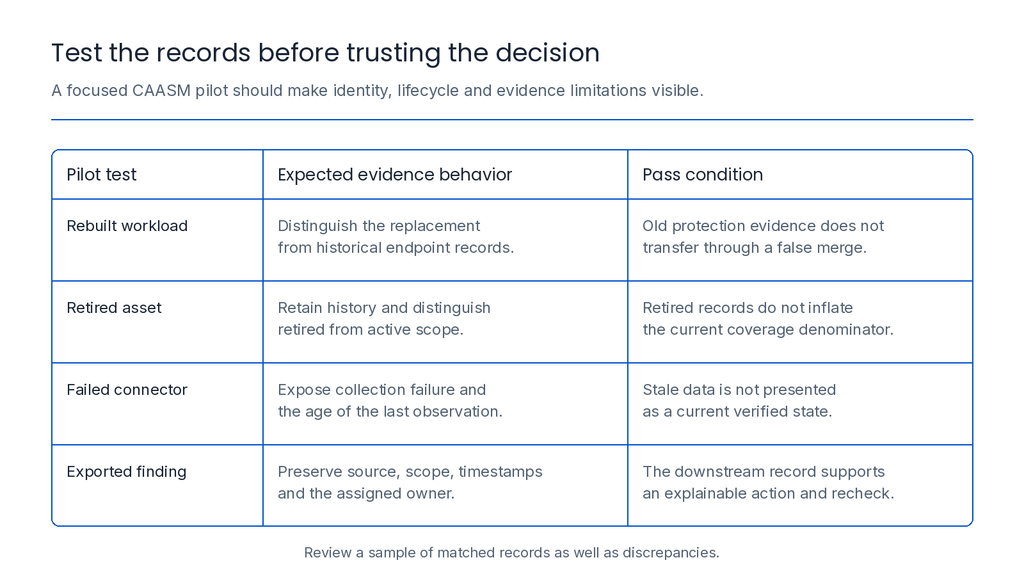
Choose one service and one repeatable question, such as which eligible production machines lack recent endpoint evidence. Establish source coverage and sampling rules before comparing results. Independently review some matched records as well as discrepancies.
Include a renamed asset, a rebuilt workload, a retired machine and a failed connector. Measure false merges, duplicate records, stale observations and unresolved ownership. Test query export, API access and downstream workflow links, ensuring that provenance survives transfer.
Ask whether the pilot produced an explainable decision and a verified response. Asset count growth is useful only when it represents meaningful coverage rather than duplicate or outdated records.
Begin with one coverage question
Select a critical service, define its expected asset population and reconcile the evidence for one important control. Investigate uncertain records, assign corrective work and recheck the result. Expand only after the team can explain what the data proves, what remains unknown and who owns the next action.
Frequently asked questions
Cyber Asset Attack Surface Management. It connects asset and security data across sources to improve visibility and support decisions.
It makes fragmented asset information comparable, helping teams investigate missing coverage, unclear ownership and exposures with shared context.
No. Discovery depends on connected sources and additional discovery capabilities. Assets absent from all available sources can remain unseen.
No. It may indicate absent protection, stale collection or a record-matching problem. Investigate before assigning a control result.
CAASM correlates cross-source asset data. EASM focuses on externally observable infrastructure. Their views can complement each other.
No. A CMDB supports configuration and service management. Reconciled security data can enrich or challenge its records.
No. Scanner findings remain an input. Asset context helps teams understand affected services, ownership and response priorities.
It can support scope and evidence collection. Compliance conclusions require applicable obligations, suitable tests and evidence for the relevant period.
It contributes asset discovery and context. CTEM also requires prioritization, validation and accountable action on exposures.
Explainable matching, accurate lifecycle handling, visible data gaps and findings that reach an owner and support verified follow-up.
With 8.5+ years in B2B SaaS, I’ve led demand generation and GTM initiatives across global markets (US, UK, Europe, Africa), helping companies move from fragmented marketing efforts to structured, revenue-focused growth engines.