Exposure Management
Why CVSS Scores Alone Cannot Set Enterprise Vulnerability Priorities
A critical vulnerability on an isolated test server may be less urgent than a lower-scored flaw on an...


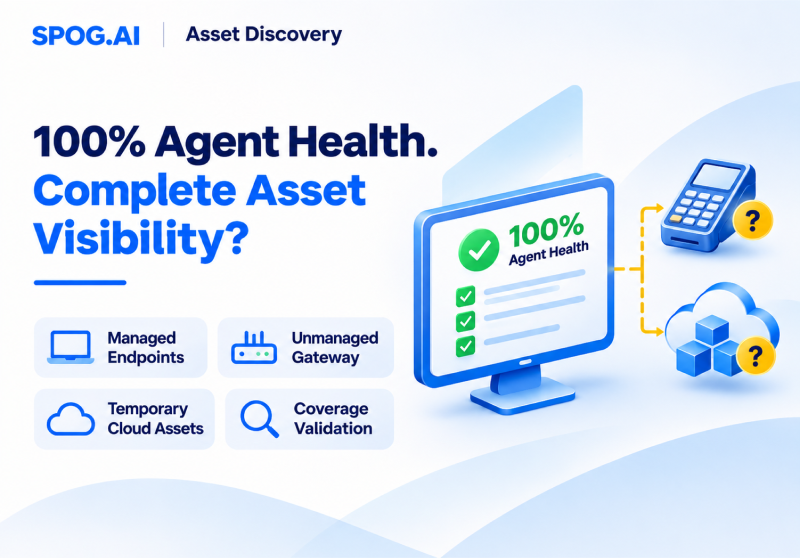
A payment-processing company reports 100% agent health across its managed endpoints. During a service review, network discovery identifies a payment-terminal gateway absent from endpoint management. Cloud inventory also reveals temporary processing instances created and retired between agent scans.
The gateway supports transaction processing, yet its security configuration and vulnerability status remain unverified. If compromised, it could disrupt payment services or complicate incident containment. The dashboard was accurate for enrolled hosts, but it did not represent every asset supporting the business service.
Agentless vs agent-based asset discovery is therefore not simply a technology choice.
Each method observes a different part of the environment. The challenge is establishing which assets exist, what evidence supports their status and which remain outside verified coverage.
Installed agents collect operating-system, software, configuration and security telemetry, depending on their capabilities and permissions. Persistent identifiers and recurring check-ins make them valuable for monitoring managed endpoints. Their limitation is enrollment. Unsupported appliances, unmanaged devices, disconnected servers and short-lived workloads may never report. An agent heartbeat confirms communication, not necessarily the effectiveness of installed security controls.
Microsoft’s Azure Arc connectivity documentation illustrates this distinction. The Connected Machine agent reports connectivity through heartbeats, while a disconnected server may continue operating without providing current management telemetry.
Agentless discovery identifies assets through cloud APIs, network traffic, active scans and management interfaces without requiring an installed agent on every target. However, not all agentless techniques provide the same depth of evidence.
An API record may confirm that a cloud instance existed without proving its security controls were effective.
A complete dashboard is not necessarily a complete asset inventory.
| Decision factor | Agent-based | Agentless |
| Primary evidence | Host-reported state | Network, cloud or platform observations |
| Best use | Recurring host-level visibility | Identifying assets outside agent enrollment |
| Main limitation | Unenrolled or disconnected assets | Reachability, permissions and limited host detail |
| Evidence freshness | Last successful agent check-in | Last scan, API sync or observation |
| Assurance boundary | Agent health does not prove protection | Asset presence does not prove protection |
Neither method is universally more complete.
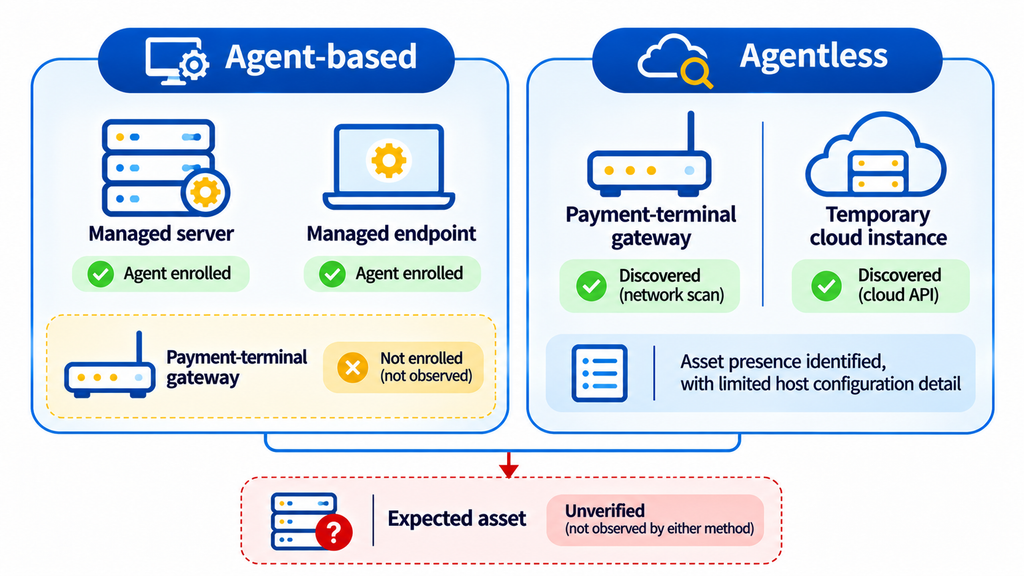
Servers may justify continuous host telemetry, while appliances require network or management-plane discovery. Temporary cloud workloads may need lifecycle events because periodic scans can miss their entire existence. The objective is not simply combining more records. It is establishing which assets should exist and what each observation actually proves.
Suppose a payment-service owner expects 233 assets within the assessment scope. After duplicate records are resolved, agents report 204 assets, while cloud and network discovery identify 21 additional assets. Eight expected assets remain unmatched.
| Reconciled status | Assets | Assurance implication |
| Current agent-observed | 204 | Reporting through installed agents |
| Agentless-only | 21 | Require ownership and control validation |
| Expected but unmatched | 8 | Existence or current status unresolved |
| Total expected | 233 | Defined assessment population |
The 204 reporting agents represent 87.6% of the expected population. This measures observed agent enrollment, not security protection or control effectiveness.
The 21 agentless-only assets are not necessarily unprotected. Similarly, the eight unmatched records do not automatically represent missing devices. Some may have been retired, renamed or affected by synchronization delays. A defensible reconciliation should preserve the source system, asset identifier, observation timestamp, matching decision and unresolved status.
For the payment-terminal gateway, teams must establish its business owner, management method and applicable controls. For temporary cloud instances, they must determine whether discovery sources capture their creation, exposure and retirement within the relevant assessment period.
Discovery establishes visibility. Assurance requires evidence that the right controls protect the required assets.
Inventory discrepancies should trigger investigation rather than automatically becoming confirmed security failures.
| Finding | Required response |
| Critical asset seen only agentlessly | Confirm owner, business dependency and required controls |
| Agent offline; cloud record active | Investigate connectivity and control state separately |
| Expected asset unmatched | Verify existence, retirement or synchronization delay |
| Duplicate asset identities | Reconcile using identifiers and documented evidence |
| Approved exclusion | Record authority, rationale, safeguards and review date |
The asset owner confirms business purpose and lifecycle. Technical teams reconcile observations and investigate exposure. The control owner determines whether available evidence supports the required coverage claim. Authorized risk owners decide how unresolved exposure should be treated.
Before accepting an enterprise asset coverage report, security and risk leaders should establish:
These checks prevent inventory completeness from being mistaken for verified security coverage.
This is where Cyber Asset Attack Surface Management (CAASM) becomes valuable. Reconciled asset observations can be connected to exposure, ownership and business context while preserving their source and freshness.
SPOG.AI supports this broader assurance process through connected security and governance workflows. Its Continuous Control Monitoring capabilities help organizations monitor defined control conditions using connected data sources. Its Governance, Risk & Compliance capabilities connect control requirements, supporting evidence, ownership, exceptions and risk decisions.
In the payment-processing example, the operational objective is to identify which assets support the service, which are visible only through agentless sources, which required controls remain unverified and who must investigate the discrepancies. Connecting these observations to accountable workflows helps organizations prioritize investigation and track unresolved exposure rather than treating inventory reconciliation as a standalone reporting exercise.
SPOG.AI does not independently guarantee complete discovery or effective protection. Those conclusions depend on configured integrations, authoritative scope and validated evidence.
Agentless and agent-based discovery are complementary methods, not competing guarantees of complete visibility. Their combined value comes from reconciling observations against an expected asset population, understanding evidence limitations and prioritizing unresolved assets according to business impact.
For enterprise leaders, the meaningful outcome is not a larger inventory. It is knowing which assets are visible, which controls are verified, where uncertainty remains and who is responsible for resolving it.
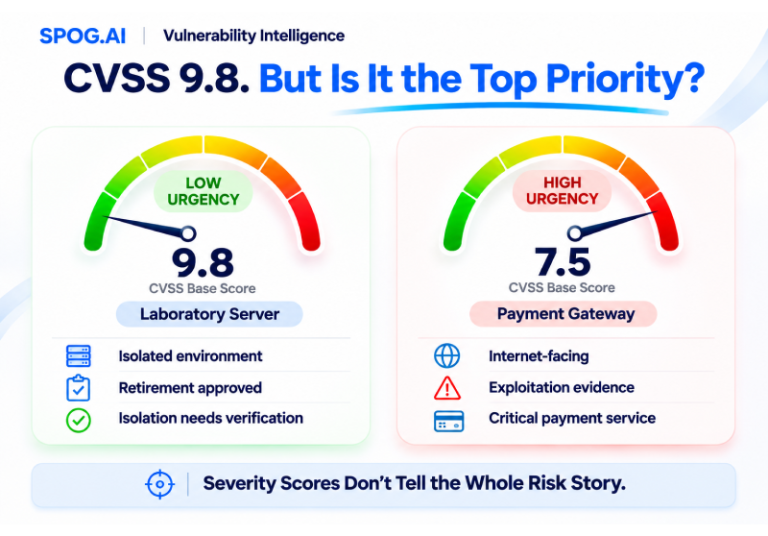
A critical vulnerability on an isolated test server may be less urgent than a lower-scored flaw on an...
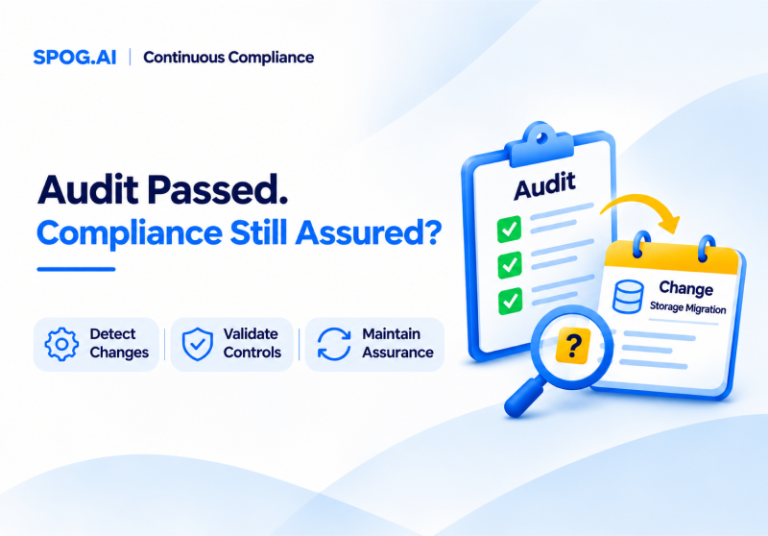
An audit can confirm that security controls met assessed requirements during a defined period. But system changes can...
Seven critical PHP vulnerabilities pose risks of remote code execution and service disruption. While patching is essential, which...