Continuous Control Monitoring
Security Questionnaires: Respond with Accurate, Verifiable Answers
Security questionnaires help buyers understand how a supplier protects the data, systems and services involved in a proposed...
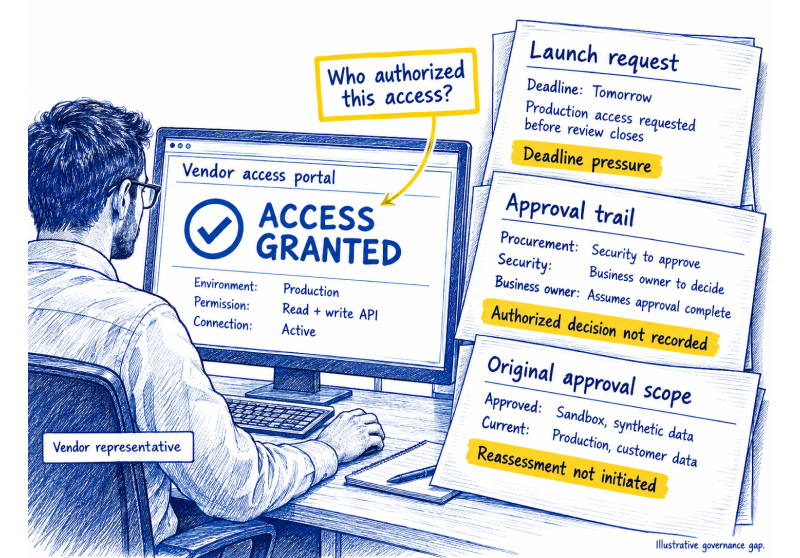
A vendor management policy establishes internal authority for entering, governing and exiting supplier relationships. Questionnaires, contracts and assessment procedures support execution; they do not replace policy-defined permission.
Define scope, review depth, approval rights, prohibited conditions, exception authority, change triggers and exit obligations. Procedures hold the implementation detail.
Set approval requirements before contract signature, production connectivity or sensitive-data sharing. Define which commitments require review and which narrowly specified low-impact activities may follow a delegated route. A purchase order or completed questionnaire must not silently authorize access.
Require enough context to identify the business owner, intended use, data, access, dependency and onward processing. Controlled procedures can specify the intake fields and evidence checklist.
Define who approves each risk tier, when specialist concurrence is required and which findings prevent commitment. Keep detailed thresholds in controlled procedures. Classification must change scrutiny and authority, with documented reasons for overrides.
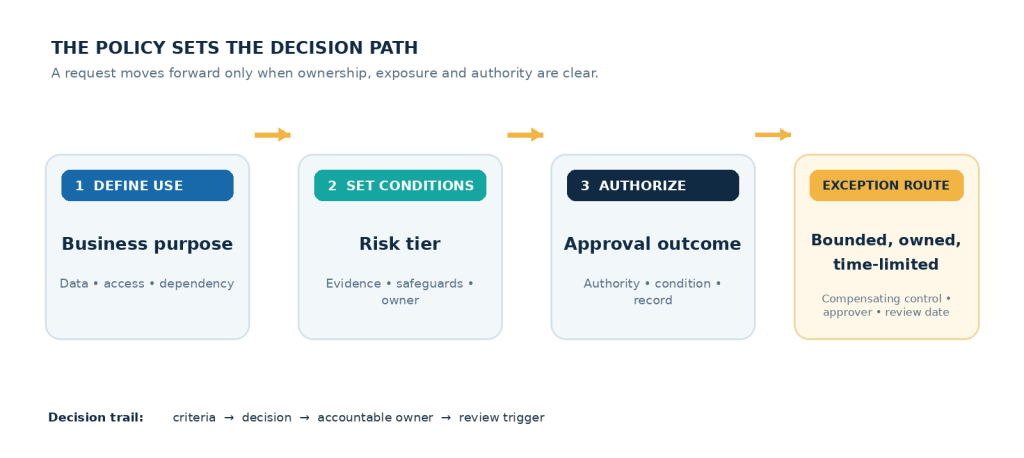
Illustrative approval rule: “Employees must not grant production access or share sensitive information until the designated authority approves the documented use. Any outstanding mandatory requirement must have a permitted, unexpired exception before use begins.” Adapt this wording to actual delegation and obligations.
Illustrative change rule: “An approval covers only its recorded scope. The sponsor must obtain reassessment before expanding data use, access or processing beyond that scope. Emergency containment may proceed under the incident playbook.” These rules establish authority; procedures define the operational steps.
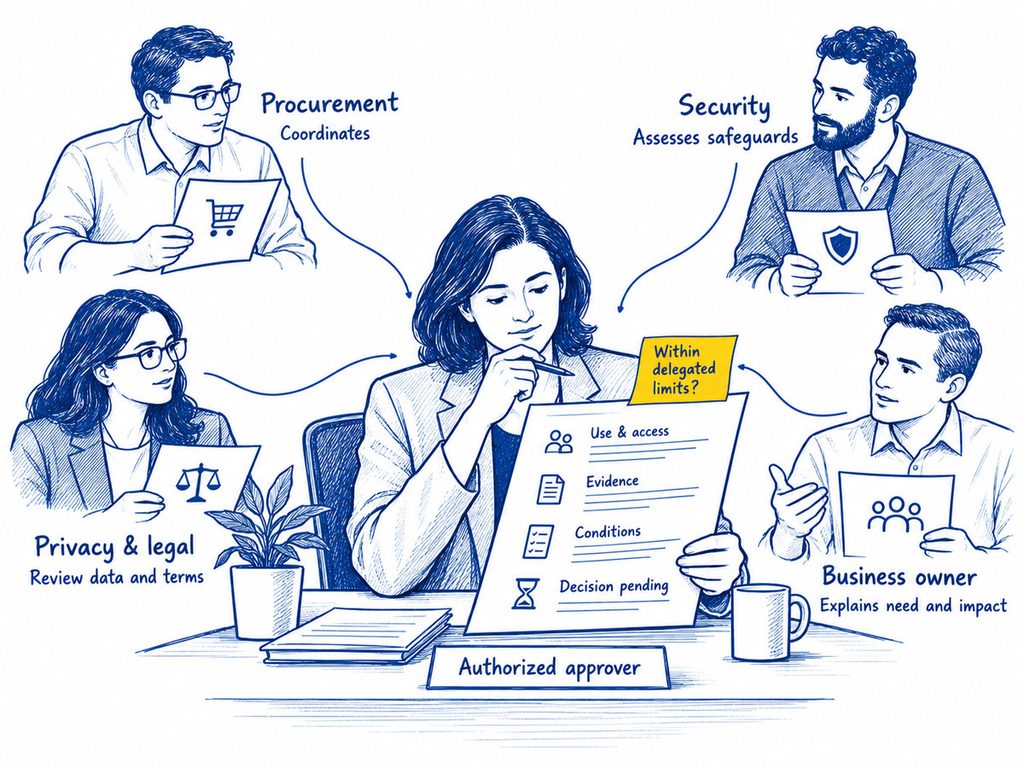
Procurement coordinates workflow; security assesses safeguards; privacy evaluates data use; legal reviews obligations. The business owner explains need and disruption. Contributing to review does not automatically confer risk acceptance authority.
Name the approver for each tier and the escalation route. Sponsors and technical reviewers must not accept exposure outside delegated limits.
Record approve, approve with conditions, defer or reject, with rationale, evidence, owner and date. Internal approval cannot override binding legal or contractual duties. Risks above delegated limits require escalation.
A temporary exception needs the unmet requirement, affected scope, rationale, residual risk, safeguards, action owner, authorized approver and expiry. Set a review date where useful, but do not let it substitute for expiry. Risk acceptance records a deviation; it does not make the underlying control effective.
Define the evidence required for closure and what happens at expiry. Continued use requires renewed authorization before the deadline or the specified restriction, suspension or exit action. Escalation alone must not silently extend permission. Prohibit exceptions that would breach a binding obligation.
Link exceptions to the relationship. Expanded access or data use may invalidate safeguards; reassess before extending the original permission.
Require reassessment for material changes to data, access, integrations, subprocessors, incidents, control failures, criticality or ownership. Include renewal and planned exit triggers.
For each trigger, assign detection, validation, impact review and decision authority. Specify whether existing use may continue, must be restricted or needs suspension while review proceeds. The policy should require the relationship record and relevant contract conditions to change with the decision.
Delegate emergency containment in advance. The incident playbook may authorize responders to revoke compromised sessions, disable an integration or isolate an endpoint within defined limits, with prompt notification and retained records. Broader business disruption follows the designated escalation route. Reassessment must not become a reason to delay an authorized containment action.
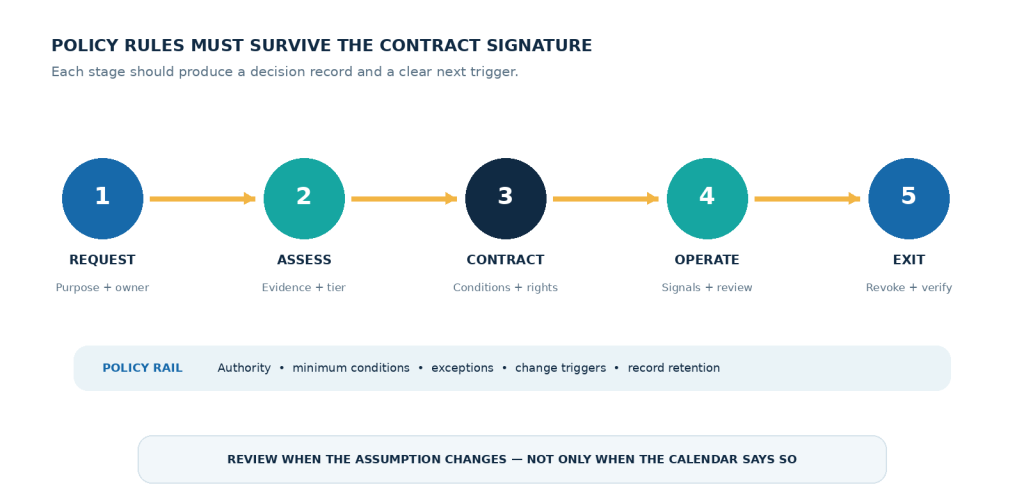
Require review of contract terms covering permitted use, access, incident cooperation, subcontracting, assurance, continuity, data disposition and termination support. Legal and procurement negotiate the resulting conditions.
Assign exit duties before approval: revoke credentials and integrations, return or delete data, retain required records and test transitions for critical dependencies.
Keep approved use, conditions, owners, open issues, review dates and exit status together so the record explains what would invalidate permission.
Map the policy to obligations that apply to your organization. The OCC’s September 2026 proposed third-party guidance is proposed for banking organizations, not a final or universal rule. Its risk-based tailoring can inform design without becoming a mandate for every company.
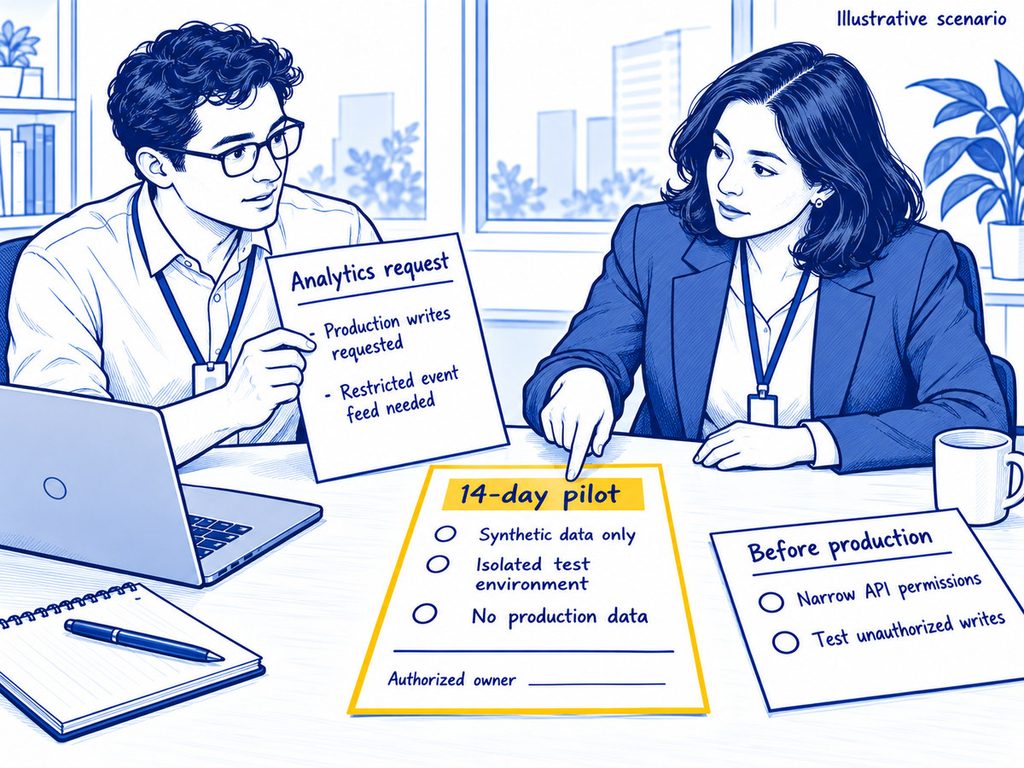
Illustrative scenario: a product team requests a cloud analytics service before a customer launch. It will receive event data and connect to production. The deadline is close, but the proposed access exceeds the approved business purpose.
In this illustrative case, security finds that the requested API credential allows production writes, although the analytics use needs only a restricted event feed. The authorized risk owner defers that connection and permits a 14-day pilot using synthetic data in an isolated test environment. The exception names an owner, prohibits production data and expires unless renewed through the stated authority.
Before production approval, engineering must narrow the integration permissions and supply the configuration and negative-test results showing unauthorized writes are rejected. Security reviews those results; privacy and legal review data use and terms. A later request to add identifiable records requires a new decision before the expanded processing begins.
Keep authority and mandatory boundaries in policy; put forms and workflow instructions in controlled procedures. Procedure changes require delegated approval and must not weaken policy.
Review the policy on a set cadence and after changes to business models, data flows, regulatory scope, approval authority or incident lessons. SPOG.AI’s GRC capabilities can support this oversight by connecting requirements, controls, ownership and related evidence. Sample approvals, exceptions and exits to confirm the right owner acted and teams followed triggers.
Monitor approvals granted before access, expired exceptions still in use, unreviewed material changes and verified exit obligations. Define population, period and threshold. Sample transactions to find bypasses and misclassification; completion statistics alone cannot show whether the policy was followed.
A written policy needs proof of use. SPOG’s Governance, Risk and Compliance solution connects requirements, controls, owners and operational evidence. Continuous Control Monitoring solution supports assessment of defined controls against operational evidence, while Security Maturity relates maturity models to evidence, ownership and context. These capabilities support governance records; they do not replace supplier selection, contract negotiation, independent assurance or authorized risk acceptance.
For guidance focused on individual supplier decisions, see SPOG’s vendor risk management best practices. The broader vendor risk management guide covers governance across the relationship, and the maturity model addresses program capability. This article fills a different role: it explains the policy authority and operating rules that make those practices consistent.
A vendor management policy matters when it changes decisions before onboarding, after material change and at exit. Define what must be known, who approves each level of exposure, how to bound exceptions, what reopens approval and what evidence shows teams acted.
Test those rules against real approvals and changes. SPOG.AI’s GRC capabilities can support traceability across requirements, controls, ownership and operational evidence. Leadership remains responsible for setting authority and deciding whether the documented conditions permit continued use.


Security questionnaires help buyers understand how a supplier protects the data, systems and services involved in a proposed...

A vendor cybersecurity inquiry should establish what the supplier will do, which data and systems it can access,...
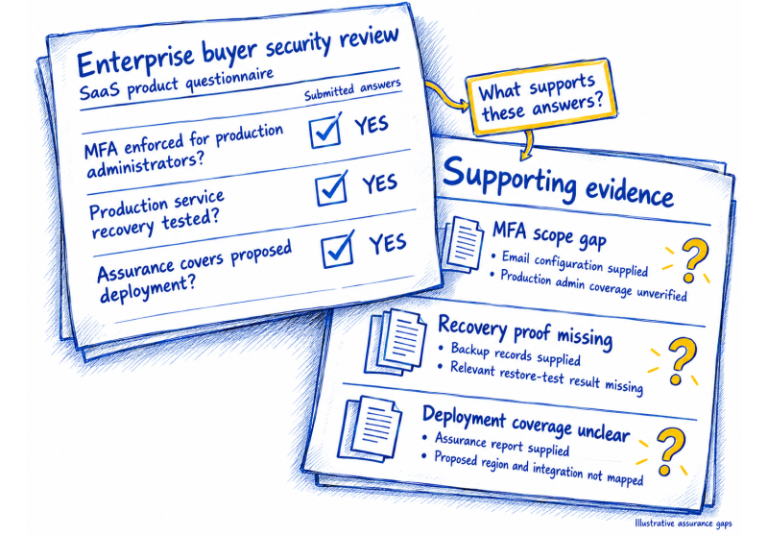
Enterprise buyers expect SaaS startups to demonstrate how they protect customer data, identities, and business operations not just...