Automated Compliance Evidence: Make Control Signals Traceable and Reviewable
Automated evidence can save teams from repeated exports and audit-week searches. But capture is only the start: the evidence must still answer the auditor’s question.
Automated compliance evidence collection can make assurance work less dependent on screenshots, spreadsheets and last-minute requests. Yet a connector that retrieves data is not, by itself, proof that a control operated as intended. The evidence still needs the right source, population, time period and relationship to the control being assessed.
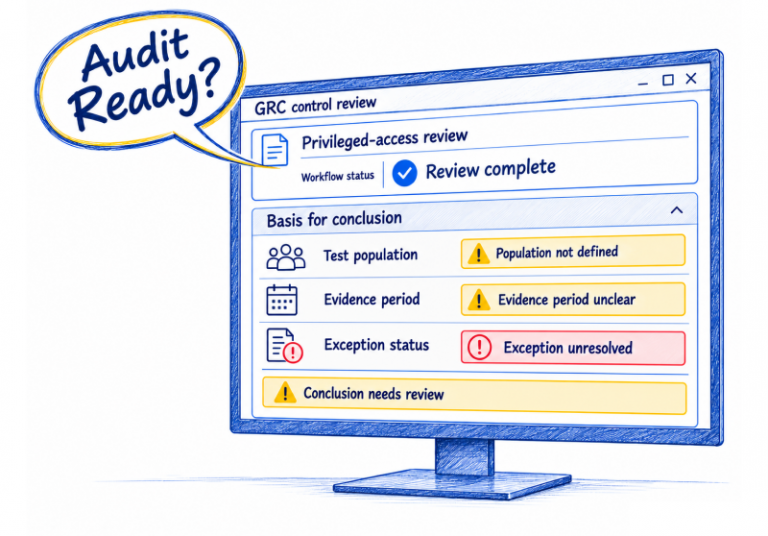
That distinction matters when a platform shows a green status but an auditor asks a narrower question: which accounts were tested, during what period, and how does this record support the control conclusion? The answer depends on the evidence chain, not the dashboard color. In this article, “automated evidence collection” means using connected systems and defined workflows to gather and organize operational records. It does not mean that software can make every assurance judgment on behalf of the control owner or auditor. The objective is a traceable path from a control question to an authoritative source and a reviewable conclusion.
Why collected evidence can still fall short
Evidence must support a specific objective. A current export may still miss the relevant population; a policy describes intent, and a closed ticket does not prove the expected state was restored. Recent guidance from The Institute of Internal Auditors emphasizes relevance, reliability and sufficiency in audit documentation. Put simply, evidence must relate to the objective, come from a trustworthy basis and provide enough detail for another reviewer to follow the conclusion. These principles are a helpful test for automated compliance evidence as well as manually assembled records.
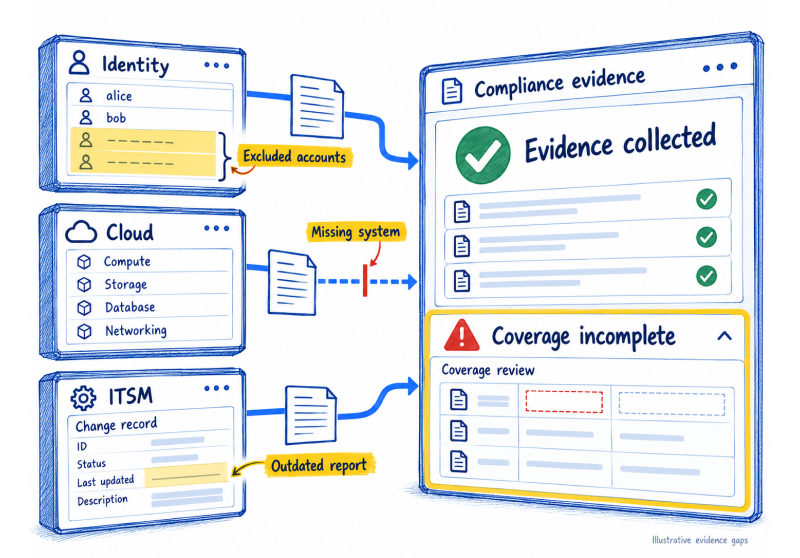
The failure often sits between collection and interpretation. A correct identity report may omit contractors, administrators or workload identities across other tenants. The report is real; the conclusion that all in-scope identities are covered is not supported until scope is reconciled. A weekly snapshot also cannot establish uninterrupted operation across a quarter.
Design the evidence chain around the question
Write the evidence question before choosing a connector. For example: “Were production privileged identities reviewed and approved this quarter?” This names the activity, population and period.
1. Define the control test and population
Document the control objective in testable language. Identify systems, accounts, assets, locations and time windows that are in scope. Record exclusions and why they are legitimate. The test should say what counts as a pass, what produces an exception, and who can resolve a scope question. If the organization cannot define the population, evidence collection cannot reliably prove coverage.
2. Choose an authoritative source
Choose the system closest to the control activity. An access review may need identity records and approvals; a change control may need both the change record and deployment logs. Treat screenshots or trackers as context, not sole proof of system state. Document authoritative sources and any needed corroboration.
3. Preserve time, scope and provenance
Retain context on what was queried and when: source, tenant or account, test definition, collection time, observation period, population, exceptions and connector health. Preserve the original artifact or a reproducible source reference. Record any transformation used for reporting.
A timestamp alone does not establish currency. Distinguish event time, report-generation time and collection time; a report generated today may contain older activity. Make those boundaries visible.
Map data to controls without overstating what a mapping proves
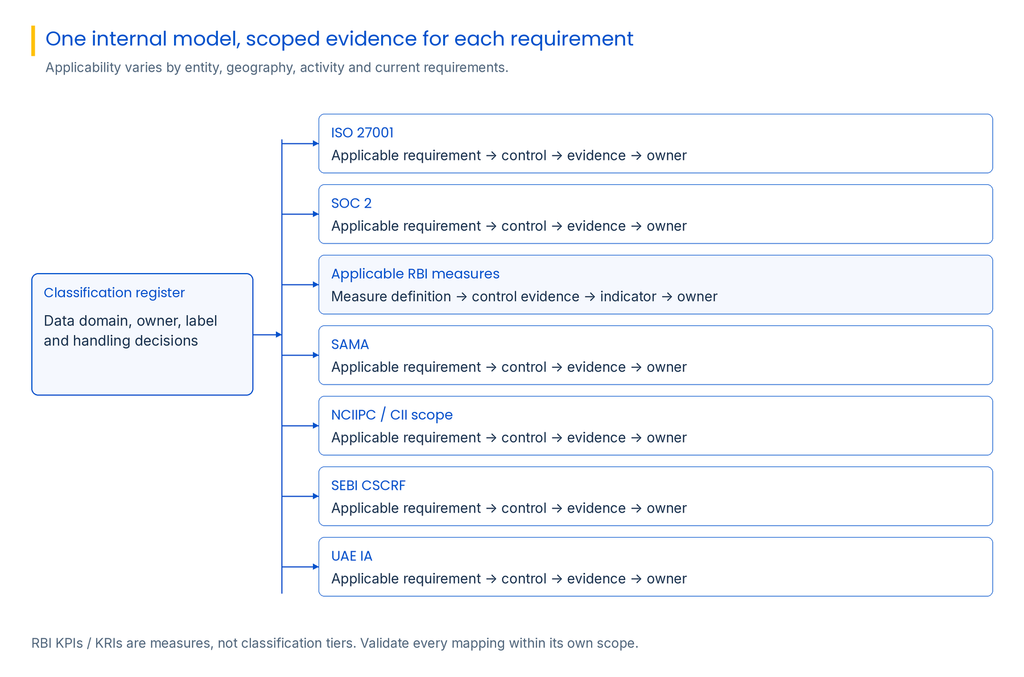
A control mapping links a record to a requirement; it is not a verdict. One record may support several controls, but check each mapping for differences in intent, scope, frequency and period. Generic mappings can hide a mismatch between the requirement and what the source measures.
Keep three states distinct: evidence collected, evidence reviewed and control conclusion. Collection confirms that a data item was obtained. Review checks its relevance, completeness and exceptions. The conclusion states whether the test supports the control’s intended outcome for the stated scope and period. A workflow can record each state, but it should not collapse them into one unexplained “compliant” indicator. For judgment-based controls, automation can route records and flag missing fields, but an accountable reviewer must make or approve the decision. If evidence is incomplete, mark the conclusion unverified and investigate.
Treat integration health as part of evidence quality
Collection depends on connectors, credentials, permissions, query logic and source availability. A revoked token, changed permission or new cloud account can reduce coverage while the integration still appears connected.
Monitor the evidence pipeline itself. Track last successful collection, expected versus observed records, known scope, failed queries, permission changes and unresolved gaps. Alert an owner when an evidence source becomes stale or its population changes unexpectedly. Reconcile the connected scope with an independent inventory or accountable system owner at a defined interval and after material environment changes. Do not call a daily poll continuous observation. Conditions between polls may be missed. Match cadence to the control’s risk, or qualify what the record can establish.
Use review rules that expose uncertainty
Review should answer four practical questions. Is the source suitable for the assertion? Does the record cover the full approved population? Does its period match the control’s required frequency? Can a second reviewer reproduce how the conclusion was reached? If an answer is no or unknown, route the item for investigation and preserve the reason.
A useful exception record includes the affected requirement, system and population; the observed condition; the evidence gap or failure; the owner; the decision authority; the due date; and the next validation step. If the gap is accepted temporarily, preserve the approval, rationale, expiry and reassessment trigger. An exception is a decision about response; it does not change the underlying control result. Sampling may be appropriate when full-population analysis is unavailable or disproportionate. Record the method, population and limitations. Full-data analysis is useful only when the source is complete and the query validated.
Make the audit handoff reproducible
Before an audit request arrives, ask a reviewer who did not configure the integration to reproduce one evidence item. Can they identify the control question, find the source, understand the population and period, inspect exceptions, and follow the review to its conclusion? If not, improve the record or the accompanying explanation.
Keep a history of collection, review, correction, export and approval under approved retention and access rules. Limit access and avoid retaining data beyond the assurance purpose. This also distinguishes management reporting from independent assurance. Auditors may need the source report, test method and reviewer challenge. State what the artifact supports and what it does not.
VISUAL 4 — Place after “Make the audit handoff reproducible.” Create a decision table with columns “Question,” “Evidence to retain,” and “What it supports.” Rows: source authenticity, population coverage, timing, exception disposition, reviewer conclusion. Use a refined portrait-leaning table or landscape 4:3 card layout. Alt text: “Audit-ready evidence checklist linking review questions to retained records and supported conclusions.”
Where SPOG fits in the evidence workflow
SPOG.AI’s published platform description connects enterprise systems, controls, operational evidence, risk context, ownership and remediation workflows. Its Governance, Risk & Compliance solution describes connecting requirements, controls and operational evidence. Its Continuous Control Monitoring solution describes using operational evidence to assess coverage and effectiveness and route material gaps for remediation.
This connection can help teams relate an observed state to its control and owner, then follow an exception through action and revalidation. It does not decide whether the test or population is appropriate. Confirm that the relevant sources and fields are in scope before relying on a workflow.
Automate retrieval, preserve the reasoning
Automated compliance evidence is valuable when it reduces repetitive retrieval and makes control information easier to review. Its reliability depends on what happens around collection: test design, source authority, scope, timing, provenance, exception handling and human review. Build those details into the evidence record, test the chain with someone outside the configuration team, and state the limits of every conclusion. The result is not just a faster audit response; it is a more defensible explanation of what the organization knows, what remains uncertain and what it has done next.
Frequently asked questions
It uses connected systems or defined workflows to gather and organize records used to assess controls or meet assurance requirements. Collection can be automated; the interpretation of whether evidence proves a control objective may still require review.
Not automatically. The record must be relevant, reliable and sufficient for the audit objective, with suitable scope, timing and source context.
System states, access records, configuration data, ticket histories and other structured operational records are common candidates when a reliable source and integration are available. Human approvals and judgments may need separate review.
A trustworthy source, clear provenance, a defined observation period and enough context to confirm that the artifact has not been misrepresented or detached from its origin.
Set cadence according to the control objective, risk and required observation period. A daily snapshot cannot prove uninterrupted operation between collections.
Sometimes. Validate each mapping against the control’s scope, intent, frequency and period rather than assuming a shared artifact proves every requirement.
No. It means the control conclusion is unverified until the team determines whether the source failed, the scope changed, or the control itself did not operate.
Record the start and end of the gap, affected scope, cause, owner and recovery action. Recollect or reconstruct evidence where possible, then document any remaining limitation.
No. Apply approved retention, access and data-minimization rules. Retain enough to support the assurance purpose and applicable recordkeeping requirements.
Ask an independent reviewer to trace a sample from the control question to source, scope, period, exception handling and conclusion. Fix any step they cannot reproduce.
Technology writer and content strategist with 5+ years of experience, including work for a US-based B2B SaaS client and a cybersecurity solution. I create cybersecurity and GRC content, product documentation, and user guides that help technical teams and business leaders understand security capabilities and workflows. Currently working on Confluence documentations on vulnerability management, ITSM, incident management, and continuous control monitoring, alongside SEO and AEO content, and technology partner database development.