A practical guide for security and IT leaders deciding what to fix first. Use exploit evidence, real exposure, and business impact to create a defensible remediation queue.
Risk-based vulnerability management is often described as a better ranking method. In practice, the harder problem comes after ranking: deciding whether to interrupt a release, isolate an asset, apply a mitigation, schedule a patch, or accept a short-lived exposure. Teams rarely lack severity data. They lack a consistent way to translate that data into a defensible action when hundreds of findings compete for the same change window.
A Common Vulnerability Scoring System (CVSS) score describes technical severity under defined assumptions. It is useful for comparing vulnerability characteristics, but it does not tell an organization whether a vulnerable component is reachable, whether exploitation is occurring, what business process depends on it, or what disruption a rushed change could cause. Treating the score as the decision turns an input into a verdict.
The practical aim is not a more elaborate universal score. It is a triage rule that makes the important evidence visible, groups findings into a few action lanes, and gives each lane a clear next move. That keeps the conversation focused on exposure and consequence rather than on competing score formulas.
Use evidence to answer three questions
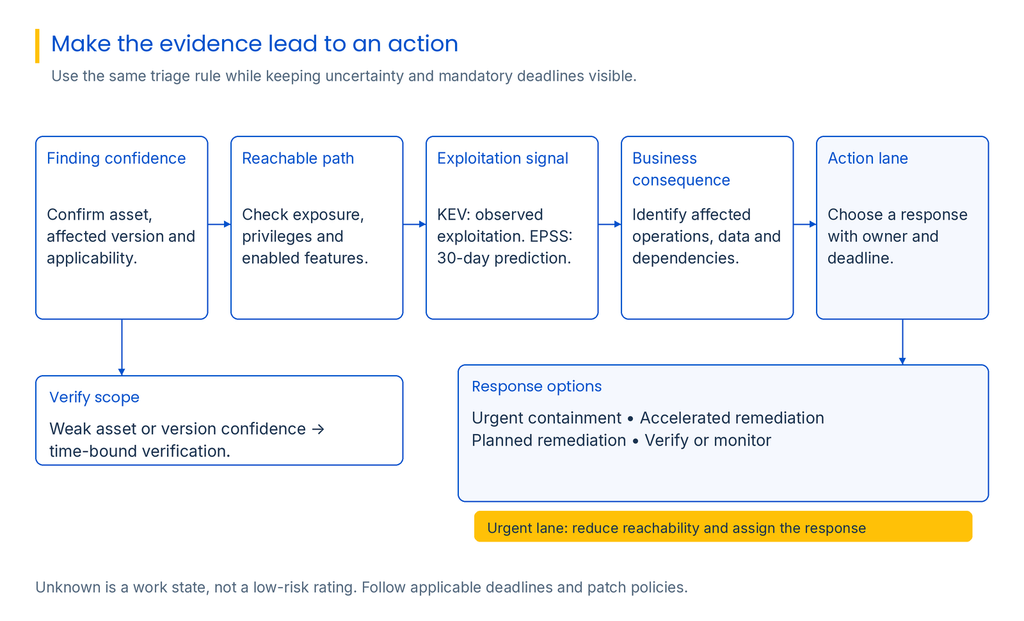
Start with three questions, in order. First, can an attacker reach the vulnerable component along a plausible path? Check asset identity, network and application exposure, required privileges, affected version, and whether the vulnerable feature is enabled. A scanner finding without a reliable asset match or version confirmation is a verification task before it is a patch order.
Second, is there evidence that the vulnerability is being exploited or is likely to be weaponized? CISA’s Known Exploited Vulnerabilities (KEV) catalog records vulnerabilities with evidence of exploitation in the wild; CISA’s September 2026 notice continues to encourage organizations to prioritize remediation of catalog entries. FIRST’s Exploit Prediction Scoring System (EPSS) estimates the probability that a published CVE will be exploited in the next 30 days. These signals answer different questions: KEV is observed exploitation; EPSS is a prediction. Neither tells you whether your instance is exposed or important.
Third, what would successful exploitation interrupt, expose, or enable? Map the asset to the process, data, identities, and dependencies it supports. A flaw on an internet-facing identity provider or a system holding sensitive production secrets has a different consequence from the same flaw on a disposable isolated build agent. Include safety, legal obligations, customer impact, recovery options, and concentration risk where they apply.
Build action lanes, not another score
A workable triage model should be simple enough for analysts to apply consistently and specific enough to trigger action. Four lanes usually cover the decisions teams need to make. Define them with observable conditions, owners, and response expectations that fit your environment and applicable obligations.
Action lane
Typical evidence
Next decision
Urgent containment
Credible active exploitation or a highly exposed path to a critical function
Reduce reachability now; assign an emergency fix or approved mitigation.
Accelerated remediation
Strong exploit signal or high consequence, with reachable affected asset
Bring the fix into the next safe window; escalate blockers to the risk owner.
Planned remediation
Confirmed flaw, limited exposure or consequence, no current urgent signal
Schedule against capacity and track until the agreed date.
Verify or monitor
Uncertain asset/version, disputed applicability, or compensating control needs proof
Resolve the uncertainty; document the condition and set a review trigger.
The lanes should express what the team will do, not imply false precision. A high score can justify investigation without proving immediate danger. Conversely, a vulnerability with a moderate technical score may deserve urgent action if exploitation is observed and the affected asset is exposed in a critical path. Document the evidence and rationale so another analyst can understand why the lane was chosen.
Test the rule against the same finding
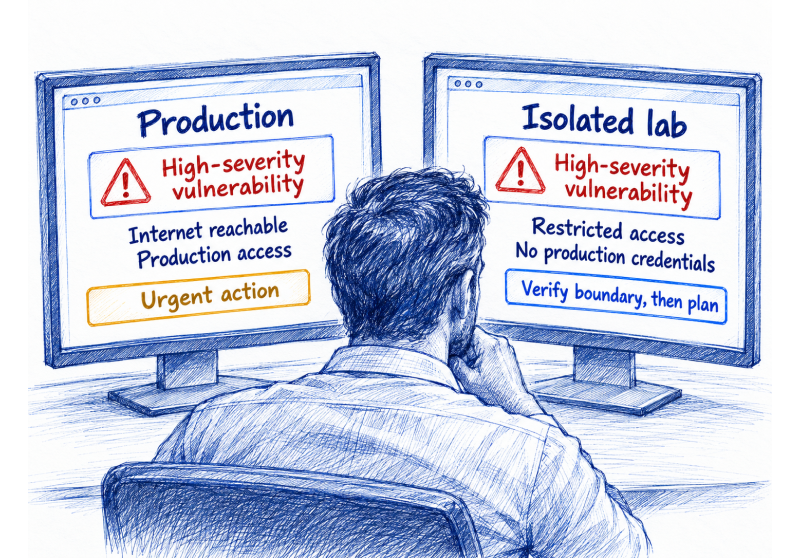
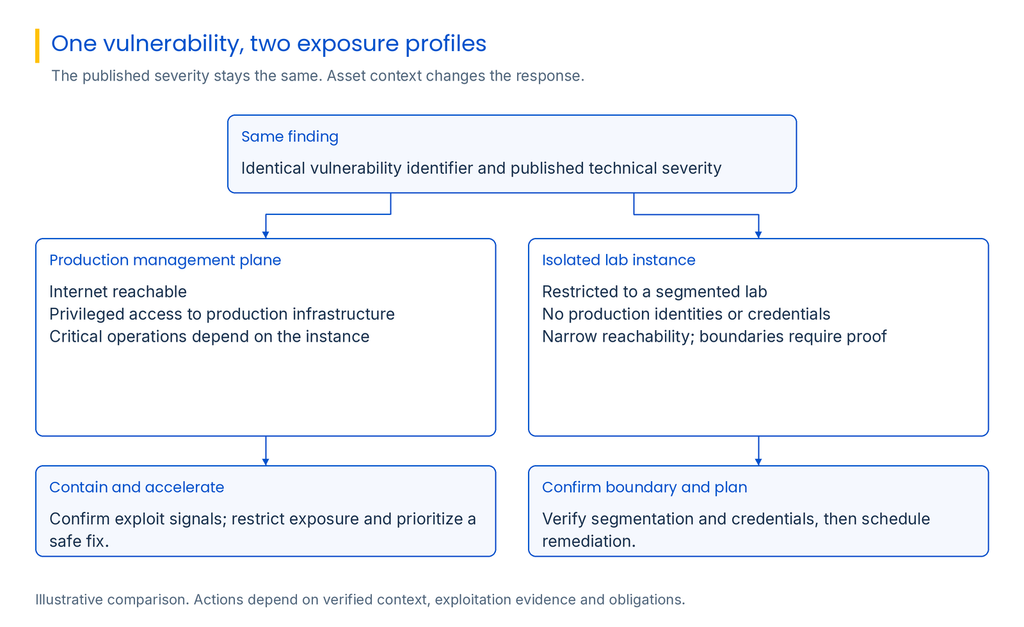
Illustrative scenario: a vulnerability affects a remote management component used by two business units. One instance is internet reachable and manages production infrastructure; the other is restricted to a segmented lab with no production credentials. The vulnerability identifier and published severity are identical. The first instance may enter urgent containment or accelerated remediation because reachability and consequence compound the exploit signal. The lab instance may enter planned remediation after confirming segmentation and credential boundaries.
That is not inconsistent treatment. It is the purpose of risk-based vulnerability management: apply one decision rule to different operating conditions. The rationale should name the specific differences, such as external reachability, privilege, data sensitivity, dependencies, and containment options. Avoid vague labels like “critical business system” unless the business owner and dependency are recorded.
Choose signals carefully and state their limits
Use CVSS to understand technical severity, not as a business-risk estimate. KEV identifies observed exploitation; absence from KEV is not evidence that a flaw is safe. EPSS is a probabilistic signal for the next 30 days, not a guarantee or a substitute for asset context. Record the source and date of threat reporting because conditions change.
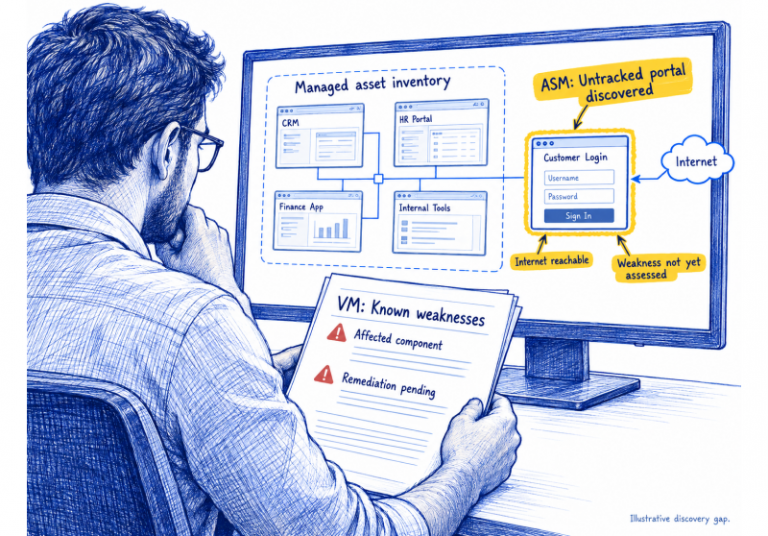
Stale asset ownership, incomplete cloud inventory, duplicate scanner records, and controls that do not cover the affected path can weaken a model. If exposure, version, or ownership is unknown, route the finding to time-bound verification. Unknown is a work state, not a low-risk rating.
Avoid a weighted formula unless its inputs are stable and explainable. An opaque score is difficult to challenge or improve. Keep regulatory deadlines and internal patch policies as explicit constraints; risk-based prioritization does not replace them.
Connect priority to an executable response
A priority only matters if it reaches the team that can change the exposure. Each action should carry the finding, affected asset, evidence, business consequence, proposed route, accountable owner, deadline, and any dependency or exception. Where patching is unsafe or unavailable, consider a compensating measure such as restricting access, disabling the vulnerable function, isolating the host, or increasing detection. Record what the measure changes and when it must be reviewed.
SPOG’s Exposure Management solution describes connecting asset, threat, control, business, ownership, and workflow evidence to prioritize exposures. Its Remediation solution carries priority and context into accountable workflows. Organizations should define their own decision criteria.
Do not let a priority lane become a quiet exception mechanism. A deferral needs a named risk owner, rationale, scope, compensating controls, expiry, and a condition that triggers reassessment—for example, new exploitation evidence, a change in reachability, or a business process going live. If the accepted risk is outside delegated authority, route it to the person who can accept it.
Revisit the decision when conditions move
Reassess when exploitation evidence, reachability, asset criticality, or mitigation changes. Preserve the earlier rationale and show what new evidence changed the decision.
Review whether the triage rule led to the intended action and still fits current conditions. Use the review to improve the rule and remove friction.
Conclusion: make the next action defensible
When vulnerability queues are ranked only by severity, teams spend time debating order while exposure remains unevenly understood. A compact evidence rule gives them a better basis for action: confirm the finding, establish reachability, check exploitation signals, understand the business consequence, and select a response lane. Keep uncertainty visible, preserve mandatory deadlines, and define who can approve exceptions.
The objective is not perfect prediction. It is a queue that explains why one issue moves today, why another can wait, and what new information would change that choice. That is a practical foundation for vulnerability management that security, IT, and business owners can execute together. For teams operationalizing that handoff, SPOG’s Remediation solution can carry priority and context into accountable workflows.
Frequently asked questions
It is a way to prioritize and respond to vulnerabilities using technical severity plus evidence about exploitation, asset exposure, business consequence, and the organization’s obligations.
Severity-based patching mainly orders findings by technical rating. Risk-based vulnerability management adds the affected asset’s real exposure and consequence, then routes the finding to a fitting action.
No. CVSS characterizes vulnerability severity using defined technical metrics. It does not know your asset reachability, business dependencies, or potential operational impact.
The KEV catalog identifies vulnerabilities with evidence of exploitation in the wild. EPSS estimates the probability of exploitation in the next 30 days. Observed exploitation and predicted likelihood are distinct signals.
Treat KEV inclusion as a strong prioritization signal and follow applicable mandates and organizational policy. Determine affected scope and exposure, then select patching or a documented mitigation with appropriate urgency.
Yes. A reachable weakness on a critical, privileged, or sensitive path can warrant fast action even when its technical severity is below other findings.
Review when material evidence changes, such as exploitation status, reachability, asset criticality, or mitigation state. Also set a regular review cadence for findings waiting in planned lanes.
Route the item to a time-bound verification task. Incomplete context should remain visible instead of being interpreted as low risk.
They can reduce exposure when patching is not feasible, but they need a clear scope, owner, evidence, review date, and reassessment trigger. They do not automatically remove the underlying vulnerability.
Keep decision lanes explainable, identify the evidence behind each choice, separate observed exploitation from predictive signals, and avoid combining unstable inputs into an unreviewable formula.
Technology writer and content strategist with 5+ years of experience, including work for a US-based B2B SaaS client and a cybersecurity solution. I create cybersecurity and GRC content, product documentation, and user guides that help technical teams and business leaders understand security capabilities and workflows. Currently working on Confluence documentations on vulnerability management, ITSM, incident management, and continuous control monitoring, alongside SEO and AEO content, and technology partner database development.