Cybersecurity Risk Management Process: A Practical Guide to Decisions
A cybersecurity risk management process should move from a defined business question to a decision, funded action, and evidence that the response worked. This guide gives security and GRC leaders a practical cycle for making those handoffs clear and repeatable.
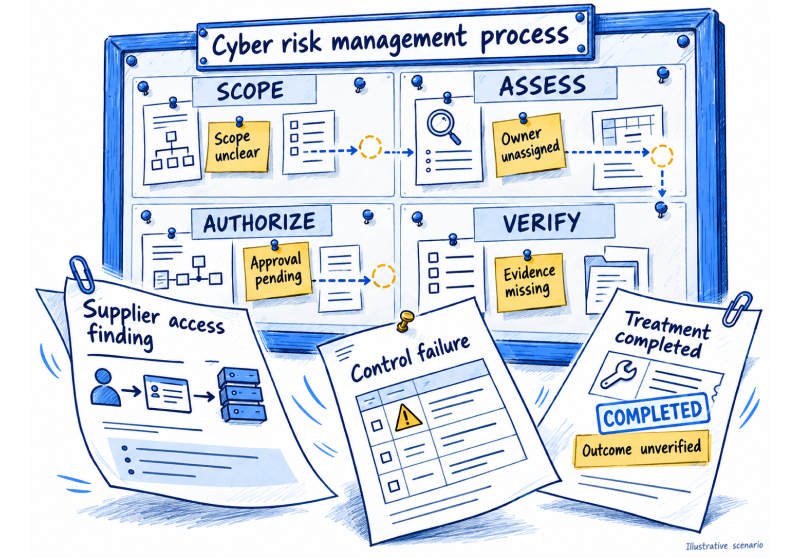
A cybersecurity risk management process matters when it changes a decision. Teams can identify threats, assess risk, and update a register while leaders still lack a clear action, an authorized decision-maker, or proof that a response reduced exposure.
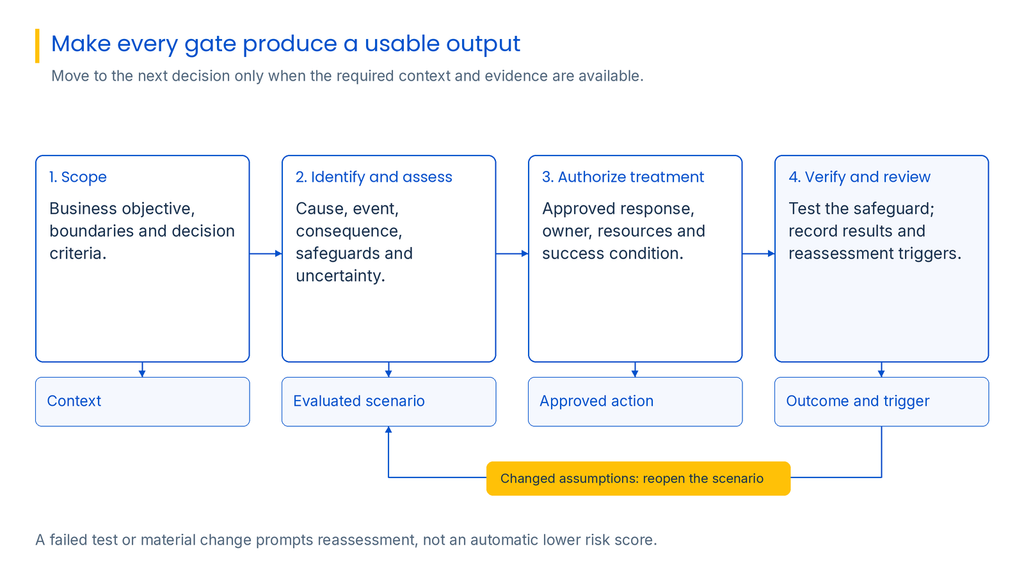
Each stage should produce an input the next decision-maker can use: a clear scope, an assessed scenario, an authorized treatment, and evidence for review. Strategy sets priorities and authority; a register records decisions. The process connects them.
Build the cybersecurity risk management process around decision gates
A familiar loop, identify, assess, treat, monitor, can hide stalled handoffs. Make the process actionable by defining four decision gates, each with a minimum output: set context; identify and assess a scenario; authorize a response; verify the result. Missing output means the next decision is premature.
Scale the depth to the decision. A routine issue may need a short review. A risk that could interrupt a critical operation may require impact analysis, specialist input, and executive approval. Keep the gates consistent while varying the evidence and effort.
Gate 1: Set the scope and decision context
Begin with the decision: launch a platform, accept a control gap, fund resilience, or limit supplier access. Define the business objective, affected systems and information, critical dependencies, obligations, and review period. This scope determines who must contribute and what evidence matters.
Name both the person accountable for the affected outcome and the authority that can approve treatment. Agree on impact dimensions, likelihood method, escalation thresholds, and treatment of uncertainty before scoring. Appetite and tolerance guide decisions, but cannot override legal, contractual, safety, or customer commitments.
Set boundaries for dependencies that could change the result. A scoped assessment of one application may need to include its identity provider, hosting environment, data exchange, and recovery arrangements if failure in those areas can interrupt the objective. Record what is outside scope and why; otherwise, an assessment may look complete while omitting the path that drives the consequence.
Gate 2: Identify and assess the risk scenario
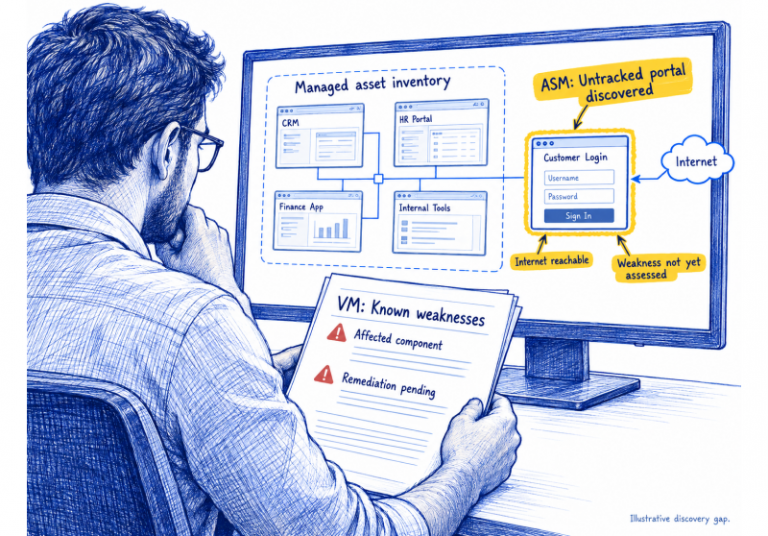
Turn observations into an event that could affect the objective. A vulnerability, audit finding, failed control, or supplier questionnaire is evidence or a condition, not a complete risk statement.
Connect cause, event, and consequence. For example, an identity-provider outage or compromise could block staff access to a customer-support platform and delay responses. This is illustrative, not a claim about a real organization. Ask security, process, legal, privacy, and supplier stakeholders what would fail first, what workarounds exist, and which obligations apply.
Group findings when they lead to the same event and decision. Separate them when consequences, owners, responses, or approval authority differ. Capture the source and date of material observations so assessors can distinguish current evidence from assumptions carried forward from an earlier review.
Analyze exposure and evaluate it against criteria
Estimate how plausible the event is and what consequences could follow, based on current evidence and safeguards. Use a method suited to the decision: qualitative ranking when data is limited, scenario analysis to expose dependencies, or quantitative analysis when loss data and assumptions support it. Do not imply more certainty than the inputs allow.
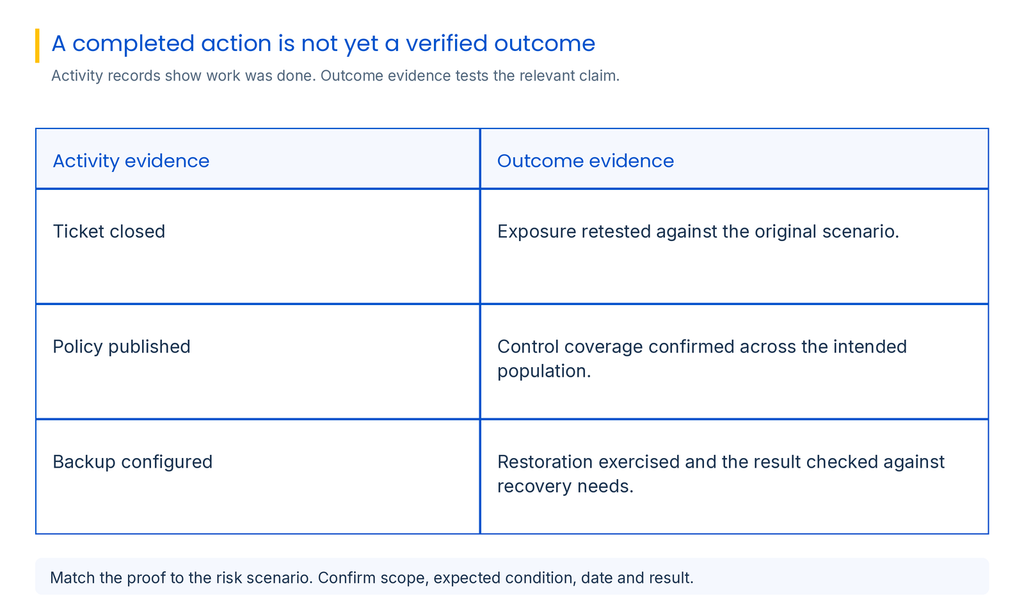
Separate inherent exposure from residual exposure. Residual risk accounts for safeguards that are deployed and functioning, plus uncertainty. A policy, planned control, or closed ticket does not prove effectiveness. Compare the result with agreed criteria; a score should not conceal a severe consequence, binding obligation, or weak evidence. Record assumptions and material disagreement. If a key fact cannot be verified, mark it as unknown and test how that uncertainty affects the decision.
NIST IR 8286 Rev. 1, finalized in December 2025, describes communicating cybersecurity risk into enterprise risk management and aggregating information from lower levels. Practically, translate technical exposure into business consequences while retaining detail for teams responsible for action. When combining risks, preserve shared dependencies and avoid adding scores that represent the same exposure twice. For executives, summarize the objective at risk, plausible impact, current response, and decision required. Keep technical drivers available so a summary does not flatten several different scenarios into one opaque rating.
Gate 3: Select and authorize a response
Options include reducing exposure, avoiding the activity, transferring some financial consequences, or accepting residual risk within delegated authority. Transfer does not remove operational accountability or regulatory obligations.
Compare options by expected risk reduction, time, dependencies, cost, and new exposure. For the identity scenario, treatments might include a tested emergency access route or stronger recovery arrangements. A decision needs an owner, resources, due date, success condition, and validation method. For acceptance or deferral, record scope, rationale, approving authority, review date, and reconsideration trigger. Acceptance carries exposure; it is not a control.
Make the treatment measurable before work begins. Define the expected end state in operational terms, such as who can perform recovery, under which approvals, within what time, and with what logging. This helps avoid a common handoff problem: the project team completes its task, but the risk owner cannot determine whether the business outcome improved.
Gate 4: Verify outcomes and reopen decisions when needed
Confirm the safeguard is deployed, covers the relevant population, operates as expected, and addresses the scenario. Use testing, configuration evidence, recovery exercises, or another suitable method. Ticket closure proves workflow ended, not that risk changed.
Set review triggers as well as dates: system or supplier changes, control failure, incident, new attack path, or a changed business impact. NIST SP 800-61 Rev. 3 (April 2025) places incident response considerations throughout cybersecurity risk management. Incidents and exercises should therefore inform reassessment and treatment. Teams should record what the event changed: a likelihood assumption, an impact estimate, a control belief, or the response itself. That is more useful than simply adding the incident to a log.
Track process quality with measures tied to decisions: time from a material finding to an authorized response, overdue treatments for risks above tolerance, and the share of critical safeguards whose operation has been validated. These measures show whether the process is functioning. They should not be mistaken for direct measures of total cyber risk.
Worked example: follow one decision through the process
For the illustrative identity-provider scenario, the objective is keeping customer support available during an outage or compromise. Scope the platform, identity dependency, recovery accounts, and restoration team. Analyze current safeguards, restoration time, and alternatives; compare disruption with impact thresholds and obligations.
Leaders may authorize a controlled test of emergency access and improved recovery instructions. Define success in advance: authorized responders regain access within the agreed window, and the test leaves reviewable evidence. If the test fails or architecture changes, reassess. The outcome is a defensible continuity decision, not simply a lower score. The same logic applies to other risks: identify a business-relevant result, validate it independently of task completion, and reopen the decision when the result is not achieved.
Make the process repeatable without making it bureaucratic
Standardize the minimum record, then scale detail to the risk. Preserve the scenario, objective, scope, evidence, method, assumptions, safeguards, decision, owner, due date, approval, and review trigger. Keep the register as a record of decisions, not a substitute for analysis or governance.
SPOG’s GRC solution describes connecting requirements, controls, and operational evidence. Its remediation solution describes coordinating owners, workflows, deadlines, and outcome validation. These capabilities support connected follow-through; they do not replace business judgment or approval authority.
Conclusion: judge the process by the decisions it improves
A cybersecurity risk management process should show what matters, what to do, and what proof will establish whether the response worked. Tie stages to outputs, scale analysis to consequence and uncertainty, and revisit decisions when evidence or conditions change.
Start with one risk decision that moves slowly or lacks context. Map its handoffs, define the output each gate needs, and test whether the evidence supports the final decision. Expand only after that path helps people act with clarity and accountability.
Frequently asked questions
A repeatable method to identify, assess, treat, and review cyber risks against business objectives.
Define context, identify scenarios, analyze and evaluate exposure, authorize treatment, then verify and review.
Strategy sets priorities and authority; the process applies them to specific risk decisions.
Finding plausible events that could affect objectives and describing them clearly enough to assess.
Set scope and criteria, select a suitable method, and document evidence and uncertainty.
The exposure that remains after relevant safeguards are considered.
The person accountable for the affected business outcome, with technical owners supporting analysis and treatment.
On a defined cadence and after material changes, incidents, or control failures.
No. Verify the safeguard and test whether it changed the relevant exposure.
It records scenarios, evidence, decisions, owners, actions, and review information; it does not replace the process.
Technology writer and content strategist with 5+ years of experience, including work for a US-based B2B SaaS client and a cybersecurity solution. I create cybersecurity and GRC content, product documentation, and user guides that help technical teams and business leaders understand security capabilities and workflows. Currently working on Confluence documentations on vulnerability management, ITSM, incident management, and continuous control monitoring, alongside SEO and AEO content, and technology partner database development.