Risk Control Matrix: Connect Cybersecurity Risks to Controls and Useful Evidence
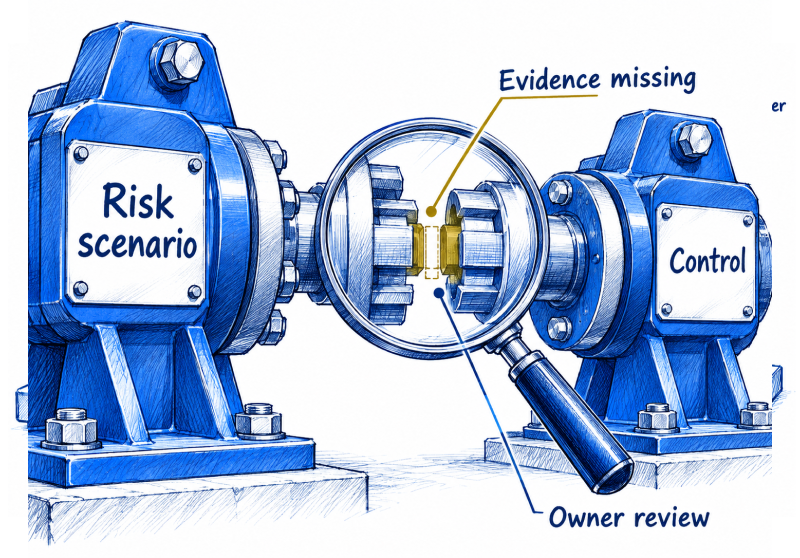
A risk control matrix makes clear how a defined business risk is addressed, who owns the response, and what evidence shows the control works. For cybersecurity and GRC teams, its value comes from traceability that supports decisions, not from the number of rows.
A Risk Control Matrix (RCM) links a defined risk to controls intended to prevent, detect, or reduce it. It records accountability, how performance is assessed, what evidence supports the status, and what happens when a control is weak or unverified.
A risk register records scenarios and assessments; a control framework describes expected outcomes. The RCM connects a material scenario to the controls selected for the organization and the evidence needed to assess them. It is not a list of every setting, audit test, or technical finding. Keep individual weaknesses in remediation workflows so the matrix stays focused on material risk decisions.
Start the risk control matrix with the decision
Start with the service, objective, or obligation that needs protection and the decision the matrix should support: remediate a gap, approve an exception, or report control effectiveness.
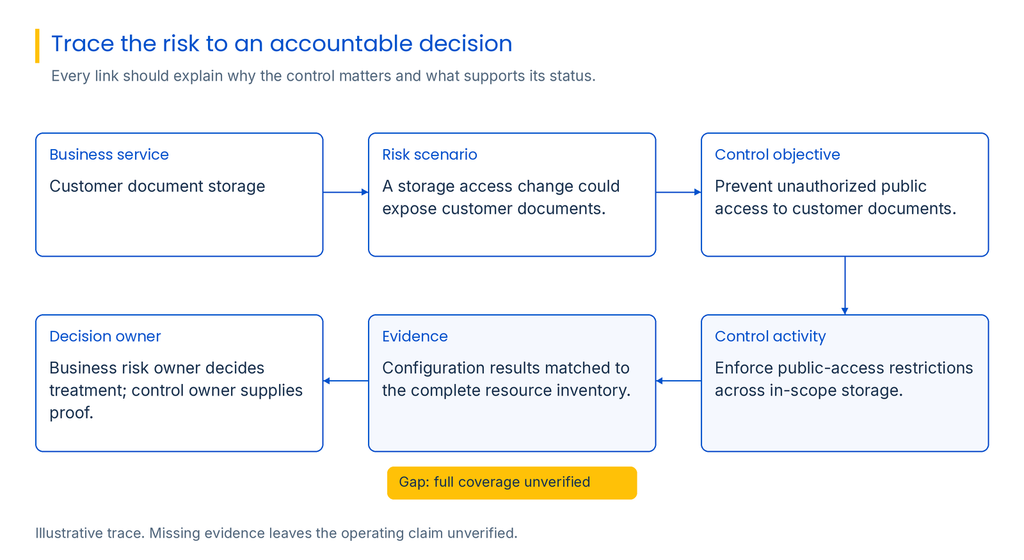
Write a scenario before selecting controls. Describe the condition, event, affected service, and consequence. “Cloud security risk” is too broad. “A storage access change could expose customer documents and trigger incident response and contractual notification” gives teams a testable path from cause to impact.
Assess inherent risk before crediting controls, then residual risk after considering their design and operation. Use the organization’s criteria and record uncertainty in scope, likelihood, or impact rather than hiding it in a precise-looking score. If a control lowers residual risk, show which one, what evidence supports the conclusion, and who reviewed it.
Map controls that interrupt the risk scenario
Map a control because it changes the likelihood or consequence of the scenario, not because its title resembles a framework requirement. Record the intended outcome, activity, scope, owner, and test method.
For a cloud-storage exposure, preventive controls might restrict public access and require approval for policy changes. Detection could identify a resource that becomes public; response could revoke access, preserve logs, and alert the service owner. This reveals whether the scenario has layered safeguards or depends on one control.
Use stable risk and control identifiers. One risk may rely on several controls, and one control may reduce several risks. Link to an authoritative control record instead of copying descriptions that can drift.
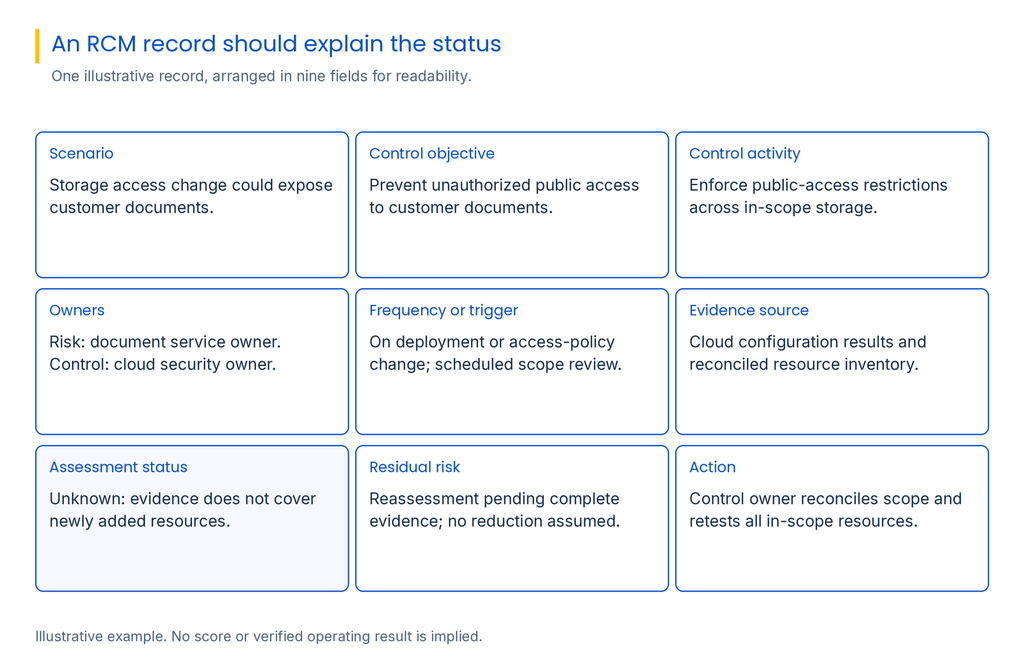
Assess design separately from operation. A suitable rule can fail because scope is incomplete, an exception bypasses it, or no one reviews its output. Define status meanings such as designed, operating with evidence, not operating, and unknown. Risk ownership and control ownership should remain distinct: the business risk owner is accountable for the exposure and treatment decision; the control owner is accountable for explaining the activity and its evidence. One person may hold both roles in a small team, but the matrix should preserve both accountabilities.
Make evidence strong enough to support the status
Evidence must support the control claim. A policy shows that a requirement was documented, not that a setting covers the intended population or that a review occurred on time. Record the source, scope, period, test criteria, and limitations. For automated controls, show what was evaluated and against which condition. Missing, stale, or incomplete evidence means unknown or qualified status, not a pass.
Current guidance reinforces this distinction. NIST’s December 2025 revision on cybersecurity and enterprise risk management addresses how risk registers inform business decisions. The IIA’s Cybersecurity Topical Requirement, effective February 5, 2026, sets a baseline for assessing design and implementation of cybersecurity governance, risk, and control processes. It does not mandate an RCM format. Both support traceability from control detail to a defensible decision.
Use the RCM to expose gaps and govern exceptions
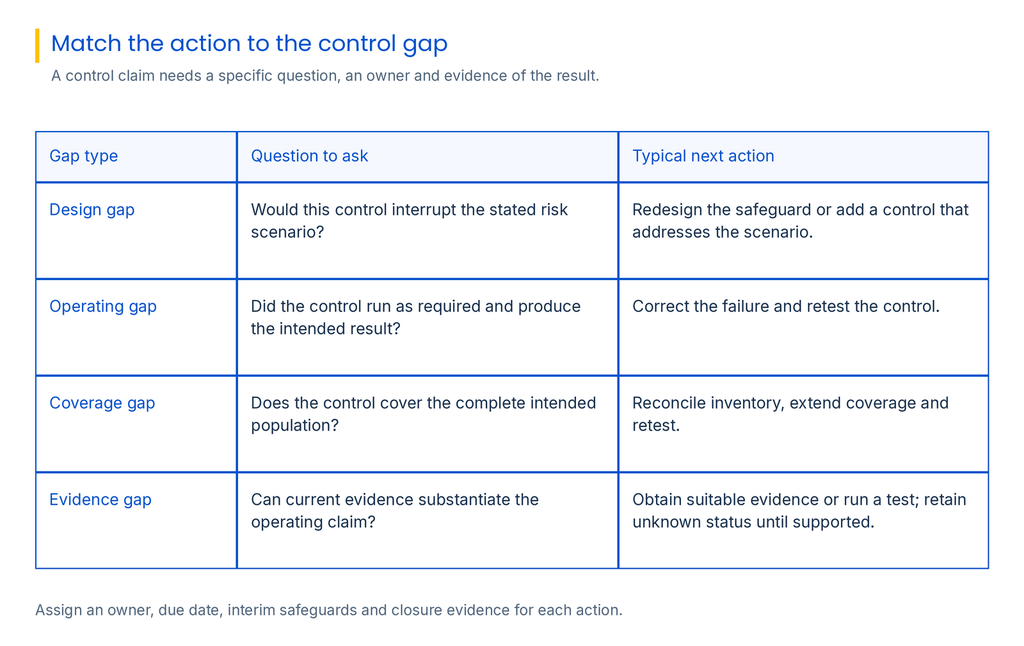
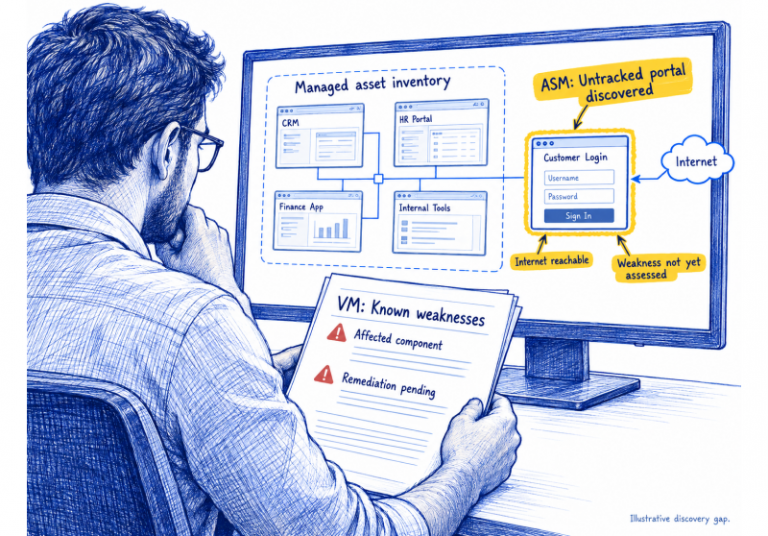
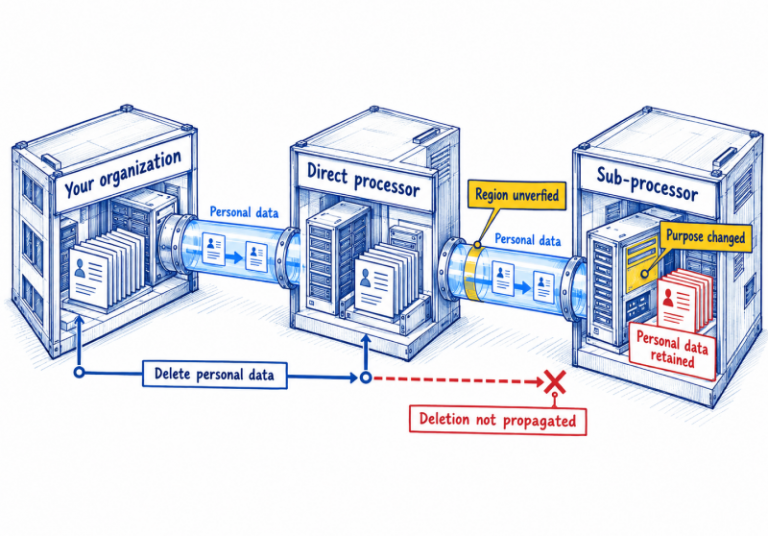
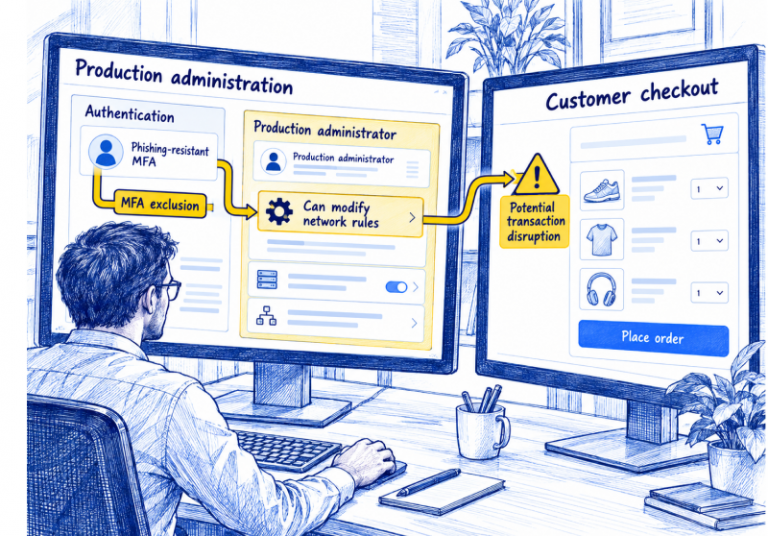
An RCM should distinguish design gaps (the control does not address the scenario), operating gaps (it failed or was not performed), coverage gaps (it misses part of the population), evidence gaps (the claim cannot be substantiated), and ownership gaps (nobody can explain or fix the condition).
Match the response to the gap. A design weakness may need a new safeguard; a coverage problem may need inventory reconciliation; an evidence gap may need a test or better source. Assign an owner, action, due date, interim protection, and closure evidence.
If remediation is delayed, record the approver, rationale, scope, safeguards, review date, and escalation trigger. Acceptance is a business decision, not proof that a control works. Revisit it when exposure, criticality, or evidence changes.
Keep the risk control matrix current as systems change
Control status loses value when its evidence or assumptions become stale. Set a review cadence based on control frequency and failure impact, plus triggers such as a new service, system or supplier change, incident, failed test, or expired exception.
Review the affected relationship rather than changing dates in bulk: did the scenario, control scope, evidence, or business decision change? Record why material ratings or statuses changed so reviewers can follow the reasoning.
NIST’s 2025 guidance treats risk registers as inputs to enterprise risk decisions. An RCM complements that role by connecting scenarios to controls and evidence, then surfacing unresolved exposure. It should support decisions, not become an isolated spreadsheet.
SPOG.AI’s GRC service describes connecting requirements, controls, operational evidence, ownership, and exceptions. Its continuous control monitoring service describes assessing coverage and effectiveness from connected evidence and tracking gaps through remediation. These capabilities can support maintenance where systems and assessments are connected. The organization retains risk criteria, control judgments, and acceptance authority.
Build a matrix people can use
A risk control matrix earns its place when it explains why a control addresses a real scenario, whether evidence supports its status, and what action is needed for the remaining exposure. A complete-looking template cannot provide that assurance.
Start with material scenarios. Map controls by purpose and scope, define evidence and status rules, name risk and control owners, and govern exceptions. Keep each row only if it helps someone make a decision.
Frequently asked questions
A risk control matrix maps defined risks to the controls intended to address them, with owners, assessment status, evidence, and follow-up decisions.
It helps teams see whether controls address material risks, whether evidence supports their status, and who must act when a gap remains.
A risk register records risk scenarios and assessments. An RCM links those risks to specific controls, evidence, owners, and performance decisions.
Include the scenario, affected objective or service, control purpose, activity, scope, owners, test criteria, evidence, status, residual risk, and action.
A framework describes expected control outcomes or requirements. An RCM connects organizational risks to the controls selected to address them and their evidence.
Yes. A control may reduce several scenarios, while one scenario may require several preventive, detective, and response controls.
Evaluate whether the control is suitably designed and whether it operated across its defined scope and period, using evidence that meets stated criteria.
It means available evidence is insufficient to support an operating or failing status. It should prompt review, not be treated as a pass.
Review it on a defined cadence and when material changes, incidents, failed tests, supplier changes, or expired exceptions affect its assumptions.
GRC may coordinate it, but risk owners decide how exposure is treated and control owners explain operation, evidence, exceptions, and remediation. Assign a named role for maintaining the relationship and resolving disputes over scope or status; coordination does not transfer accountability for the risk.
Technology writer and content strategist with 5+ years of experience, including work for a US-based B2B SaaS client and a cybersecurity solution. I create cybersecurity and GRC content, product documentation, and user guides that help technical teams and business leaders understand security capabilities and workflows. Currently working on Confluence documentations on vulnerability management, ITSM, incident management, and continuous control monitoring, alongside SEO and AEO content, and technology partner database development.