Operational Risk Management in 2026: Keep Decisions Current as Operations Change
Operational risk management helps leaders understand how everyday activity can disrupt critical services, and what to do before a weakness becomes a loss. A practical program connects risk scenarios to controls, evidence, accountable owners, and verified action.
Operational risk management begins with the service at risk
Operational risk management (ORM) identifies and treats the possibility that people, processes, technology, or external events will disrupt services or cause loss. It sits within enterprise risk management, which also covers strategic, market, and financial uncertainty.
Risk categories alone do not tell a decision-maker what to do. “Third-party risk” names a source, not the event or its consequence. A useful scenario connects a specific event to a business outcome, the safeguards that matter, and the person with authority to act.
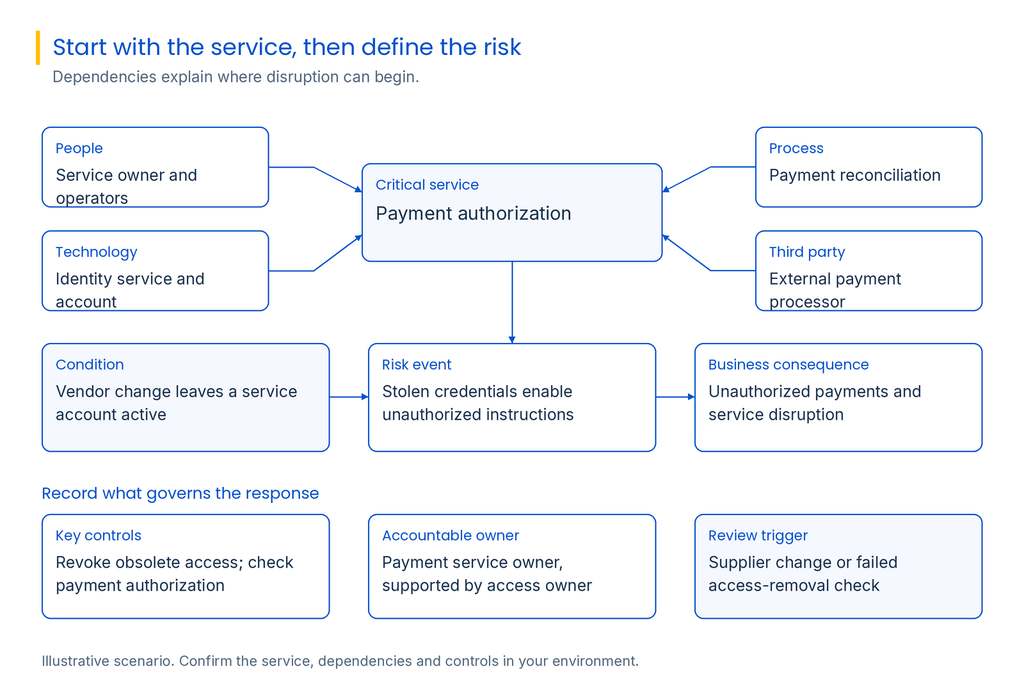
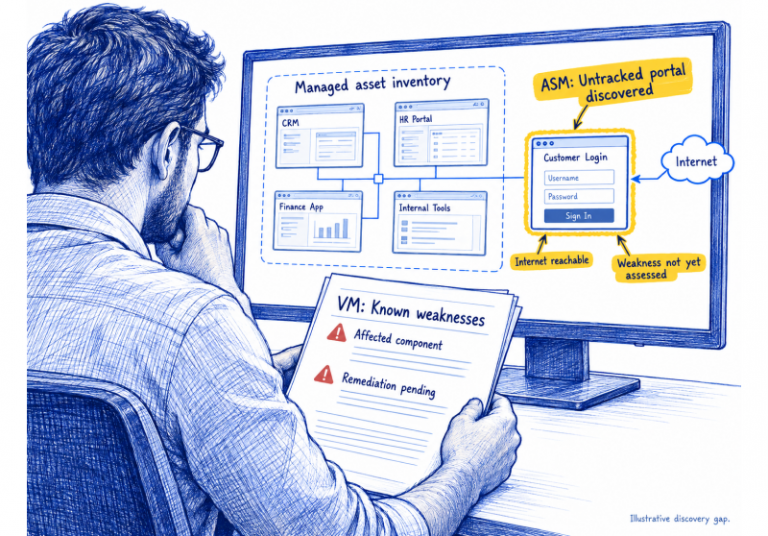
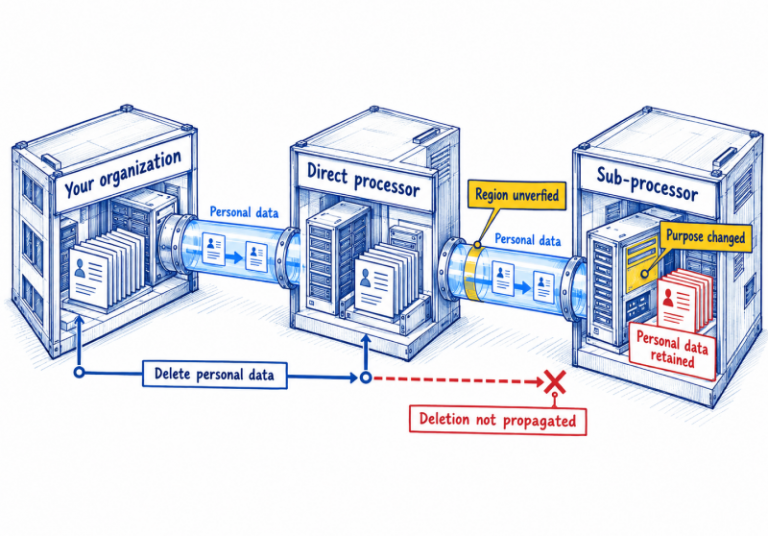
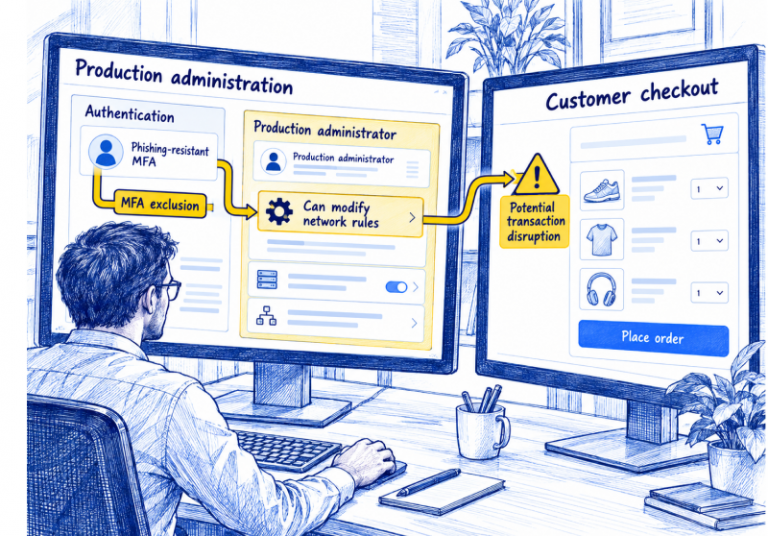
Consider a payment service that depends on an external processor, an identity service, and a reconciliation job. If a vendor change leaves a service account active, a stolen credential could enable unauthorized payment instructions. Framing this as a path from dependency change to business consequence makes the register useful to service owners and executives, not just its maintainers.
Why a static risk register loses decision value
A risk register records a judgment at a point in time. Its assumptions can become invalid when a supplier changes, a system moves, a control is disabled, or an incident exposes a recovery weakness.
An annual assessment provides structure, but cannot show whether risk remains within tolerance after a material change. A lower score does not necessarily mean lower exposure: the evidence or scoring method may have changed. Record the scenario, impact, assumptions, controls, uncertainty, treatment, owner, and review trigger so teams can distinguish changed risk from changed confidence.
The European Banking Authority’s December 2025 report describes operational and resilience pressures in EU banking, including cyber threats, fraud, geopolitical pressures, and digital and third-party dependencies. This is sector-specific evidence, but it illustrates why a local control status may not reveal the full consequence for a critical service.
Use operational risk management to assess scenarios
Start an operational risk assessment with the decision it needs to support. Which service or obligation could be affected, what event could disrupt it, and what evidence would show whether safeguards work?
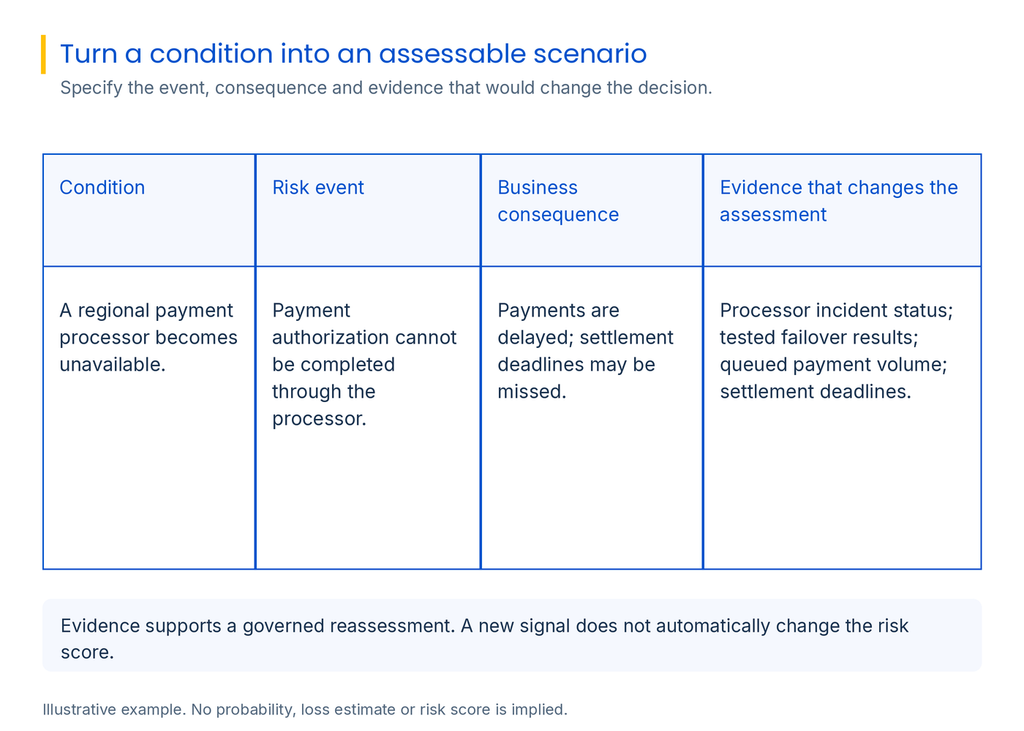
Write the scenario as: “Because [condition], [event] could affect [service or objective], leading to [business consequence].” This separates cause, event, and impact. “Supplier outage” is vague; “a regional processor outage could prevent payment authorization and delay settlement” gives teams an assessable scenario.
Apply defined likelihood and impact criteria, while considering duration, scope, recovery dependencies, obligations, and data uncertainty. Use qualitative bands when evidence does not support numerical precision. Keep estimates traceable to their inputs.
Inherent risk is exposure before controls; residual risk is what remains after safeguards. A control’s existence does not prove it is effective. Evidence should show that it covers the intended population and operates as expected.
Connect controls, KRIs, and incident records to decisions
Risk and Control Self-Assessment (RCSA) structures owner reviews of risks and safeguards. Key Risk Indicators (KRIs) signal changing exposure. Incident records capture realized events. They have different purposes and work best together.
A KRI matters when a threshold triggers action. Rising overdue recovery actions at a critical supplier could prompt a service-owner review; more unowned privileged accounts could trigger investigation. Define the population, source, owner, threshold, and response. Without these, a metric is reporting rather than early warning.
Distinguish risk indicators from control indicators. A risk indicator tracks exposure or conditions; a control indicator shows whether a safeguard operates. The views complement each other, but they are not interchangeable.
Use incidents and near misses to test assumptions. They may reveal that a control depended on an employee noticing an exception, or that recovery relies on a supplier omitted from the continuity plan. Record the service, cause, control performance, response, and follow-up, then decide whether risk, treatment, or review cadence should change. Signals should prompt governed review, not automatic score changes: they may be stale, incomplete, or unrelated.
Treat operational risks and verify the result
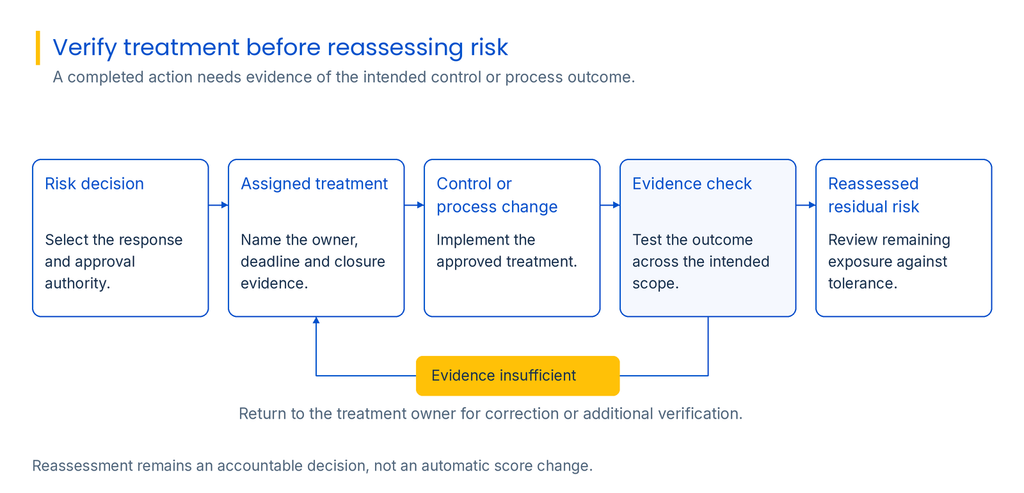
For each material risk, reduce it, avoid the activity, transfer or share exposure, or accept what remains. The decision should name its intended outcome, owner, deadline, interim safeguards, closure evidence, and acceptance authority.
Acceptance is a time-bounded decision to operate with known exposure. Record the reason, affected service, safeguards, expiry or review date, and escalation conditions. If risk exceeds tolerance, send it to an authorized decision-maker rather than leaving it with the implementer.
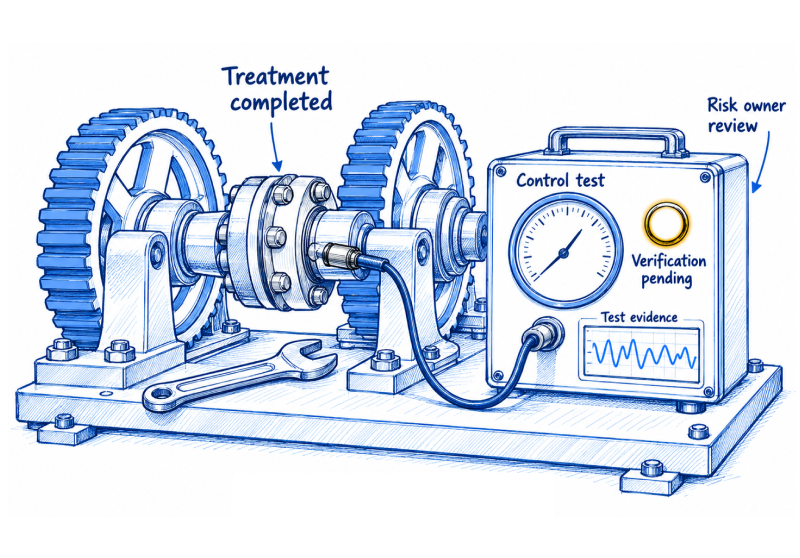
A completed ticket is not proof of closure. Verify that a change restored the intended control across the right service and that evidence supports the result. If treatment creates another dependency, update the scenario and reassess.
Make review cadence respond to change
Set review frequency according to how quickly a risk changes and how serious the consequence could be. Pair routine reviews with triggers such as an incident, supplier change, major release, new service, control failure, regulatory shift, or invalidated recovery assumption. A trigger should prompt assessment, not an automatic score change.
Give leaders a compact view of risks outside tolerance, overdue treatment, expired exceptions, recurring incidents, missing evidence, and changes to critical dependencies. “No evidence received” does not mean “control passed,” and a closed action does not necessarily mean risk fell. A useful report shows what changed since the last review, what remains uncertain, and which decision is overdue, so trend review leads to action.
SPOG.AI’s GRC service connects requirements, controls, operational evidence, ownership, and exceptions. Its continuous control monitoring service describes assessing coverage and effectiveness from operational evidence and tracking gaps through remediation. These capabilities can support evidence and follow-through where systems and assessments are connected; risk criteria, service-owner judgment, and acceptance authority remain organizational decisions.
Conclusion: Keep the decision attached to the risk
Operational risk management is more than maintaining a register or assigning a score. It is the discipline of understanding how a disruption could affect a service, deciding which safeguards matter, and revisiting that decision when evidence or operating conditions change.
Start with one important service. Map its dependencies, write a specific disruption scenario, identify the controls and evidence the assessment relies on, name the person who can act, and define what would trigger a review. Then verify whether treatment changed the risk in practice. This gives teams a manageable way to improve the quality of risk decisions without pretending that uncertainty can be removed.
Frequently asked questions
Operational risk management identifies and treats risks from people, processes, systems, and external events that could disrupt services or cause loss.
Operational risk concerns the delivery of day-to-day services. Enterprise risk management includes this and broader strategic, financial, and market risks.
Examples include process breakdowns, access failures, technology outages, human error, fraud, supplier disruption, cyber incidents, and external events.
Record the scenario, affected service, impact, assumptions, controls, residual risk, owner, treatment, approval, evidence, and review triggers.
Set a routine cadence based on risk and change velocity, then review sooner when incidents, control failures, supplier changes, or new evidence affect assumptions.
A Risk and Control Self-Assessment is a structured review by business and control owners of operational risks, existing safeguards, and remaining gaps.
A Key Risk Indicator is a defined measure that signals changing exposure and prompts a specified action when it reaches an agreed threshold.
Record the event, affected service, cause, control performance, response, and follow-up, then assess whether it changes risk assumptions or treatment.
Residual risk is the exposure that remains after relevant controls and other safeguards are considered.
Automation can organize evidence and surface changes. Authorized people must assess context, select responses, and approve risk acceptance.
With 8.5+ years in B2B SaaS, I’ve led demand generation and GTM initiatives across global markets (US, UK, Europe, Africa), helping companies move from fragmented marketing efforts to structured, revenue-focused growth engines.