Business Impact Analysis in 2026: Connect Critical Services to Recovery Decisions
Business impact analysis helps organizations understand how disruption affects critical services and set recovery priorities. This article explains how to assess impacts over time, map dependencies, define realistic recovery targets and verify that a restored service is safe to resume.
The process often becomes a questionnaire exercise. Owners specify tolerable downtime and recovery objectives, then file the results in a continuity plan. Those answers need to explain how disruption consequences grow, which dependencies could prevent recovery and whether the proposed targets are achievable.
In 2026, that assessment must consider more than service availability. Compromised identities or corrupted transaction records can leave an application running while making it unsafe to use. Recovery planning therefore needs to establish both when operations should resume and the checks required before they do.
What a business impact analysis should decide
A BIA identifies essential functions, supporting services and assets, disruption effects and recovery conditions. It assumes disruption and asks what the business must preserve, restore or communicate.
NIST IR 8286D, published in February 2025, describes BIA as a foundation for consistent cybersecurity risk prioritization and response. It extends the traditional continuity view to help leaders understand how the compromise or loss of information and technology assets can affect mission-essential functions.
That distinction matters. A vulnerability assessment may rate a database weakness. A BIA says which service depends on it, what a four-hour loss means and whether the latest backup preserves integrity.
Start with the service, not the application inventory
Choose a small set of services that leadership would struggle to operate without. Examples include customer payments, claims processing, order fulfilment, clinical scheduling or regulatory reporting. Define the service outcome in plain language and identify the business owner.
Document the service boundary:
– Who relies on it and what information must remain confidential, accurate and available.
– Applications, infrastructure, identities, facilities, teams and suppliers involved.
– Manual workarounds and limits.
Do not treat every dependency as equally critical. Ask what fails first if it is unavailable, corrupted or no longer trustworthy. A supplier may have strong assurance and still be a single point of failure.
Define impact by time and consequence
Impact changes over time. Ask what happens after 15 minutes, four hours, one business day and several days. Separate:
1. Operational impact: what work stops, slows or becomes unsafe?
2. Customer impact: which commitments, services or trust relationships are affected?
3. Regulatory and contractual impact: which notification, service-level or reporting obligations may apply?
4. Financial and strategic impact: what costs, revenue effects or decision constraints follow?
Use impact categories and state assumptions. Avoid precise loss when the owner can establish only a range.
Set recovery objectives that can be tested
Recovery Time Objective (RTO) is the target time to restore a defined service level after disruption. Maximum tolerable downtime is the duration beyond which disruption consequences become unacceptable. Set the RTO early enough to allow any subsequent business recovery activities before that limit. Neither objective is a recovery strategy; architecture, procedures and resources must support it.
For each objective, record the clock and condition. State when the RTO begins, what minimum service level must be restored and which data the RPO covers. RPO is the point in time to which data must be recovered, reflecting the tolerable data-loss window. A 15-minute RPO does not mean every record must be less than 15 minutes old.
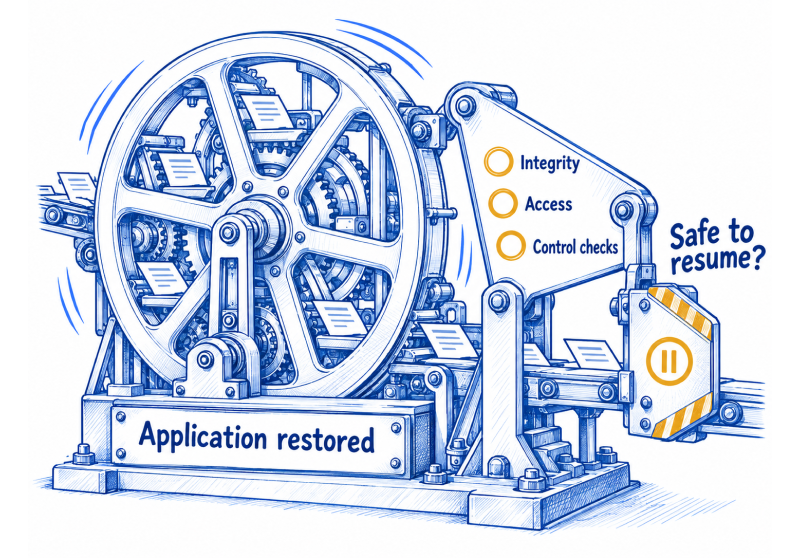
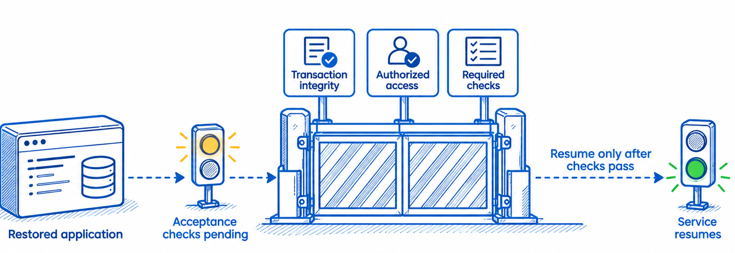
Add a recovery acceptance condition. A server being online does not prove transaction integrity, access control or safe customer-facing status.
Business owners validate consequences and tolerable disruption. Technology and supplier owners assess whether recovery requirements are achievable. Finance checks resource assumptions, while legal and compliance teams identify applicable deadlines and contractual commitments. The authorized leadership forum approves funding or records the residual exposure when capability falls short. An approved target should not be reported as a tested capability.
Build a dependency-aware BIA record
BIA field
What the decision owner should know
Service outcome
What must continue or be restored
Impact window
How consequences change over time
Critical information
What must remain confidential, accurate and available
Dependencies
People, technology, identity, suppliers and facilities
RTO and RPO
Recovery targets and their starting conditions
Workaround
What can operate manually, for how long and with what risk
Recovery acceptance
Evidence required before normal operation
Trigger for review
Change that invalidates the record
Work through an illustrative cyber disruption
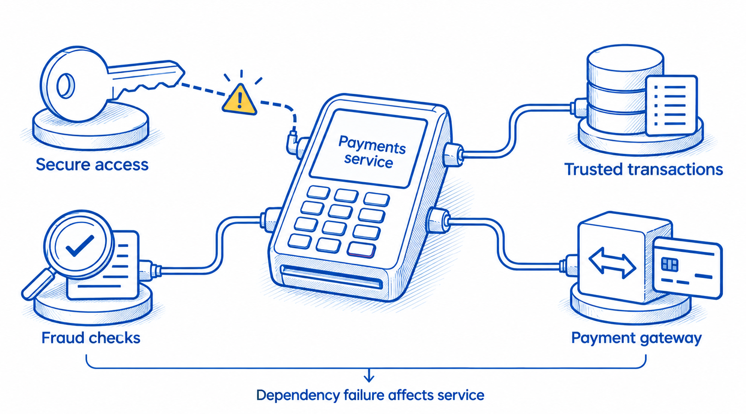
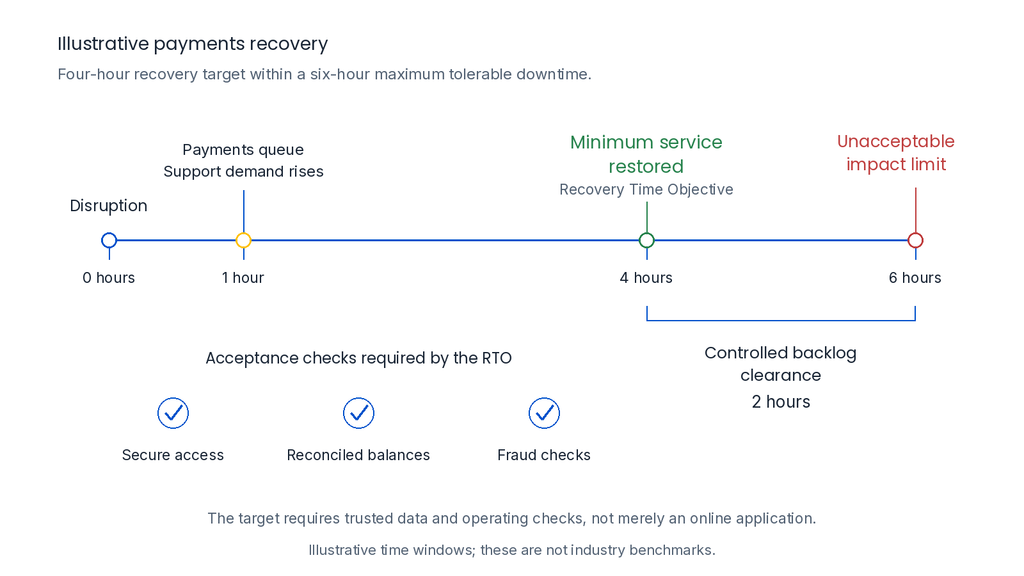
The following scenario is illustrative, not a customer case. A digital payments service depends on an identity provider, transaction database, fraud engine and external payment gateway. Assume its owners establish that disruption beyond six hours would cause unacceptable missed settlement commitments. They select a four-hour RTO for the defined minimum payment service, leaving two hours for controlled backlog clearance before that limit. A 15-minute RPO applies to completed transactions.
The BIA review identifies three failure modes:
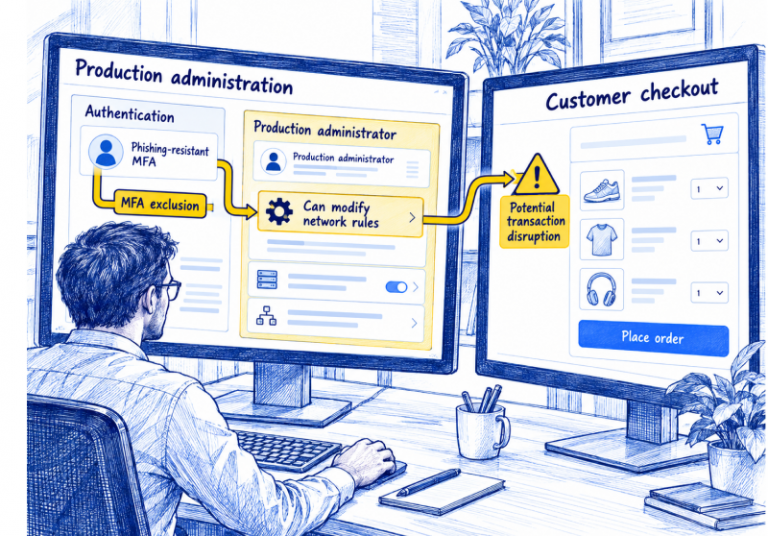
– If the identity provider is unavailable, staff cannot administer the service and customers may fail authentication.
– If the database is corrupted, restoring quickly without reconciliation could create incorrect balances.
– If the payment gateway is unavailable, a manual process may support urgent transactions but cannot sustain normal volume.
After one hour, payments queue and support demand rises. By four hours, the minimum service must process priority payments with reconciled balances and functioning fraud checks. By six hours, the assumed settlement commitments would be missed. These illustrative time windows explain the recovery requirement; they are not industry benchmarks.
Recovery therefore starts with secure administrative access and trusted transaction data, followed by fraud checks and gateway connectivity. If the gateway remains unavailable, the owner must decide whether the tested workaround can process priority payments within its capacity. Bringing the application online does not satisfy the RTO if balances remain uncertain or required checks cannot operate.
Use BIA findings to prioritize risk and investment
Connect service records to risk scenarios and treatment decisions. A high-priority service may need identity resilience, replicated data, supplier contingency or a tested manual procedure. The BIA provides the consequence and recovery requirement, not the investment decision itself.
Test the record, not just the plan
Run a tabletop or technical exercise against one critical service and a dependency, such as identity compromise, corrupted records or supplier unavailability.
Review five questions:
1. Could the team identify the service owner and current dependency chain?
2. Did the recovery steps meet the stated RTO and RPO definitions?
3. What evidence established that the restored service was trustworthy?
4. Which workaround created additional privacy, security or operational risk?
5. Which assumption in the BIA changed during the exercise?
Keep the BIA current as the environment changes
Review a BIA when a critical service changes its owner, supplier, architecture, identity dependency, data flow or recovery design. A calendar review remains useful, but material changes should trigger reassessment sooner. Track signals such as failed restore tests, expired supplier commitments, changes in transaction volume and unresolved dependency ownership.
SPOG.AI’s continuous control monitoring connects defined controls with operational evidence, which can help teams check whether recovery and control assumptions remain valid. Its governance, risk and compliance capability can support a shared view of requirements, services, control gaps and exceptions as BIA decisions move into governance review.
Conclusion: make the BIA a decision record
A business impact analysis earns its place in cyber resilience when it explains what the business must preserve, how disruption consequences grow, which dependencies matter and what evidence permits recovery. Start with critical services, define impact over time, make RTO and RPO testable, and record acceptance conditions. Then exercise the result and update it when the environment changes.
Frequently asked questions
A BIA identifies critical services and evaluates how disruption affects operations, customers, obligations and finances so recovery requirements can be set.
It connects cyber disruption to business consequences, helping leaders prioritize protection, recovery and resilience investments.
BIA assumes disruption and evaluates its consequences. Risk assessment analyzes scenarios, likelihood, controls and treatment options.
Critical services, information, people, technology, suppliers, facilities, workarounds, impact windows and recovery acceptance conditions.
Recovery Time Objective is the target time to restore a service or function after a defined disruption.
Recovery Point Objective identifies the point in time to which data must be recovered, reflecting how much data loss measured in time the business can tolerate.
No. It is a requirement that must be supported by architecture, procedures, resources and testing.
Update it after material changes to services, dependencies, ownership, data, suppliers or recovery design, as well as on a defined review cycle.
They provide business impact and recovery requirements that can inform risk prioritization and treatment decisions.
Use a tabletop or technical exercise that challenges one service dependency and checks the stated impact, recovery objectives and acceptance evidence.
With 8.5+ years in B2B SaaS, I’ve led demand generation and GTM initiatives across global markets (US, UK, Europe, Africa), helping companies move from fragmented marketing efforts to structured, revenue-focused growth engines.