Cloud Security Posture Management: Find and Fix What Matters
Cloud security posture management helps teams find configuration gaps and understand which exposures matter most. Learn how to establish coverage, prioritize findings, assign owners and verify that remediation restores the expected security state.
A cloud team can close hundreds of findings and still leave one important database exposed. The hard part is not producing more alerts. It is understanding which cloud resources matter, whether the expected population was assessed, who owns the configuration, and whether a change actually removed the exposure. Cloud security posture management, or CSPM, gives teams the visibility to answer those questions.
Used well, CSPM is not a compliance scorecard or a substitute for engineering judgement. It is a repeatable way to discover cloud resources, test their configuration against agreed expectations, surface gaps with context, and verify the result after remediation. That makes it useful to cloud engineers, security leaders and GRC teams working from the same control objectives.
What is cloud security posture management?
Cloud security posture management is the process and supporting technology used to discover cloud resources, assess their configuration against defined rules, and follow up on the resulting findings. A CSPM program commonly covers accounts or subscriptions, projects, identities, storage, networking, logging, encryption and other cloud services across providers.
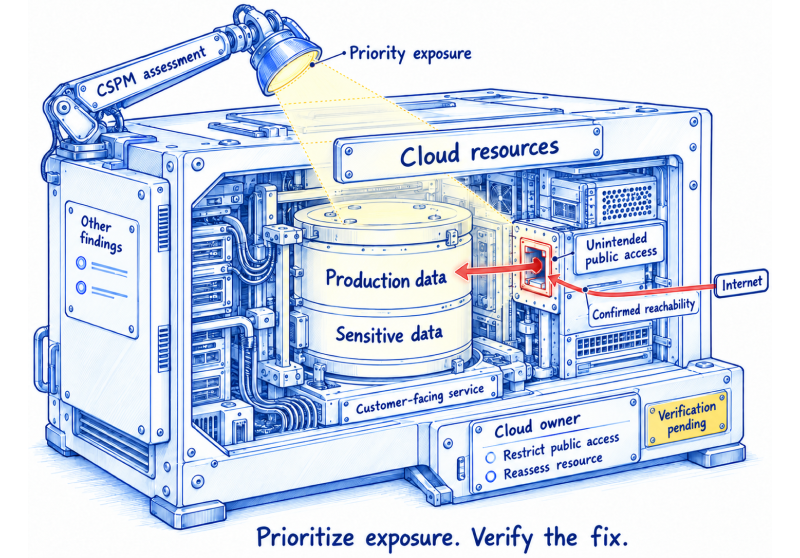
A storage resource that permits public access illustrates the boundary. A CSPM check can identify the setting and affected resource. The team still needs to establish whether the resource is truly reachable, whether it contains sensitive data, whether public access is intended, who can change it, and whether the corrected configuration remains in place. CSPM provides an observed posture. It does not alone prove that a whole framework, service or legal obligation is satisfied.
How cloud security posture management works
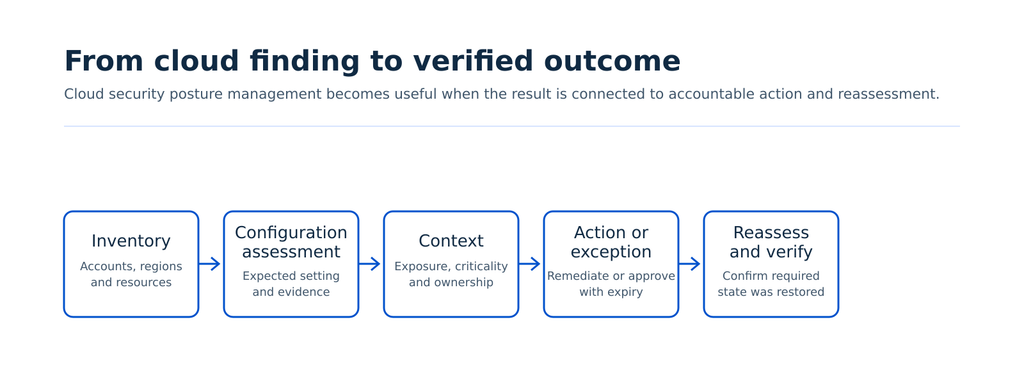
A useful CSPM operating model has five connected stages. First, discover the environment: cloud accounts, subscriptions, projects, regions and resources. Second, assess configuration against a baseline or control test. Third, add context, such as internet exposure, sensitive data, privilege, service criticality and the age of the finding. Fourth, route the finding to the team that can act or record a justified, time-limited exception. Finally, reassess after the change and watch for recurrence.
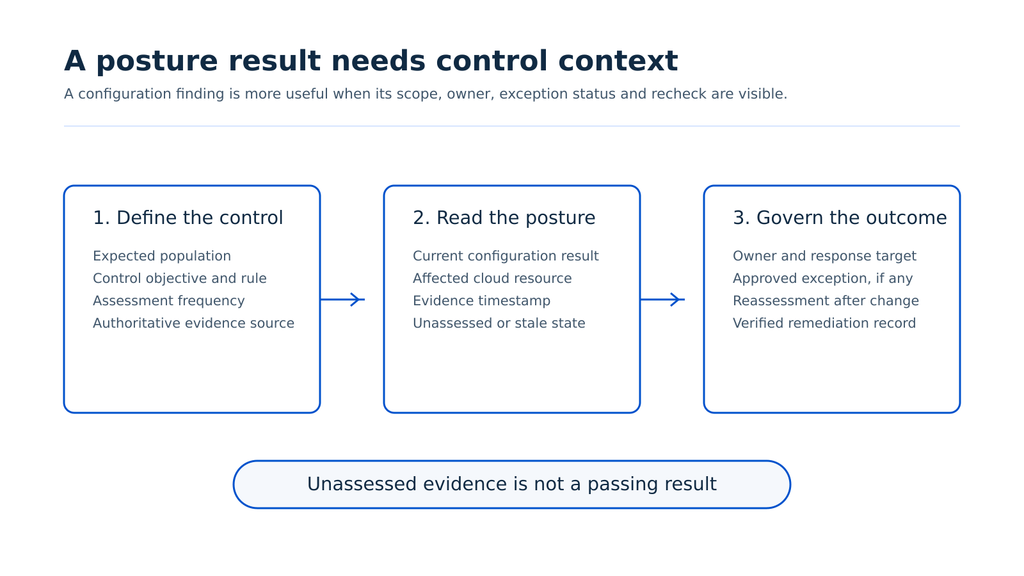
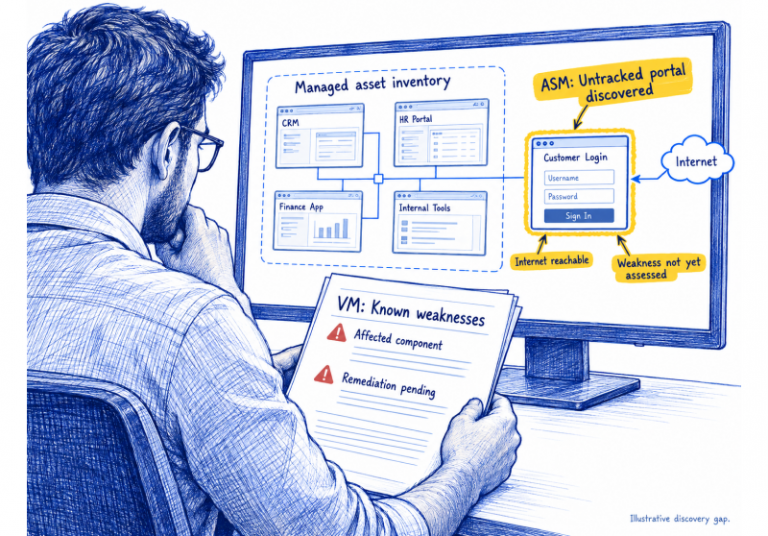
The quality of the result depends on scope and recency. A pass for the resources a tool could see is not proof that all intended accounts and regions were assessed. Show the expected population, the assessed population, the last assessment time and any failed connections. A resource that was never assessed is an unknown state, not evidence of compliance.
What CSPM can identify and what it cannot conclude
CSPM is particularly useful for issues that are visible in cloud configuration: unintended public exposure, broad administrative permissions, missing audit trails, weak encryption or network settings, unsafe backup configurations, and drift following a deployment or manual change. It can also reveal incomplete coverage when a new account or region has not joined the assessment population.
A finding is a starting point, not the final risk decision. Prioritization should validate reachability and business context. A publicly accessible test object is not equivalent to a publicly accessible production data store. Similarly, a passing benchmark check may support a defined control test, but it does not replace independent assessment, threat detection, runtime protection or a review of how a control has operated over time.
CSPM and continuous control monitoring
CSPM supplies observed cloud configuration data. Continuous control monitoring asks a broader assurance question: does a defined control cover the population it should cover, meet its test criteria, and remain effective as the environment changes? The disciplines work together when a posture finding is tied to a control objective, an owner, an exceptional decision and a verified outcome.
Consider the control objective: production storage must not be publicly accessible without an approved exception. The check should name the production accounts, regions and storage resources in scope; the expected state; the evidence source; the owner; the exception process; and the method for rechecking the resource after change. A rate such as ‘99 percent compliant’ can hide an excluded account or a critical exposed resource.
SPOG.AI’s continuous control monitoring capability is relevant at this point because it connects control coverage, operational evidence, accountable owners and remediation follow-through. The cloud platform remains the source of configuration evidence; the operating model determines how that evidence supports a control decision.
CSPM compared with adjacent cloud security capabilities
Capability
Primary question
CSPM
Are cloud resources configured against the security rules expected for their scope?
CIEM
Who or what has cloud permissions, and are those entitlements excessive?
CWPP
Are workloads and runtime environments protected against relevant threats?
CNAPP
How can posture, workload, identity and code security capabilities be combined?
Product labels overlap, so evaluate the capability rather than the category name. Some platforms add identity, data, code or workload features to their CSPM offering. Ask which resources are covered, what the tool actually assesses, how quickly evidence refreshes and how it records a validated fix.
Who needs CSPM most urgently?
Any organization operating meaningful cloud infrastructure can benefit from CSPM, but the need is greatest where change is frequent and consequences are material. This includes teams running customer-facing production services, storing regulated or sensitive data, managing several cloud accounts or providers, supporting rapid infrastructure-as-code releases, or working to demonstrate cloud control performance to customers and assessors. A small estate can also have high exposure when ownership is unclear or a critical service depends on a few cloud resources.
CSPM should therefore be scoped by business importance, not just cloud spend or asset volume. Start with the environments that support material services and the controls whose configuration failure would create meaningful exposure. Extend from there once the team can demonstrate reliable coverage, accountable remediation and verified restoration.
How to implement CSPM without creating alert overload
1. Define the cloud boundary
List production and nonproduction accounts, subscriptions, projects and regions. Identify the services and workloads that support important business processes, then name platform and application owners. Reconcile the CSPM inventory with another trusted asset source. New accounts should enter inventory, logging and posture checks as part of onboarding, not after an incident.
2. Start with meaningful cloud security posture management checks
Begin with settings that matter to critical services: public exposure, privileged access, logging, encryption, network restrictions and recovery configuration. State the expected setting, evidence source, assessment frequency and allowed exception route. Provider recommendations are a useful input, but they do not remove the organization’s responsibility to define its own scope and risk tolerance.
3. Prioritize the exposure, not the alert volume
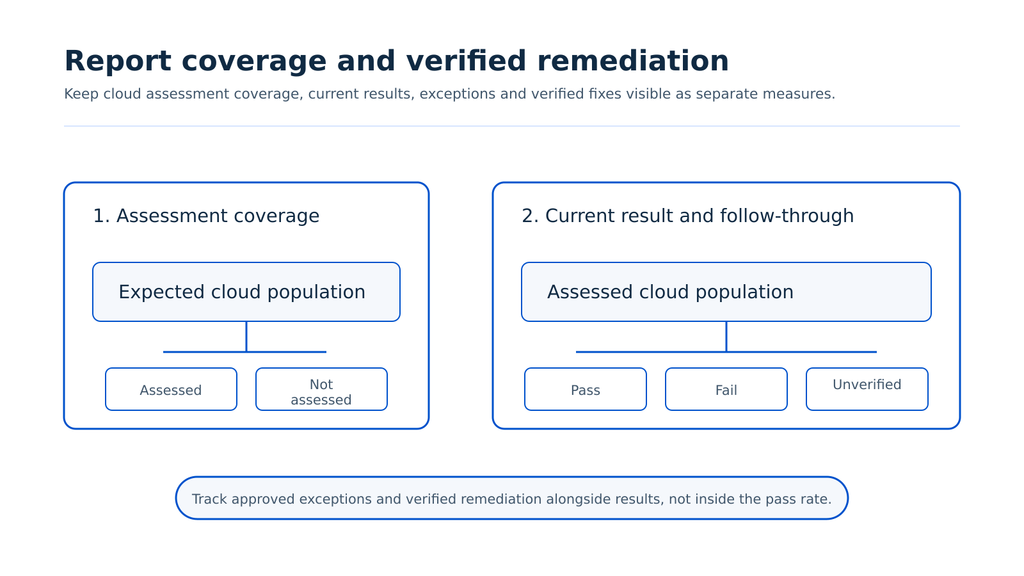
Use business service criticality, actual reachability, data sensitivity, privilege, compensating controls and finding age to determine priority. Separate confirmed failures, approved exceptions and unverified states. An approved exception still has an owner, a reason, a validity period and a review date. A missing assessment needs investigation even when no detected configuration failure is visible.
4. Make remediation verifiable
Create work for the cloud or application team that can change the resource. Include the resource identifier, observed setting, expected state and the reason it matters. For repeated failures, correct the infrastructure template or deployment process as well as the affected resource. After the fix, rerun the relevant assessment and retain the result. A closed ticket records activity; a reassessment provides evidence that the required state was restored.
What to require from a CSPM tool
Ask vendors to demonstrate one real control from discovery through verified remediation. The demonstration should show coverage by account, region and resource type; the last assessment time; policy logic; a newly discovered account; a material finding; an exception with an expiry date; an owner; a work item; and the reassessment after closure. A long integration list or an attractive dashboard is less useful than this end-to-end evidence trail.
For governance teams, the evaluation should also establish how cloud findings relate to requirements, risk decisions, evidence retention and accountability. SPOG.AI’s governance, risk and compliance approach describes connecting requirements, controls and operational evidence so that teams can govern exceptions and remediation in context. Confirm exact integrations and evidence coverage for your environment during evaluation.
Conclusion
Cloud security posture management earns its value when it connects a configuration gap to the service it affects, the owner who can act and evidence that the required state was restored. Start with critical cloud controls, make coverage and evidence freshness visible, and treat reassessment as part of remediation. That turns posture data into a defensible cloud security decision rather than another alert queue.
Frequently asked questions
CSPM stands for cloud security posture management. It discovers cloud resources, assesses their configuration against expected rules and supports follow-up on gaps.
It is both. A tool supplies discovery and assessment data; the operating process defines scope, ownership, exceptions, remediation and verification.
CSPM can identify and help teams reduce risky configurations. It does not prevent an incident on its own, and it does not replace identity, workload, detection or response controls.
A storage resource allowing unintended public access is a common example. The finding should identify the resource, setting, owner and evidence needed to confirm the corrected state.
Frequency should reflect the rate of change, the risk of failure and the assessment capability. Always show when the evidence was last collected and assessed.
No. CSPM results can support cloud control testing, but compliance also depends on requirements, scope, operating decisions, evidence and independent assessment where needed.
CSPM focuses on cloud configuration and posture. CNAPP is a broader category that may combine CSPM with workload, identity, code and other cloud security capabilities.
Usually the cloud or application team that owns the affected resource makes the technical change. Security and GRC teams set expectations, prioritize gaps and verify evidence.
Keep approved exceptions separate from pass and fail results. Record the scope, rationale, owner, compensating measures, approval, expiry date and review cadence.
Check whether the full expected cloud population is assessed, important findings reach accountable owners, exceptions remain current and remediation is confirmed by a follow-up assessment.
With 8.5+ years in B2B SaaS, I’ve led demand generation and GTM initiatives across global markets (US, UK, Europe, Africa), helping companies move from fragmented marketing efforts to structured, revenue-focused growth engines.