Enterprise GRC in 2026: Connect Cyber Risk, Evidence and Accountable Decisions
Effective enterprise GRC connects cyber risk to business services, current control evidence and accountable owners. Learn how to reassess decisions when conditions change, manage exceptions and verify treatment outcomes.
A compliance dashboard shows a critical service as compliant. Its supporting evidence predates an infrastructure change. The control owner has moved roles. An approved exception depends on a compensating control that has stopped reporting.
Which status should leadership trust?
This illustrative situation exposes a weakness that centralizing records alone cannot resolve. The organization has information, but the connection between that information and the current decision is incomplete.
Enterprise governance, risk management and compliance (enterprise GRC or EGRC) aligns governance responsibilities, risk management and compliance obligations with business objectives. It encompasses strategic, financial, operational, legal and technology risks.
This article focuses on its cybersecurity component: connecting technical conditions and control evidence to enterprise decisions. Cyber risk belongs within that broader picture because a compromised system can interrupt a service, create financial loss or affect contractual commitments.
An effective enterprise GRC program makes those consequences traceable and gives accountable people sufficient evidence to act.
Connect cyber risk to business objectives
NIST’s December 2025 revision of IR 8286 reinforces the integration of cybersecurity risk management with enterprise risk management (ERM). It describes using risk registers to communicate cybersecurity risk in the context of business objectives and enterprise risk processes.
That connection requires more than transferring technical findings into a risk register.
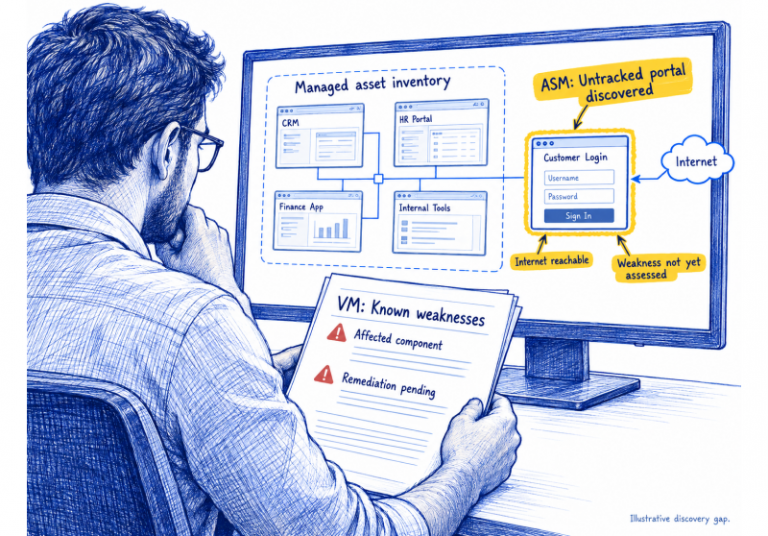
A vulnerability describes a technical weakness. A risk scenario explains how a threat could exploit relevant conditions and affect a business objective. A compliance finding identifies a shortfall against an applicable requirement.
One event may affect all three, but each requires a distinct assessment.
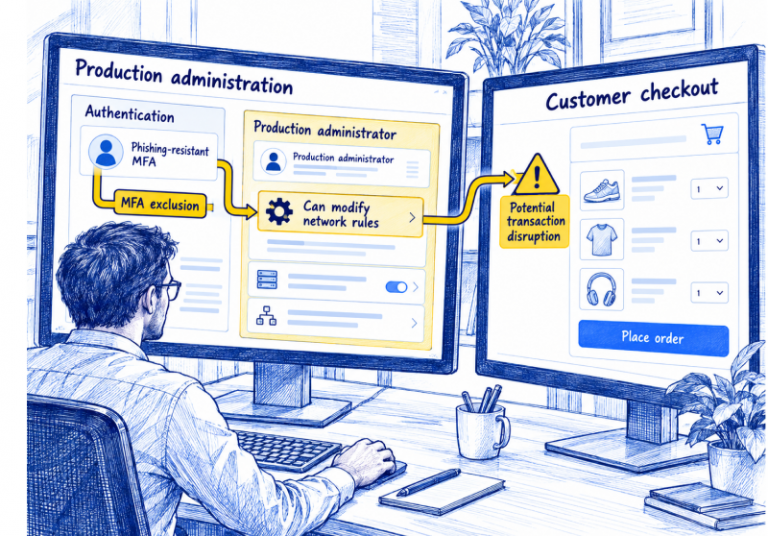
For example, an access-control weakness in a payment service may create exposure to unauthorized transactions, disrupt operations and raise compliance questions. These consequences should inform a coordinated assessment involving security, service ownership, finance and compliance.
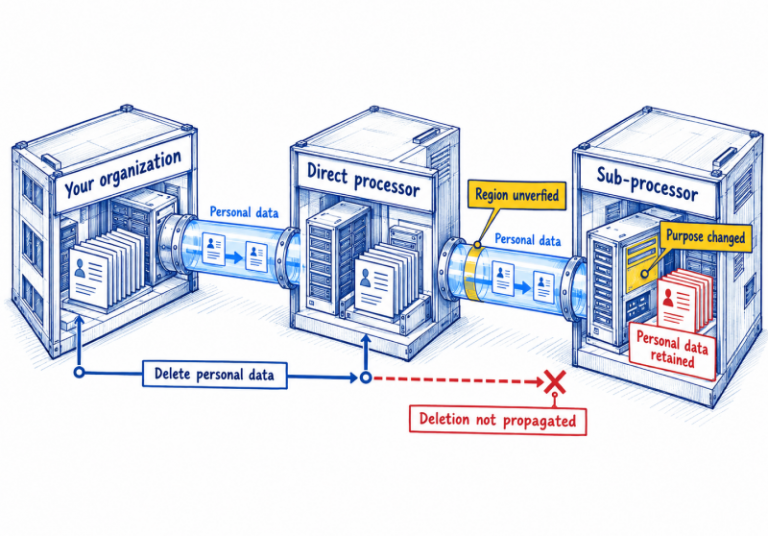
Avoid treating overlapping consequences as unrelated risks. Examine shared dependencies too: two services may appear independently protected while relying on the same identity provider or support supplier.
The enterprise view should reveal these relationships, material assumptions and uncertainty.
Make the decision traceable
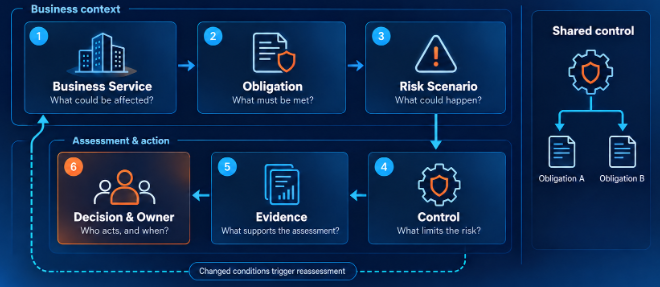
A practical enterprise GRC framework connects six elements:
Element
Question it must answer
Business service or objective
What activity or outcome could be affected?
Applicable requirement
What must be met, and why does it apply?
Risk scenario
What could happen, under which conditions, with what consequences?
Control
What measure is intended to prevent, detect or limit that outcome?
Evidence
What supports the assessment, for which scope and period?
Decision and accountability
What happens next, who authorizes it, and what triggers review?
This is a proposed operating model, rather than a prescribed regulatory framework. Its relationships can be many-to-many: one control may address several risks, while one risk may require several controls. A control failure should identify affected services and requirements. A leadership question about a service should lead back to its controls, supporting assessments and unresolved decisions.
Distinguish obligations from frameworks
A legal obligation, contractual commitment, internal policy and voluntary framework criterion do not have identical authority. A framework criterion may become mandatory through regulatory incorporation, contract or an adopted organizational commitment. Its presence in a control library alone does not make it a legal obligation.
Similarly, mapping a control to several compliance frameworks does not establish that every mapped requirement is satisfied. Requirements may differ in scope, implementation expectations and assessment periods.
Shared controls and evidence can reduce duplication when those differences remain visible.
Keep ownership clear across functions
Enterprise GRC coordinates accountability. It does not transfer every risk to a central GRC team.
Business owners remain accountable for services and authorized risk decisions. Control owners operate controls. Security teams assess technical exposure. Legal and compliance teams interpret obligations. Independent assurance evaluates the reliability of assessments and processes.
The enterprise layer establishes common definitions, reporting expectations and escalation rules.
A shared repository helps people access information. Agreed responsibilities determine whether that information leads to action.
Set boundaries for risk acceptance
An exception record should identify:
The affected service, requirement and risk scenario.
The reason for the exception and alternatives considered.
Compensating controls and their supporting evidence.
The authorized approver, expiry date and review triggers.
Approval authority should reflect risk appetite, delegated limits and escalation arrangements. Operating a control does not automatically confer authority to accept the business consequences of its failure.
Internal risk acceptance also does not waive a legal or contractual obligation. Exceptions affecting such obligations require the relevant legal or compliance assessment.
Assess what the evidence establishes
Continuous control monitoring identifies changes in observable conditions. Automated evidence collection reduces manual gathering. Neither establishes every aspect of control effectiveness.
Consider privileged access. An identity and access management (IAM) system may show that multifactor authentication is configured. That finding does not establish whether every relevant route is covered, bypasses exist or privileges remain appropriate.
Separate four assessment dimensions:
Dimension
Assessment question
Design
Is the control capable of addressing the intended risk?
Coverage
Does it apply to the complete relevant population?
Operation
Has it functioned as intended during the assessment period?
Outcome
What demonstrates the intended result within the tested scope?
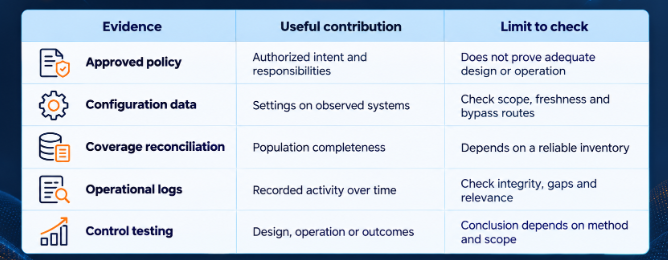
An approved policy establishes authorized intent and responsibilities. Assessing design adequacy requires examining whether the requirements and implementation address the risk.
Operational logs can support an assessment of execution if their completeness, integrity and relevance are established. Control testing can assess design, operation or outcomes; its conclusion depends on the objective, method, population, sampling and period.
The visual identifies contributions and limitations rather than universal assurance ratings. Several evidence types may be needed to support one defensible conclusion.
ENISA’s June 2025 NIS2 technical implementation guidance provides practical advice, evidence examples and mappings for specified entities covered by the relevant implementing regulation. Its sectoral scope should not be generalized to every organization.
Preserve uncertainty in reporting
A failed connector or interrupted log feed creates an evidence gap. It does not, by itself, establish that the underlying control failed.
Useful assessment states include:
Operating as expected within the assessed scope.
Failed against defined criteria.
Partially assessed, with known coverage gaps.
Unknown because evidence is missing or unreliable.
Not applicable, with a documented rationale.
Retain the source, collection time, assessment period, population and method. Define freshness requirements according to how quickly the relevant conditions can change.
A current configuration snapshot and a month of operational evidence answer different questions. Continuous compliance requires an ongoing assessment process, rather than a guarantee that every requirement remains satisfied.
Translate findings into residual risk
Residual risk is the risk remaining after accounting for the controls and responses in place. Assessing it requires judgment about the risk scenario, informed by evidence of control effectiveness.
A failed control does not automatically determine the residual risk level. Reviewers must consider exposure, threat conditions, business consequences and other relevant controls. An unknown control state may require a more cautious assessment, with the uncertainty recorded explicitly.
In the payment-service example, missing session records weaken assurance over supplier activity. They do not establish that unauthorized access occurred. Preventive restrictions may still limit access, while other records may help reconstruct activity.
The assessment should explain which assumptions changed, how they affect likelihood or consequences, and whether the remaining risk is within authorized tolerance.
Avoid mechanically subtracting a control score from an inherent-risk score. Qualitative ratings and quantitative estimates both need a defined method, consistent assumptions and an explanation of uncertainty.
Review decisions when conditions change
Consider an illustrative payment service supported by an external provider.
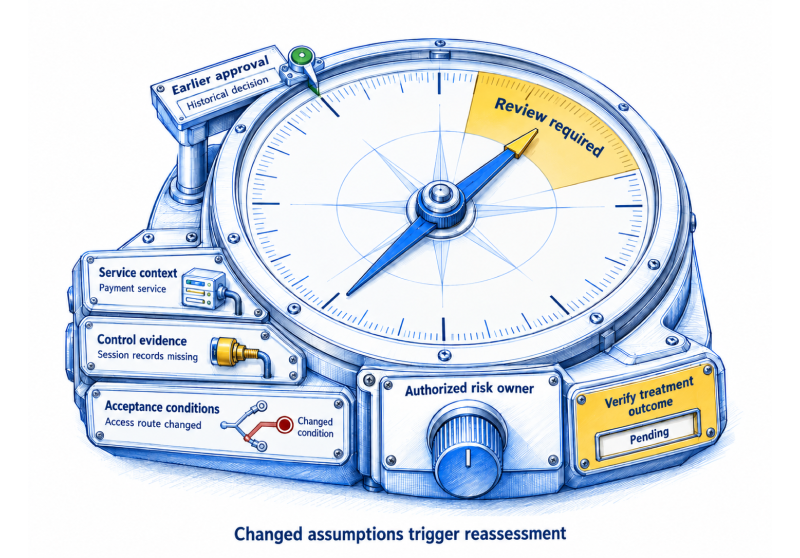
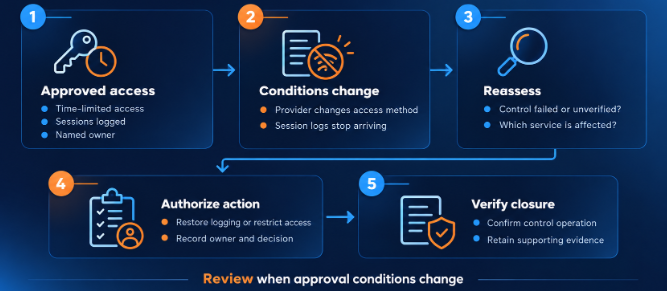
Temporary privileged access is approved because it is time-limited, sessions are logged and responsibility is assigned. Later, the provider changes its access method and session logs stop arriving.
The approval remains documented. Its supporting conditions have changed.
The organization should establish whether logging has failed or is currently unverified, reassess the affected risk scenario and route the decision to the appropriate authority.
Expiry dates alone cannot address this situation. Review triggers should include material changes to access methods, service criticality, control coverage, supplier arrangements and evidence availability.
Visual: A privileged-access exception moves from conditional approval through changed conditions, reassessment and authorized action to verified closure.
A worked assessment record
The timings below are illustrative internal choices, not regulatory requirements.
Field
Illustrative record
Risk scenario
Unauthorized supplier access could alter payment configurations, causing disruption or financial loss.
Control criterion
All supplier privileged sessions use the approved route, expire as authorized and produce retrievable records.
Population and evidence
All supplier privileged accounts and access routes; assessed using inventory, configuration, session records and a controlled access test.
Freshness and triggers
Reconcile accounts daily; check record delivery hourly; review missing records, expired accounts or changed access routes.
Ownership and authority
Control owner investigates; service owner decides within delegated limits, escalating where necessary.
Residual-risk review
Reconsider access likelihood, remaining preventive controls and uncertainty during the recording gap.
Closure outcome
Verify the agreed treatment outcome or obtain explicit approval for remaining risk, with conditions and review triggers recorded.
Restoring the feed resolves the collection problem. Reviewers must also assess the affected period and determine whether the agreed risk treatment achieved its intended result.
If remaining risk is accepted, record the authority, rationale, scope, conditions and review date. Acceptance may permit administrative closure under the organization’s process, but it should not be reported as risk reduction.
Implement an Enterprise GRC Model Around One Critical Service.
Choose a service with meaningful consequences, identifiable owners and accessible evidence. Use it to test the enterprise GRC operating model before expanding.
First, establish its systems, data, suppliers and dependencies. Confirm applicable requirements, develop material risk scenarios and agree on assessment methods and decision authority.
Next, select consequential controls and connect the evidence needed to assess them. Integrations with vulnerability scanners, IAM platforms, security information and event management (SIEM) systems and IT service management (ITSM) tools are useful where their data supports a defined assessment or workflow.
Connect third-party risk management findings to dependent services. A completed supplier questionnaire does not establish the effectiveness of a specific operational control.
Finally, exercise the process using a controlled condition, such as a missing evidence feed or an expiring exception. Check whether it reaches the correct owner, supports an authorized decision and verifies the agreed outcome.
Expand once the workflow works consistently and the participating teams understand their responsibilities.
Measure coverage and treatment outcomes
Metrics need explicit populations, periods and treatment of uncertainty. Otherwise, reported performance can improve while assurance weakens.
Measure
Definition
Ownership coverage
Material services with acknowledged risk and control responsibilities ÷ all in-scope material services.
Current assessment coverage
Control–population assessments completed with sufficient current evidence ÷ all required assessments for the period.
Unknown assessment rate
Assessments with insufficient or stale evidence ÷ all required assessments for the period.
Decision time
Time from detection of a material change to an authorized decision; report the median and an upper percentile.
Triggered-review completion
Exceptions reviewed within the defined response time ÷ all exceptions requiring triggered review.
Treatment outcome verification
Treatments due for verification with evidence that their agreed outcomes were achieved ÷ all treatments due for verification in the period.
Assessment coverage is not a pass rate. A complete assessment can reveal a failed control.
Treatment verification should use the criteria agreed when the response was authorized. Those criteria may demonstrate improved control operation, reduced exposure or another defined outcome; they should not rely solely on a completed ticket.
Report accepted residual risks separately, including overdue reviews and breached acceptance conditions. This keeps authorized acceptance distinct from demonstrated treatment success.
Define denominators before reporting and break results down by service criticality. Strong performance in low-impact areas should not obscure weaknesses in essential services.
Evaluate enterprise GRC software through a live case.
Enterprise GRC software should support the organization’s operating model.
Ask vendors to demonstrate a material scenario involving imperfect evidence and changed conditions. Follow it through collection, assessment, exception handling, decision, reporting and outcome verification.
Evaluate whether the enterprise GRC solution can:
Preserve evidence provenance, scope and assessment periods.
Distinguish failed, partially assessed and unknown states.
Map shared controls without losing requirement differences.
Connect findings to services, risk scenarios and owners.
Enforce approval authority and retain an audit trail.
Handle connector failures, access restrictions and data export.
Assess policy management, risk registers, audit management and compliance workflows against actual responsibilities.
Apply the same standard to AI-assisted assessments. Reviewers should be able to inspect supporting evidence, understand limitations and approve consequential conclusions.
How SPOG.AI supports this approach
SPOG.AI supports the operational evidence layer of cyber GRC through continuous control monitoring, control-effectiveness validation, automated evidence collection, framework-aligned compliance mapping and executive visibility.
These capabilities help connect operational control conditions with governance assessments.
SPOG.AI provides a practical starting point: establish its requirements, assess relevant controls and determine how findings reach authorized decision-makers.
Start with one decision you cannot explain
Choose a material risk acceptance, control assessment or compliance status that leadership struggles to explain.
Trace it to the service, applicable requirement, control owner and supporting evidence. Identify outdated assumptions and uncertain conclusions. Establish what should trigger reassessment and how the agreed treatment outcome will be verified.
Then test the process under a changed condition.
A defensible enterprise GRC program can explain why a decision remains acceptable, who authorized it and what would require it to change. Use that standard to judge the next process improvement or software investment.
Frequently Asked Questions
Enterprise GRC is the coordinated approach to governance, risk management and compliance across an organization. It connects business objectives, applicable requirements, risk scenarios, controls, evidence, ownership and decisions so leaders can understand and manage risk defensibly.
Enterprise GRC covers strategic, financial, operational, legal, technology and other business risks. Cybersecurity GRC is one part of it, focused on how cyber threats, technical controls and security evidence affect business services, obligations and risk decisions.
A technical issue matters differently depending on the service it affects. Connecting cyber risk to business services helps leaders assess potential operational disruption, financial loss, contractual impact and regulatory exposure, rather than treating every finding as an isolated technical problem.
A vulnerability is a technical weakness. A risk scenario explains how a threat could exploit conditions to affect a business objective. A compliance finding identifies a gap against an applicable requirement. They may relate to the same event, but they need different assessments and actions.
Reliable evidence should show its source, scope, collection time, assessment period and relevant population. It must be sufficient for the question being assessed. For example, a configuration snapshot may prove a setting exists, but it may not prove that a control operated effectively over a full period.
Continuous control monitoring is the ongoing observation of measurable control conditions through connected systems and evidence sources. It can identify changed conditions, missing evidence or control deviations, but it does not automatically prove that every part of a control is effective.
An approved exception should identify the affected service, requirement and risk scenario; the reason for the exception; compensating controls; supporting evidence; the authorized approver; an expiry date; and clear triggers for reassessment when conditions change.
Not always. Internal risk acceptance may allow a business to accept remaining risk within its approved risk appetite, but it does not remove legal, regulatory or contractual obligations. Exceptions affecting those obligations require appropriate legal or compliance review.
Residual risk is the risk that remains after considering controls and agreed risk responses. It should be assessed using the risk scenario, business impact, threat conditions, control effectiveness and known uncertainty, rather than by mechanically reducing an inherent-risk score.
Accordion content heSPOG.AI helps organizations connect requirements, controls, evidence, ownership, exceptions and remediation across existing security and IT systems. Its continuous control monitoring and evidence capabilities help teams identify changed conditions, assess control health and route findings toward accountable decisions.re.
With 8.5+ years in B2B SaaS, I’ve led demand generation and GTM initiatives across global markets (US, UK, Europe, Africa), helping companies move from fragmented marketing efforts to structured, revenue-focused growth engines.