Compliance Automation: Make Your Integrations Count for Trusted Control Evidence
Integrations connect cloud, identity, endpoint and business systems to automate evidence collection and coordinate compliance workflows. They reduce repeated requests, support control assessments and route exceptions to accountable owners. The strongest connections do more than supply data: they provide the missing information needed to complete a compliance task or reach a defensible decision.
A routine compliance review can require several teams to export records, reconcile identities, explain discrepancies and submit evidence. Much of that work repeats during the next assessment. Integrations allow operational data to support these activities more consistently, while preserving the decisions that require practitioner judgment. Their value depends on which work they simplify and which questions they help answer.
What Compliance Automation Can Automate
Integrations connect operational systems with the platform or workflow used to manage compliance. Depending on the source and supported functionality, records can arrive through application programming interfaces (APIs), scheduled collection or event-driven feeds.
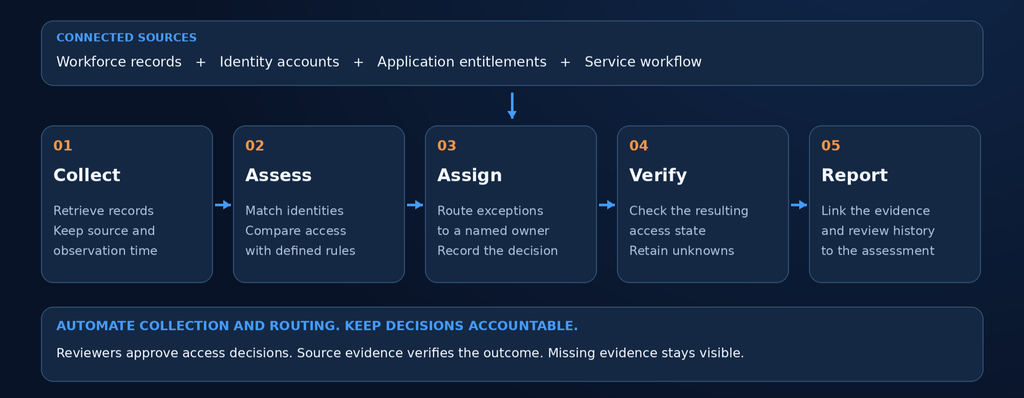
Those connections can support the progression from collecting records to assessing controls, coordinating exceptions, verifying outcomes and retaining evidence for reporting.
The extent of automation depends on the available data and platform capabilities. A configuration check may support automated assessment against a defined rule. Determining whether privileged access is justified may still require an authorized reviewer.
Integrations prepare that decision by assembling the relevant records and context. Reviewers spend less time gathering information and more time resolving the questions it raises.
How Compliance Automation Moves from Collection to Audit.
An access review shows how several integrations work together. The following scenario is illustrative, rather than a customer implementation or result.
An organization needs to establish whether departing employees retain access to a purchasing application. The relevant records sit in its workforce system, identity provider, application and service-management workflow.
Collect and Assess
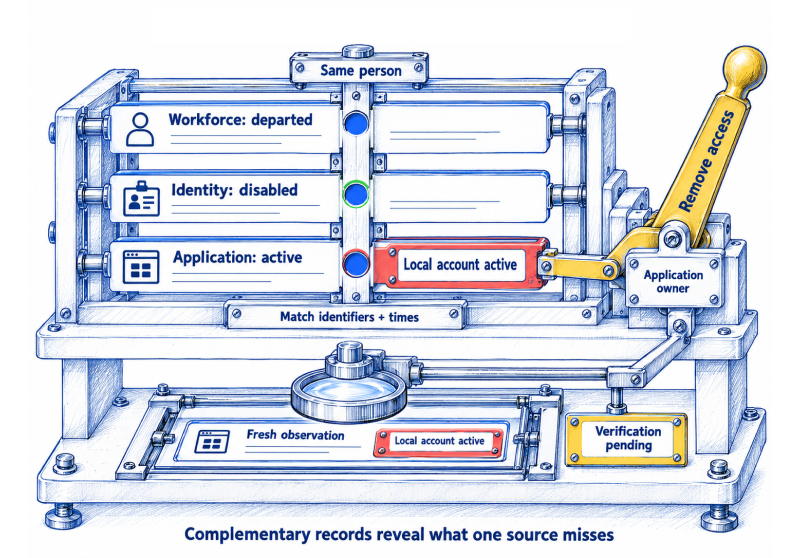
The workforce record establishes an employee’s effective departure date. The identity and access management (IAM) system shows that the central account is disabled. Application records reveal a separate local account that remains active.
Matching those records identifies an exception that the central identity record alone would not reveal. The assessment retains the source identifiers, observation times and rule used to identify the discrepancy.
Assign and Resolve
The exception reaches the application owner through the service workflow, with the affected account, supporting records and required action attached.
The owner investigates and follows the approved process to remove access. Decisions and completion details remain linked to the finding, allowing compliance reviewers to follow progress without requesting separate status updates.
Verify and Retain
A fresh application observation supports verification of the resulting account and entitlement state, provided it covers the relevant records and access paths. Other paths within scope, such as active sessions or separate credentials, require appropriate evidence of their own.
If collection stops or covers only part of the required scope, verification remains incomplete. Otherwise, the linked finding, decision, action and subsequent evidence provide a traceable assessment history.
The integration that closes the decision gap matters most. Central identity records establish one part of the departure process. Application records establish another. Connecting both allows the reviewer to reach a conclusion that neither source supports alone.
Which Systems Should You Integrate?
Select connections according to the compliance work they support. These categories describe common source types and potential uses; connector availability and data access depend on the implementation.
Integration category
Records it contributes
Compliance work it supports
Cloud providers
Resource inventories, configuration, permissions and change records
Assessing defined cloud settings across relevant accounts and regions
Identity and workforce systems
Employment status, accounts, roles and entitlements
Access reviews, joiner and leaver checks, and identity reconciliation
Version control and CI/CD systems
Code reviews, approvals, pipeline activity and deployment records
Tracing implemented changes to approval and testing records
Project management and service systems
Owners, tasks, deadlines, approvals and status
Coordinating exceptions, evidence requests and corrective work
Policy and document systems
Approved versions, review history and acknowledgments
Managing policy approval, maintenance and acknowledgment
Mobile device management and endpoint tools
Device inventory, configuration and protection observations
Assessing endpoint coverage and defined security requirements
Vulnerability and threat intelligence systems
Findings, affected assets and threat context
Supporting risk review, treatment decisions and follow-up
Web security systems
Protective configuration, traffic records and security events
Reviewing specific application-protection measures
Training and background-check systems
Completion or verification status
Checking required activities against the applicable workforce population
Complementary sources can strengthen an assessment. Mobile device management (MDM) records may establish device enrollment and configuration, while endpoint security records may establish protection status.
For change control, continuous integration and continuous delivery (CI/CD) records need to include relevant approval, deployment and bypass paths. Reviewing only the standard pipeline can leave exceptions outside the assessment.
Web application firewall (WAF), content delivery network (CDN) and encrypted-connection records support conclusions about particular technical measures. They do not independently establish compliance with an entire framework.
Reduce Repeated Collection and Follow-Up
When several assessments need the same records, shared collection can reduce duplicate requests to operational teams. Reliable matching also reduces the recurring work of reconciling separate spreadsheets.
Connecting findings to service workflows preserves responsibility, deadlines and decisions. Retaining this history as work proceeds makes audit preparation less dependent on reconstructing events from emails and individual files.
The benefit is a more consistent working record, from the initial observation through review and action.
Assess the total effort involved. Connector administration, maintenance and unresolved-record review remain part of the process. Reduced collection effort is valuable when it improves the workflow as a whole.
Reuse Evidence Without Merging Obligations
An approved change record may support internal policy review and several assurance assessments. Collecting it once can reduce repeated requests, but each assessment must retain its own scope, period and evidence expectations.
Framework mapping organizes these relationships. It does not establish compliance by itself.
For organizations operating across India and Middle Eastern jurisdictions, maintain applicability by legal entity, activity and regulator. This allows shared records to support distinct obligations without merging their conclusions.
SEBI issued technical clarifications to its Cybersecurity and Cyber Resilience Framework (CSCRF) on 28 August 2025. In the UAE, Article 7 of the CBUAE’s 2026 Operational Risk Management Regulation, C 1/2026, includes activities relying on third-party service providers within the internal control system. Each reference applies within its respective regulatory scope. SEBI technical clarifications; CBUAE Article 7.
The practitioner implication is to maintain evidence mappings as applicable requirements evolve and account for relevant provider-held records. This is implementation advice derived from the regulatory context, rather than an explicit requirement in those provisions to deploy integrations.
Keep Automated Evidence Dependable
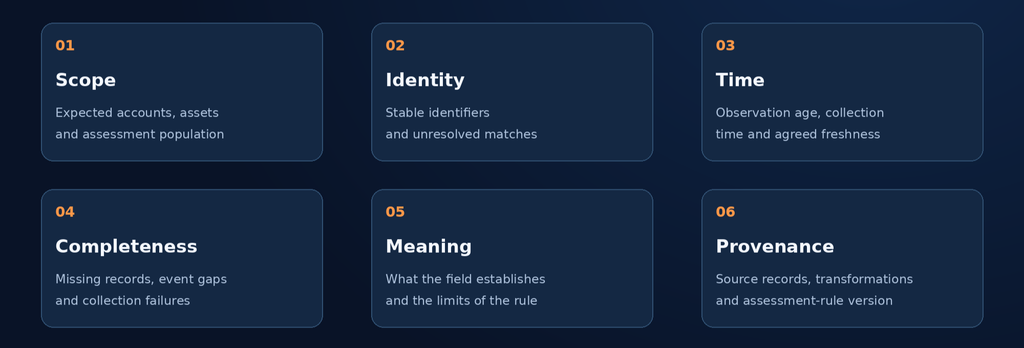
Six checks provide a practical framework for deciding whether collected records can support an assessment.
Apply these checks when interpreting the output. A recently collected endpoint record may contain an old observation. An unmatched account may disappear from a review if reconciliation errors are silently discarded. A completed task may lack evidence that the underlying condition changed.
Each problem calls for a different response: obtain a current observation, resolve the identity match or verify the outcome. Treating all three as a successful collection would obscure the work still required.
Preserve those limitations alongside the result. The six checks are an editorial assessment framework, not a regulatory checklist.
Secure collection through least privilege, appropriate credential management and defined access-review responsibilities. Separate collection permissions from permissions that can change source systems.
For bidirectional connections, define field ownership, approval requirements and conflict handling. Workforce, training and background-check integrations should retrieve only the personal information needed for the approved purpose, subject to applicable legal and retention requirements.
Select Connections That Sustain the Workflow
A relevant source is useful only if the required records can be collected and interpreted dependably.
Selection criterion
What to establish
Data availability
Required fields and relevant history are accessible through the supported collection method
Identifier quality
Stable identifiers allow records to be matched across systems
Collection reliability
Pagination, rate limits, failed requests and recovery behavior are understood
Freshness
Source updates can support the assessment’s required observation period
Permission requirements
Access is appropriate, with clear credential ownership
Maintenance effort
Responsibility is assigned for source changes, failures and assessment-rule updates
Use these criteria to compare what each connection adds to the workflow.
In the access-review example, application entitlements close a gap left by central identity records. Another feed containing the same central account information may add little to that decision.
If the required application lacks a suitable API, use an alternative controlled collection method and record its coverage and timing limitations. The objective remains completing the assessment with appropriate evidence.
How SPOG.AI Supports Compliance Automation.
SPOG.AI connects security tools, IT systems, asset intelligence and compliance workflows to support automated evidence collection, framework-aligned compliance mapping, continuous control monitoring and control effectiveness validation. Executive dashboards bring these insights together for leadership oversight.
These capabilities help organizations bring operational records into continuous compliance assessments, review control performance and maintain visibility into outstanding work. Aligning integrations with priority workflows gives each connection a clear purpose, from collecting evidence to supporting review and reporting.
Connect for a Clear Outcome
Choose a recurring compliance workflow and identify where collection, reconciliation or follow-up slows it down. Select the sources that resolve those gaps, establish dependable access and retain the evidence supporting the outcome.
Expand when additional connections help complete an assessment, reduce repeated work or improve coordination. That gives compliance automation a practical measure of success: work completed consistently, with decisions that reviewers can explain and evidence they can trace.
Compliance automation uses connected systems and defined workflows to collect evidence, assess specified conditions, assign follow-up actions and maintain records. It reduces repetitive work while preserving the judgments and approvals that require accountable reviewers.
Integrations bring relevant records from operational systems into compliance assessments and workflows. For example, combining employee departure dates with identity and application records can reveal access that remains active after someone leaves.
Start with a recurring compliance task and identify the information needed to complete it. Prioritize sources that resolve a specific gap, such as application permissions missing from an access review, rather than selecting connections solely by availability.
No. Collection establishes that records were retrieved. A defensible control assessment also requires appropriate scope, relevant observations, defined criteria and consideration of evidence limitations. Some conclusions still require testing or practitioner review.
Continuous control monitoring evaluates defined control conditions through recurring or event-driven observations. Compliance automation supports a broader workflow, including evidence collection, review, exception handling, corrective actions and reporting. Monitoring results can inform that workflow.
Evidence should identify its source, observation time, covered population and assessment context. Reviewers should also be able to identify missing records, matching errors and collection failures. A successful connection alone does not establish complete or current coverage.
Yes, where the evidence meets each assessment’s requirements. Shared collection can reduce duplicate requests, but each use must retain its applicable scope, period and evaluation criteria. Mapping one record to several requirements does not automatically satisfy them.
Obtain evidence of the resulting condition and assess it against the original finding. For an access exception, a completed removal ticket should be followed by appropriate account and entitlement checks, including other access paths within scope.
Use permissions limited to the approved purpose, assign credential ownership and review access periodically. Distinguish read-only collection from actions that modify source systems. For connections that write data back, define approval requirements, field ownership and conflict handling.
Reviewers remain responsible for interpreting ambiguous evidence, determining applicability, approving justified exceptions and accepting remaining risk. Automation can assemble context and route decisions, but those decisions still need clear authority and a recorded rationale.
Technology writer and content strategist with 5+ years of experience, including work for a US-based B2B SaaS client and a cybersecurity solution. I create cybersecurity and GRC content, product documentation, and user guides that help technical teams and business leaders understand security capabilities and workflows. Currently working on Confluence documentations on vulnerability management, ITSM, incident management, and continuous control monitoring, alongside SEO and AEO content, and technology partner database development.