Build a Risk Register in 2026 With Clear Evidence and Traceable Business Decisions
A risk rating needs a clear basis and a record of the decision behind it. Build risk entries that connect business scenarios with evidence, ownership and review triggers, keeping current exposure separate from expected improvements.
A risk register records identified risks, their assessments, accountable owners, responses and review status. For security and GRC teams, it should preserve enough context to explain why an exposure received its rating and whether that conclusion still holds. Creating the register means defining those records and the rules for maintaining them.
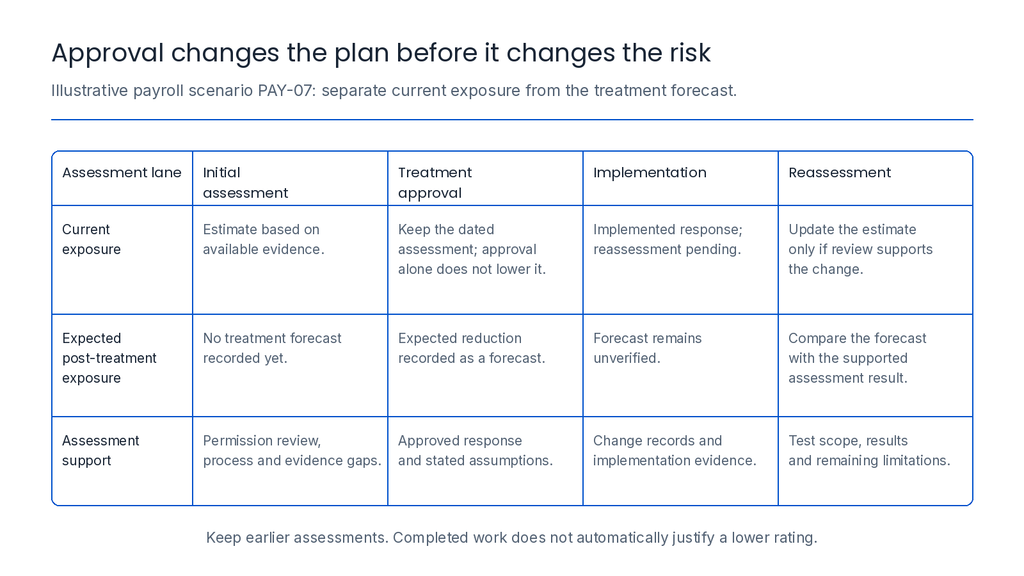
Consider an entry marked “Medium” after a mitigation project is approved. Does that describe today’s exposure, the expected result after implementation, or a reassessment supported by testing? Without that distinction, the record cannot support a reliable decision.
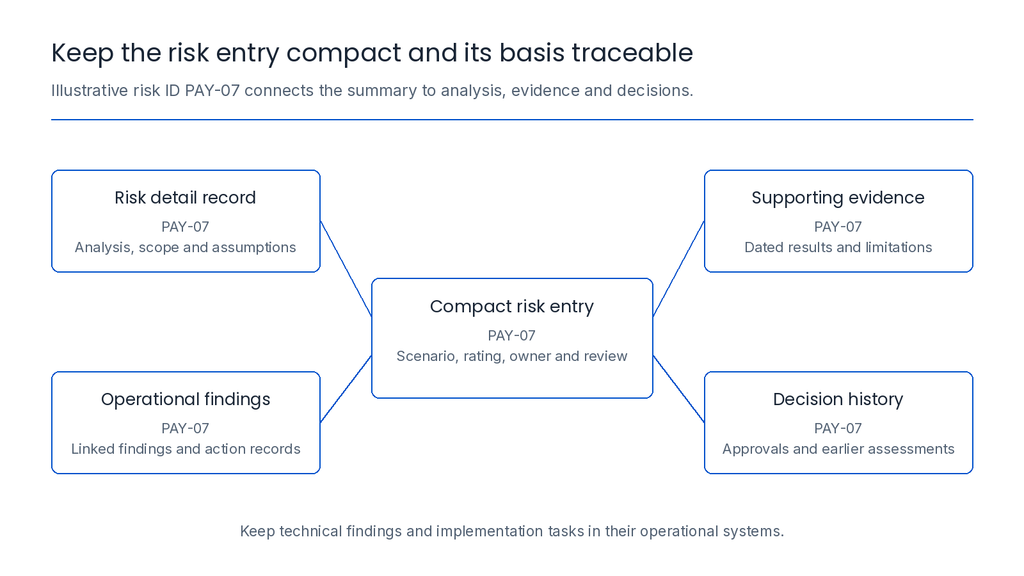
Treat each entry as a dated assessment with linked decisions. Keep technical findings and implementation tasks in their operational systems.
Set the boundary of your risk register
Define the services, business units and objectives covered before collecting entries. Establish which risks belong in this register, who maintains it and how material exposures reach enterprise risk management (ERM). Use business consequences to determine reporting significance, rather than importing every scanner finding.
A vulnerability is a weakness. An issue is a condition requiring action. A risk scenario explains how an uncertain event could affect an objective. Connect these records where appropriate, but preserve their different purposes.
For example, several findings affecting a payment service may support one unauthorized-payment scenario. Keep each finding traceable beneath that entry. Create separate risks where consequences, ownership or response decisions materially differ.
NIST IR 8286 Revision 1, published in December 2025, describes integrating cybersecurity risk information into ERM. Its example register is guidance, not a universally mandated template.
Write a scenario that can be assessed
Start with a business owner and the people who understand the service. Establish the affected objective, relevant assets or dependencies, possible event, enabling conditions and adverse consequence.
“Unauthorized modification of payroll payment details through an overprivileged integration could redirect salary payments and disrupt payroll completion” is assessable. “Integration risk” leaves the event and consequence unclear.
Define boundaries. Does the entry cover payment-file generation, bank submission or both? Which entities and integrations are included? Record exclusions that could affect the conclusion.
Use incidents, control assessments, supplier changes and business workshops for risk identification. Record the concern’s source. Evidence of a weakness does not establish that the adverse event happened.
Build a compact entry with linked detail
Use a stable risk ID to connect the register summary with supporting analysis, evidence and decisions. NIST IR 8286A Revision 1 distinguishes a compact register from a risk detail record (RDR) containing additional analysis and history. Keep the summary readable while making its basis retrievable.
These field groups form a practical risk register template, without prescribing a universal field count.
Field group
What to record
Identity and scope
Risk ID, description, category, business objective and affected service or population
Assessment basis
Assessment date, time horizon, method version, likelihood, impact, inherent and current ratings and rationale
Safeguards and evidence
Relevant controls, evidence references, observation dates, scope limitations and assumptions
Accountability
Risk owner, assessor, response owner and decision authority
Response and decision
Selected strategy, linked treatment plan, approval, conditions and decision date
Remaining exposure
Current residual risk and separately labeled target risk after planned treatment
Review and history
Status, next review date, reassessment triggers and links to previous versions
Retain the evidence version or dated result supporting each assessment, subject to applicable retention and access requirements.
Record assessment assumptions before assigning priority
Use defined likelihood and impact criteria, a stated assessment period and a documented method. Explain which controls were considered and where their operation remains uncertain. A rating without this context can be difficult to reproduce.
Inherent risk estimates exposure without direct risk-reducing actions. Document assumed operating conditions so the baseline is consistent. Residual risk describes what remains after considering implemented safeguards. Both are estimates; neither becomes a measured fact simply because it appears in a register.
Keep expected post-treatment risk separate from the current assessment. Project approval, configuration changes and successful control tests provide different information. Reassess remaining exposure after evaluating what the implemented response actually changes.
If your method multiplies likelihood and impact scores, explain the scales. Ordinal scores are prioritization aids, not automatically probabilities or monetary loss estimates. Record rationale and uncertainty rather than implying precision through extra decimal places.
Prioritize current exposure against risk appetite, tolerance and applicable obligations. Inherent risk alone may obscure the protection already operating. A missing evidence feed should prompt investigation of assessment confidence; it does not automatically prove a control has failed.
Work through a risk register example
The following payroll scenario is illustrative, not a reported customer result.
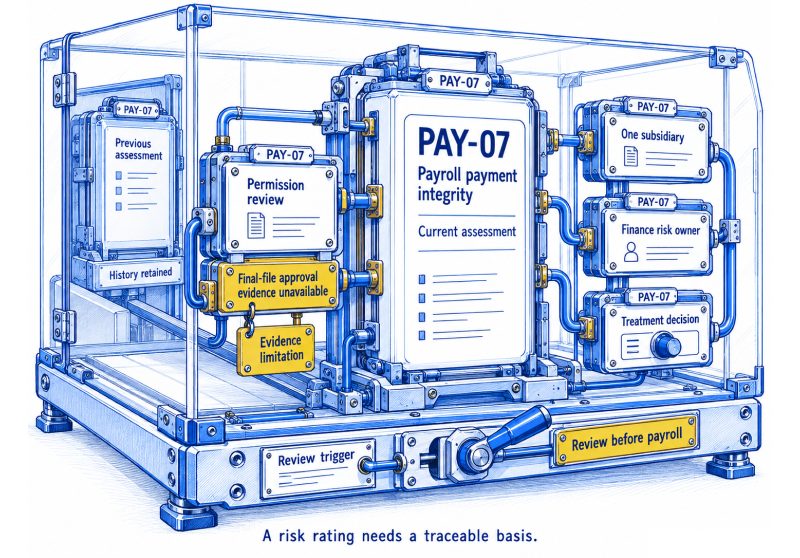
An integration can modify a payroll payment file after business approval. The finance owner confirms that the affected file covers one subsidiary. The assessment considers unauthorized alteration before bank submission, with financial loss and delayed salary payments as consequences. Record PAY-07 under the finance director, with review before the next payroll run.
The entry references the permission review and transaction process. An assessor records likelihood and impact rationale under the organization’s criteria. Evidence confirming independent approval of the final file is unavailable. That limitation remains visible alongside the current rating.
Risk mitigation restricts modification permissions and adds a check of final payment details. The response owner tracks implementation. A lower target rating remains a forecast until the changed process is assessed.
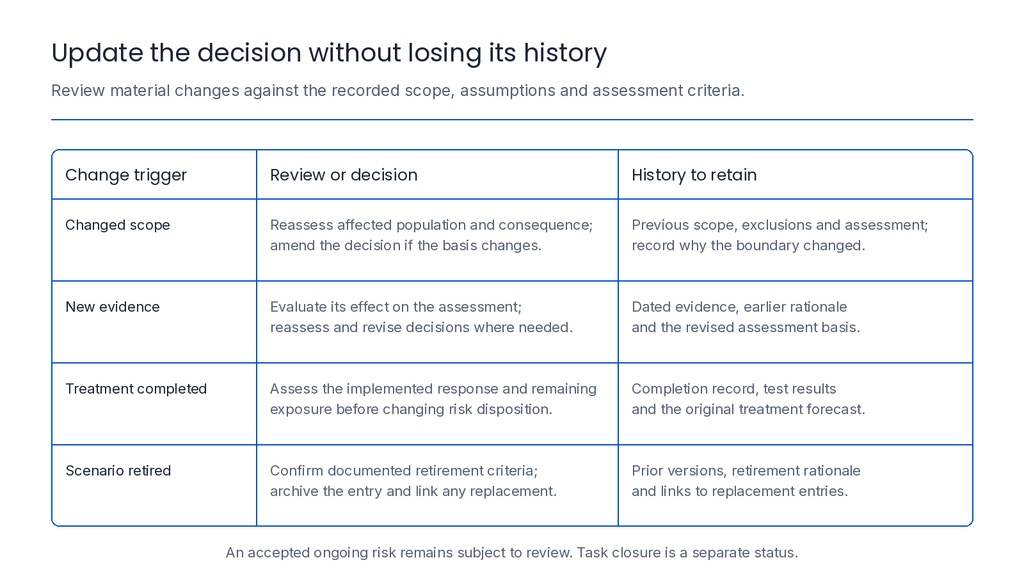
If testing reveals an alternative modification route, retain the finding and reconsider the assessment. If the response works under the tested conditions, record the supported conclusion, remaining limitations and next review trigger. Preserve the earlier version so the change in judgment can be explained.
Keep risk decisions separate from task status
Assign a risk owner accountable for business exposure and a response owner responsible for implementation. Identify who can approve acceptance or escalation.
Record avoidance, mitigation, transfer or sharing, and acceptance where selected. Link detailed delivery commitments to the treatment plan. The register should retain the decision, its conditions and the exposure being addressed.
Use separate fields for treatment progress and risk disposition. “Implemented” describes work completed; “accepted” describes an authorized decision. Acceptance needs scope, rationale, conditions and review. A closed remediation task does not necessarily justify retiring the risk entry.
Retire entries under documented rules, preserving history and links to replacement entries. An ongoing scenario with accepted residual exposure still needs review.
Update entries without losing their history
Set review frequency according to exposure, obligations and the pace of change. Add triggers tied to the assessment’s assumptions, such as broader integration permissions, a changed supplier dependency or a failed control test.
Change detection should lead to review where it affects the scenario. For specific technical changes, post-change validation can supply evidence for that judgment. Maintain comparable scope and criteria across assessments, or explain what changed.
When consolidating business-unit registers, preserve source IDs and reconcile categories, scales and periods. NIST IR 8286C Revision 1 addresses aggregation and normalization for enterprise oversight. Adding ordinal scores or averaging ratings without an appropriate method can obscure shared dependencies and local differences.
A controlled spreadsheet can support this process. Risk register software becomes useful when permissions, relationships, version history or review routing exceed the team’s manual capacity. Assess these needs directly rather than assuming automation guarantees better judgments.
SPOG.AI’s published capabilities connect requirements, controls, operational evidence, ownership, exceptions and remediation. These relationships can inform risk review where connected sources and configured assessments provide relevant coverage. Keep control scope and evidence aligned within the information security management system. Business impact, acceptance authority and remaining-risk judgments still require accountable review.
Create one entry that another reviewer can defend
Start with a consequential scenario. Complete its assessment basis, evidence links, ownership and decision record, then test whether another reviewer can explain the rating. Resolve missing context before expanding the template. A useful register preserves what was known, what was assumed and why the decision changed.
A report selects register information for a particular audience and date. The register retains assessments, decisions and their history.
Define scope and assessment rules, identify scenarios, record evidence and ratings, assign owners, document decisions and establish review triggers.
Scenarios affecting business objectives through information or technology exposure, with linked technical findings where relevant.
No. An issue log tracks existing problems; the register records assessed uncertainty and consequences. Link related records.
Inherent risk uses a defined baseline before relevant controls; residual risk considers implemented safeguards. Document the assumptions behind each.
No. Keep the expected result of planned treatment separate until reassessment supports a revised current estimate.
Someone accountable for its business consequences, with response ownership and approval authority specified separately.
Use a schedule reflecting risk and obligations, plus triggers when evidence, scope or assumptions materially change.
A risk control matrix (RCM) links risks to relevant controls. The register retains assessments and decisions; mappings alone do not prove effectiveness.
Yes, with controlled access, consistent records, history and review. Evaluate software when those arrangements become difficult to maintain.
Technology writer and content strategist with 5+ years of experience, including work for a US-based B2B SaaS client and a cybersecurity solution. I create cybersecurity and GRC content, product documentation, and user guides that help technical teams and business leaders understand security capabilities and workflows. Currently working on Confluence documentations on vulnerability management, ITSM, incident management, and continuous control monitoring, alongside SEO and AEO content, and technology partner database development.