Risk Management Plan in 2026: Turn Decisions into Funded and Accountable Actions
Risk decisions need funding, ownership and follow-through. Build a risk management plan that connects response choices to accountable actions, tracks delivery and keeps remaining exposure visible as conditions change.
A risk management plan sets out how an organization identifies, evaluates, responds to and monitors risks to its objectives. For security leaders, its value lies in the decisions it makes executable: which exposure deserves investment, who can authorize the response, and what happens while the work remains unfinished. A register containing “mitigate” and a deadline leaves those questions unresolved.
Consider a critical supplier integration that could interrupt order processing. Security recommends redesigning it; operations needs uninterrupted service; finance has not approved the expenditure. The risk is documented, but the response has no agreed route to delivery. A useful plan addresses that disagreement before it becomes an overdue action.
Separate the risk management plan from the treatment plan
The overall plan establishes scope, assessment criteria, decision authority, reporting arrangements and review rules. A risk treatment plan documents the selected response to a particular risk, including activities, resources, responsibilities and expected remaining exposure. The risk register connects these decisions to the assessed scenarios.
A risk mitigation plan focuses on reducing exposure; a treatment plan can also include acceptance, avoidance or transfer.
Keep these records related without treating them as interchangeable. An assessment explains why a risk matters. A treatment plan explains what the organization will do about it. An incident response plan explains how teams act when an event occurs.
Use one risk identifier across the register, treatment record and reporting view. Preserve previous decisions when updating the plan, so reviewers can understand why the response changed. The document can be concise; the important requirement is traceability between the scenario, authorized choice and delivery commitments.
For 2026 planning, NIST’s December 2025 revisions to its enterprise risk guidance provide a current foundation for connecting cybersecurity decisions with business objectives. This is an updated basis for established practice, rather than a newly invented discipline.
Define the decision before selecting controls
Write the scenario around a business consequence. “Supplier risk” is too broad. “Failure of the order-routing provider prevents confirmed orders reaching fulfillment during peak trading” identifies an event, dependency and consequence that managers can discuss.
Record the assessment horizon, assumptions and existing safeguards. Distinguish inherent risk, assessed before the relevant controls, from current residual risk, reflecting controls already operating. Expected residual risk describes the forecast after proposed treatment. Keep that forecast separate until implementation and assessment support it.
Document uncertainty alongside likelihood and impact. Missing supplier recovery evidence should remain an information gap; it should not silently become a favorable rating. Use a defined scoring method, but retain the rationale behind the score. Addressing weaknesses in enterprise risk assessments improves the inputs to treatment decisions.
Translate appetite into an actionable boundary
Risk appetite expresses the exposure leadership is willing to pursue or retain. Tolerance makes that direction more specific for an objective or activity. The plan should state the boundary relevant to this decision and who may authorize an exception.
For the order-processing scenario, suppose management sets an illustrative tolerance of no more than two hours of disruption during peak trading, with queued orders reconciled before the next fulfillment cutoff. Recovery evidence must address both conditions. A supplier promise alone does not demonstrate that they can be met. If evidence is missing, investigate, restrict the activity or escalate for an authorized interim decision. These thresholds are examples, not universal requirements.
Compare responses using their business tradeoffs
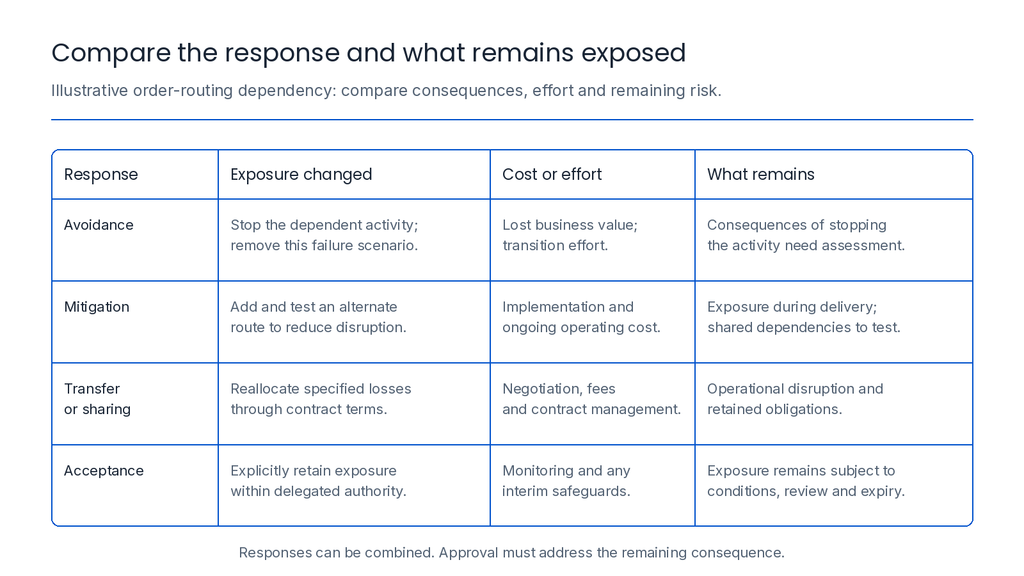
Risk treatment options include avoidance, mitigation, transfer or sharing, and acceptance. They can be combined. Evaluate what each changes, its cost, delivery dependencies and what remains exposed.
Avoidance means declining or stopping the activity producing the specified exposure. Mitigation reduces likelihood, impact or both. Transfer or sharing reallocates some consequences, such as specified financial losses, through contractual arrangements; operational disruption and other consequences may remain. Acceptance is an explicit decision to retain exposure under defined authority and conditions.
For the supplier integration, compare limiting transaction volume, funding an alternate routing mechanism, negotiating service commitments, or retaining the present arrangement temporarily. None should be selected merely because its label appears in a dropdown.
The matrix should reveal the tradeoff: a low-cost response can leave substantial business disruption, while a stronger intervention may need funding and operational capacity.
Build a risk management plan that can be funded
A useful treatment record answers six questions: What outcome is required? Which actions produce it? Who delivers them? What resources are committed? What protects the business meanwhile? Who decides whether the remaining exposure is acceptable?
Separate the risk owner from action owners. A service leader may own the business exposure while engineering delivers a routing change and procurement negotiates supplier terms. Assigning the engineering ticket does not automatically give its assignee authority to accept disruption.
Show the budget decision explicitly. “Awaiting approval” needs a named approver, decision date and consequence of delay. Identify dependencies such as supplier cooperation, contract renewal, integration testing and release capacity. Sequence work around those constraints.
Compare response cost with the outcome it is intended to protect. Include implementation effort, recurring operating costs and transition disruption where relevant. A cheaper proposal may impose more manual work on operations. Bring that tradeoff into the approval discussion rather than allowing it to surface after the budget is agreed.
Illustrative example of a treatment decision
Assume an order-routing service depends on one provider. Recovery capability is uncertain, and an alternate integration needs eight weeks after funding approval. The following timings and limits are illustrative, not customer results or universal benchmarks.
The operations director owns the risk and can authorize temporary acceptance within delegated limits. Finance must decide funding within ten working days. Engineering delivers the alternate route; operations tests manual handling; procurement confirms supplier obligations. Before relying on manual handling, test its capacity and restrict dependent transaction volume to that capacity. If the director lacks authority for the assessed exposure, escalate to the designated approving body.
Temporary acceptance expires thirty days after approval. Additionally, review by day twenty-five, using current exposure, interim-test results and the delivery forecast. Continuation requires a fresh, documented decision before expiry; it does not extend automatically to the eight-week deployment date. If you decide not to renew or safeguards fail, activate the agreed restriction or suspend dependent order flows.
Illustrative risk treatment record
Field
Recorded decision or commitment
Risk identifier and outcome
R-017. Restore order routing within two hours during peak trading and reconcile queued orders before the fulfillment cutoff.
Response and ownership
Mitigate through an alternate route; temporarily accept remaining exposure. Operations director owns the risk; engineering, operations and procurement own actions.
Funding and delivery
Funding pending. Finance decision due within ten working days; no committed delivery baseline until resources are approved. Implementation estimated at eight weeks after approval.
Interim protection and expiry
Test manual capacity before use and cap dependent volume accordingly. Acceptance expires on day 30; review by day 25. Renewal requires explicit approval.
Evidence and reassessment
Engineering supplies failover-test results, recovery timings and transaction reconciliation. Operations director reassesses residual risk with security input and approves or escalates the remaining exposure.
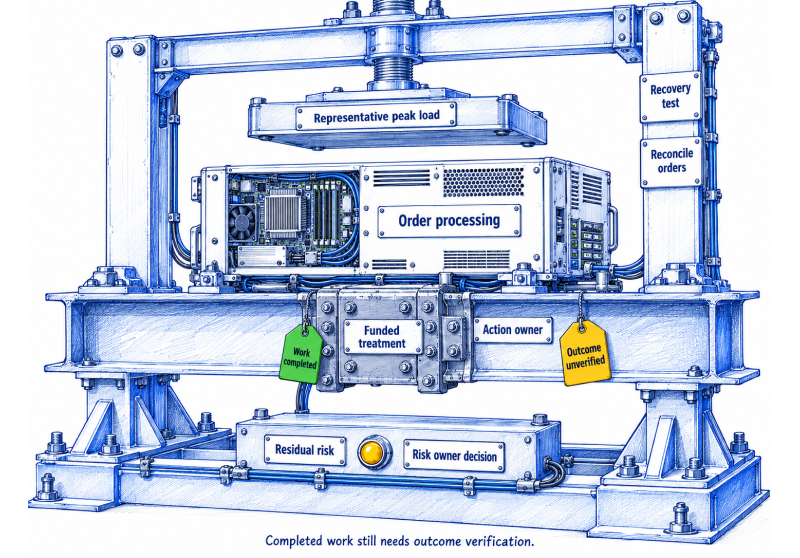
This record exposes two separate commitments: permission to carry temporary exposure and resources to deliver the longer-term response. Neither should be inferred from a green project status.
Evidence should demonstrate recovery at representative peak load: fail over to the alternate route, measure restoration time and reconcile orders for loss or duplication. Check that the alternate route does not share the dependency responsible for the original failure. Record test scope, date, result and unresolved limitations. A deployed integration is not sufficient evidence of resilience.
Monitor delivery and remaining exposure separately
A risk management plan should distinguish work progress from risk status. An action can be overdue while interim safeguards remain effective. Conversely, delivery can be on schedule while the business faces unacceptable exposure.
Track a small set of decision-relevant measures: material treatments without committed funding, temporary acceptances approaching review, blocked dependencies and assessments awaiting evidence. State the population and reporting date. Avoid aggregating all items into one completion percentage.
Record what would reopen the decision: a failed interim measure, a materially changed supplier service, a missed funding milestone or a revised business requirement. Select review intervals appropriate to the exposure and obligations; do not assume one monthly cycle suits every case.
When evidence contradicts the expected benefit, revise the assessment and response. Preserve the original forecast alongside the updated judgment. That gives leadership a basis for changing investment or scope without mistaking an earlier estimate for an established result.
Where treatment involves system changes, ISO 27001 change management addresses the separate question of validating the resulting control state. The treatment record then uses those results to support reassessment and the remaining-risk decision.
Review shared dependencies before approving the portfolio
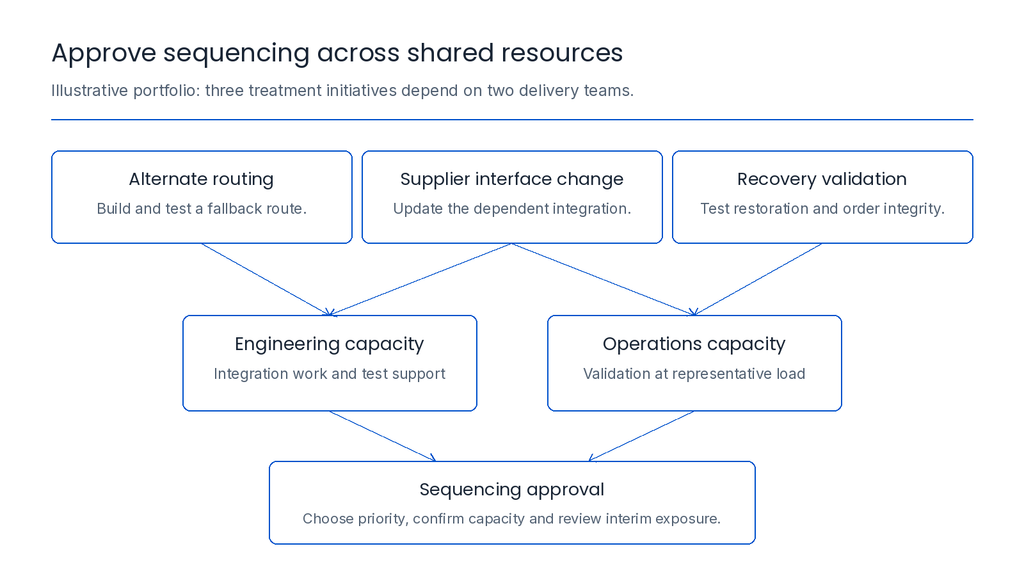
Several individually credible plans can compete for the same engineering team or rely on the same supplier. Identify those dependencies before leadership approves dates that cannot all be met.
Use the map to decide which work proceeds first, what must be resourced differently and which temporary exposures need renewed authorization. Avoid adding ordinal scores together to manufacture a portfolio loss estimate.
SPOG.AI can support the evidence side of this process by connecting control information with assets, risk context, ownership, exceptions and remediation. Coverage depends on connected systems and configured assessments. Funding, response selection and acceptance authority remain organizational decisions.
Put the next decision on the record
Start with one material risk whose treatment is stalled. Confirm the business outcome, compare feasible responses, name the funding authority and document the interim position. At the next review, ask which decision is needed, who can make it and what exposure remains until delivery. That makes the plan useful to both leadership and operating teams.
Frequently asked Questions
Scope, assessment criteria, decision authority, response arrangements, resources, reporting and review rules. Link individual treatment records to risk identifiers, interim safeguards, acceptance expiry dates and evidence requirements.
The register records assessed risks and their status. The treatment plan specifies the selected response and its delivery commitments.
Mitigation is one treatment option. Avoidance, transfer or sharing, and acceptance are other responses to negative risk.
No. Residual risk remains after controls or responses. Further action may reduce it; whether to act requires another decision.
The risk owner remains accountable for the exposure. Named action owners deliver the assigned work under the organization’s authority arrangements.
It can reallocate activities or some consequences. The organization must assess remaining dependencies, disruption and obligations.
Acceptance depends on its criteria, authority and applicable obligations. A high rating requires appropriate escalation, not an automatic prohibition or approval.
Record the funding approver and decision deadline. Mark delivery as uncommitted, assess the interim exposure and escalate as required. An unfunded action should not appear as an approved treatment commitment.
At defined intervals and when specified conditions change, including failed safeguards, missed milestones or altered business requirements.
Action completion supports reassessment. The remaining exposure still needs a documented decision; ongoing risks may continue to require monitoring.
With 8.5+ years in B2B SaaS, I’ve led demand generation and GTM initiatives across global markets (US, UK, Europe, Africa), helping companies move from fragmented marketing efforts to structured, revenue-focused growth engines.