Frameworks
Getting Started With Cyber Risk Quantification: Key Concepts Explained
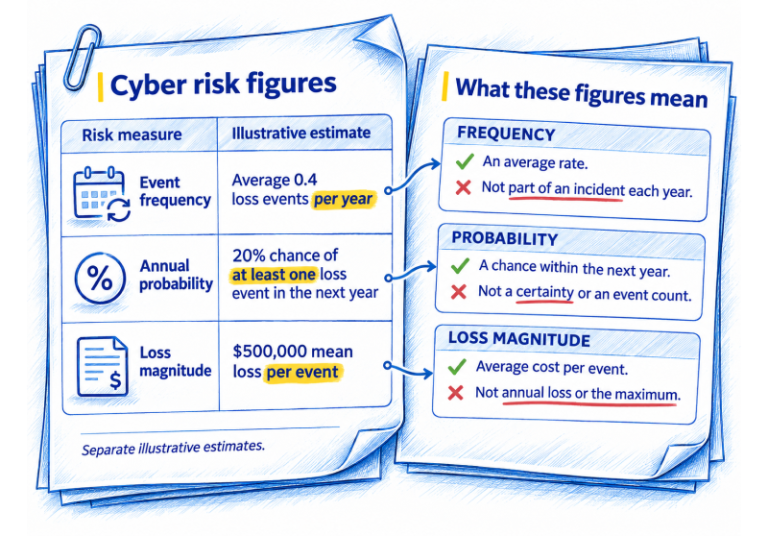
Cyber risk quantification expresses possible cyber losses in numerical terms, often money, for a defined scenario and period....
Assess response speed alongside its consequences. Faster containment may limit an incident while unnecessarily interrupting a critical service. Review whether responders had enough context to choose a proportionate action and whether a narrower intervention could have achieved the same protection.
Use recurring problems to revisit the underlying activity as well as the response playbook. The distinction between risk avoidance and risk reduction helps frame that review: should the organization discontinue an unnecessary activity that creates exposure, or retain it with stronger safeguards? Record the business tradeoff, assign the resulting changes and test whether they improve outcomes.
Risk avoidance vs risk reduction depends on what changes
Classify the response by its effect on the specified exposure. Cancelling an optional production-data export avoids the exposure created by that export. Keeping the export while restricting access and reducing the data included is risk reduction.
Segmentation, backups and awareness training are generally reduction measures. They limit the likelihood or consequences of an event while the underlying activity continues. Calling a strong control “avoidance” can hide the fact that its protection depends on continuing operation.
NIST IR 8286 Revision 1, published in December 2025, identifies acceptance, transfer, mitigation and avoidance as responses to negative cybersecurity risks. It places response selection in the context of enterprise objectives and risk tolerance. Avoidance and reduction are therefore choices within a wider treatment strategy.
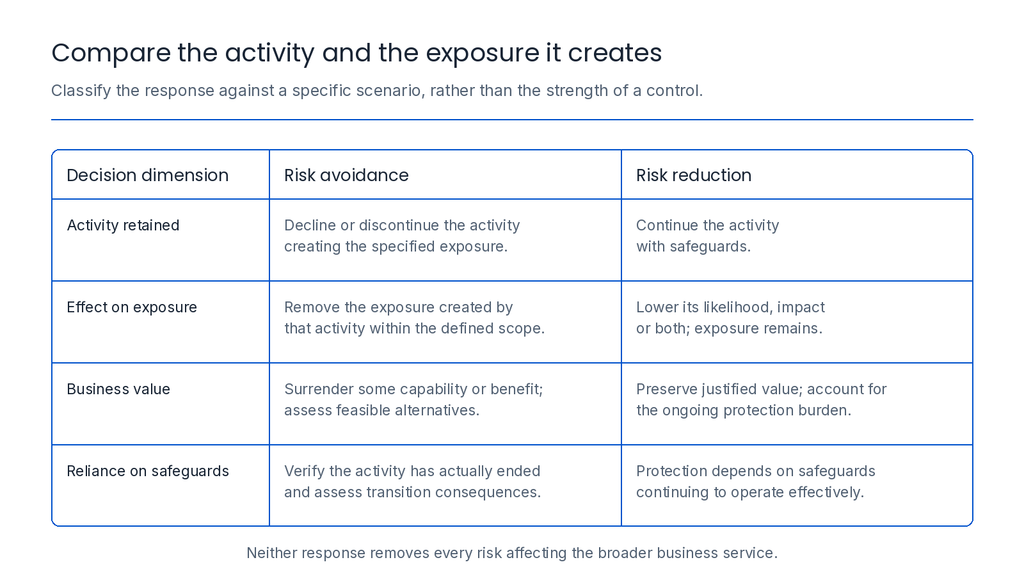
The useful distinction is what the business gives up and what it must keep protecting. Neither response establishes that every risk affecting the broader service has disappeared.
Separate the business objective from the way it is currently achieved. A team may need realistic software tests without needing unrestricted copies of customer records.
Ask what would stop if the activity ended. Identify the affected customer outcome, operating process or contractual commitment. Then ask whether a different design can deliver enough of that value with a different exposure. This prevents an avoidable implementation choice from being treated as an unavoidable business requirement.
Avoidance is especially worth examining for optional features, redundant data flows or activities whose benefits are small relative to their protection burden. Essential activities need a closer comparison of redesign, reduction and withdrawal consequences.
Use the assessed scenario in the risk register as the starting point.
Compare the value of continuing the activity with the cost and consequences of stopping or redesigning it. Then assess whether feasible safeguards can keep the remaining exposure within acceptable limits.
Include lost functionality, slower service, migration effort and the cost of an alternative process. Do not assume that the safer-looking option is automatically better for the enterprise.
A decision to stop a diagnostic process could reduce data exposure while making critical defects harder to reproduce. That consequence belongs in the comparison. Avoidance may be appropriate, but the business should understand the capability it is relinquishing and how it will handle the resulting constraint.
Identify the assumptions on which protection depends. Does the proposed safeguard cover every relevant route? Can teams sustain the operating effort? Would one missed approval or bypass defeat the intended protection?
Risk reduction carries an ongoing obligation to operate safeguards. Compare that burden with the value of continuing the activity. A technically sound control that the organization cannot maintain is a weak basis for choosing reduction.
Evaluate the expected remaining exposure against the relevant tolerance and applicable obligations. A low estimated likelihood alone does not justify retaining an unacceptable consequence. High likelihood alone does not tell the organization which response to choose.
Where estimates are uncertain, explain which unresolved question could change the preferred option. If that question concerns an optional activity, a restricted trial or temporary suspension may help resolve it. Do not treat a lack of evidence as an automatic reason for permanent withdrawal or unrestricted continuation.
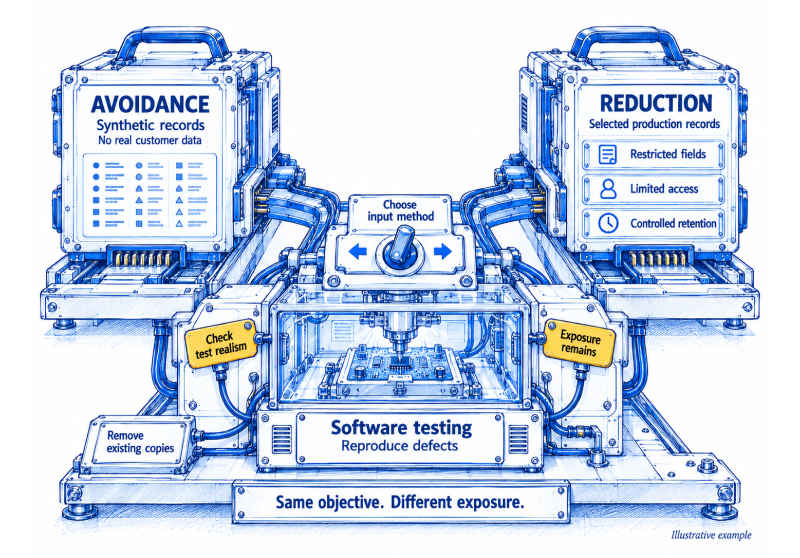
Consider an illustrative software company that copies production transaction records into an internal test environment to reproduce defects. The records contain customer identifiers. The exposure being considered is unauthorized disclosure through the testing copy. This is not a customer case study.
Engineering values realistic test inputs, but the security review asks whether full production copies are necessary for every test. The team compares three options.
Avoid the specified exposure. Stop using production records in routine testing and generate synthetic records containing no real customer data instead. This removes customer-data exposure through those routine copies, once existing copies are securely removed. The tradeoff is that synthetic inputs may omit characteristics needed to reproduce some defects.
Reduce the exposure. Continue using selected production records with restricted fields, limited access and controlled retention. The testing benefit remains, but protection depends on how well those safeguards work.
Combine the responses. Use synthetic records for routine tests and permit narrowly justified production-data investigations through a separate controlled process. This avoids the routine-copy exposure while reducing exposure for the exceptional investigations that still need real records.
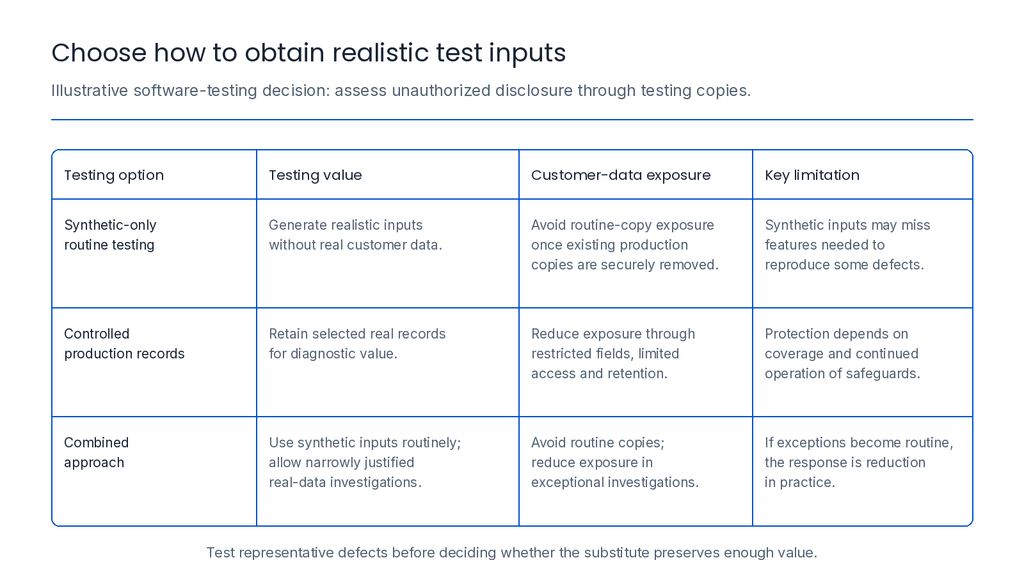
If every team continues copying production records under an exception label, the organization has selected reduction in practice.
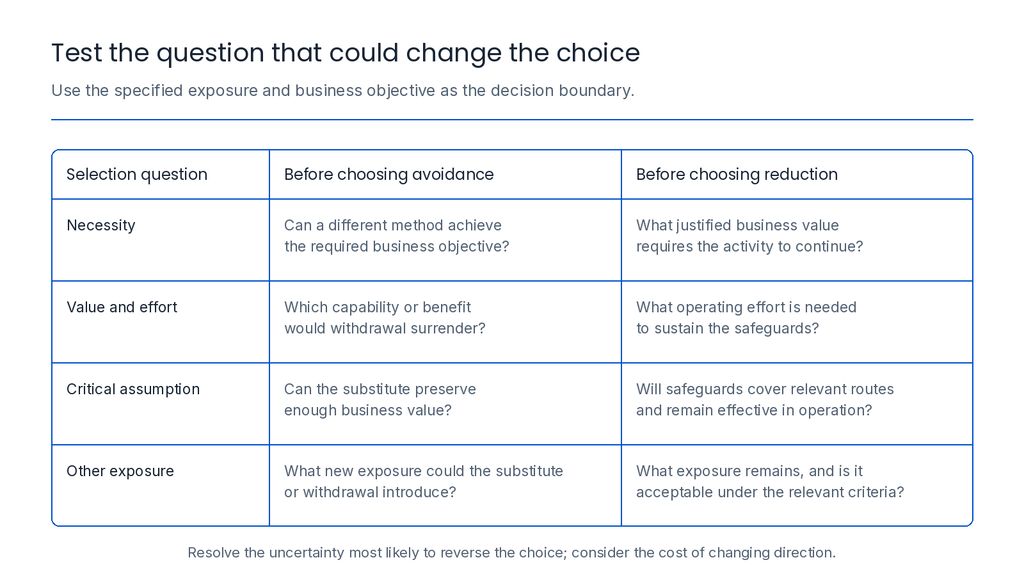
Before committing to avoidance, test whether the alternative preserves enough business value. In the illustrative scenario, engineering can attempt to reproduce representative defects using synthetic inputs. Success would strengthen the case for stopping routine production copies; failure would identify the situations needing a different treatment.
Before committing to reduction, test its weakest assumption. Can prohibited fields enter the test environment through an overlooked import? Can users create uncontrolled copies? If the response relies on a manual review, is the volume manageable?
For risk avoidance vs risk reduction, one option depends on the adequacy of a substitute; the other depends on continued protection.
Also compare reversibility. A controlled pilot may resolve uncertainty before a costly withdrawal. Conversely, waiting for perfect information can prolong an exposure that leadership has already judged unacceptable. Choose a decision sequence that reflects the consequence and the cost of changing direction.
Stopping an activity can introduce a different problem. Synthetic testing may miss defects that affect live transactions. Outsourcing a process may change who operates it while leaving business dependency and some consequences with the organization. Evaluate these effects without relabeling them as complete risk elimination.
If an alternative involves cloud services or external processing, cloud risk management should assess that arrangement. Provider responsibilities and connected-service dependencies require their own analysis.
Once the response is chosen, the risk management plan should carry its delivery commitments. Reconsider the choice when its business basis changes, such as synthetic tests proving inadequate or exceptional investigations becoming routine.
Choosing avoidance or reduction creates commitments that need ownership, evidence and review. SPOG.AI’s GRC solution connects requirements, controls, evidence and exceptions, helping teams review whether the basis for their risk decision still holds.
Its Remediation solution supports accountable action and validation, helping teams track agreed changes and assess whether they achieved the intended control outcome. Coverage depends on connected systems and configured assessments. Business and risk owners remain responsible for deciding whether to retain, redesign or discontinue the activity.

Cyber risk quantification expresses possible cyber losses in numerical terms, often money, for a defined scenario and period....
Fintech startup security must protect money, identity and financial data across live workflows enterprise buyers depend on. A...
Balancing security and compliance to prevent cyberattacks requires more than passing an audit or buying another security tool....