Cyber Risk and Compliance Risk: Decide What Needs Action
Cyber risk and compliance risk can share the same control weakness while requiring different decisions. Learn how mid-market teams can assess business harm and applicable obligations together, coordinate corrective action and verify that each issue is resolved.
Cyber risk and compliance risk can reach the same management meeting through different routes. Security reports a weakness that could enable fraud. Compliance reports a missed approval requirement. For a mid-market team with limited capacity, treating these as unrelated findings can duplicate work while leaving the business consequence unresolved.
The useful distinction is between potential harm and an obligation that must be met. Evaluate both against the same service, control and evidence, then assign a coordinated response. Keep the consequences separate enough to understand, but connected enough to act.
Start with the event, then examine both risks
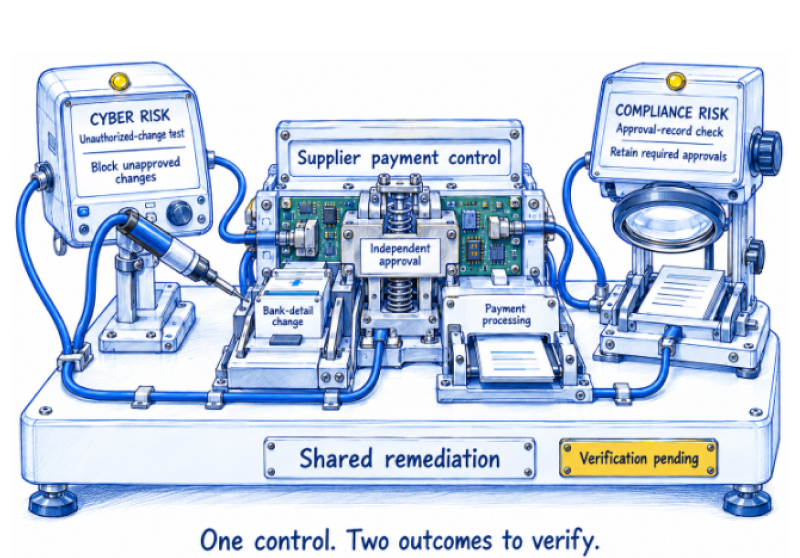
Consider an illustrative mid-market distributor whose supplier bank details can be changed without an independent approval. Its lender agreement requires both that approval and a retained record before changed details are used for payment.
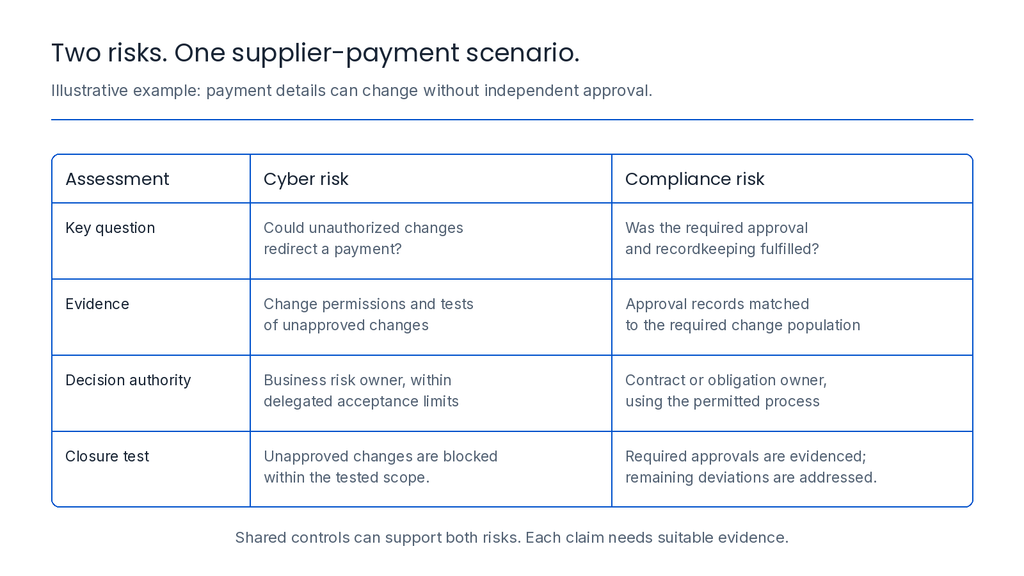
The cyber scenario is an unauthorized alteration that redirects money. The compliance issue concerns the agreed approval and recordkeeping requirement. The absence of a known fraudulent payment does not establish that the obligation was met. Equally, possessing an approval record does not establish that an unauthorized change is technically impossible.
Start the assessment with a specific event: “Someone changes supplier payment details without authorized approval, and payments reach the wrong account.” Identify the affected process, credible routes to the event, existing safeguards and uncertainty. Then attach the exact obligation, its scope and the evidence needed to demonstrate fulfillment.
NIST’s December 2025 revision of IR 8286A supports documenting cybersecurity scenarios, likelihood and impact in risk registers connected to enterprise risk management. The practical application here is to give leaders a business event they can evaluate, rather than separate labels such as “access risk” and “audit risk.”
What cyber risk and compliance risk mean
Cyber risk concerns potential business harm arising from compromised information or systems. The confidentiality, integrity and availability objectives, known as the CIA triad, help describe that harm:
Confidentiality: unauthorized disclosure, including personally identifiable information (PII) or commercially sensitive records.
Integrity: unauthorized or erroneous changes that make information unreliable, such as altered payment instructions.
Availability: inability to use necessary systems or information when required, interrupting a business service.
The objectives can overlap. The March 2025 joint FBI, CISA and MS-ISAC Medusa ransomware advisory describes data theft and encryption used together for extortion. Treating ransomware solely as an availability problem would miss the disclosure consequence.
Compliance risk concerns potential adverse consequences from failing an applicable obligation. Sources include legislation, regulation, contracts and formally adopted policies or standards. A requirement’s source matters: a contractual deviation, an internal policy exception and a statutory breach do not have interchangeable approval paths.
A cyber incident does not automatically prove noncompliance. Compliance can also fail without an incident, as when an explicitly required record was not retained. Assessment must establish the relevant facts and obligation.
The table should make the shared control visible without collapsing the two judgments. Preventing an unauthorized payment and demonstrating a required approval are related outcomes that need their own evidence.
Establish the obligation before declaring a gap
Create a concise obligation register: authoritative source, affected entity or process, required behavior, effective date, evidence period and accountable interpreter. Record why the obligation applies. Do not infer applicability from the label “mid-market” or from a customer’s generic questionnaire.
Different instruments serve different purposes. ISO/IEC 27001 specifies requirements for an information security management system, as confirmed by ISO’s July 2026 overview publication. A certification commitment should be assessed against its actual scope and terms.
The California Consumer Privacy Act (CCPA) is legislation, while the Payment Card Industry Data Security Standard (PCI DSS) is a payment-security standard. Their applicability and validation paths require different analysis. Keep these distinctions visible when mapping requirements to controls.
Dates also require attention. California’s regulations approved in September 2025 took effect in January 2026, with different compliance schedules for certain provisions. PCI DSS v4.0.1’s future-dated requirements became effective on 31 March 2025. Those are existing obligations where applicable, rather than upcoming developments. Confirm relevant scope and dates before committing to a remediation schedule.
Prioritize with consequence and obligation together
A single blended score can conceal why action is required. Use two judgments: the plausible business consequence of the scenario and the applicable obligation, including any fixed deadline. Retain supporting reasoning and evidence of confidence for each.
For the distributor, removing unnecessary change privileges may reduce immediate exposure. It does not settle whether earlier changes received required approval. The response also needs a review of the relevant records and a decision about any unresolved contractual deviation.
Use four practical situations to organize work:
Material cyber exposure and a confirmed obligation gap: coordinate containment, corrective work and the obligation-specific response.
Material exposure without an identified obligation gap: treat the business risk; the absence of a compliance finding is not evidence of safety.
Confirmed obligation gap with limited observed cyber exposure: meet the obligation and assess its consequences without inventing a severe attack scenario.
Uncertain control condition or obligation: assign investigation and proportionate interim protection before making a confident claim.
The model does not authorize delay of a binding requirement. A low cyber rating cannot waive an applicable legal duty. Where obligations permit an exception or revised commitment, use the proper authority and process.
Avoid double-counting financial consequences. If lost customer revenue appears in both cyber and compliance estimates for the same event, document the overlap before aggregating losses. Include separate costs only when they represent distinct consequences. Qualitative ratings should retain the same discipline, even without monetary estimates.
Reuse controls, but test each claim
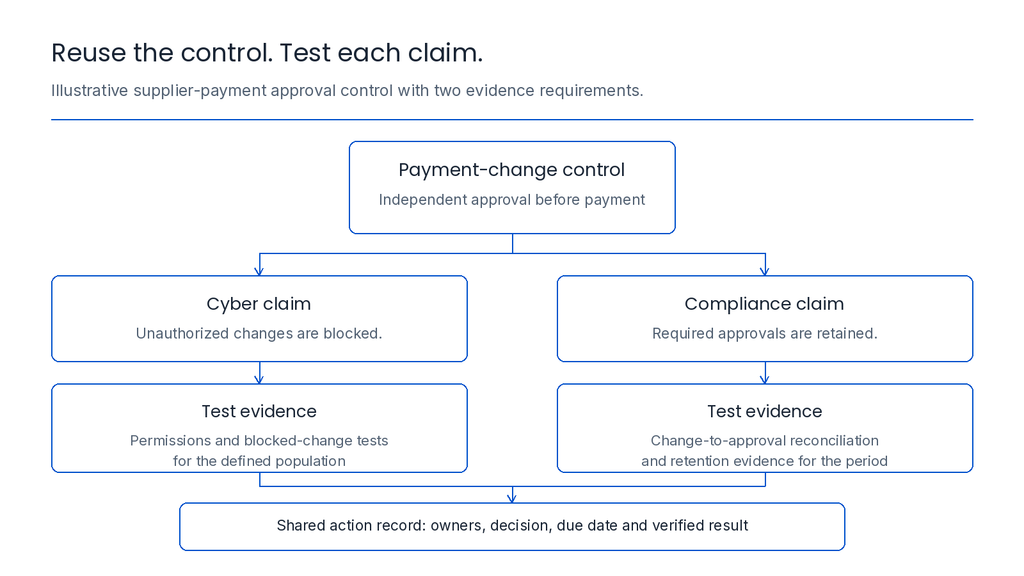
One approval control can support fraud prevention, internal policy and a contractual commitment. That does not make every evidence item sufficient for every purpose. Confirm the population, period and expected behavior for each claim.
In the illustrative distributor, reconcile supplier-detail changes against approval records and the identities authorized to make changes. Test whether unapproved changes are blocked before payment processing. Investigate unmatched changes. Establish whether logs are complete enough to support conclusions about the period under review.
Missing evidence means a conclusion may be unverified. It becomes a demonstrated compliance failure when the missing evidence itself violates a confirmed retention obligation. Preserve that distinction so the right owner receives the right action.
Keep the response proportionate and accountable
A lean governance, risk and compliance (GRC) program needs reliable decisions more than a large reporting pack. Name the control operator, business risk owner and person interpreting the obligation. Set a due date, interim safeguard and a testable closure condition.
Keep the risk register connected to current evidence and decisions through the same discipline described in risk management. Reassess when an affected system, supplier, threat or obligation changes materially.
Continuous control monitoring can support repeatable checks where suitable operational data exists. SPOG.AI’s May 2026 platform announcement describes connecting cyber risk, control validation, compliance evidence and operational workflows. That supports this approach; legal interpretation, acceptance authority and the adequacy of a treatment remain organizational decisions.
Report material scenarios, obligation deadlines, unresolved evidence questions and decisions awaiting approval. A completed remediation ticket should lead to a recheck of the intended outcome before the finding is closed.
Make the next risk review a treatment decision
Bring one material scenario to the next review with its direct consequences, applicable obligations and current control evidence. Agree what must change, who can decide and how success will be tested. Addressing cyber risk and compliance risk together should produce a clearer response, while preserving the distinct judgments each requires.
Frequently asked questions
Cyber risk concerns harm from compromised information or systems. Compliance risk concerns failure to meet an applicable obligation. One scenario can involve both.
Yes. Compliance addresses defined requirements and scope. It does not establish that every threat or potential loss is controlled.
Yes. A required approval or retention obligation can be missed without evidence of account misuse, data theft or disruption.
Confidentiality, integrity and availability describe information security objectives. They help identify consequences but do not replace scenario analysis.
Choose a material business process, describe a plausible harmful event, identify applicable obligations and test the safeguards already operating.
No universal ordering applies. Evaluate business consequences while preserving binding obligations, deadlines and the authority needed for decisions.
Yes. Reuse it where appropriate, but verify that its evidence supports each requirement’s objective, population and period.
Not automatically. Determine whether it prevents verification or breaches an explicit evidence requirement. Record the distinction and investigate.
Internal acceptance does not waive a legal duty. Permitted exceptions or contractual changes require the relevant authority and process.
A recheck must support the stated closure condition. Preserve the scope, evidence, result and any remaining issue requiring a decision.
Technology writer and content strategist with 5+ years of experience, including work for a US-based B2B SaaS client and a cybersecurity solution. I create cybersecurity and GRC content, product documentation, and user guides that help technical teams and business leaders understand security capabilities and workflows. Currently working on Confluence documentations on vulnerability management, ITSM, incident management, and continuous control monitoring, alongside SEO and AEO content, and technology partner database development.