Your company already has an identity tool, a cloud platform, endpoint protection and a ticketing system. Yet when a customer asks whether every administrator has multifactor authentication, the team spends days gathering screenshots. The tools contain the answer, but no one has checked whether they cover all the right accounts.
This is a common security governance problem for mid-market teams. A small group needs to answer customer questions, prepare for audits, track vendors and help leaders understand risk. Hiring a separate owner for every task is rarely practical. Building a longer policy library does not solve the problem either.
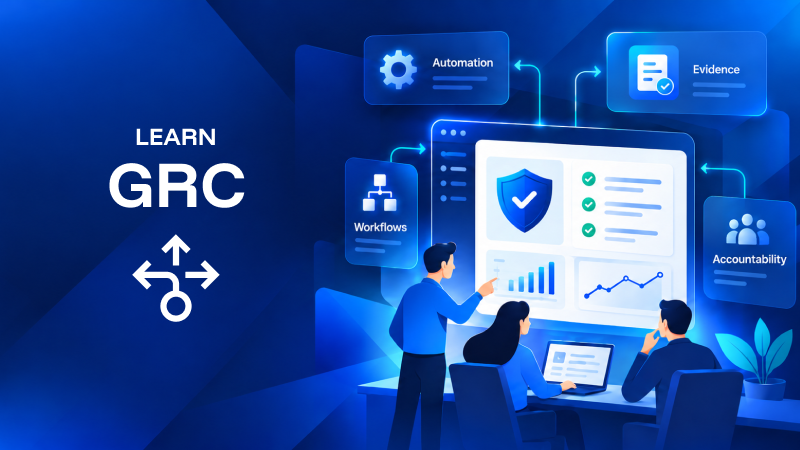
A useful GRC program connects five things: the requirement, the control, the systems it covers, the evidence of how it works and the person who acts when it fails. This article shows how to make those connections with limited time and budget.
What is security governance for a mid-market company?
Security governance is how an organization decides what it must protect, who is responsible and how it checks that its safeguards work. It includes policies and risk reviews, but it also includes daily decisions: removing access after a departure, investigating a failed backup or accepting a temporary exception.
For a lean team, the aim is a routine people can follow. A control owner knows the expected result and evidence source. A risk owner knows when a gap needs a decision. Leadership sees which important services are affected.
The first budget decision is about scope. What must the team do now?
Choose requirements that actually apply
Start with your products, customers, legal entities and locations. Then list the commitments that apply to each. A service company may need a SOC 2 report for a customer contract. Another may choose ISO 27001 certification. A regulated financial institution may have requirements from its supervisor. These are different paths, with different scopes and evidence needs.
Do not pick a framework simply because another company uses it. Equally, do not place an applicable regulatory duty behind a voluntary project because the certification has more marketing value. The team should first establish which obligations are mandatory, which customer promises are already in place and which assurance work it has chosen to pursue.
For SPOG.AI’s focus areas, that may mean ISO 27001, SOC 2, or specific RBI, SAMA or SEBI CSCRF requirements for entities they cover. NCIIPC-related duties concern designated critical information infrastructure or protected systems in India; UAE information assurance requirements depend on the relevant entity and authority. None of these labels applies to every mid-market company. Check the actual scope before mapping a control to it.
A one-page register is enough to begin. Record why each requirement applies, which service it affects, its owner and its next review date.
Reuse a control, but check each obligation
Many requirements ask for related outcomes. An access review may support both an ISO 27001 information security management system and a SOC 2 examination. The team can operate one clear review process and retain one set of source records, then map those records to both requirements where appropriate.
Reuse saves work only when the evidence fits each scope and period. A SOC 2 report may cover a defined service over a particular examination period. An ISO 27001 scope may include different teams or sites. A regulator may ask for a specific approval or reporting step. One access review cannot prove coverage that it never tested.
Build a short control record before making mappings. It should state:
- What the control is meant to achieve
- Which people, assets or services it covers
- Who operates and reviews it
- What evidence comes from the source system
- How failures and approved exceptions are handled
Take MFA as an example. “MFA is enabled” is a starting statement. A better control record names the in-scope accounts, checks which ones are protected, identifies exclusions and records what happens to accounts that fail the test. That one verified control can be reused more safely than several copied policy paragraphs.
Give each gap a real owner
Small GRC teams often become the default owners of work they cannot perform. A coordinator can track an overdue access review, but the application owner knows who still needs access. An identity administrator can remove an account. A business leader may need to accept a short-term risk if the access cannot be removed at once.
Write down these decision rights. For a material gap, identify who investigates it, who fixes it and who may approve an exception. If the named owner leaves, appoint a replacement. A shared inbox or a field marked “security team” is not enough when the deadline arrives.
Suppose a contractor’s privileged account remains active after the contract ends. The GRC lead sees the gap. The contract owner confirms the end date. IT disables the account. The service owner checks whether any dependent work will break. The record closes when someone verifies the access is gone, not when an email says the request was sent.
Get more value from the tools you already pay for
Before buying a GRC platform or hiring another analyst, make a list of your current evidence sources. Identity systems show accounts and authentication settings. Cloud systems show configurations. Endpoint tools show protected devices. Ticketing systems show approved changes and assigned fixes. Backup tools show jobs and recovery tests.
Ask two questions of each source: What does it actually show, and what does it miss? A dashboard reporting 100% endpoint coverage may be using the endpoint tool’s own device list. If the company asset inventory includes devices the endpoint tool has never seen, the dashboard can look clean while protection is incomplete.
Do one manual check on a high-value control to learn the data problem. Compare the asset list with the endpoint list, or the privileged account list with PAM coverage. Keep the mismatches. They tell you whether the next investment should be a better inventory, an integration, an owner or a remediation workflow.
Automate the repeatable work
Compliance automation can reduce the time spent exporting reports, requesting screenshots and reminding people about reviews. It works best when a check has a defined scope and an expected result. For example, a daily comparison can flag new privileged accounts that are outside PAM. A scheduled review can show which critical backup jobs failed.
Automate in this order: define the control, confirm the source data, assign the owner, then set up the test and the response. If you connect a tool before agreeing on scope, it may produce a neat chart for the wrong population.
Some decisions still need people. A failed endpoint check on a test laptop and one on a critical production server should not receive the same response simply because the technical signal is identical. Someone must understand the affected service, other safeguards and the time available to fix the gap.
The result of a useful automated check is an action with evidence, a named owner and a way to verify closure. An alert with no route to a decision only creates more work.
Measure whether controls work across the whole scope
A control can exist and still miss important assets. Consider a company with 100 privileged accounts. Its PAM tool covers 94. Four accounts have approved exceptions with review dates. Two remain outside the tool with no approved reason. The team should see the 94% coverage, the four known exceptions and the two unexplained gaps separately.
The next question is which of those two accounts can reach critical systems. That is the difference between counting compliance tasks and understanding risk. The same approach works for MFA, endpoint protection, patching, logging and backups.
| Control | Simple status | More useful answer |
|---|---|---|
| MFA | Enabled | Which in-scope accounts are protected, and which are not? |
| Endpoint protection | Installed | Which devices in the asset inventory are missing an active agent? |
| Backups | Scheduled | Which critical services have a recent successful restore test? |
| Vulnerability treatment | Tickets open | Which exposed, critical assets still need a fix or decision? |
Set thresholds based on the risk of the service and the quality of your data. Report the number checked as well as the percentage that passed. If the inventory is incomplete, say so. It is better to show a known blind spot than to report a perfect number that nobody can trust.
Spend carefully when buying help or software
A vendor demo should answer a real question from your environment. Give the vendor one control, its expected population and a sample gap. Ask how the product connects to the source, shows missing assets, assigns the issue, records an exception and proves the fix worked.
Compare the full cost over time. Include the license, implementation, integrations, support, extra modules and the hours your team will still spend reviewing results. A low first-year price may be less useful than a tool that fits the workflows your people can sustain.
Use outside specialists for work where expertise changes the outcome, such as confirming the scope of a regulation or reviewing a certification plan. Keep routine control ownership inside the teams that operate the systems. A consultant can design a review, but the application owner still needs to perform it after the project ends.
Free guidance and existing platform features can help the team get started. Templates are useful as prompts, but policies should describe what your organization actually does. A copied procedure can add work if staff cannot follow it.
Show leadership what the budget achieved
Do not rely on generic claims that automation saves a fixed percentage of audit time. Measure your own baseline. How long did the last access review take? How many auditor questions needed manual evidence gathering? How long did a material control failure remain unassigned?
After changing the process, compare the same measures. Also track overdue actions affecting critical services, exceptions past their review date and controls whose evidence has stopped arriving. This makes the spending case more credible than a count of policies completed or dashboard tiles created.
Start small. One useful management view may show five priority controls, their coverage, their open gaps and the next decision. Add controls when the team can keep the first set current.
How SPOG.AI can help a lean GRC team
SPOG.AI’s governance and risk capabilities connect requirements, controls, owners, evidence and remediation across existing systems. Its continuous control monitoring approach helps show whether a defined control covers the intended environment and where its state has changed.
For a mid-market team, that connection matters when a control fails. Instead of passing a spreadsheet between security, IT and the risk owner, the team can relate the finding to the affected asset and service, record the decision and check the result after a fix. The organization still chooses its requirements, owners and acceptable risk.