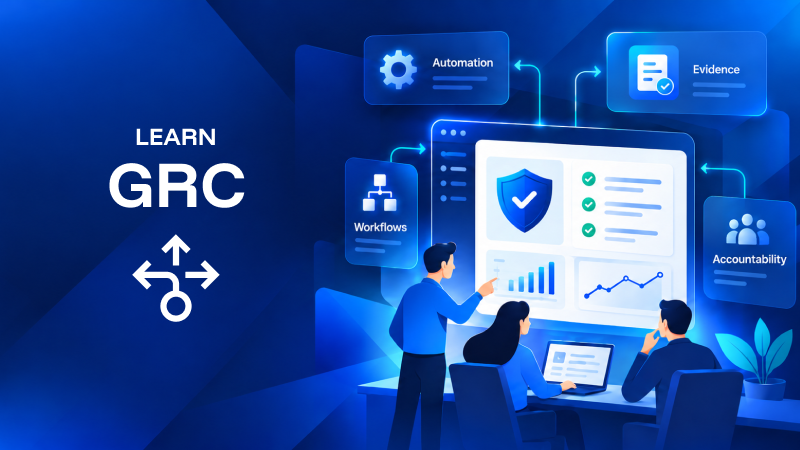
A small governance, risk, and compliance (GRC) team can support a growing business, but it cannot be the owner, evidence collector, reviewer, and decision maker for every control. As systems change and audit requests multiply, the team needs a way to see what is happening, involve the right people, and focus its limited time on material risk.
The starting point is a simple operating model: assign decisions to the people with authority, connect routine evidence to the controls it supports, and escalate gaps based on their effect on the business. Compliance automation helps when it supports that model. It cannot replace clear ownership.
Make risk ownership explicit
A GRC lead might spot that a critical application’s access review is overdue. That person can document the gap, explain the potential impact, and recommend a response. The application owner can confirm the access that is still needed. A business or risk leader may need to approve an exception or decide whether the remaining risk is acceptable.
Those are different responsibilities. If they all land with the GRC lead, decisions stall and the evidence trail becomes dependent on one person. Define an owner for each control, an accountable decision maker for each exception, and a deadline for each action. Record the reason for decisions as well as their status, so another team member can understand what happened later.
For a lean team, this also makes handoffs more useful. An IT owner should receive a specific request, the affected system, the relevant control, the evidence of the gap, and the date by which a response is needed. That is easier to act on than a generic reminder to “fix compliance.”
Use automation where the process is repeatable
Audit evidence often exists already in identity, cloud, security, and IT systems. The manual work lies in finding it, checking its freshness, linking it to a requirement, and asking someone to confirm an exception.
Start by identifying recurring tasks with a clear trigger and outcome. Examples include collecting evidence for an access review, flagging a failed configuration check, notifying a control owner when evidence expires, and tracking whether an assigned action was completed. Document what qualifies as valid evidence and who reviews exceptions before automating the workflow.
Some judgments still require a person. A failed check may affect a test environment, a critical customer service, or both. The team must understand the asset, its business role, and any compensating control before deciding how urgently to respond. The goal of compliance automation is to surface that context and reduce repetitive follow-up, so people can spend more time on decisions that matter.
Keep an evidence trail that survives handoffs
When evidence lives in one person’s inbox or spreadsheet, audit readiness depends on that person’s availability. A more durable record connects each requirement to its control, the system that supplies evidence, the control owner, recent results, exceptions, and actions taken.
This is especially valuable when one control supports several requirements. The team can reuse the same verified evidence where appropriate while retaining a clear link to each obligation. When an auditor or customer asks how a control performed over time, the answer should include changes and exceptions, not only a document collected at the last audit.
This is where continuous compliance and continuous control monitoring can help. Current operational evidence gives a small team a better chance of finding a control gap between scheduled reviews and directing attention to the systems it affects.
Extend the same ownership model to AI use
AI tools introduce new questions for a GRC program: which tools are in use, what information people enter into them, and whether they are part of an internal workflow or a customer-facing service. A lean team needs a practical way to identify uses that call for review.
Ask employees or system owners to register the tool, its purpose, the data it will process, and the person responsible for it. Use the answers to determine which uses need a deeper security, privacy, or legal assessment. For example, summarizing approved public material and connecting an AI service to sensitive customer data should not follow the same review path.
Keep the process proportionate. Clear guidance on permitted data and a route for escalation can help people seek advice early. Where AI use changes an existing system or control, update the owner and evidence record rather than leaving the decision in a separate, disconnected list.
Prioritize the gaps that change business risk
A small GRC team cannot treat every overdue item as equally urgent. A useful review asks: Which service is affected? Is the control absent, failing, or simply missing recent evidence? Is the asset exposed? Are other controls reducing the risk? Who can make the decision, and what action is due next?
That approach also helps leadership make informed trade-offs. Instead of a long list of open tasks, leaders can see which gaps affect important services, which exceptions they have accepted, and where an owner has not yet acted.
SPOG.AI connects requirements, controls, operational evidence, ownership, and business context across existing systems. Its continuous compliance capabilities help teams see control coverage and exceptions, reuse relevant evidence, and direct follow-up to accountable owners. For a lean GRC team, the practical benefit is a shared view of what needs attention and why.
A scalable program does not require one person to remember every deadline or resolve every risk. It needs reliable evidence, clear decision rights, and a routine for acting on the gaps that matter most.