Continuous Control Monitoring
Why Passing an Audit Does Not Prove Ongoing Compliance
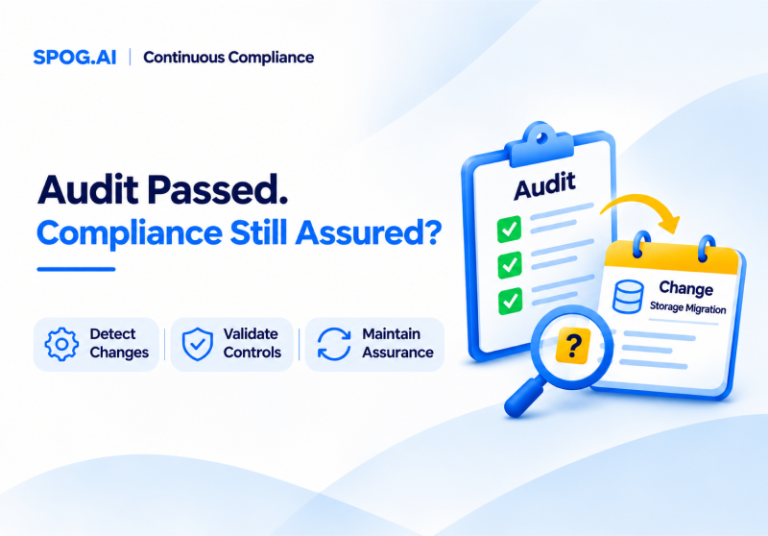
An audit can confirm that security controls met assessed requirements during a defined period. But system changes can...


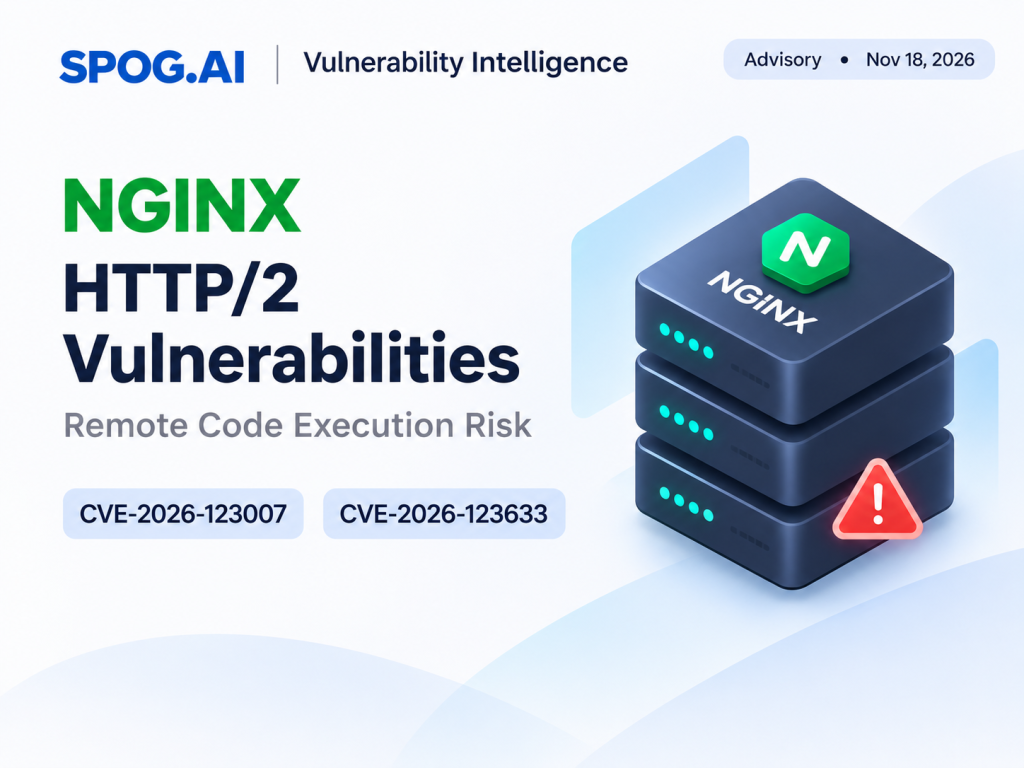
CVE-2026-123007 involves an integer overflow that can lead to memory corruption, while CVE-2026-123633 involves a use-after-free condition during HTTP/2 connection handling. Both affect a widely deployed technology used to deliver websites, APIs and enterprise applications.
Although NGINX has released security updates, deploying them across enterprise environments takes time. During this period, organizations need to identify affected installations and determine whether their existing security controls can provide protection.
Primary CVE: CVE-2026-123007
Related CVE: CVE-2026-123633
| Attribute | Details |
|---|---|
| Product | NGINX Open Source / NGINX Plus |
| Vendor | F5 / NGINX |
| Asset Classes | Server, Virtual Machine, Container; Network / Security Appliance where embedded |
| Technology Categories | Web Server, Reverse Proxy, API Gateway, Ingress Controller |
| Impact | Potential Remote Code Execution, Service Disruption |
| Vulnerability Type | HTTP/2 Memory Corruption |
| CWE | Integer Overflow / Wraparound for primary CVE |
| CVSS | 9.2 – Critical |
| EPSS | Not yet available |
| CISA KEV | Not listed |
| Attack Vector | Network |
| Authentication | Not required |
| User Interaction | None |
| Exploitation Prerequisite | Affected NGINX version with HTTP/2 enabled and reachable |
| Exploit Availability | Current public exploit status to be verified |
| Exploitation in the Wild | No confirmed status established for this article |
| Affected Versions | Refer to the applicable NGINX security advisory |
| Patch Available | Yes |
| Vendor Workaround | Disable HTTP/2 |
| Compensating Controls | CDN protocol termination and origin access restrictions (conditional) |
| Mitigation Validation | Configuration, protocol and reachability checks |
| Published | November 18, 2026 |
| Last Reviewed | November 19, 2026 |
NGINX is widely deployed as a web server, reverse proxy and application traffic gateway. Its HTTP/2 implementation manages how clients and servers exchange data, and the newly disclosed vulnerabilities affect how certain protocol operations are processed.
CVE-2026-123007 arises from an integer overflow in HTTP/2 flow-control processing that can lead to memory corruption. Meanwhile, CVE-2026-123633 involves a use-after-free condition during HTTP/2 connection handling in reverse-proxy operations.
If successfully exploited, these weaknesses could allow remote code execution with the privileges of the NGINX worker process. Depending on the deployment, an attacker could potentially compromise hosted applications, disrupt services or access information available to the affected process.
The vulnerabilities are relevant to affected NGINX installations running on physical servers, virtual machines, containers or appliances where the vulnerable software is embedded. However, exploitation requires access to the affected HTTP/2 processing path, while CVE-2026-123633 also has specific reverse-proxy prerequisites.
As a result, organizations should assess both the installed software version and the relevant configuration when determining which systems require immediate attention.
Organizations may already have security controls that protect against these NGINX vulnerabilities or limit the consequences of successful exploitation. However, it is important to distinguish between controls that prevent exploitation and those that reduce its impact.
For these vulnerabilities, disabling HTTP/2 on affected NGINX listeners is the most direct temporary mitigation. Alternatively, a CDN or reverse proxy that terminates HTTP/2 and communicates with NGINX exclusively over HTTP/1.1 can prevent the vulnerable processing path from being reached, provided direct access to the origin is restricted.
Existing NGINX and operating-system hardening controls can provide additional protection by limiting what an attacker could do following a successful compromise.
| Security Control | Effectiveness | Protection Offered |
|---|---|---|
| Disable HTTP/2 on NGINX | Prevents exploitation | Removes the vulnerable HTTP/2 processing path, preventing exploitation of both CVEs through affected listeners. |
| CDN / Reverse Proxy | Prevents exploitation (conditional) | Terminates HTTP/2 and forwards HTTP/1.1 to NGINX, preventing malicious HTTP/2 frames from reaching the origin through that path. |
| Origin Firewall / Access Control | Supporting protection | Prevents attackers from bypassing the CDN or reverse proxy to reach an HTTP/2-enabled origin directly. |
| Run NGINX Workers as Non-Root | Limits impact | Restricts the privileges available to an attacker following successful code execution. |
| Restrict Filesystem Permissions | Limits impact | Reduces access to sensitive files, application data and configurations. |
| SELinux / AppArmor Confinement | Limits impact | Restricts the actions a compromised NGINX process can perform, depending on the enforced security policy. |
| Restrict Outbound Network Access | Limits impact | Can constrain attacker communication, lateral movement and data exfiltration. |
Disabling HTTP/2 across all affected NGINX listeners prevents exploitation of these two HTTP/2 vulnerabilities through the vulnerable protocol implementation, even before the software is patched. However, it does not remove the underlying flaws, so upgrading to a fixed release remains necessary.
Similarly, CIS-aligned hardening measures such as non-root execution, restricted filesystem permissions and operating-system confinement can limit the damage following a compromise, but they do not independently prevent exploitation.
The practical distinction is straightforward: protocol-level controls can prevent exploitation, while system hardening can limit its consequences. Both contribute to protection during the remediation window.
NGINX has released fixes for the affected versions, making upgrading to the applicable security release the recommended remediation.
| Product | Fixed Version |
|---|---|
| NGINX Open Source — Stable | 1.30.7 |
| NGINX Open Source — Mainline | 1.31.9 |
| NGINX Plus | Applicable vendor-fixed release |
Organizations using distribution-packaged versions should also check for vendor-backported security fixes, as the displayed software version may not fully reflect the installed security patches.
Where immediate patching is not possible, disabling HTTP/2 on vulnerable listeners provides a temporary mitigation for the two vulnerabilities.
For NGINX versions supporting the standalone HTTP/2 directive:
server {
    listen 443 ssl;
    http2 off;

    server_name example.com;
}
For older configurations, the http2 parameter can be removed from the listen directive. Alternatively, organizations using a CDN may enforce HTTP/1.1 communication between the CDN and NGINX while restricting direct origin access. This can preserve HTTP/2 support for website visitors, provided that all relevant origin paths are protected.
Before implementing either approach, application dependencies should be assessed. For example, services using gRPC may require HTTP/2 and could therefore need a different mitigation strategy.
Although these measures can reduce exposure during the remediation window, they address only the two HTTP/2 vulnerabilities discussed here. Applying the vendor security update remains necessary to permanently resolve the underlying weaknesses.
Implementing a configuration change does not necessarily establish that the vulnerable attack path has been removed. Consequently, security teams should validate both the effective NGINX configuration and the network paths through which the affected service can be accessed.
First, inspect the installed version and effective configuration:
nginx -v
nginx -T
Next, where direct origin testing is authorized, verify the protocol negotiated with NGINX:
curl -k --http2 -I \
  --resolve example.com:443:ORIGIN_IP \
  https://example.com/
If HTTP/2 has been disabled, the origin should negotiate HTTP/1.1. However, this confirms only the tested connection, so other relevant listeners, hostnames and network routes must also be assessed.
The following evidence can help establish whether the mitigation is operating as intended:
| Validation Requirement | Expected Evidence |
|---|---|
| Affected assets identified | Asset inventory, product and version |
| HTTP/2 exposure assessed | Configuration and reachability |
| CDN protection validated | Edge-to-origin protocol configuration |
| Origin access restricted | Firewall policy and connectivity tests |
| Temporary mitigation implemented | Approved change and post-change validation |
| Permanent remediation completed | Fixed build or vendor backport |
Together, these checks help organizations distinguish systems that remain vulnerable and reachable from those protected by validated controls or permanently remediated.
SPOG.AI connects vulnerability intelligence with asset context, security configurations, control validation and remediation. This helps organizations understand newly disclosed vulnerabilities, determine whether existing defenses provide protection and verify that remediation has been effective.
Know the vulnerability. Understand the protection. Validate the outcome.
Assessment date: November 19, 2026. Dynamic intelligence fields, affected versions and fixed-release information require verification against authoritative sources before publication.
An audit can confirm that security controls met assessed requirements during a defined period. But system changes can...
Seven critical PHP vulnerabilities pose risks of remote code execution and service disruption. While patching is essential, which...
An approved policy can coexist with an unprotected business-critical system. The governance failure begins when leadership treats approval,...