Continuous Control Monitoring
Why Passing an Audit Does Not Prove Ongoing Compliance
An audit can confirm that security controls met assessed requirements during a defined period. But system changes can...


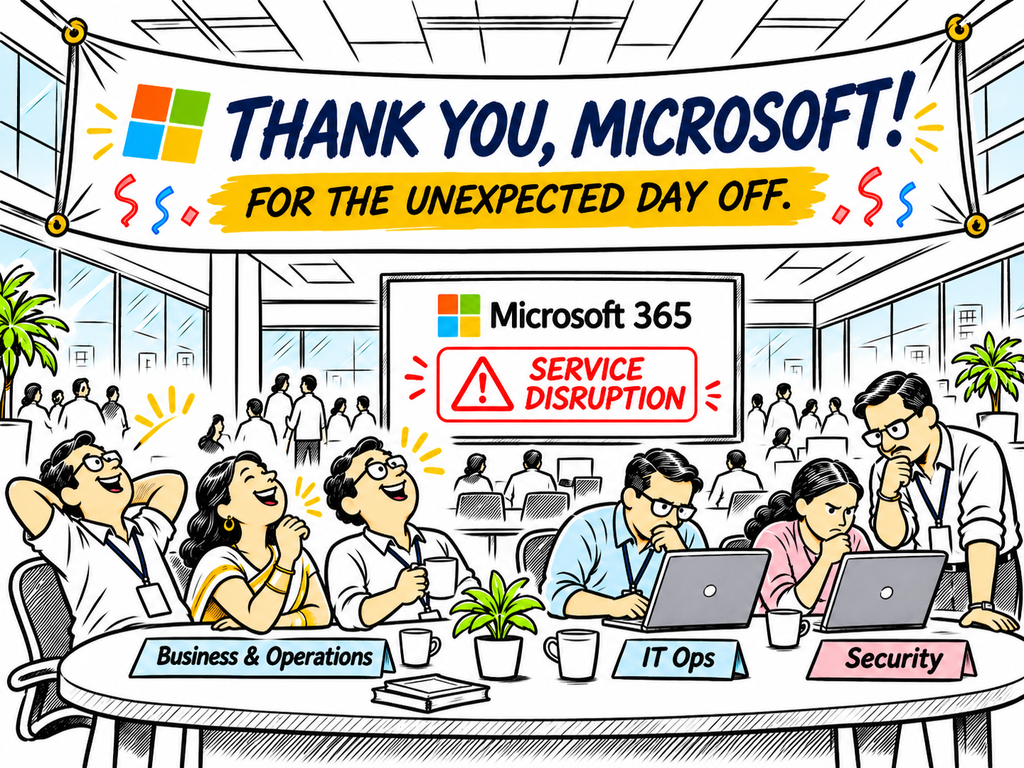
On November 12–13, 2026, Microsoft 365 experienced a significant service disruption, affecting a platform widely used by enterprises for communication and collaboration. Beyond service availability, the outage exposed a more fundamental question:
How well do organizations understand their dependencies on critical technology providers?
Consider an organization facing a critical application failure during the outage. The IT team identifies the issue and raises an emergency change request to restore service. However, the application owner’s approval notification depends on Microsoft 365 email. With email unavailable, the change remains pending even though the application infrastructure, ITSM platform and technical solution are all available.
The application itself does not depend on Microsoft 365. But the process required to restore it does. This distinction is central to understanding the enterprise risk exposed by the outage.
Microsoft’s preliminary investigation found that several servers had unexpectedly become unavailable after failing automated health checks, placing additional pressure on the remaining infrastructure. Bringing these servers back online proved challenging, as they became unresponsive again under production traffic. Investigators subsequently identified an overwhelmed process responsible for establishing secure connections.
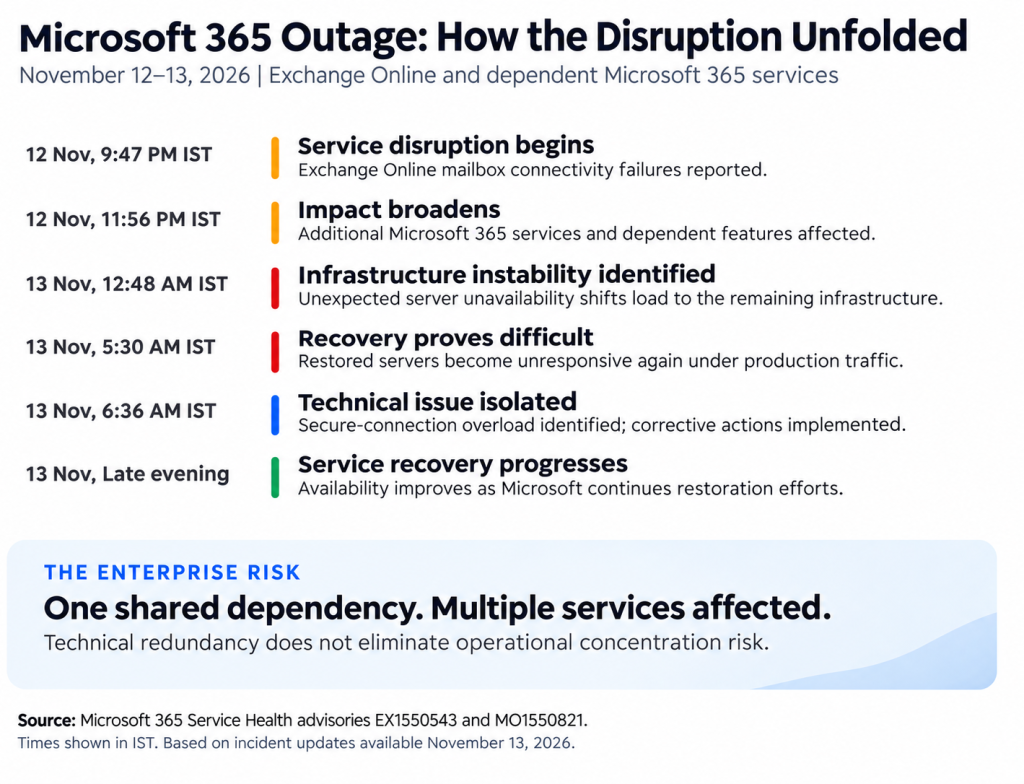
Since creating new secure connections requires significantly more processing than reusing existing ones, recovery remained difficult and required traffic redistribution, selective throttling, alternative health checks and phased restoration of affected infrastructure.
The disruption affected Exchange Online and other Microsoft 365 services, with varying levels of impact. Microsoft had yet to establish a definitive root cause and committed to publishing a detailed post-incident report.
As organizations assess the disruption, attention naturally turns to Microsoft’s contractual obligations and the service credits available under its SLAs. These provisions establish a mechanism for holding the provider accountable, but how much of the actual business impact can they compensate for?
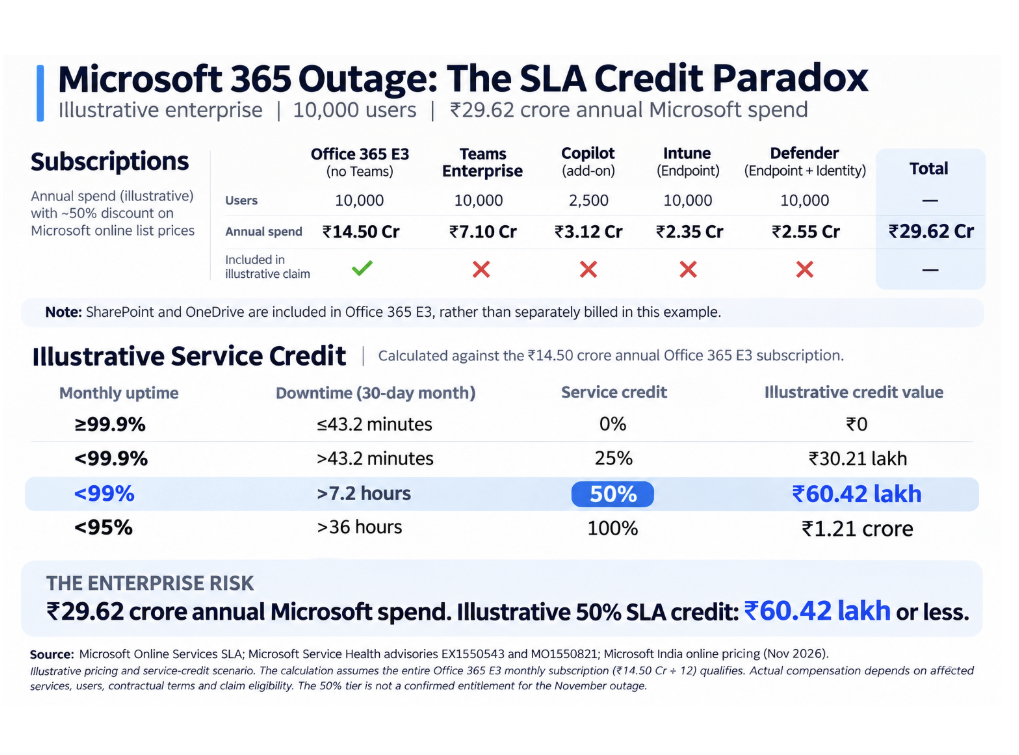
Service credits may address contractual accountability, but they neither compensate for the full business impact nor demonstrate that the enterprise adequately understood its exposure. The more important question is not what Microsoft owes us, but whether we understood the consequences of depending on it.
Organizations invest significantly in risk assessment and assurance. Yet even when individual assessments are satisfactory, dependencies spanning technology, operational processes and third-party services can remain unidentified.
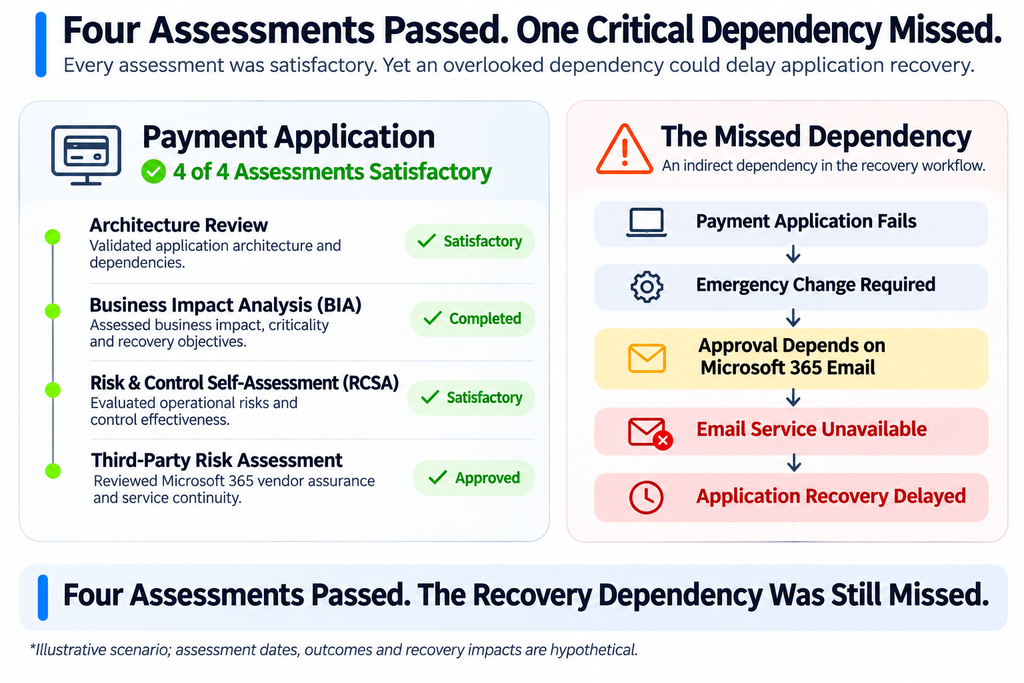
The challenge is compounded by timing. Technology environments, integrations and operational workflows change continuously, while assessments are often conducted periodically. A satisfactory assessment six months ago may no longer reflect today’s exposure.
But the problem goes beyond assessment frequency. Were these dependencies never identified, identified but inadequately mitigated, or consciously accepted without fully understanding their business impact?
Each points to a different weakness in how risk is managed.
Risk does not wait for the next assessment cycle. Neither should the validation of controls intended to manage it.
Disaster recovery drills have long been a cornerstone of operational resilience. But does successfully recovering an application demonstrate that an organization can continue operating during a wider disruption?
Traditional DR exercises typically validate whether critical applications can recover within defined Recovery Time Objectives (RTOs). Yet they may assume that supporting services such as email, identity systems, approval workflows and communication channels remain available.
This raises important questions:
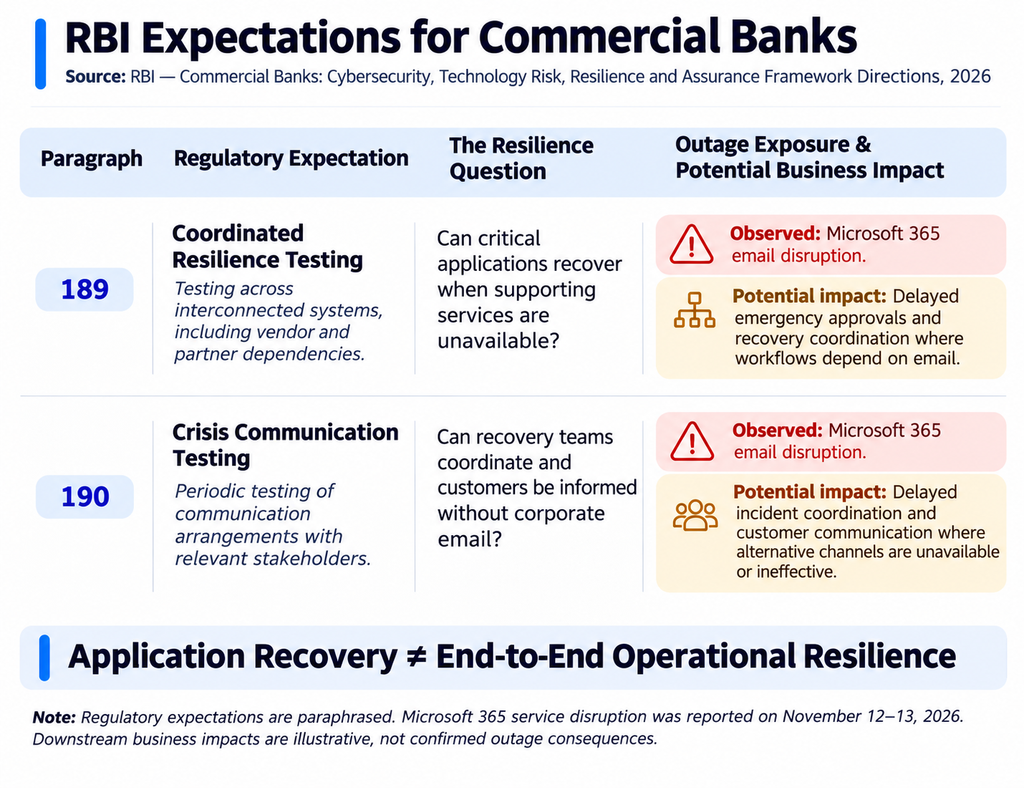
But recovery is only part of the challenge. Organizations must also continue responding, coordinating and communicating while critical services remain unavailable.
The Microsoft 365 disruption highlighted another dimension of resilience: crisis communication. Some organizations may have struggled to reach customers through alternative channels, while others may have taken more than 24 hours to communicate the impact. Such delays, where they occurred, raise questions about how effectively crisis communication arrangements were prepared, tested and activated.
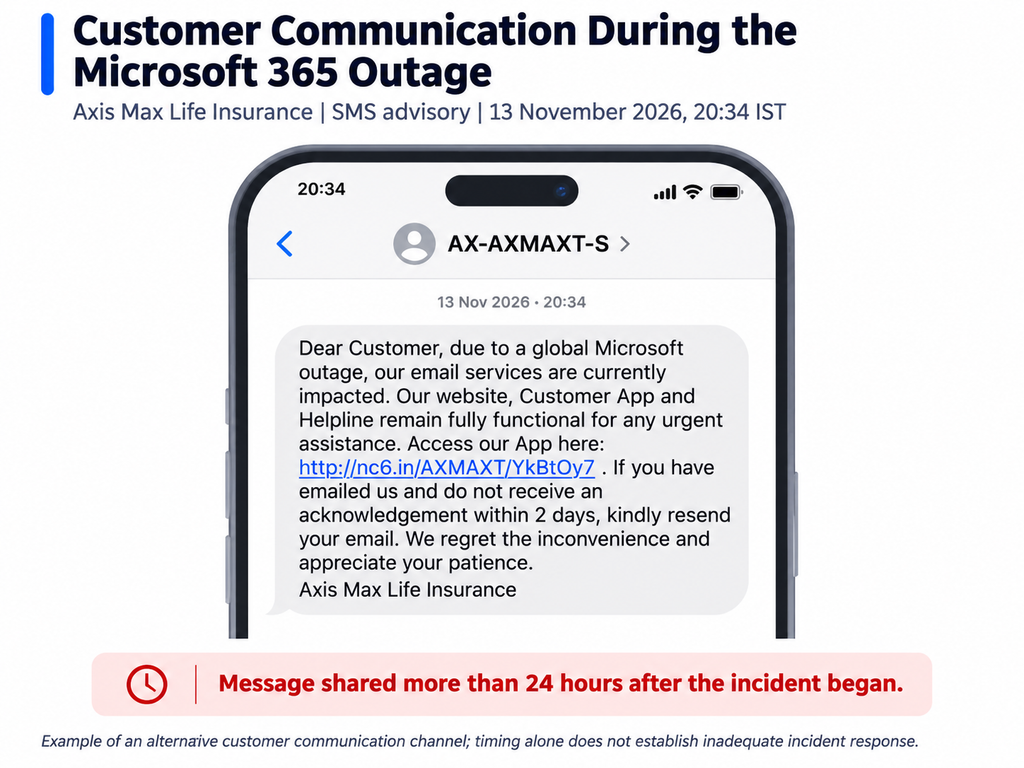
Ultimately, resilience depends not only on restoring technology but also on sustaining critical business operations during a disruption. This raises another question: what do our assessments of the third parties supporting those operations actually establish?
Consider how a financial institution might assess Microsoft 365. Its certifications, assurance reports, business continuity arrangements and contractual SLAs may all be found satisfactory.
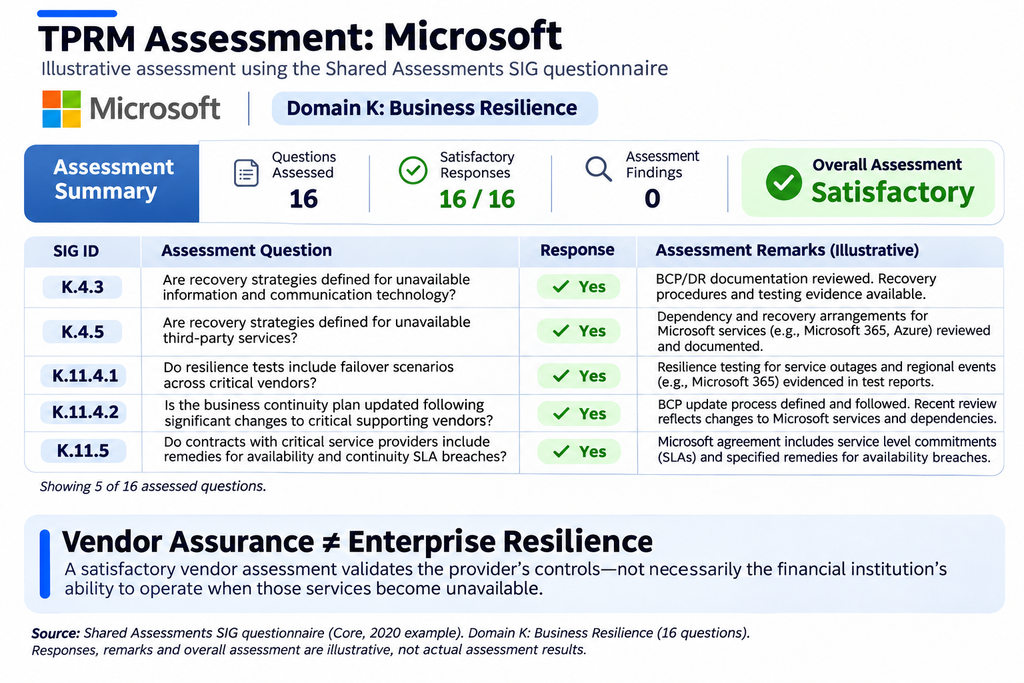
A satisfactory third-party assessment may establish confidence in a provider’s controls, but not necessarily the enterprise’s ability to withstand a prolonged service disruption. The answer requires looking beyond the assurance provided by certifications and audit reports to consider real-time service availability, outage duration and the impact on dependent business processes.
How many organizations actually use their critical service providers’ live status dashboards as a data source for continuous third-party risk assessment?
Even when an enterprise identifies increasing exposure to a critical provider, how realistic is finding an alternative?
Consider an enterprise relying on Microsoft for email, identity, collaboration, endpoint management and security controls. Switching to Google Workspace or Zoho is not simply a change of email provider. Deep integration across business processes makes replacement complex, expensive and potentially disruptive.
This is the Cloud Resilience Paradox: consolidation reduces operational complexity but can simultaneously increase concentration risk.
Diversification is not necessarily the answer either. Multiple vendors may still share the same cloud infrastructure, identity provider or other critical dependencies.
The real challenge is identifying shared failure points and determining where independence is essential. For example, centralized identity management may be efficient, but emergency administration should remain independently accessible. Similarly, critical communication and approval workflows should function even when the primary collaboration platform is unavailable.
The objective is to consolidate visibility and risk intelligence without necessarily consolidating every critical technology onto one provider.
Resilience is not about maximizing consolidation or diversification. It is about maintaining operational efficiency while ensuring that critical business functions can withstand the failure of shared dependencies.
The Microsoft 365 outage exposed a fundamental limitation of traditional risk management: assessments capture risk at a point in time, while operational exposure changes continuously.
Understanding enterprise risk requires connecting business services, applications, technology assets, third-party dependencies and control effectiveness—not assessing each in isolation. The same principle should extend to third-party assurance. Vendor assessments should go beyond periodic certifications, SOC reports, trust centers and external attack surface monitoring.
Imagine a live vendor assurance dashboard combining real-time service availability, outage history, maintenance activity and independently validated control evidence, continuously updating the enterprise’s view of third-party risk. When a critical provider experiences an outage, this intelligence should identify affected business processes, evaluate alternative arrangements and automatically reassess operational risk exposure.
The shift is from periodically reviewing evidence of vendor controls to continuously understanding their effectiveness and impact on the enterprise.
Ultimately, operational resilience is not measured by the number of assessments completed, but by the enterprise’s ability to continue operating when critical dependencies fail.
.
Editorial note: The critical business application scenario and associated assessment outcomes are illustrative and do not represent a confirmed consequence of the Microsoft 365 outage. Actual approval workflows, escalation mechanisms and recovery procedures vary across organizations. Even where alternative mechanisms exist, unfamiliarity, limited testing or operational dependencies can introduce friction and delay response times. Some workflows may also depend on email-based authentication, including one-time passwords (OTPs), creating additional dependencies.
The Axis Max Life advisory is referenced solely as an example of alternative customer communication, not as evidence of inadequate incident response. The SIG questionnaire responses and assessment results shown in the infographic are hypothetical and do not represent Microsoft’s actual responses or assurance outcomes. Potential downstream business impacts discussed in the article should not be interpreted as confirmed consequences of the outage.
An audit can confirm that security controls met assessed requirements during a defined period. But system changes can...
Seven critical PHP vulnerabilities pose risks of remote code execution and service disruption. While patching is essential, which...
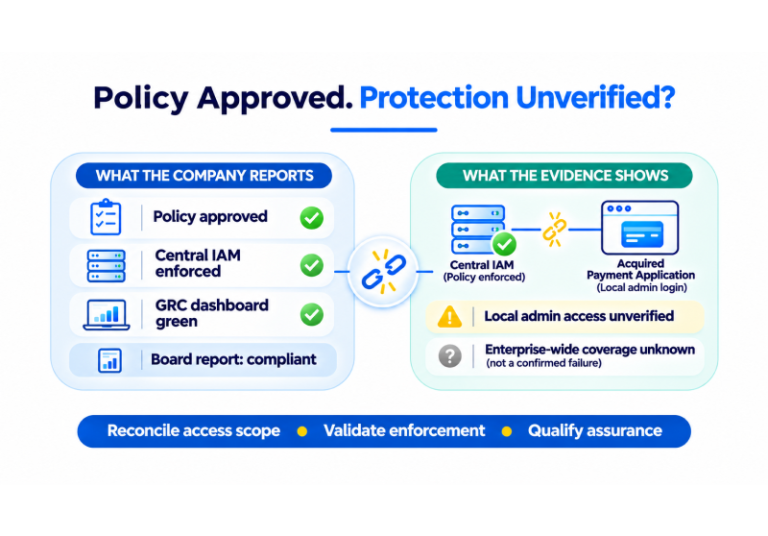
An approved policy can coexist with an unprotected business-critical system. The governance failure begins when leadership treats approval,...