Continuous Control Monitoring
Vendor Cybersecurity Questions That Test Scope, Evidence and Exposure
A vendor cybersecurity inquiry should establish what the supplier will do, which data and systems it can access,...
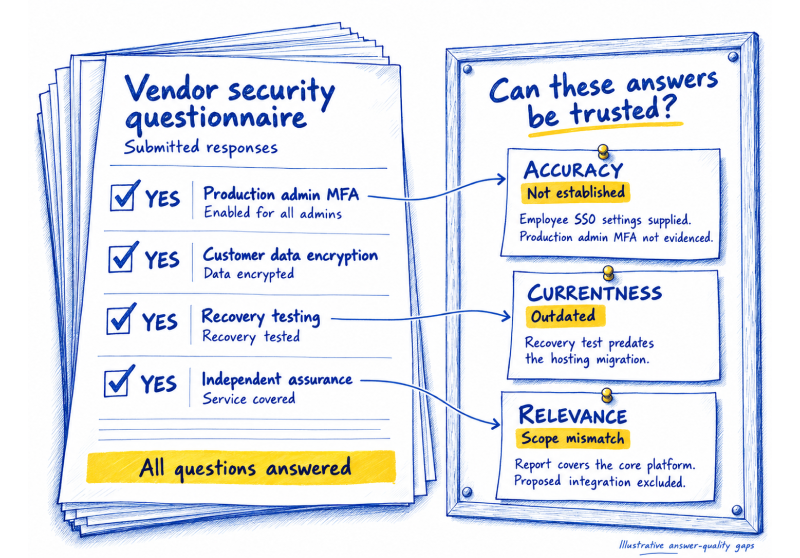
The same questionnaire serves two roles. The buyer uses responses as one input to supplier due diligence; the responding organization uses them to explain how its controls operate in a particular product and deployment. A completed form is neither an audit nor proof that every risk has been assessed.
That distinction matters when a sales deadline is short. Fast answers help only when they remain true, current and clear about boundaries. An overbroad “yes” can create a false assurance; a precise answer lets the buyer decide whether the remaining gap is acceptable.
A security questionnaire is a structured request for information about an organization’s security practices, policies, technical controls and data handling. Buyers send one to understand how a supplier will protect the systems and information involved in a proposed relationship. Suppliers may receive them during procurement, renewal or a material change in use.
Common topics include identity and privileged access, encryption, vulnerability handling, incident response, business continuity, data retention, subcontractors, secure development and control governance. The exact sections depend on the product, the buyer’s obligations and the information or access at stake. A cloud provider may receive a standard template such as the Cloud Security Alliance’s Consensus Assessments Initiative Questionnaire (CAIQ v4.1), released in January 2026. A template organizes questions, but it does not itself verify the answers.
For buyers, responses surface issues that deserve follow-up before onboarding. They can clarify whether a supplier’s controls cover a specific system, data flow or business dependency. They are useful inputs to due diligence, but should be considered alongside contracts, independent assurance, technical evidence and the buyer’s own risk criteria.
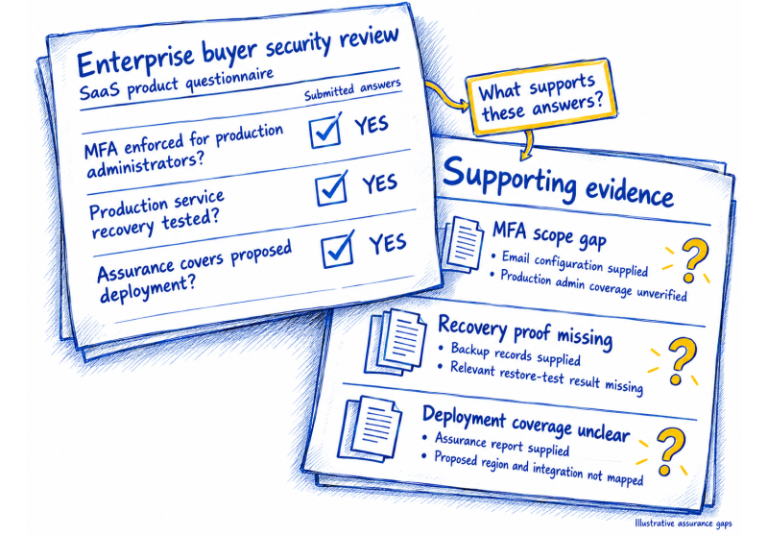
For suppliers, each answer represents the organization to a customer. The response should describe actual control operation, not planned work or policy language alone. If a control is partial, recently changed or not in scope, say so. Explain the boundary and next action instead of using a confident answer that the evidence cannot support.
A reliable response process separates interpretation from evidence. Before selecting yes, no or not applicable, translate the prompt into a concrete claim and identify what would demonstrate it. This reduces both ambiguity and unnecessary escalation.
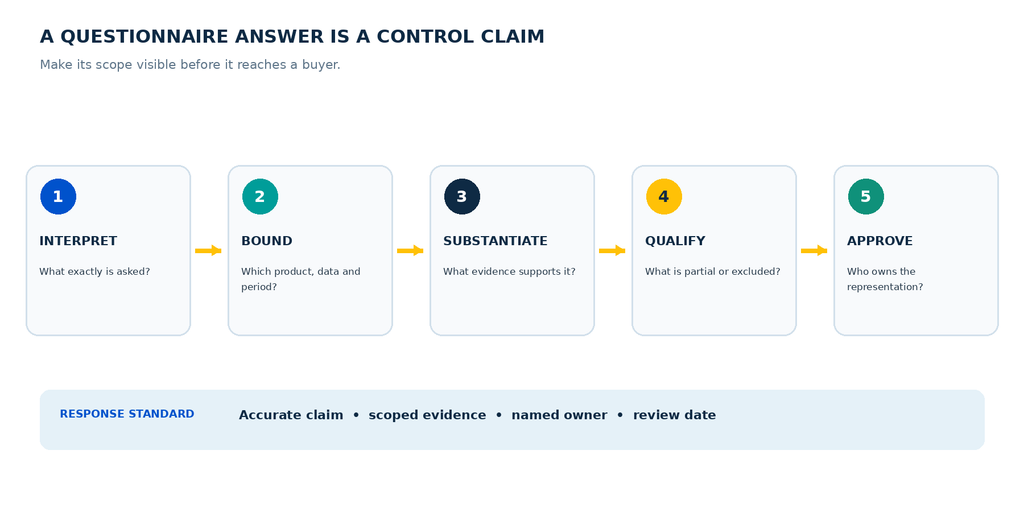
Identify the control the buyer wants to understand. “Do you use encryption?” may refer to customer data in transit, stored data, backups, logs or administrative channels. If the prompt combines distinct requirements, answer each separately or ask the buyer to clarify. Avoid answering only the narrowest interpretation without disclosing it.
Name the product, environment, data types, regions, users or process covered by the answer. Separate production from corporate IT where the controls differ. Identify exclusions, inherited cloud controls and customer responsibilities. A boundary turns a general statement into a claim someone can verify.
Choose evidence that matches the question and boundary: a current policy excerpt, architecture description, control test, scoped assurance report or recovery exercise. Check the document’s date, scope, owner and exceptions. A certificate or report can support an answer, but its title page cannot establish that every system or control relevant to the buyer sits within scope.
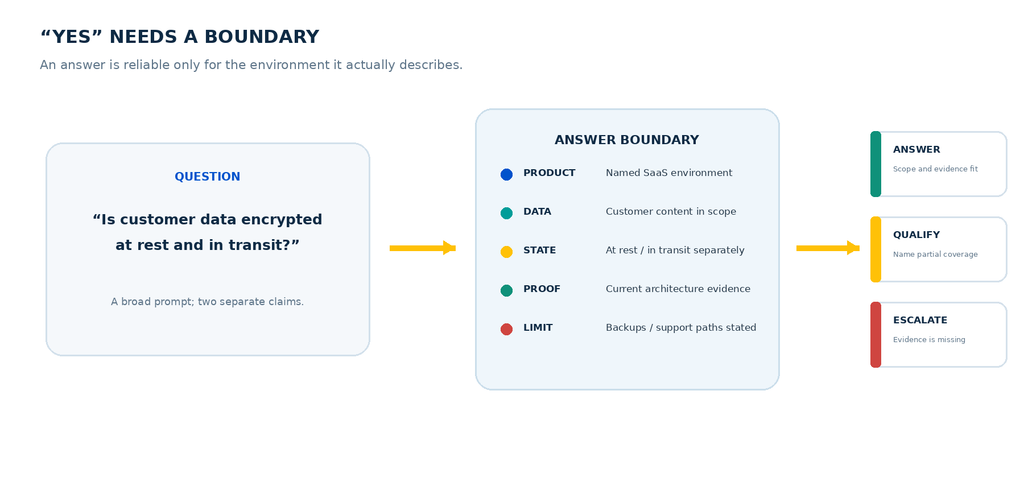
Use “partial” when implementation varies by system, customer configuration or data path. For a genuine gap, state what is missing, its impact, any compensating safeguard, the owner and the expected review or remediation date. Do not present work in progress as an operating control. If evidence cannot be shared, offer an appropriate alternative such as a redacted extract or controlled review, and record what remains unverified.
Efficiency comes from reducing avoidable interpretation and rework. Maintain an approved set of recurring claims with an owner, evidence link, scope, last-reviewed date and review trigger. Reuse a response only when the new question asks the same thing and the product or deployment remains within the stated boundary. Similar wording does not always mean equivalent scope.
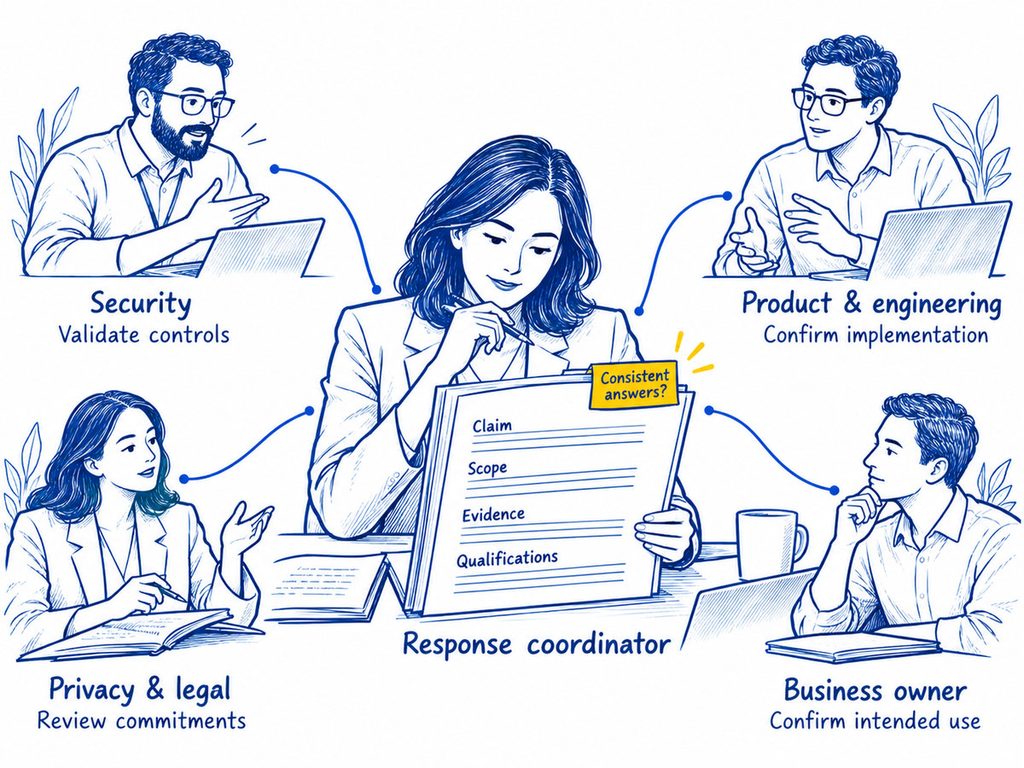
Route questions by decision authority. Security can validate technical controls; privacy and legal can review data use and contractual commitments; product or engineering can confirm implementation; the business owner can confirm the proposed solution configuration and use. One coordinator should own the final package so that sections do not contradict each other.
Reserve time for a final consistency review. Compare related answers about encryption, data retention, subcontractors and incident notification. Confirm that named certifications remain current, shared evidence is approved for disclosure and any dates or quantitative claims use the same reporting period. A short clarification to the buyer is often more efficient than guessing and correcting the record later.
A recognized template can make review more consistent. The CSA’s CAIQ is aligned to its Cloud Controls Matrix and gives cloud customers a structured way to ask about controls. CAIQ v4.1 is the current released edition described by CSA. Buyers may still add questions about their own data flows, integrations or contractual expectations, so a framework response should not replace product-specific explanation.
Current National Institute of Standards and Technology (NIST SP 1326) supplier due-diligence guidance also helps clarify why a questionnaire is only one piece of evidence. Published in July 2026, it covers ICT supplier assessment factors including provenance, resilience, foundational cybersecurity practices, foreign ownership or influence and supply-chain tiers. It provides considerations for due diligence, not a universal legal checklist or a guarantee of supplier security.
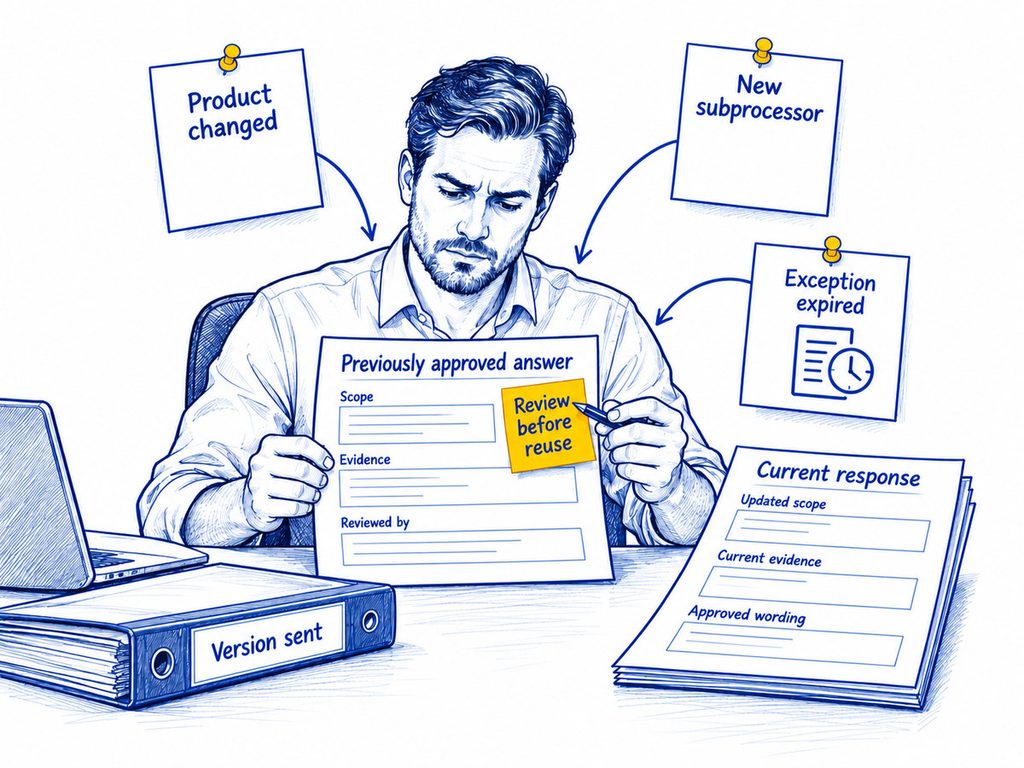
An answer can become stale when a product changes, a control owner changes, a new subprocessor enters the data path or an exception expires. Review material claims when these events occur, and set a reasonable periodic review for answers that support active customer commitments. Preserve the version sent, approver and evidence used so the organization can explain what it represented at the time.
SPOG’s governance, risk and compliance (GRC) solution connects requirements, controls, evidence and ownership. Its Continuous Control Monitoring solution supports assessment of defined controls using operational evidence. These capabilities can support internal oversight of control state; they do not generate or validate customer questionnaire responses. For workflow automation, see SPOG’s separate article on automating security questionnaires. This article focuses on the accuracy and scope of answers, not automation design.
A strong security questionnaire response is concise, scoped and supported. It tells the buyer what is true for the relevant product, where the control applies, what evidence supports the claim and what remains outside it. Set an owner for each representation, update it when the underlying control changes and make unresolved gaps visible. This gives the buyer a usable basis for a decision and protects the responding team from treating a form as a substitute for control reality.


A vendor cybersecurity inquiry should establish what the supplier will do, which data and systems it can access,...

A vendor management policy sets the rules for approving suppliers, accepting exceptions and responding when relationships change. This...
Enterprise buyers expect SaaS startups to demonstrate how they protect customer data, identities, and business operations not just...