Continuous Control Monitoring
Security Questionnaires: Respond with Accurate, Verifiable Answers
Security questionnaires help buyers understand how a supplier protects the data, systems and services involved in a proposed...
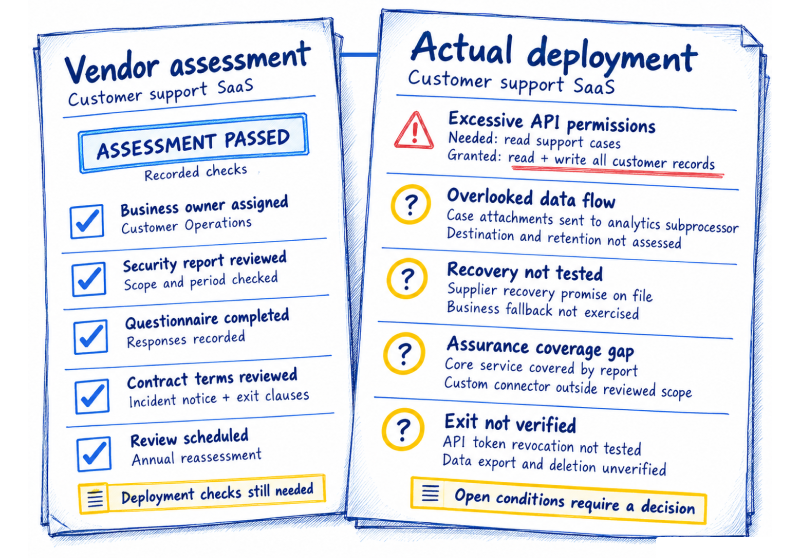
A supplier may pass onboarding while the organization remains exposed through excessive integration permissions, an untested recovery arrangement or data processing outside the assessed scope. Security reports and questionnaires provide useful evidence, but their value depends on whether they cover the service, environment and safeguards your organization actually relies on.
GRC and security teams therefore need a coordinated process with business owners, Procurement, Legal, Privacy and IT. Each relationship should have a documented decision, an authorized route for accepting residual risk and clear triggers for reassessment. Oversight must continue as access, data use and dependencies evolve, with evidence that agreed safeguards work and exit arrangements are usable.
Vendor risk management (VRM) governs risks created by suppliers of goods, software or contracted work. It covers the relationship: the supplier’s role, access, data, process dependencies and exit conditions.
Third-party risk management (TPRM) can include partners and contractors beyond direct suppliers. Supply chain risk management (SCRM) examines products, logistics and upstream dependencies. Define boundaries in policy because usage varies.
Applications, identity integrations, cloud hosts, contractors and manufacturers create different exposure. Consider cyber, privacy, resilience, legal, concentration, continuity and reputation. Scope scrutiny to the relationship’s role.
Ask what business outcome the relationship supports, what data or systems it can reach, which providers it depends on and how the business would respond to unavailability or compromise.
The answers define the assessment. A vendor handling employee records creates different exposure from an identity provider with broad privileges. A low-cost SaaS tool can still matter if departments depend on it or it stores sensitive information. Review the use case, not only the vendor name.
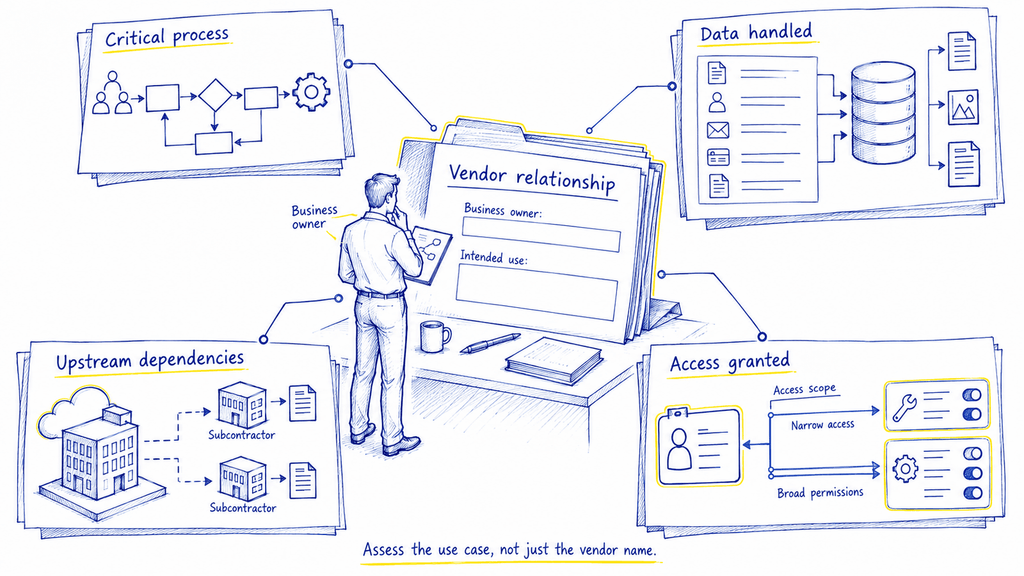
Record the business owner, intended use, data categories, access and privilege, critical processes, contract status, key subcontractors where relevant, review decision and exit path. Keep unknowns visible. If the owner or data access is unknown, discovery—not a low-risk rating—is the next step.
A useful vendor risk management process moves through four decision points. Teams can tailor the evidence and control depth, but they should preserve the decision record from initial request through exit.
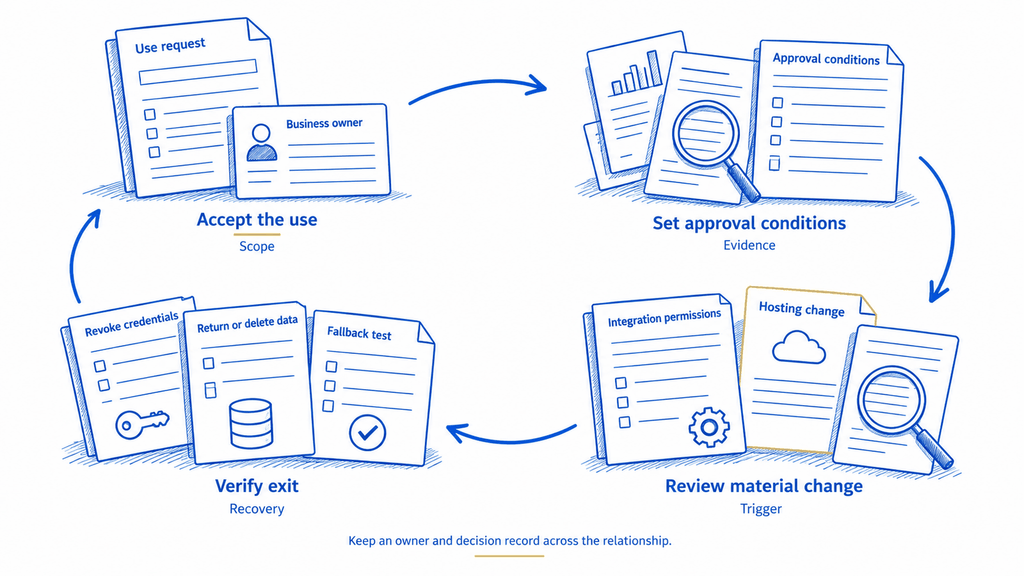
Confirm need, scope and owner before onboarding. Identify required data and access; compare approved alternatives. Limit production access or avoid sharing sensitive data where possible. Reduce exposure before collecting assurance documents.
Assess evidence against the use. Check independent reports for scope, period, exceptions and user controls. Use questionnaires to close gaps, not as proof. Validate material claims about authentication, logging, deletion, incident coordination or access limits.
Record the outcome: approve, approve with conditions, defer or reject. Note concerns, safeguards, owner, approver and review date. A score supports prioritization; it does not make the decision or transfer accountability.
Set review cadence by the relationship’s business impact and exposure, then add event-driven triggers. New data use, wider permissions, a major subcontractor or hosting change, an incident, a material control exception, acquisition or service discontinuation may invalidate assumptions behind the original approval. Assign a person to validate each signal and decide whether to reopen the review.
At exit, confirm that the business has stopped using the product, identities and integrations have been disabled, credentials have been revoked, and data has been returned or deleted as agreed. Preserve records needed for legal or audit purposes. For critical dependencies, test the transition or fallback before a contract ends; an exit clause alone does not demonstrate that the organization can operate without the supplier.
Tiering directs review capacity where it can change a decision. Set criteria that reflect risk appetite and obligations, including sensitive data, privilege, critical process dependency, substitutability, concentration and influence over downstream providers.
| Exposure question | Evidence or signal to examine | Decision it should inform |
|---|---|---|
| What can the vendor access? | Identity permissions, integration scopes, support paths, environment boundaries | Whether to limit access, add safeguards or escalate approval |
| What information does it handle? | Data flow, location, retention, deletion, encryption and subcontractor details | Whether use, transfer and retention conditions are acceptable |
| What happens if it fails? | Recovery objectives, outage history, tested continuity, alternatives and concentration | Whether to require contingency measures or a transition plan |
| Can obligations be enforced? | Contract terms, incident notice, audit rights, change notice and exit support | Whether to proceed, negotiate conditions or reject the arrangement |
Use the table as a prompt for evidence, not as a scorecard. A single high-impact exposure can outweigh several low-risk answers. Record why the tier fits the use and what new information would change it.
NIST’s July 2026 due diligence guide for ICT suppliers highlights provenance, resilience, foundational cybersecurity practices, foreign ownership, control or influence, and supply-chain tiers. It offers current supply-chain context, not a universal checklist for every vendor or sector. For covered banking organizations, the OCC’s September 2026 third-party risk proposal emphasizes tailoring oversight to relationship risk and organizational context. It remains proposed guidance, not a final requirement.
Point-in-time assessments show what the team could verify in a defined period; they do not prove the relationship stayed unchanged. Periodic reviews provide a baseline, while event-driven reviews catch changes between cycles. Both need an owner and clear action conditions.
External ratings, breach notices and vendor attestations can prompt review, but rarely show what is exposed in your deployment. Validate alerts against the vendor’s role, access path, affected data and safeguards. “Continuous monitoring” needs a defined signal, validation step and response; it does not mean every vendor control is observed live.
Specify each trigger, source, owner, validation evidence, decision authority and response target. Keep responses proportional: a subprocessor change may prompt privacy review; a compromised token may require immediate revocation and incident coordination.
Useful metrics show whether the organization understands exposure and acts on change. Track in-scope relationships with a named owner, documented use and current tier; the time material findings await decision; validation of reassessment triggers; and unconfirmed access removal or data deletion at exit.
State each metric’s population, period and threshold. Review completion says little if teams assessed the wrong vendors or skipped evidence validation. Measure decisions, unresolved conditions, response and verified closure, not questionnaire volume.
Vendor decisions involve evidence across GRC, security, IT and business operations. SPOG’s Governance, Risk and Compliance solution describes connecting requirements, controls, owners and operational evidence. Its Continuous Control Monitoring solution connects defined controls to operational evidence for assessment of coverage and effectiveness. The Security Maturity solution relates maturity models to evidence, ownership and business context.
These capabilities can support the governance record behind a decision; they do not replace supplier selection, contract negotiation, independent assurance or a business owner’s risk acceptance. For guidance focused on individual relationship decisions, see SPOG’s vendor risk management best practices.
A vendor risk management program should help teams explain why a relationship is acceptable, what conditions keep it acceptable and what they will do if those conditions change. Start with the business dependency, limit unnecessary exposure, validate evidence against the intended use and preserve clear decision authority. Then verify that the organization can respond or exit. That is the foundation of vendor oversight that stays useful after onboarding.


Security questionnaires help buyers understand how a supplier protects the data, systems and services involved in a proposed...

A vendor cybersecurity inquiry should establish what the supplier will do, which data and systems it can access,...

A vendor management policy sets the rules for approving suppliers, accepting exceptions and responding when relationships change. This...