The UAE Risk Landscape Is Changing. Is Your Risk Strategy Keeping Up?
The article explains why UAE enterprises need to update risk assessments when threats, business dependencies, or control effectiveness change. It highlights how geopolitical uncertainty, cyber threats, and third-party disruptions can make previously acceptable risks more serious. Its central message is that risk strategy should guide timely decisions and show whether actions are protecting critical business operations.
For organizations operating in the UAE, risk management is becoming increasingly complex. Geopolitical uncertainties, evolving cyber threats, growing digital dependencies, and changing regulatory expectations are reshaping the business environment.
The impact varies across industries, depending on critical operations, technology dependencies, third-party relationships, existing vulnerabilities, and resilience capabilities. The challenge is that these conditions do not remain constant.
An enterprise may have established risk management frameworks, regularly conduct assessments, maintain treatment plans, and demonstrate strong compliance. Yet changes in the operating environment can increase business exposure without immediately affecting the risk ratings recorded in its risk register.
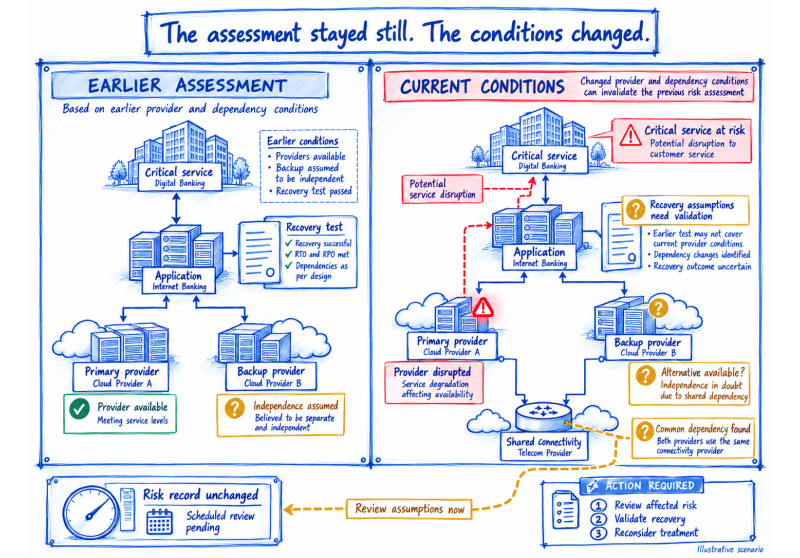
Consider an organization dependent on cloud services, regional connectivity, and external technology providers. Its risks may initially be considered acceptable based on established safeguards and recovery capabilities. However, geopolitical uncertainty, increased cyber threats, or service disruptions can invalidate the assumptions supporting those assessments.
An organization can remain compliant with its risk management processes while its actual business exposure continues to increase.
The fundamental challenge for UAE enterprises is no longer simply identifying risks, but ensuring their understanding of those risks remains relevant as business conditions evolve.
When External Uncertainty Becomes Enterprise Risk
Geopolitical developments are often treated as external risks, but their consequences can directly affect enterprise operations. Disruptions to telecommunications, supply chains, critical infrastructure, or third-party services can increase cyber exposure, interrupt business services, and challenge existing safeguards.
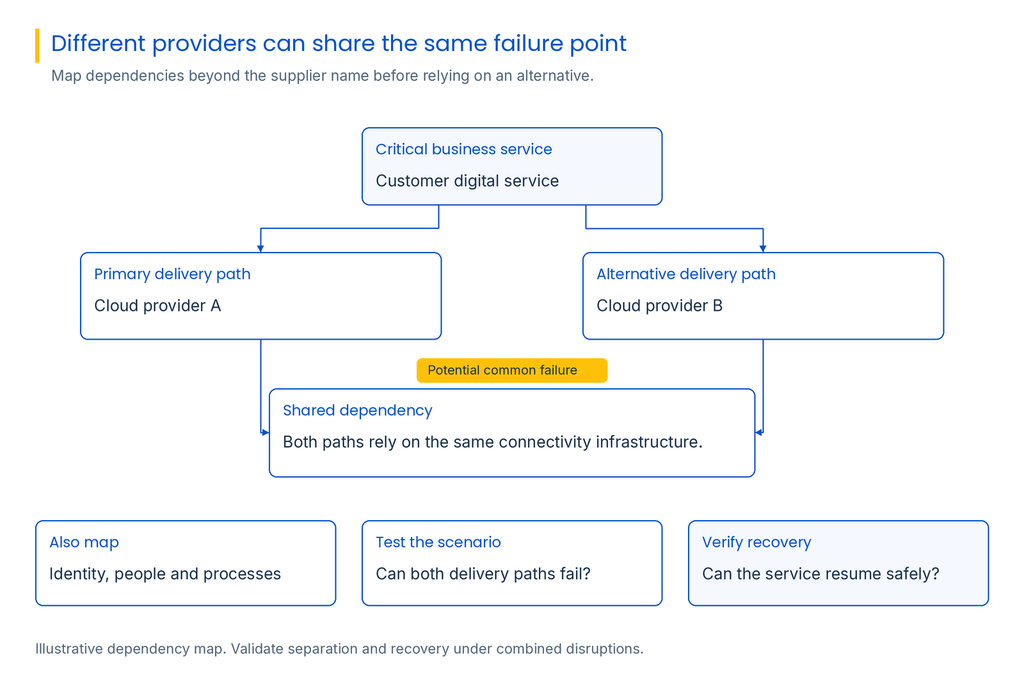
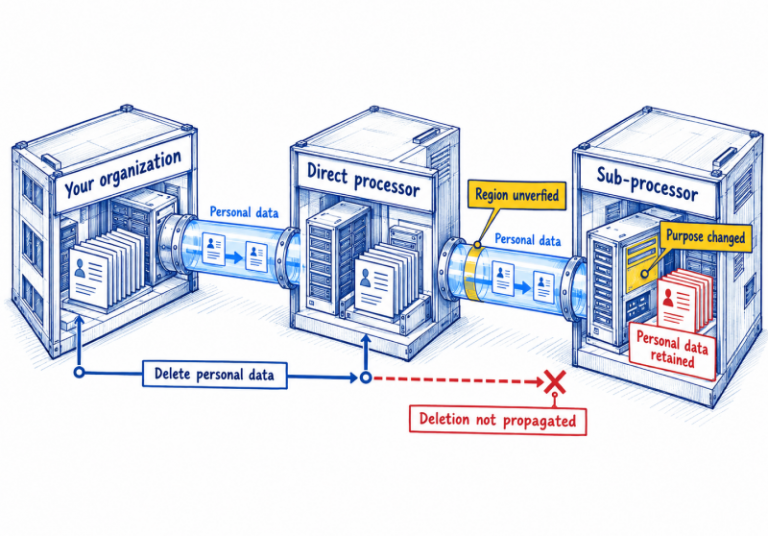
Consider a UAE enterprise relying on a managed technology provider for a critical business service. Under normal conditions, contractual commitments, backup arrangements, and tested recovery procedures may provide sufficient protection. However, prolonged provider disruption, particularly when alternative services share the same infrastructure or geographic dependencies, can significantly increase business exposure.
The concern is not simply whether an external disruption occurs, but how it affects the organization’s ability to maintain critical operations. The same external threat can represent a manageable exposure for one enterprise and a critical business risk for another.
Organizations must therefore understand the dependencies connecting their critical business services, technology assets, third parties, and existing controls. Without this visibility, enterprises may recognize rising external threats without understanding which business operations are becoming more vulnerable.
Effective risk management requires translating external uncertainty into measurable business exposure and identifying where intervention is most critical.
The Gap Between Risk Assessments and Changing Business Exposure
Most enterprises have established risk management mechanisms, including risk registers, periodic assessments, control evaluations, and business continuity plans. However, their effectiveness depends on how well they reflect changing business conditions.
A risk initially considered acceptable may become more significant when existing safeguards weaken, new cyber threats emerge, vulnerabilities become exploitable, or critical technology dependencies are disrupted.
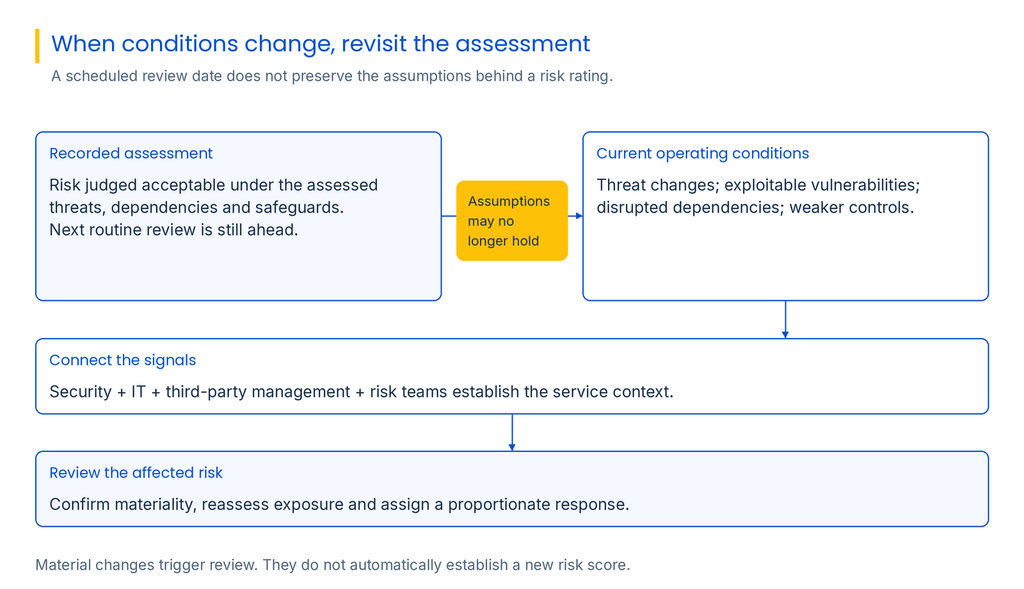
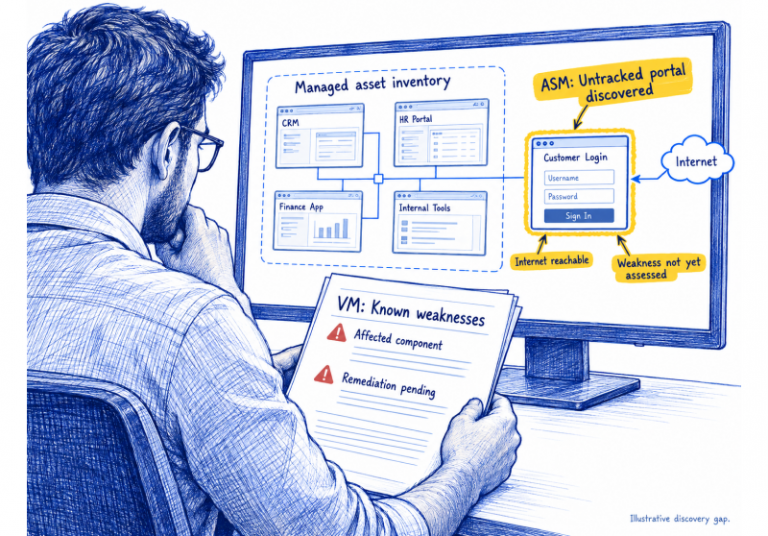
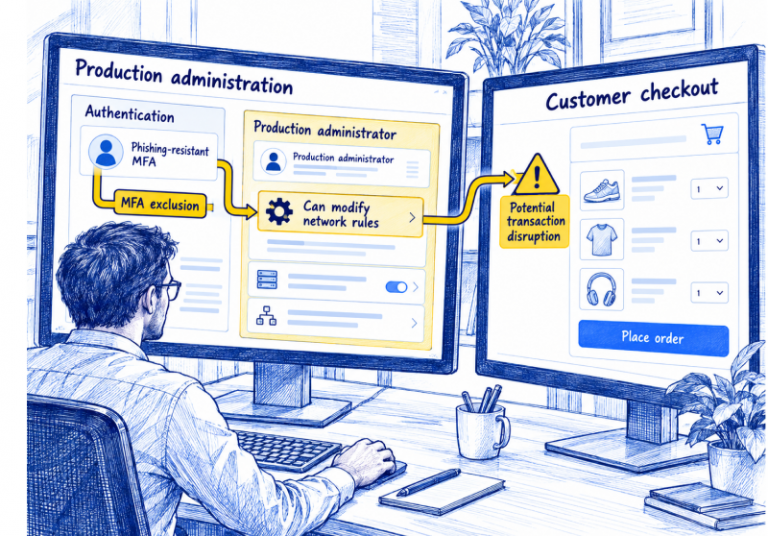
These changes are often monitored independently. Security teams track threats and vulnerabilities, IT manages infrastructure, vendor management oversees third-party dependencies, and risk teams maintain assessments. While each function may recognize individual changes, their combined impact on business exposure often remains unclear.
As a result, enterprises may continue relying on previously assessed risk ratings even when the conditions supporting those assessments have changed.
Risk assessments should not remain valid simply because their scheduled review dates have not arrived. They must reflect current threats, vulnerabilities, dependencies, and control effectiveness.
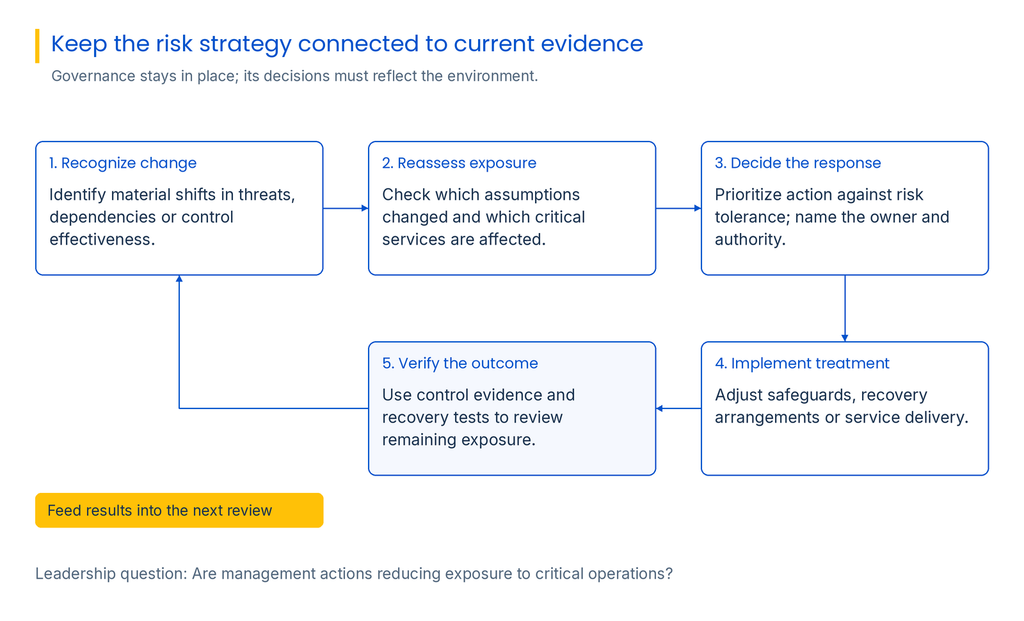
This calls for a shift toward dynamic risk assessment, where significant changes in threats, vulnerabilities, business dependencies, or control effectiveness trigger a reassessment of the affected risks.
The objective is not to continuously reassess every risk in the enterprise. It is to recognize when a material change could invalidate an existing assessment and respond proportionately. This allows risk management to remain connected to the operating environment rather than functioning only as a periodic governance exercise.
Risk Strategy Must Influence Decisions Before Disruption Occurs
More frequent risk reassessments do not automatically improve resilience. Their value lies in helping organizations identify what needs to change as business exposure evolves.
Consider an enterprise facing increased disruption risk to a critical digital service. While its existing treatment plan may focus on long-term recovery improvements, changing conditions may demand immediate action, such as validating recovery arrangements, reviewing third-party dependencies, strengthening monitoring, or adjusting service delivery.
These decisions must reflect whether the likelihood of disruption has increased, its potential business impact has grown, or existing controls have become less effective. Risk management must move beyond maintaining treatment plans to actively guiding business decisions and keeping exposure within acceptable levels.
For UAE enterprises, this is increasingly important as regulatory expectations evolve. The Central Bank of the UAE’s Operational Risk Management Regulation, effective September 2026, reinforces the need to address material changes in risk profiles and continuously manage ICT and cybersecurity risks.
Although regulatory obligations vary across sectors, the underlying challenge remains the same: organizations must translate changing risk conditions into timely, proportionate decisions that meaningfully reduce business exposure.
Building Resilience Around the Risks That Matter
Operational resilience is often associated with the ability to recover after a disruption. Recovery remains essential, but resilience begins much earlier.
It begins with knowing which business services are critical, understanding the dependencies that support them, identifying how those dependencies could fail, and determining whether existing safeguards can withstand changing conditions.
For UAE enterprises, operational resilience requires understanding risks across technology infrastructure, third-party services, connectivity, workforce, and critical business processes. The challenge is not simply identifying these dependencies, but recognizing how disruption in one area can affect the wider business.
For example, an alternative cloud provider may appear to reduce dependency risk, but shared infrastructure or connectivity could leave critical services exposed. Similarly, recovery plans tested under specific conditions may prove insufficient when multiple disruptions occur simultaneously.
Building resilience requires connecting business criticality, evolving threats, operational dependencies, control effectiveness, and recovery capabilities into a current view of enterprise risk.
This also demands coordination between cybersecurity, IT, operations, business leadership, and risk management. Without a unified understanding of exposure, organizations risk addressing individual issues without reducing the underlying business risk.
The true measure of resilience is not the number of controls implemented or risks treated, but whether critical business operations are becoming less vulnerable to disruption.
The Risk Strategy Must Evolve With the Environment
The changing UAE risk landscape does not mean that established risk management frameworks have become obsolete. The principles of risk identification, assessment, treatment, monitoring, and governance remain essential.
What is changing is the expectation that these activities must remain relevant as business conditions evolve.
Organizations cannot control geopolitical developments, eliminate every cyber threat, or prevent all third-party disruptions. They can, however, improve their ability to recognize how these developments affect their business, reassess their exposure, and make timely decisions before vulnerabilities translate into significant operational consequences.
For boards and executive leadership, the critical question is no longer simply whether the enterprise has a comprehensive risk management strategy.
It is whether that strategy can identify when previously acceptable exposure has become unacceptable, recognize when existing safeguards are no longer sufficient, and demonstrate that management actions are reducing the risks that matter most.
A risk strategy is only as relevant as the conditions it reflects. When those conditions change, the organization’s understanding of risk must change with them.
For UAE enterprises navigating an increasingly uncertain environment, this ability to keep risk decisions aligned with current business exposure will be an important measure of long-term resilience.
SPOG.AI – Bringing Risk Decisions Closer to Business Reality
SPOG.AI helps enterprises connect dynamic risk assessments, continuous control monitoring, exposure management, and risk treatment within a unified governance approach. By bringing operational evidence and business context into risk decisions, organizations can better understand changing exposure, prioritize meaningful interventions, and evaluate whether their actions are improving resilience.
FAQs
Geopolitical uncertainty, evolving cyber threats, growing digital dependencies, and changing regulatory expectations can affect business operations. Their impact depends on each organization’s critical services, third-party relationships, and ability to withstand disruption.
Dynamic risk assessment means reviewing affected risks when significant changes occur in threats, vulnerabilities, dependencies, or control effectiveness. It helps organizations keep risk decisions aligned with current conditions.
Reassessment is needed when a material change challenges the assumptions behind the existing rating. Examples include a critical provider disruption, an exploitable vulnerability, a failed control, or an increase in a service’s business importance.
Understanding how critical services depend on technology, connectivity, people, and suppliers helps organizations identify potential disruption points. It also reveals whether backup arrangements share dependencies that could fail at the same time.
Enterprises should check whether treatment reduces the likelihood or impact of a defined risk scenario. Current control evidence, recovery testing, unresolved gaps, and dependency reviews help establish whether critical operations are better protected.
Product Leader – GRC & Regulatory Technology | Building Scalable Risk, Compliance & Data Platforms for Global Enterprises
I am a Product Leader in Cyber GRC and Regulatory Technology with 13+ years of experience building enterprise-grade platforms across risk, compliance, vulnerability management, and global regulatory reporting. I specialize in transforming complex regulatory and cyber risk requirements into scalable, intuitive, and intelligent products. My work spans U.S. federal regulations (CFR, FR, U.S. Code), global reporting mandates (MAS, APRA, SAMA, ADF, FRY 9C, COREP/FINREP), and cybersecurity standards, including ISO 27001, NIST, PCI...