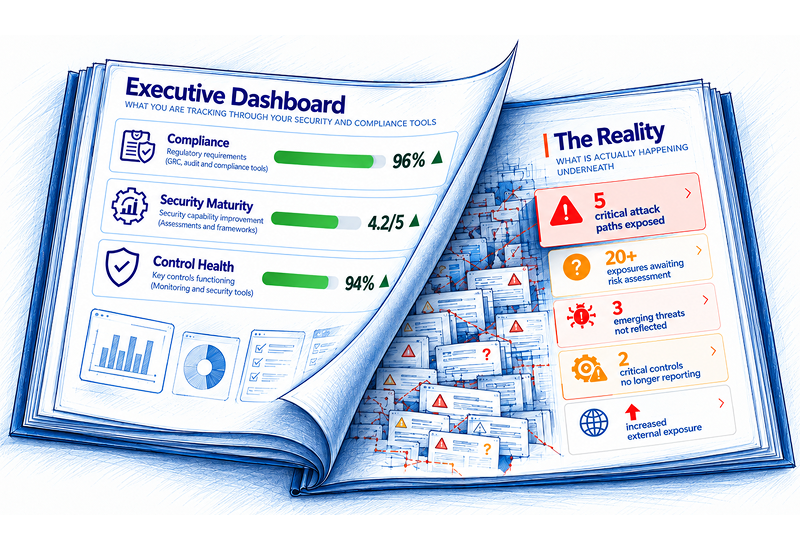
Compliance, security maturity, and risk assessment are three essential pillars of enterprise cybersecurity. Compliance measures adherence to defined requirements. Security maturity assesses organizational capabilities and opportunities for improvement. Risk assessment evaluates business exposure and the potential consequences of threats, considering existing safeguards. Yet an enterprise can achieve 96% compliance, improve its security maturity, and report 94% control health while its exposure to a critical business application continues to increase.
This happens because business exposure can change without immediately affecting the metrics leadership relies on. A critical application becomes internet-facing, a compensating control fails, or an emerging threat makes an existing vulnerability more dangerous. The dashboards may remain green even as business risk increases. The challenge is not that these disciplines lack value, but that they provide different perspectives on enterprise security. Strong compliance and improving maturity do not necessarily indicate declining business risk. Risk assessment is intended to provide that perspective, but traditional approaches have their own limitations.
Business Risk Changes Faster Than Risk Registers
Most enterprises assess business risk periodically, documenting risk ratings, treatment plans, and review dates. These assessments establish accountability, but their conclusions reflect the conditions at the time of assessment. Those conditions can change overnight.
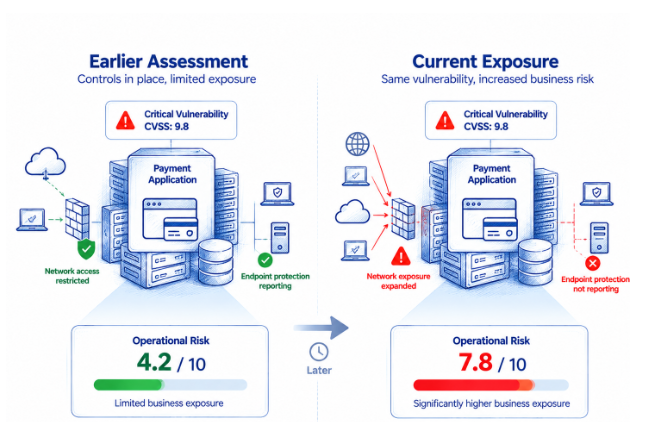
Consider a critical payment application with an unpatched vulnerability. Initially, restrictive network access, controlled privileges, and functioning endpoint detection help limit exposure while the application team prepares a patch. A subsequent firewall change expands network access, while the endpoint detection agent stops reporting. The vulnerability and its CVSS score remain unchanged, but business exposure has increased, and confidence in a key safeguard has declined. Yet the risk register may continue showing the original rating until the next scheduled review.
A risk assessed three months ago cannot be assumed to represent today’s exposure.
Risk registers remain essential for governance and accountability. However, the assessments supporting them must respond to changing threats, vulnerabilities, business exposure, and control effectiveness. Continuous risk assessment addresses this gap by reassessing business exposure when relevant conditions change. Continuous Control Monitoring provides evidence of whether safeguards are functioning, while vulnerability intelligence and business context help determine how those changes affect residual risk. The objective is not to replace the risk register, but to keep its assessments aligned with current business exposure.
Changing Risk Must Drive Remediation Priorities
Identifying changes in business risk is valuable only if those changes influence remediation decisions. Traditional remediation processes often prioritize findings independently. Vulnerabilities are ranked by severity, control failures by compliance status, and audit deficiencies by closure deadlines. Each approach serves a purpose, but none necessarily reflects the combined exposure of the affected business service.
Consider the payment application. Its vulnerability remains critical, but expanded network access and reduced endpoint visibility have changed both remediation urgency and the available response options. Restoring network restrictions may immediately reduce exposure. Restoring endpoint detection can improve the ability to identify and contain an attack. Either intervention may provide meaningful risk reduction while the permanent patch is prepared.
The highest-severity finding is not always the action that delivers the greatest immediate risk reduction.
Risk-based remediation connects vulnerabilities, threats, control effectiveness, and business criticality to prioritize actions that reduce consequential exposure. It must also account for mandatory compliance deadlines and operational constraints. This shifts remediation from closing findings in isolation to reducing the risks that matter most to the business.
Unified Governance for Competing Priorities
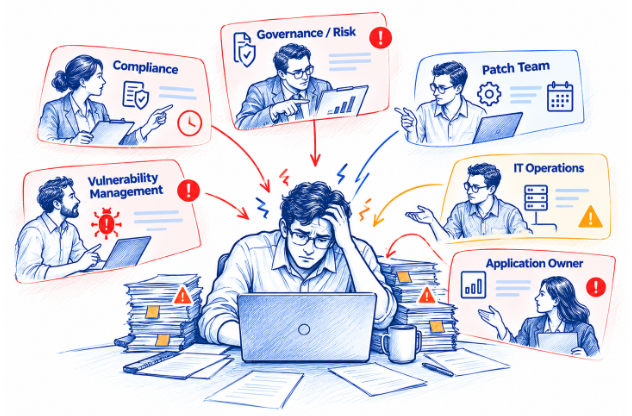
Even with better risk-based prioritization, execution remains difficult when enterprise functions operate independently. Compliance teams focus on regulatory obligations, security teams address vulnerabilities and control failures, risk teams manage exposures and treatment plans, while IT teams must implement changes without disrupting business operations.
Each function has legitimate objectives, but they often maintain separate governance processes, escalation paths, and remediation deadlines. Meanwhile, the teams responsible for implementing changes have limited bandwidth. The result is multiple teams competing for the same limited remediation capacity, often with conflicting deadlines and priorities. Enterprises need one coordinated prioritization process, not multiple governance queues competing for the same engineers.
Leadership must establish a common governance framework that reconciles regulatory obligations, business criticality, current exposure, and operational feasibility. Unified governance does not eliminate functional accountability. Compliance, security, risk, and IT teams retain their responsibilities, while shared governance establishes priorities, resolves conflicts, and tracks outcomes. The goal is not to remediate everything simultaneously. It is to direct limited capacity toward mandatory obligations and the actions that reduce the most consequential business risks.
Security Exceptions Must Remain Connected to Risk
Not every vulnerability or control failure can be resolved immediately. Production dependencies, vendor limitations, and maintenance windows often require temporary exceptions. However, exceptions frequently operate outside the broader risk and remediation process. An approved patch exception may continue generating alerts across multiple systems, creating operational noise. Alternatively, the finding may be suppressed entirely, making dashboards appear healthier without reducing the underlying exposure. Neither approach provides effective governance.
Consider the payment application again. If the patch cannot be deployed immediately, an approved exception may defer remediation while compensating safeguards remain in place. But that exception must remain connected to the affected application, residual risk, compensating controls, accountable owner, and expiry date. If network restrictions subsequently fail, the assumptions supporting the exception have changed. The residual risk must be reassessed, and the approval may need reconsideration.
An exception authorizes a deviation from a requirement; it does not automatically constitute formal risk acceptance or remove regulatory obligations. This is particularly important when multiple exceptions and control failures affect the same business service. Individually acceptable deviations may collectively create unacceptable exposure.
Quantifying Operational Risk to Demonstrate Risk Reduction
Continuous assessment and unified governance improve decision-making, but leadership still needs to know whether remediation is actually reducing risk. Traditional security metrics provide only part of the answer. Patch compliance may improve, control failures may decline, and hundreds of findings may be closed without materially reducing exposure to critical business services.
A more meaningful approach is to quantify operational risk through a consistent, evidence-based assessment of vulnerabilities, threats, business criticality, exposure, and control effectiveness. This does not require assigning a financial loss estimate to every cyber risk. A comparable operational risk score can help enterprises understand how exposure changes and whether interventions are reducing it.
A completed remediation task should not automatically be treated as successful risk reduction. Its effectiveness must be verified, and the residual risk reassessed. By connecting operational evidence to business services and tracking risk before and after interventions, enterprises can evaluate remediation outcomes rather than relying solely on activity metrics.
The Real Measure of Security Is Risk Reduction
Compliance, security maturity, and business risk are complementary perspectives, not interchangeable measures of security. Compliance ensures mandatory obligations are addressed. Security maturity guides capability improvements. Continuously assessed operational risk reveals how changing threats, vulnerabilities, and control effectiveness influence business exposure.
Together, they provide the foundation for better decisions. Unified governance then ensures those decisions translate into coordinated action across security, risk, compliance, and IT teams. Closing 500 low-risk findings may improve dashboard metrics. Addressing a handful of weaknesses affecting a critical business service may deliver far greater protection. Leadership must look beyond improving compliance scores and shrinking remediation queues to understand whether critical business exposures are actually declining.
The real measure of security is not how green the dashboards appear, but whether the enterprise can demonstrate meaningful risk reduction.
Go Beyond Green Dashboards with SPOG.AI
SPOG.AI brings together continuous control monitoring, exposure management, dynamic risk assessment, exceptions, and risk-based remediation to help enterprises understand changing business exposure and prioritize meaningful risk reduction.
Frequently Asked Questions
A dashboard may show strong results across its measured population while a critical service becomes more exposed. Changed access, emerging threats or failing safeguards can increase risk without immediately changing aggregate compliance or control-health scores.
Compliance assesses adherence to applicable requirements. Security maturity evaluates how well organizational capabilities are established and managed. Risk assessment examines potential business consequences under relevant threat and exposure conditions. Each answers a different leadership question.
High compliance can support security, but it does not establish that every material risk is adequately controlled. Leaders also need to understand assessment scope, evidence limitations, critical-service exposure and whether safeguards remain effective as conditions change.
Material changes to internet exposure, privileged access, threat activity, vulnerabilities, service criticality or compensating controls should trigger review. Missing or stale evidence may also require reassessment because it weakens confidence in the assumptions supporting the current risk rating.
Continuous control monitoring provides evidence about observable safeguard conditions, including coverage, configuration and operational health. Teams combine that evidence with threat information and business context to reassess risk. A missing signal creates uncertainty; it does not automatically prove control failure.
Prioritize actions using current exposure, credible threat conditions, business consequences, mandatory deadlines and operational feasibility. An interim safeguard may reduce exposure while a permanent fix is prepared, provided its effectiveness is verified and remaining risk receives appropriate review.
Unified governance establishes a coordinated process for resolving priorities across security, compliance, risk and IT. Teams retain their responsibilities, while shared escalation rules and decision authority help reconcile competing deadlines, allocate capacity and track agreed outcomes.
Not automatically. An exception permits a defined deviation under specified conditions. Formal risk acceptance requires the appropriate authority and a documented assessment of remaining risk. Neither internal decision removes a binding legal or contractual obligation.
A score can support comparison when its scope, inputs and method remain consistent. A lower score alone does not prove improvement: it may reflect changed assumptions, missing data or revised scoring rules. Verify the intervention and explain its effect on the risk scenario.
Evidence should show that the intended safeguard was restored or exposure reduced across the affected scope. Retain the original condition, action taken, verification result and updated residual-risk assessment. Completed tickets and fewer open findings establish activity, but require further evidence to demonstrate reduced risk.
Founder & CEO at SPOG.AI | Cyber Risk Intelligence | Continuous Security Assurance | AI & Cybersecurity Leadership
Sumit Malhotra is the founder of SPOG.AI, a cybersecurity mesh platform purpose-built to unify risk visibility, automate compliance, and drive continuous security maturity across complex enterprise environments. With over 24 years of experience across cybersecurity, GRC, IT operations, and infrastructure strategy, Sumit has partnered with organizations to solve some of the most persistent challenges in security operations: fragmented tooling, audit fatigue, delayed risk decisions, and lack of ownership alignment.