Continuous Control Monitoring
Security Questionnaires: Respond with Accurate, Verifiable Answers
Security questionnaires help buyers understand how a supplier protects the data, systems and services involved in a proposed...
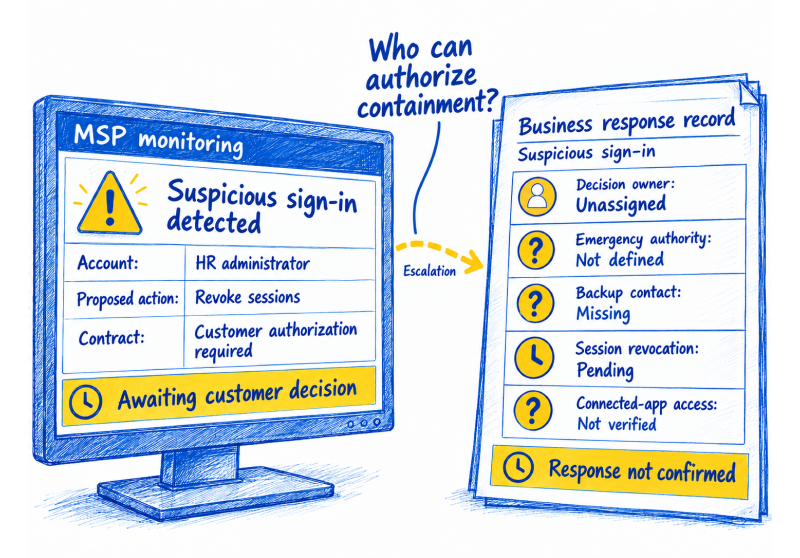
Small businesses may rely on an employee for IT, a managed service provider (MSP) for endpoint monitoring, and software vendors for business applications. Current NIST guidance recognizes that the right cybersecurity team may combine internal staff, outside providers, and community support, depending on the company’s resources and needs.
The question is not whether every task belongs inside or outside the company. Each important outcome needs a business owner, an operator with the authority to act, and someone who can confirm the result. Make those assignments visible without building unnecessary bureaucracy.
Small teams often rely on informal arrangements. The founder calls the MSP, IT changes settings, and a department lead approves a new app. This can break down when an issue crosses teams: the provider receives an alert, but only the business owner can pause a workflow. A cloud vendor operates its platform, while the company decides who can access its data.
The handoff is where “we thought they handled it” becomes a risk. A contract may promise monitoring without saying who reviews after-hours alerts, who can isolate an account, or who can stop a customer-facing process. A department name does not answer those operational questions.
Assign cybersecurity responsibility around outcomes the business must protect, such as customer records or reliable payment processing. Identify the decisions and actions that keep each outcome dependable.
Separate business decisions from security tasks
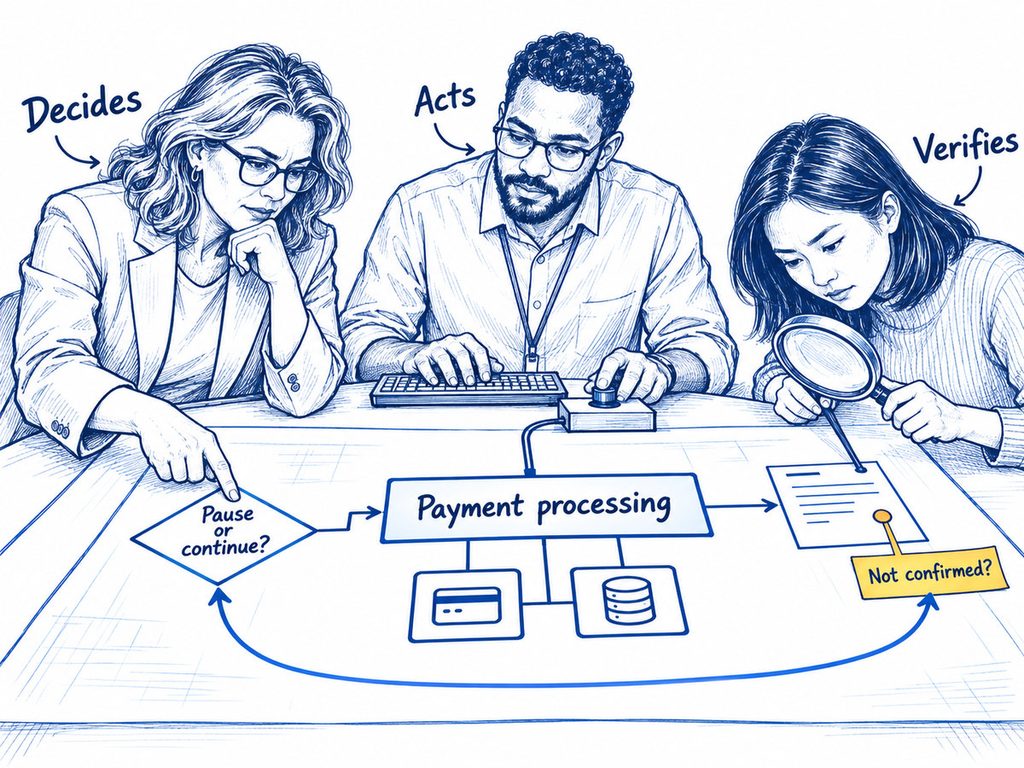
A useful responsibility model distinguishes three kinds of work.
Business decisions set priorities and accept operational consequences. A process owner defines tolerable interruption, approves data use, and escalates unresolved risk. A provider may advise, but should not make business decisions on the company’s behalf.
Security execution puts safeguards into operation. IT, an MSP, an application administrator, or a cloud provider may configure access, review alerts, maintain systems, or contain threats. Match the assignment to the contract, access, and capability.
Verification and escalation establish whether the action worked and who responds if it did not. One person may operate and verify a task. If separate review is impractical, record the limitation and add a proportionate check, such as a periodic leadership review.
RACI—Responsible, Accountable, Consulted, and Informed—can clarify cross-team tasks. But labels alone do not show whether a person can approve the decision, access the system, or confirm completion. Add decision limits, timing, and escalation steps for critical work.
Start with activities where internal and external work meets, and trace each from trigger to closure. Ask who receives the signal, authorizes and performs the response, and checks the affected systems or users.
| Activity | Business decision owner | Operator | Verification and escalation |
|---|---|---|---|
| Suspicious sign-in | Process owner decides whether access must pause | IT or MSP revokes sessions and investigates | Confirm connected apps are covered; escalate suspected data exposure |
| New cloud application | Business owner approves purpose and data use | IT configures identity and access; provider operates the platform | Confirm user and data scope; record gaps for the risk owner |
| Security update | Business owner sets the maintenance window | IT or MSP tests and deploys the update | Confirm systems updated and workflow still operates; escalate deferrals |
| Provider incident | Executive owner decides continuity and external response | Provider investigates and supplies agreed information | Internal incident lead assesses company impact and coordinates open actions |
These examples are not universal assignments. Name the people who hold each role and a backup for time-sensitive duties. A team name without a reachable decision-maker is not a complete escalation path.
Record responsibilities so they survive turnover
Keep a concise record for each important activity: protected outcome, affected systems or data, decision owner, operator, verifier, provider boundary, escalation contact, and evidence of completion. Add response windows and a backup contact where delay matters.
Link unresolved issues to the risk register. Record the decision-maker, treatment, remaining exposure, action owner, and review trigger. Leadership can then distinguish an accepted risk from a gap without an owner. NIST’s current risk guidance also emphasizes relating cybersecurity risk to broader business objectives.
Keep the record usable. A maintained spreadsheet can work for a small team. A shorter map linked to real workflows is more useful than a document nobody updates.
Provider agreements should replace “manage security” with specific commitments. State which systems and activities the provider covers, what it monitors, how it reports incidents, its response times, and what records or assistance it supplies. Put exclusions and customer-side actions beside those commitments.
For cloud and SaaS products, identify which settings the customer controls and which the provider operates. Assign owners for users, data, integrations, configuration, and business response. For an MSP, clarify whether it only sends alerts or may also disable accounts, isolate devices, or make emergency changes. Record approval limits and contact paths.
Contracts set expectations; procedures make them usable. Test the alert path, contact list, access revocation, and evidence handoff. Revisit provider boundaries when an application, integration, or managed function changes. CISA’s 2025 SMB vendor supply-chain template can help structure supplier discussions, but it does not replace a tailored agreement.
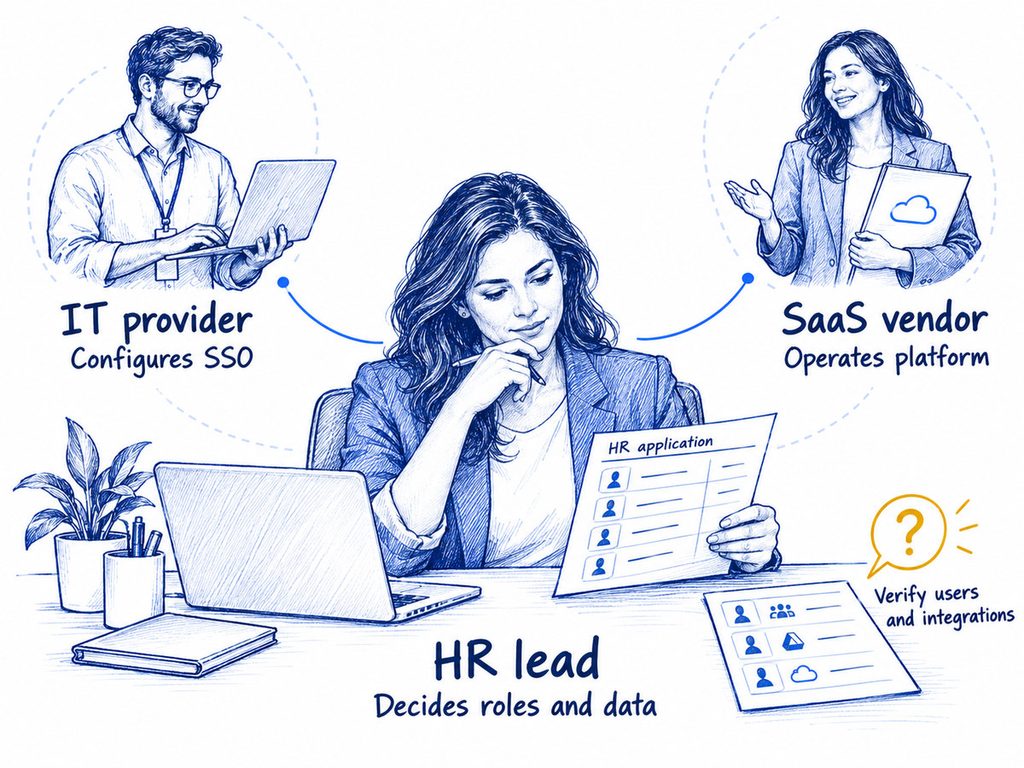
A 45-person design firm adds a cloud HR application linked to its identity provider. The vendor operates the platform, the IT provider configures single sign-on, and the HR lead decides which roles need access and which records belong in the application.
Before launch, the firm records who approves the data use, configures the connection, disables access, and validates the user population. It identifies who contacts the vendor about suspected misuse and who decides whether the HR process should pause.
In a short walkthrough, the HR lead reports an unfamiliar export. Can the provider contain access, can the firm identify affected records and integrations, and can an authorized leader decide the next step? Any unclear answer reveals a boundary to fix before routine use.
Revisit assignments when the business changes
Review the map when staff or provider roles change, a system or integration is added, an incident exposes a handoff failure, or a new obligation appears. Authority and access can change even when policy text does not.
At management review, look for activities without owners, unclear provider duties, stale contacts, repeated exceptions, and tasks no one verifies. Decide whether to train staff, adjust an agreement, add a check, or bring work in-house. Updated NIST guidance supports choosing a mix of internal skills and outside support to fit the company’s needs and capacity.
SPOG.AI’s GRC solution connects risk, control, ownership, and remediation context. IT & Operations supports governed workflows across teams. Where operational evidence is available, Continuous Control Monitoring assesses control coverage and effectiveness, and Remediation supports accountable follow-through.
These capabilities can make work and open issues more visible. They do not set risk appetite, replace provider agreements, or authorize business decisions. Confirm integrations and scope before relying on a workflow.
Small-business cybersecurity does not require a large security department. It does require clear decision, execution, and verification roles. Start with one activity that crosses teams, trace its handoffs, and test how the company will confirm completion. Repeat when the business or provider relationship changes.


Security questionnaires help buyers understand how a supplier protects the data, systems and services involved in a proposed...

A vendor cybersecurity inquiry should establish what the supplier will do, which data and systems it can access,...

A vendor management policy sets the rules for approving suppliers, accepting exceptions and responding when relationships change. This...