And this isn’t an isolated case. According to Verizon’s Data Breach Investigations Report (DBIR) 2025, the share of data breaches involving third parties has doubled—from 15% to 30%—in just one year. That’s not a statistic to gloss over; it’s a warning sign. It means nearly a third of today’s breaches are happening because of vulnerabilities outside direct organizational control.
This reality highlights an uncomfortable truth: no matter how strong your internal defenses are, your security is only as strong as the weakest link in your vendor ecosystem. Which is why tracking and reporting on third-party risk metrics has become a non-negotiable. It’s the only way to shine a light on blind spots, measure vendor accountability, and keep leadership informed enough to act before risks turn into headlines.
In this article, we’ll unpack the most critical third-party risk metrics to track, explore practical methods for gathering them, and share best practices for reporting in ways that resonate with executives, security teams, and regulators alike.
What are the Different Categories of Third-Party Risk Metrics?
Before diving into the “what to track,” it’s important to clarify why metrics matter in the first place. Third-party risk management can feel overwhelming—dozens of vendors, endless questionnaires, compliance checklists, security scans, and contractual obligations. Without a clear framework for measurement, it all becomes noise. Metrics cut through that noise.
At their core, third-party risk metrics are simply signals that help you understand where vendors are exposing your organization to risk, how serious that risk is, and whether it’s getting better or worse over time. They translate complex vendor relationships into something measurable and actionable.
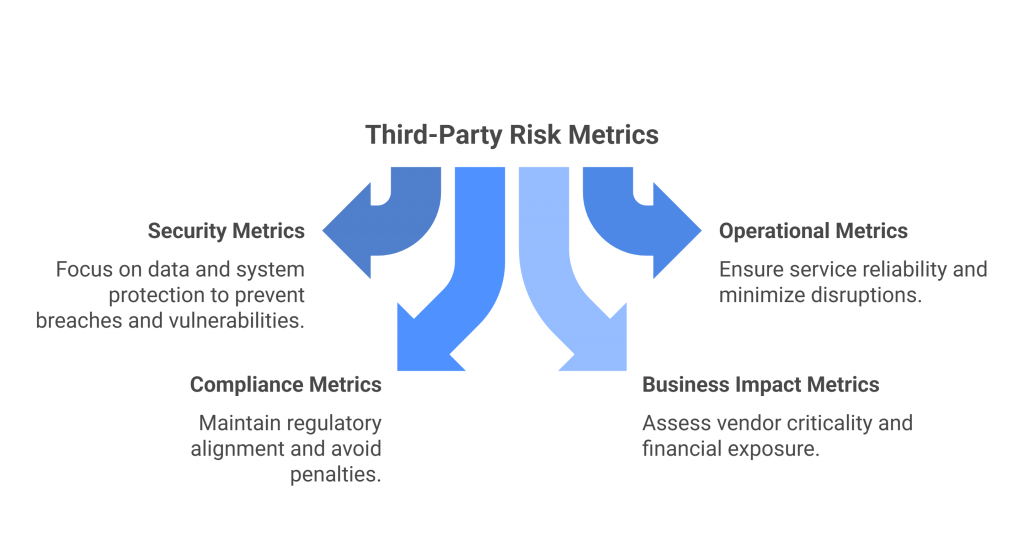
Think of them as falling into four broad categories:
- Security Metrics – How well vendors protect your data and systems (e.g., number of vulnerabilities, patching timelines, incident history).
- Operational Metrics – How reliable vendors are in delivering services (e.g., SLA breaches, downtime, disruption frequency).
- Compliance Metrics – How aligned vendors are with regulations and policies (e.g., audit findings, adherence to standards like SOC 2 or ISO 27001).
- Business Impact Metrics – How critical a vendor is to your operations (e.g., dependency level, financial exposure, concentration risk).
The point isn’t to track everything. It’s to zero in on the metrics that provide a clear picture of which vendors present the highest risk and where you should focus your limited time and resources.
What are the Core Third-Party Metrics to Track?
When it comes to third-party risk, not all data points are equally useful. The key is to focus on metrics that directly reflect a vendor’s ability to protect your business, meet obligations, and minimize risk exposure. Organized into four categories, here are the most critical ones:
1. Security Metrics
These measure the ability of a vendor to safeguard your data, applications, and systems from malicious activity. They are often the first indicators leadership wants to see, given the rising cost of cyber incidents.
- Third-Party Risk Score or Rating
A consolidated score that pulls in factors such as vulnerability scan results, penetration test findings, external security ratings, and threat intelligence. It works like a “credit score” for vendor security health. A low score signals that the vendor could be a weak link in your ecosystem.
- Time to Remediate (TTR)
Breaches often occur not because a vulnerability exists, but because it remains unpatched for too long. Tracking how quickly a vendor responds to known vulnerabilities or compliance gaps shows whether they’re proactive or reactive in their security approach.
- Incident Frequency & Severity
A vendor’s incident history speaks volumes. Have they been involved in breaches or ransomware attacks? Were these contained quickly, or did they cause cascading damage? This metric helps predict the likelihood of future issues.
2. Operational Metrics
These highlight whether vendors can deliver on their promises consistently. Even if a vendor is secure, frequent downtime or performance failures can disrupt your business and erode trust.
- Service-Level Agreement (SLA) Adherence
Tracking SLA violations (e.g., missed uptime commitments, slow response times) gives a concrete measure of whether vendors deliver as promised. Persistent SLA failures often point to deeper operational issues.
- System Downtime/Outages
Measuring outage frequency, duration, and business impact helps identify vendors whose reliability might threaten continuity. For example, a payroll provider with frequent downtime creates operational chaos regardless of their security controls.
- Response to Disruptions
It’s not only about avoiding disruptions but also about how quickly and effectively vendors recover from them. Strong disaster recovery and business continuity planning are essential markers of operational resilience.
3. Compliance Metrics
Regulations are tightening worldwide, and regulators increasingly hold organizations responsible for their vendors’ failures. Compliance metrics ensure vendors align with required standards and minimize regulatory exposure.
- Regulatory Compliance Rate
A measure of how many of your vendors are certified or audited against industry standards (SOC 2, ISO 27001, HIPAA, GDPR). Non-compliant vendors introduce not just risk but potential fines and reputational damage.
- Audit Findings
The number and severity of issues flagged during assessments, whether internal or by external auditors. A pattern of repeat findings suggests vendors aren’t closing gaps or learning from past mistakes.
- Data Handling & Privacy Violations
Tracking instances of improper data sharing, misconfigurations, or privacy violations helps ensure that vendors respect both the letter and the spirit of data protection requirements.
4. Business Impact Metrics
These elevate the conversation from “security” to “strategy.” They show how much your organization relies on a vendor and what the fallout would be if something went wrong.
- Vendor Criticality Score
A weighted score that considers how vital a vendor is to your operations, whether they process sensitive data, and how easily you could replace them. It’s a straightforward way to prioritize which vendors deserve deeper scrutiny.
- Financial Exposure
A calculation of the direct and indirect financial loss your organization could incur if the vendor failed—lost revenue, remediation costs, reputational damage. This ties risk directly to business outcomes.
- Fourth-Party Risk Exposure
Vendors rarely operate alone; they rely on their own subcontractors and partners. Tracking who your vendors depend on uncovers hidden risks in your extended supply chain. For instance, a SaaS platform may look stable, but if its hosting provider has vulnerabilities, you inherit those risks.
When you categorize and track vendors across these four areas, you build a holistic picture of risk. Instead of drowning in dozens of disconnected data points, you can see:
- Where your greatest vulnerabilities lie.
- Which vendors require urgent attention.
- How risk trends are shifting over time.
This approach transforms third-party risk management from a reactive compliance exercise into a proactive, strategic practice that safeguards both operations and reputation.
How to Track Third-Party Risk Metrics?
Once you know which metrics matter, the next challenge is figuring out how to actually track them. For most organizations, this is where things get messy—vendor spreadsheets pile up, questionnaires go unanswered, and risk data quickly becomes outdated. The key is to balance automation, process discipline, and vendor engagement.
The real challenge lies in consistently tracking these metrics across dozens or even hundreds of third-party vendors. Organizations need methods that balance scale, accuracy, and ongoing visibility.
Here’s how the most common approaches work in practice:
1. Automated Monitoring Tools
Automated tools, such as security rating services or continuous monitoring platforms, track a vendor’s digital footprint in real time. They can scan for things like open ports, expired certificates, leaked credentials, or vulnerabilities in public-facing systems. Many also provide scoring systems that feed directly into your risk dashboards.
This approach helps organizations move beyond one-time snapshots by offering continuous oversight. Instead of waiting for annual assessments, you can get alerts as soon as a vendor’s security hygiene slips. For example, if a cloud provider misconfigures a storage bucket or a vendor’s domain shows signs of malware, automated monitoring flags it instantly.
2. Questionnaires & Vendor Self-Assessments
Despite being traditional, questionnaires remain the backbone of third-party risk assessments. Standardized formats like SIG Lite (Shared Assessments) or CAIQ (Cloud Security Alliance) allow you to gather detailed information about vendor policies, controls, and compliance status.
The key to making questionnaires valuable is consistency. When used across all vendors, they let you compare responses side by side and build a baseline understanding of each vendor’s posture. To make the process manageable, many organizations use digital platforms to distribute, collect, and score responses. While not foolproof, questionnaires create a structured way to open a dialogue with vendors about their practices.
3. Independent Audits & Certifications
Third-party audits and certifications, such as SOC 2 reports, ISO 27001 certifications, or PCI-DSS compliance, give a more objective picture of vendor maturity. These documents are often shared during due diligence and serve as formal proof that a vendor meets certain industry standards.
The value of certifications lies in the depth of validation. An SOC 2 report, for instance, doesn’t just confirm that security policies exist; it tests whether they’ve been followed over time. These reports can highlight recurring issues, remediation progress, and areas where vendors are still falling short.
4. Direct Vendor Engagement
Sometimes, the best way to understand a vendor’s risk posture is to talk to them directly. Regular check-ins, governance meetings, or even incident response exercises with key vendors help reveal how prepared they are in real-world scenarios.
For critical vendors, some organizations go further—conducting onsite visits, running joint tabletop exercises, or collaborating on crisis playbooks. This not only provides assurance but also builds stronger relationships, making it easier to resolve issues quickly when they arise.
5. Integration with GRC & Risk Platforms
Governance, Risk, and Compliance (GRC) platforms act as the central nervous system of third-party risk management. They bring together data from monitoring tools, questionnaires, audits, and vendor communications into one place.
By integrating vendor metrics into a GRC platform, organizations can track remediation timelines, flag overdue tasks, and align third-party risks with enterprise-wide risk objectives. For example, if a vendor is consistently slow in patching vulnerabilities, the platform can automatically escalate the risk score and trigger management review.
6. Continuous Intelligence & External Risk Feeds
Some risks don’t show up in a vulnerability scan or a compliance report—they come from the world around the vendor. That’s why leading organizations supplement their tracking with threat intelligence feeds, geopolitical risk monitoring, and supply chain alerts.
For instance, if a vendor operates in a region experiencing political instability, or if their parent company is facing financial trouble, these external signals provide early warnings. This allows organizations to act before disruptions materialize—by preparing contingencies or diversifying suppliers.
Bringing It Together
No single method is enough on its own. The most effective third-party risk programs combine automation for scale, questionnaires for structured input, certifications for assurance, and direct engagement for depth. By weaving these methods together, you get a multi-layered view that’s both wide enough to cover your entire vendor base and deep enough to uncover the most critical risks.
How Do You Report Third-Party Risk Metrics Effectively?
Collecting data is one thing. Communicating it in a way that drives action is another. Many organizations get stuck in the weeds of tracking but fall short when it comes to reporting. Metrics lose their value if they sit in spreadsheets or dashboards no one pays attention to. Effective reporting means tailoring the message to the audience, presenting it clearly, and linking it back to business priorities.
1. Know Your Audience
The same risk data won’t resonate equally with everyone. Reports should be shaped by who’s receiving them:
- Executives & Boards: Want the big picture—risk trends, business impact, and how exposure is changing over time. Think dashboards, heatmaps, and concise summaries.
- Security & Risk Teams: Need granular detail to act—specific vulnerabilities, remediation timelines, and incident root causes. They benefit from drill-down reports with technical depth.
- Compliance & Legal Teams: Care most about audit trails, regulatory alignment, and proof of due diligence. Reporting here should emphasize compliance status, gaps, and remediation evidence.
2. Use Visual Storytelling
Raw data rarely moves people. Visuals—risk heatmaps, traffic-light indicators, scorecards, or trend lines—make risks easier to grasp. For example:
- A heatmap can instantly show which vendors fall into “high-risk” zones.
- A trend line highlights whether a vendor’s remediation speed is improving or declining.
- A scorecard allows quick comparison across a portfolio of vendors.
The goal is not to overwhelm but to show the story behind the numbers: Which risks matter, why they matter, and what should be done about them.
3. Set a Reporting Cadence
Risk reporting isn’t a one-and-done exercise. Different audiences need updates at different rhythms:
- Real-time alerts for critical issues (e.g., a breach at a top-tier vendor).
- Monthly or quarterly reports for leadership and governance committees.
- Annual reports to support regulatory filings or formal audits.
Consistency builds trust and ensures that risks aren’t just discussed reactively after something goes wrong.
4. Highlight Business Impact, Not Just Risk Scores
One of the biggest pitfalls in reporting is treating risk as an abstract number. Executives respond when you connect metrics to outcomes:
- Instead of “Vendor X scored 42/100 on cyber hygiene”, say “Vendor X’s weaknesses could expose 200,000 customer records, resulting in $5M in potential fines.”
- Instead of “Vendor Y has two SLA breaches this quarter”, say “Vendor Y’s downtime delayed our payroll processing by 24 hours, affecting 5,000 employees.”
Framing risk in business terms makes reports actionable and relevant.
5. Standardize But Stay Flexible
Reports should follow a consistent format for comparability but leave room for customization. A standardized template ensures stakeholders know what to expect, while flexibility allows you to highlight emerging risks or vendor-specific issues when needed.
In short: Reporting isn’t about dumping data; it’s about building a shared understanding of third-party risk across the organization. The best reports strike a balance between simplicity for decision-makers and depth for practitioners, always tying risk back to what it means for the business.
What Are the Best Practices for Tracking and Reporting Third-Party Risk Metrics?
Knowing what to track and how to report it is essential, but the real value comes from embedding these practices into the organization’s DNA. Mature programs don’t just collect data; they use it to drive decisions, shape vendor relationships, and build resilience. Here are some best practices that make third-party risk tracking and reporting truly effective:
1. Align Metrics with Business Objectives
Not all risks matter equally. A vendor failing to patch a system might be critical if they process customer data, but far less urgent if they provide low-impact services. Always connect risk metrics back to business goals and priorities. This ensures leadership sees relevance rather than noise.
2. Standardize Your Frameworks
Consistency is key. Use industry-recognized frameworks like NIST Cybersecurity Framework, ISO 27036, or Shared Assessments SIG to define what you measure and how. Standardization makes vendor comparisons fairer, simplifies reporting, and strengthens audit defensibility.
3. Validate Vendor Data
Never rely solely on what vendors tell you. Questionnaires and attestations are useful, but they need validation through independent audits, certifications, or automated monitoring tools. Otherwise, you risk basing decisions on inaccurate or outdated claims.
4. Prioritize Key Risk Indicators (KRIs)
Don’t try to track everything. Focus on a short list of KRIs that provide the clearest visibility into security, operational, compliance, and business impact risks. A lean but focused set of metrics drives clarity and prevents overload.
5. Embed Metrics into Procurement & Contracts
Risk should not be an afterthought. Incorporate risk metrics into vendor onboarding, RFPs, and contractual obligations. For example: requiring vendors to remediate vulnerabilities within 30 days, or mandating annual SOC 2 audits. This builds accountability upfront.
6. Make Reporting Action-Oriented
A report should always answer: So what? Instead of simply sharing a vendor’s score, explain what it means, why it matters, and what action is expected. For example: flagging a vendor as “high risk” should trigger a decision—monitor more closely, escalate remediation, or reconsider the partnership.
7. Leverage Predictive Analytics Where Possible
Leading programs don’t just report on what’s happened—they look ahead. Using trend data, AI-driven analytics, or predictive risk scoring can help forecast which vendors are most likely to cause future issues. This shifts reporting from reactive to proactive.
8. Foster Transparency and Collaboration
The best relationships with vendors are built on trust. Share key risk metrics with vendors, discuss them openly, and collaborate on remediation plans. This turns risk management from a policing exercise into a partnership that strengthens the ecosystem.
What Challenges Do Organizations Face in Tracking and Reporting Third-Party Risk Metrics?
On paper, third-party risk metrics sound straightforward: define what matters, collect the data, and report it clearly. In practice, things rarely go so smoothly. Organizations run into hurdles that make tracking and reporting a lot messier than the frameworks suggest.
1. Inconsistent Data Quality Across Vendors
Not all vendors are equally mature. While a global SaaS provider may hand over a polished SOC 2 report and structured dashboards, a smaller niche vendor might provide only a self-attestation form with vague assurances. This unevenness makes it almost impossible to compare risk scores directly.
Organizations can overcome this by normalizing inputs against a common framework, such as mapping every vendor’s answers—whether from a certification, questionnaire, or audit—back to the same NIST or ISO categories. This way, even if one vendor provides a hundred-page report and another only a checklist, both can be scored consistently on the same scale.
2. Metrics That Age Out Quickly
A vendor’s risk profile isn’t static. Leadership changes, acquisitions, or even external events like new sanctions can turn a previously low-risk vendor into a liability overnight. The challenge is that many organizations still treat certifications or annual questionnaires as a “one-and-done” assurance.
To fix this, companies can establish continuous or cyclical reviews of key metrics. Certifications and reports become starting points, but they’re supplemented with ongoing monitoring tools and quarterly reassessments. This ensures that metrics stay current and don’t give a false sense of security.
3. Limited Visibility Into Fourth-Party Dependencies
Often, the riskiest links are buried deeper in the supply chain. A vendor might look strong, but if they rely heavily on a subcontractor or the same cloud provider that dozens of your other vendors use, you’re still exposed. The problem is that fourth-party relationships are rarely disclosed.
The organizations that get ahead of this risk build supply chain mapping into their onboarding and due diligence process. They push vendors to disclose their critical dependencies, then assess concentration risk across the ecosystem. While it’s never perfect visibility, even partial mapping helps identify hotspots like over-reliance on a single provider.
4. Fragmented Tooling and Siloed Data
Risk data often ends up scattered—procurement keeps contracts, compliance owns certifications, security teams monitor vulnerabilities, and finance tracks financial health. With no single source of truth, reporting becomes a manual, error-prone process.
The solution many organizations can adopt is integrating these streams into a centralized risk platform or GRC system. This doesn’t mean ripping out every tool, but rather pulling key data points into a unified dashboard where leadership can see the full picture without juggling spreadsheets from five different departments.
5. Risks That Don’t Fit Neatly Into Metrics
Not every risk can be captured with numbers. Reputational red flags, leadership trustworthiness, or early signs of financial instability often live outside traditional scoring models. Ignoring them leaves dangerous blind spots.
To address this, you can combine quantitative metrics with qualitative assessments. Alongside dashboards and heatmaps, they include analyst commentary, vendor watchlists, or narrative “red flag” notes. This mix acknowledges that some risks require human judgment rather than automated scoring.
6. Alert Fatigue From Continuous Monitoring
Automated monitoring tools are a blessing and a curse. They can flood teams with thousands of alerts—expired certificates, DNS misconfigurations, small compliance gaps—that may not meaningfully impact the business. The noise overwhelms teams and risks hiding real threats.
Mature programs can handle this by calibrating thresholds and building escalation paths. Low-impact issues are logged for vendor discussions during regular reviews, while only high-severity alerts—like exposed credentials or evidence of a breach—get escalated to leadership. This filtering ensures teams focus on what truly matters instead of drowning in noise.
Conclusion
Third-party risk isn’t a problem you solve once—it’s a moving target that shifts with every new vendor, every technology change, and every disruption in the broader ecosystem. The organizations that manage it well aren’t the ones chasing perfection; they’re the ones that commit to visibility, accountability, and continuous improvement.
At its core, tracking and reporting third-party risk metrics is about building trust. Trust with your vendors, by setting clear expectations and collaborating on improvements. Trust with your leadership, by showing how vendor risk ties directly to business outcomes. And trust with your customers, by demonstrating that the partners you rely on are as resilient and secure as your own operations.
The breaches we see today—like Snowflake’s—aren’t just cautionary tales, they’re reminders that one weak link can ripple across industries. By measuring what matters and communicating it effectively, organizations put themselves in a position not only to withstand those shocks but to emerge stronger.