SOC 2 Control Ownership: Define Clear Roles and Validate Evidence Without a CISO
Build a practical SOC 2 control list with clear owners, reliable evidence and complete handoffs across teams. Learn how to manage responsibilities without a CISO, address missed controls and verify outcomes throughout the examination period.
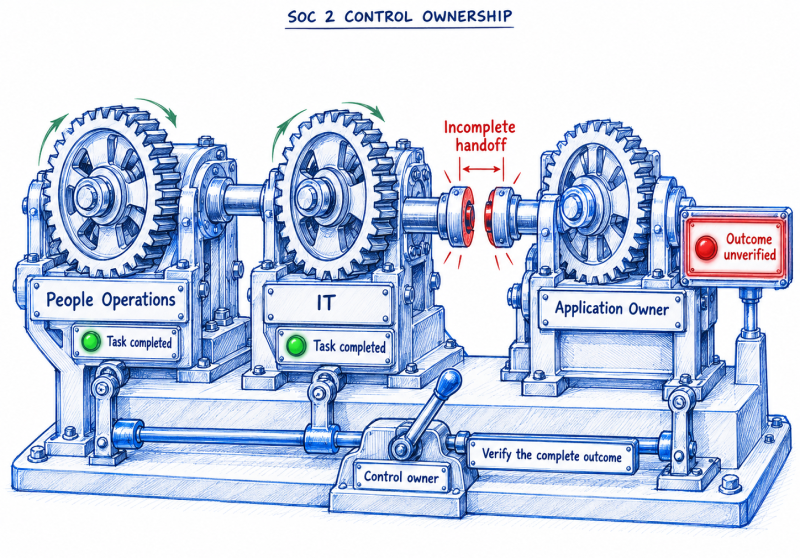
An employee leaves. People operations record the departure, IT disables the central account and the ticket closes. A local production account remains active because nobody checked the application owner’s part of the workflow.
The problem is an incomplete handoff. A control can have a name, an owner and a completed task while its intended outcome remains unverified.
A useful SOC 2 control list connects each control to its scope, operator, accountable decision-maker, evidence and response to failure. Without a CISO, those responsibilities need to be distributed explicitly across leadership, engineering, IT and business functions.
The goal is an operating model that can explain what happened throughout the examination period, including what was missed and how the organization responded.
What belongs on a SOC 2 control list?
SOC 2 is an examination and attestation report performed by an independent CPA firm. It addresses a service organization’s system description and controls against applicable Trust Services Criteria. It is not an ISO-style certification or a universal checklist of security tools.
The five categories are Security, Availability, Processing Integrity, Confidentiality and Privacy. The common criteria underpin the assessment; additional category-specific criteria apply where those categories are included. Select the scope against the service, its commitments, system requirements and intended report users.
Management is responsible for the system description and controls. The CPA firm evaluates them. A control library can help organize this work, but the organization must adapt it to its actual risks and operations.
For each control, maintain a record of:
The objective, applicable criteria and documented control activity.
The service, systems, people or transactions covered.
Who performs the activity and who is accountable for its outcome.
Its frequency or triggering event, including the relevant deadline.
The evidence source, population and retention arrangements.
The response to failure, exception authority and closure check.
These are practical record fields, not an AICPA-prescribed template. Map controls to applicable criteria and address the wider control environment, risk assessment and oversight work as well as technical activities.
Who owns the program without a CISO?
A founder, COO, CTO or other authorized leader can sponsor the SOC 2 program. The absence of a CISO title does not remove management’s responsibilities.
Separate three jobs:
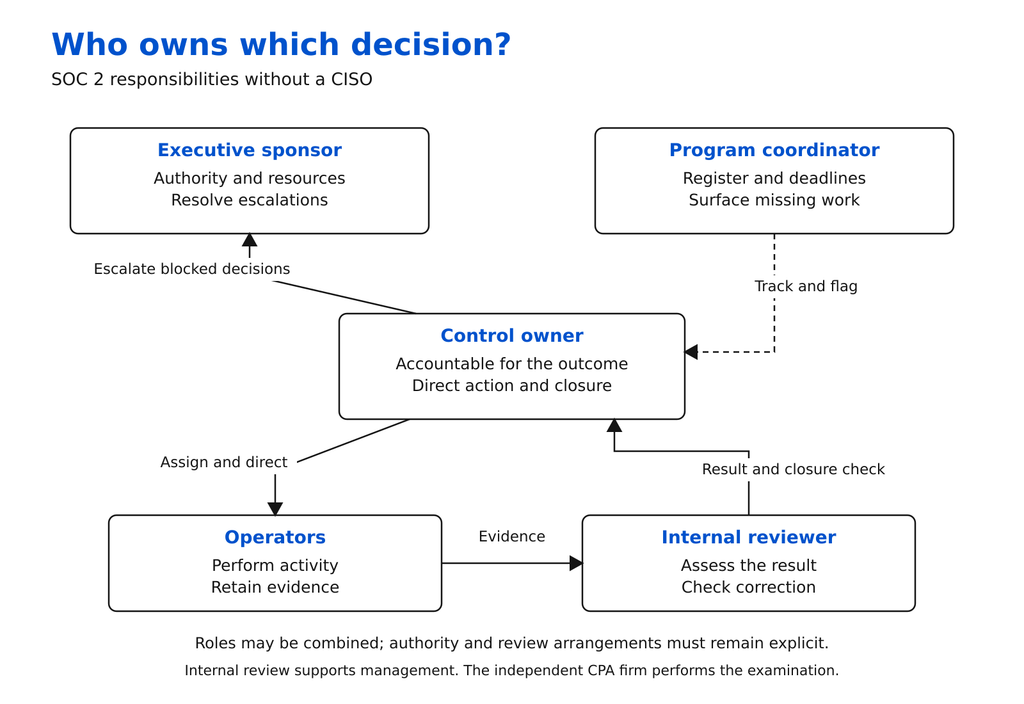
Executive sponsor: resolves resource conflicts, establishes decision authority and receives escalations about material gaps or overdue action.
Program coordinator: maintains the control register, tracks evidence requests and deadlines, and identifies unresolved ownership. The coordinator does not automatically become the operator or risk approver for every control.
Control owner: is accountable for a defined control outcome, has authority to direct the relevant work and knows when a failure must be escalated. Operators and reviewers may perform different parts of that work.
Give each assignment an incumbent, a backup and a realistic capacity allocation. A role label is insufficient if its holder cannot obtain evidence, require a correction or escalate a blocked action.
In a small team, one person may hold several roles. Identify where review or approval needs another person, particularly when someone would otherwise approve their own privileged access or production change. Establish proportionate review arrangements rather than assuming a small headcount removes the conflict.
A practical SOC 2 control list and ownership map
The examples below illustrate activities and evidence, not a complete SOC 2 control set. Adapt their scope, frequency, review arrangements and criteria mapping before use. Owner titles are examples of operational responsibility, not required job titles.
Example control activity
Likely owner
Evidence and outcome check
Review privileged access to in-scope production systems at the defined cadence
IT or identity lead, with system owners
Reconciled account population, reviewer decisions and actions; verify local and cloud administrator access is included.
Remove access when employment or engagement ends, within the organization’s defined deadline
IT lead, with people operations and application owners
Departure trigger, system-specific actions and completion times; check residual access and unresolved steps.
Review and authorize production changes under the documented change process
Engineering or platform lead
Change requests, approvals and deployments; reconcile releases and separately review emergency changes.
Maintain defined security monitoring for in-scope services and respond to relevant alerts
Platform or security operations lead
Log-source health, alerts and response records; identify missing feeds and unassigned response duties.
Assess and treat identified vulnerabilities under the organization’s prioritization rules
Engineering or infrastructure lead
Assessed assets, findings, decisions and remediation records; recheck the affected condition before closure.
Review material suppliers and their relevant assurance and responsibilities
Supplier or service owner
Due diligence, report review, required customer controls and open actions; confirm who performs each retained responsibility.
Exercise incident response and track required improvements
Incident or operations lead
Exercise or incident records, decisions and actions; verify that assigned improvements were completed.
Test recovery of prioritized services against defined recovery objectives
Service owner, supported by platform teams
Recovery scope, test results and dependencies; establish whether the service could resume as intended.
This map does not cover every governance, workforce, physical security, confidentiality, processing integrity or privacy requirement. Add the relevant activities for your system and selected categories. Avoid copying frequency or deadlines from a template that your organization cannot consistently operate.
Use a RACI for the handoffs that cause gaps
A RACI identifies who is Responsible, Accountable, Consulted and Informed. It is a management tool, not a named SOC 2 requirement.
The following offboarding example separates the central identity action from application access removal. Combining both into one task can hide an unfinished application step.
Activity
Responsible
Accountable
Consulted
Informed
Record departure and trigger workflow
People operations
People operations lead
Manager
IT lead
Disable central identity access
IT operator
IT lead
People operations
Coordinator
Remove local application access
Application operator
Application owner
IT lead
Coordinator
Reconcile required steps and escalate omissions
Coordinator
Offboarding control owner
IT and application owners
Sponsor
Assign one accountable role per activity as a practical design rule. Also name the owner of the complete offboarding outcome, so individually completed tasks do not leave an unresolved handoff.
That owner should know which applications are in scope, the required completion deadline and who can resolve a disputed or blocked step. If an application owner has no authority to remove access, the assignment needs correction before the next departure.
What evidence supports a control assessment?
Start with evidence generated by the activity itself. A useful access review record connects the population assessed, review date, reviewer decisions and resulting actions. A change record connects authorization to the actual deployment and any required validation.
Check the population before checking completion. An access review based only on the central directory may omit local accounts. A release review based only on approved pull requests may omit direct production changes.
Record extraction time, scope and selection logic where relevant. Reconcile sources and document exclusions so another reviewer can understand what the evidence covers. Retain records securely and make them retrievable for the agreed examination scope and period.
Keep three conditions distinct: evidence showing expected operation, evidence showing a failure, and insufficient evidence to reach a conclusion. A missing source or failed data collection should trigger investigation.
The CPA firm determines whether evidence is sufficient for its examination. A platform status or internal review supports that work; it does not replace the service auditor’s procedures and judgment.
Type 2 evidence needs continuity across the period
A Type 1 report addresses the system description and suitability of control design as of a specified date. A Type 2 report also addresses operating effectiveness over a specified period and includes tests of controls and their results.
Plan evidence retention before the Type 2 period begins. For recurring controls, retain the instances performed at the documented cadence. For event-driven controls, retain the relevant events and actions. Discuss expected populations and evidence with the CPA firm early.
If a scheduled review was missed, preserve that fact and the affected period. Investigate the cause and record corrective action. Later evidence can show current correction; it does not automatically demonstrate that the missed historical activity occurred.
An approved operational exception also needs its scope, rationale, authorized decision-maker, alternative measures and review or expiry date. Keep it visible during control assessment. Risk acceptance does not determine how the CPA firm evaluates a deviation or its effect on the report.
Worked example: a cloud migration leaves access outside the review
Consider an illustrative SaaS company migrating production workloads into a new cloud account. Its privileged access review uses an identity export that excludes administrator roles created during the migration.
The reviewer signs the existing list, but the assessment population is incomplete.
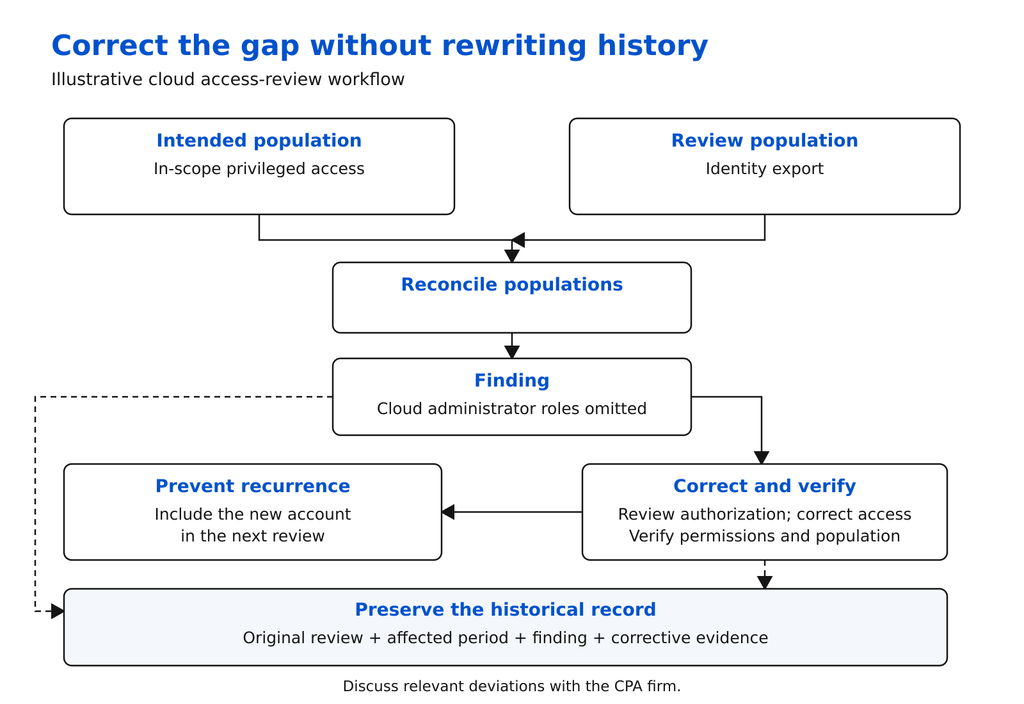
Establish the gap. The control owner reconciles the service inventory, cloud identities and review population. The finding identifies omitted roles, the systems affected and when the omission began.
Assign decisions and action. System owners review the omitted privileges against current authorization. The platform team removes inappropriate permissions. An authorized decision-maker handles any temporary deviation and its alternative protections.
Verify correction. The reviewer checks effective permissions and confirms the revised source includes the intended population. A completed ticket alone is insufficient for this closure decision.
Preserve the historical issue. The coordinator retains the original review, finding and corrective evidence. Management considers whether other reviews or services were affected and discusses relevant deviations with the CPA firm.
Prevent recurrence. The team adds a scope reconciliation step to cloud account onboarding and the recurring review. The owner verifies that the next review includes the new account.
The resulting record explains both current correction and the earlier omission. It supports a more defensible assessment than replacing the original record with a clean export.
Keep ownership current as the service changes
Review assignments when a service, supplier, application or reporting line changes. Update the scope and evidence source along with the owner. A new account can fall inside an existing report boundary while still requiring an update to the operational population.
Use a short management review to surface controls without an active owner, missed instances, unreliable evidence sources, overdue corrective action and exceptions approaching review. Agree the cadence against the program’s risk and activity level.
Escalations should name the affected service, the unresolved decision, the person needed to act and the deadline. Repeated delays may indicate insufficient capacity or authority, rather than an administrative tracking problem.
How SPOG.AI supports ownership and follow-through
SPOG.AI’s continuous control monitoring and GRC capabilities connect operational evidence with controls, assets, risk context, owners and remediation. For selected controls, this can help teams assess coverage and follow a finding through accountable action and revalidation.
Confirm the available connectors, configured scope, historical evidence handling and applicable mappings for your SOC 2 program. Technical monitoring does not establish execution of every governance, workforce or manual review activity.
Management defines and operates the controls. The independent CPA firm performs the examination and issues the report. Automation supports evidence and follow-through within those responsibilities.
Request a demo to see how SPOG.AI connects control evidence, owners and remediation.
Make every control assignment usable
A control owner should be able to identify the population covered, the work required, the evidence retained and the action needed when the result is wrong or unknown.
Start with one control that crosses teams. Trace a real instance from trigger to verified outcome, identify the incomplete handoffs and fix the ownership model. Apply that discipline across the control list before the next reporting period builds up more gaps.
dion Title
No universal list of tools, owners and evidence files applies to every organization. Management designs controls against applicable Trust Services Criteria, its service commitments, system requirements and risks. A template should be adapted to the actual service and report scope.
SOC 2 does not prescribe a CISO job title. Management must establish appropriate governance and control responsibilities. An authorized executive can sponsor the program while engineering, IT and business owners operate assigned controls. Necessary authority, competence and capacity still matter.
An executive sponsor should provide authority and resolve resource conflicts. A coordinator manages the control register, evidence requests and deadlines. Individual control owners remain accountable for their assigned outcomes. The independent CPA firm examines the system and controls rather than owning the organization’s program.
Include the control objective and activity, applicable criteria, scope, operator, accountable owner, cadence or trigger, evidence source, failure response and closure check. Add retention arrangements and exception authority. These fields are practical recommendations rather than an AICPA-prescribed form.
A RACI is not a named SOC 2 requirement. It can clarify who performs, approves, advises on and receives updates about an activity. Use it for cross-team handoffs, then verify that assignments reflect actual authority and that execution leaves evidence.
Yes, particularly in a small team. Check whether the person has sufficient authority, competence and capacity. Identify conflicts such as approving their own access or changes, and establish proportionate review arrangements. Combining roles should not conceal unperformed work or inadequate review.
Type 1 addresses the system description and suitability of control design at a specified date. Type 2 also evaluates operating effectiveness over a specified period and includes control tests and results. Evidence planning should match the engagement type and scope.
Record the omission, affected population and period, investigate its cause, assign correction and verify the result. Preserve original evidence. Discuss relevant deviations with the CPA firm. A later successful review does not automatically prove the earlier control operated.
Approval records an authorized decision, not proof of protection. Assess the affected scope and alternative measures, retain the review or expiry date and keep the deviation visible. The CPA firm separately evaluates its significance for the examination and report.
No. SPOG.AI can support selected control assessments, evidence, ownership and remediation where systems and assessments are configured. Management remains responsible for its system and controls, and an independent CPA firm performs the examination. Confirm connector coverage, evidence handling and mappings for the program.
Technology writer and content strategist with 5+ years of experience, including work for a US-based B2B SaaS client and a cybersecurity solution. I create cybersecurity and GRC content, product documentation, and user guides that help technical teams and business leaders understand security capabilities and workflows. Currently working on Confluence documentations on vulnerability management, ITSM, incident management, and continuous control monitoring, alongside SEO and AEO content, and technology partner database development.